Who is behind mystery spy devices dropped over Syria?

Radio transmitters found in Afrin, SyriaBy JOSEPH FITSANAKIS | intelNews.org |
On December 14, residents of a small town in northern Syria reported seeing unidentified aircraft circling overhead, and dropping several small items attached to mini-parachutes. Two days ago, one local resident, Adnan Mustafa, posted on Facebook several photographs of some of these items, which were found scattered around the area. The gadgets, pictured here, look suspiciously like surreptitious listening devices. Residents say the question is: who dropped them, and why? The devices were found in the hills around Afrin, a predominantly ethnic-Kurdish town 20 miles south of the Syrian-Turkish border. Local townsfolk said the flight patterns of the planes observed on December 14 resembled those of previous sightings of Turkish aircraft, which routinely invade Syrian airspace before returning to the Turkish air base in Incirlik, about 100 miles north of Afrin. Syrian newspaper Al-Hakikah (The Truth), which supports the opposition Syrian National Council for Truth, Justice and Reconciliation, said the suspected spy gadgets weigh about 90 grams each and bear “Made in Germany” labels, as well as “GRAW DFM-06” inscriptions. Graw is a Nuremberg-based German company that produces radiosondes, small radio transmitters used in weather balloons, that measure various atmospheric parameters and transmit them to fixed receivers. But Al-Hakikah reports that the devices found in Afrin seem to transmit GPS coordinates, and appear to have been modified to intercept radio communications. Some suspect that the devices are aimed at eavesdropping on the communications of Syrian government troops and of Syrian Air Force planes, which are engaged in an increasingly bloody conflict against the opposition Syrian National Council. Read more of this post

United States urges Iran to release alleged CIA spy

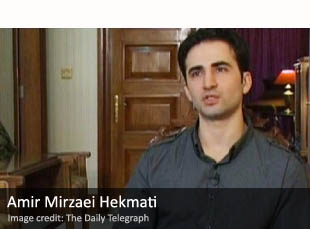
Amir Mirzaei HekmatiBy JOSEPH FITSANAKIS | intelNews.org |
The United States has called on Iran to release an American citizen of Iranian descent, who appeared on Iranian state TV last Sunday and acknowledged that he was an operative of the Central Intelligence Agency. In the pre-recorded interview, a man identifying himself as Amir Mirzaei Hekmati, from Arizona, said he was arrested by Iranian counterintelligence while on a CIA mission. Speaking calmly in Farsi and English and —as Britain’s Daily Telegraph newspaper put it— appearing to be “not under duress”, Hekmati said the joined the US Army in 2001 and served in Iraq. He also said that he was trained “in languages and espionage” while in the US Army, and eventually worked for the Defense Advanced Research Projects Agency, the US Pentagon’s research and development wing. In 2009, after nearly a decade of intelligence training, he said he was recruited by the CIA and was specifically prepared for what intelligence operatives sometimes refer to as a ‘dangling operation’ in Iran.  The aim of the mission, said Hekmati, was to travel to Tehran, contact Iran’s Ministry of Intelligence and National Security, and pose as a genuine American defector wishing to supply the Iranians with inside information about American intelligence. His immediate task was to gain the trust of Iranian authorities by giving them some correct information, in order to set the stage for a longer campaign of disinformation aimed at undermining a host of Iranian intelligence operations. Read more of this post

Did Outside Spy Agencies Know About Kim Jong Il’s Death?

Kim Jong Il lies in state in PyongyangBy JOSEPH FITSANAKIS* | intelNews.org |
According to KCNA, North Korea’s state news agency, Premier Kim Jong Il died at 8:30 am on Saturday, December 17. However, government media did not announce the startling news until early Monday morning, that is, nearly 50 hours after the “Dear Leader’s” sudden passing. Assuming that North Korean reports of the time and location of Kim’s death are truthful, the inevitable question for intelligence observers is: did anyone outside North Korea receive news of Kim Jong Il’s death during the 50 hours that preceded its public announcement? In times like this, most Westerners tend to look at the Central Intelligence Agency, National Security Agency, MI6, DGSE, or any of the other recognizable acronyms that dominate American and European news reports. The reality is, however, that despite their often-mythical status, Western intelligence agencies tend to be limited in their global reach, which is usually heavily concentrated on selected adversaries, like Russia, or China. These agencies therefore tend to rely on their regional allies to get timely and accurate information on smaller nations that are often difficult to penetrate. In the case of North Korea, Western spy agencies depend heavily on actionable intelligence collected by South Korean and Japanese spies. Read more of this post

Announcement: intelNews gets down with social networking

Social networkingBy JOSEPH FITSANAKIS | intelNews.org |
This blog first boarded the social-networking train by joining Twitter, in June of 2009. Back then Leon Panetta was in the hot seat at the CIA, US troops (of the non-mercenary kind) were still in Iraq, Osama bin Laden was living the high life in exotic Abbottabad, and South Korean intelligence were trying to kill the North’s “dear leader”, Kim Jong-Il. We’ve since managed to post over 1,200 Tweets, and have attracted a microblogging community numbering a moderately respectable 600 members. If you haven’t signed up, you can do so, here. Today we’d also like to invite you to join our newest adventure in the land of social networking, by signing onto Facebook and becoming a member of our new breathtaking, awe-inspiring page, which is located here. Our grand plan is to use the new page as a way to interact with our readers on a more frequent basis, and to invite further feedback and discussion on issues of concern to intelNews readers. Check us out, and let us know of your thoughts. We also have a hip new channel on YouTube, where we post audiovisual content relating to our work, including our research and periodic media appearances. You can find the YouTube channel here. In case you didn’t know, you can also share or bookmark articles that appear on intelNews, you can subscribe to read intelNews in one of the popular readers out there, you can get intelNews articles on your email, and you can even place our headlines on your website or blog. So there. I think we’ve covered everything. Or, have we? If you have any suggestions or advice for our growing social-networking empire, get in touch.

Does Iran have access to satellite jamming technology?

Iran displays captured US droneBy JOSEPH FITSANAKIS | intelNews.org |
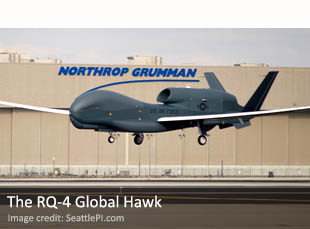
A European intelligence official has said that Iran downed an unmanned American surveillance aircraft earlier this month by remotely sabotaging its satellite navigation system. The official, who has not been named, told The Christian Science Monitor that the Iranians used a state-of-the-art laser system to effectively “blind” the American spy satellite that guided the drone’s global positioning system (GPS). In doing this, Iran’s military was able to remotely skyjack the aircraft and assume control over its navigational system. The paper also published an exclusive interview with an Iranian electronic warfare specialist, who claimed he was part of a team that hacked into the drone’s communication frequency and reprogrammed its GPS data. Eventually, the Iranian specialists managed to cause the unmanned aircraft to switch into autopilot mode, and guided it to land relatively smoothly on Iranian territory, where it was eventually captured intact by Iranian authorities. If this is true, it will mark the first-ever indication that the Iranian state is in possession of sophisticated satellite jamming technology. In an important development, Iran’s Minister of Foreign Affairs, Ali Akbar Salehi, told Iran’s government-run IRNA news agency on Saturday that the American drone was brought down by Iranian armed forces, without any foreign assistance. If this is so, then does it mean that the Iranians developed the state-of-the-art jamming system themselves? Read more of this post

Spy agencies scramble for clues after North Korean leader’s death

Kim Jong IlBy JOSEPH FITSANAKIS* | intelNews.org |
Even though rumors had been rife for quite some time about North Korean leader Kim Jong Il’s worsening health, his death startled intelligence agencies the world over. In typical fashion, North Korean state media announced yesterday that “the dear leader” had died on Saturday onboard a train during one of his usual field trips, “due to immense mental and physical strain caused by his […] building of a thriving nation”. A period of national mourning has been declared in the country until December 29. In the hours following the startling announcement, which Time magazine dubbed “a nightmare before Christmas”, no unusual activity was observed in the North, while early Monday reports from North Korean capital Pyongyang stated that traffic was “moving as usual”. Moreover, despite longstanding rumors about Kim Jong Il’s ill health, few intelligence analysts in South Korea, Japan, or the United States have been observing overt signs of political instability, or a leadership crisis. However, despite the apparent calm in the North, intelligence agencies around the world have gone on high alert, led by those in South Korea, which has remained technically at war with the North since 1950.  South Korean President Lee Myung-bak reportedly placed the country’s military on emergency alert on Sunday, and has ordered government officials to remain in capital Seoul and “maintain emergency contact” with their office staff. French sources said that one of the first outcomes of an emergency National Security Council meeting that took place in Seoul on Sunday was to request that the American Pentagon, which maintains nearly 30,000 troops in South Korea, steps up aerial surveillance over the North. Japan has also stepped up its intelligence-gathering operations in North Korea, and its Prime Minister, Yoshihiko Noda, instructed his government to “closely share information” on North Korea with the United States, South Korea, and —notably— China. Read more of this post

Trial announced for Swiss nuclear smugglers said to be CIA agents

Urs Tinner

By JOSEPH FITSANAKIS | intelNews.org |
Switzerland has officially charged three Swiss citizens with assisting the nuclear smuggling network of Abdul Qadeer Khan, the father of Pakistan’s nuclear program, who gave nuclear information to North Korea, Libya and Iran. But the scope of the trial will be severely limited under a peculiar plea bargain struck with the three defendants, which will prevent the court from examining their claims of having worked as agents of the United States Central Intelligence Agency. Friedrich Tinner and his two sons, Urs and Marco, were arrested by German and Italian authorities in 2004 and extradited to Switzerland. Soon afterwards, Swiss authorities came under political pressure from the US Department of State, which appeared displeased with the prospect of a trial for the Tinners. Swiss government investigators quickly realized that the Tinners were considered valuable assets by the CIA, something which Urs Tinner himself admitted in a January 2009 interview. So convinced were Swiss authorities of Urs Tinners’ CIA connection claims, that they turned down repeated requests by the Tinners’ lawyers to release their clients on bail, fearing the three suspects would escape to the United States. In 2007, there was further uproar in Swiss public opinion, when it emerged that the Swiss Federal Department of Defense had secretly shredded 30,000 pages of vital evidence in the Tinners’ case, ostensibly to prevent their falling into the hands of foreign governments or terrorists. Several pundits accused Swiss authorities of destroying the documents under heavy political pressure from Washington. These suspicions were rekindled this week, after Switzerland’s attorney general announced that the Tinners would be tried for “aiding the illegal nuclear weapons program of an unknown state”. Read more of this post

New book on British double spy Kim Philby published in Russia

Kim Philby

Kim Philby

By JOSEPH FITSANAKIS | intelNews.org |
An important new biography of H.A.R. “Kim” Philby, the British MI6 officer who defected to Russia during the Cold War, has been published in Moscow. It is based on candid interviews with his surviving fourth wife, Rufina Pukhova-Philby, as well as on an array of declassified documents from Russian state archives. The book, titled just Kim Philby, is authored by Nikolai Dolgopolov, editor of Moscow-based daily Rossiiskaya Gazeta, which acts as the official organ of the Russian state. Aside from Pukhova-Philby, the book, whose publication is set to coincide with the 100th anniversary of Kim Philby’s birth, on January 1, enjoyes the official blessing of Russia’s Foreign Intelligence Service (SVR), the successor organization to the KGB’s external intelligence directorate. The SVR allowed Dolgopolov access to previously secret documents on Philby, including a newly declassified Russian translation of the British double spy’s personal account of the events that led to his 1963 defection, as well as a description of his escape to Russia through Lebanon. Dolgopolov’s books describes Philby as “one of the greatest Soviet spies”, thus siding with the mainstream view in intelligence research literature, which recognizes Philby as one of the most successful double spies in history. While working as a senior member of British intelligence, Philby spied on behalf of the Soviet NKVD and its successor, the KGB, from the early 1930s until his 1963 defection. Two years later, he was awarded the Order of the Red Banner. The Soviet authorities buried him with honors when he died in 1988. Read more of this post

Lebanese TV station reveals names of alleged CIA officers

Al-Manar TV logo

Al-Manar TV

By JOSEPH FITSANAKIS | intelNews.org |
A Lebanese television station has aired the names of ten American diplomats, which it says are working for the United States Central Intelligence Agency under diplomatic cover. The identities of the ten diplomats were revealed on Friday by al-Manar, a satellite television station affiliated with Hezbollah, the militant Shiite group that controls large parts of Lebanon. The station said that all ten alleged CIA agents, which include women, are stationed at the US embassy located in the Awkar area of northern Beirut. Their names were aired during a special investigative program broadcast on Friday night, which claimed to offer proof of CIA activities in Lebanon, in alleged collaboration with Israel’s intelligence service Mossad. The program featured animated sequences recreating meetings between CIA case officers and their paid informants, which allegedly took place in fashionable Beirut cafés and restaurants, such as Pizza Hut and Starbucks. The revelation by al-Manar follows last month’s acknowledgment by US officials that Hezbollah had indeed busted a Lebanese spy ring that had been set up and operated by the CIA in the Lebanese capital. The ring, which consisted of native Lebanese citizens, including allegedly “a doctor, a researcher and a journalist”, was apparently discovered after Hezbollah counterintelligence forces employed sophisticated telecommunications data analysis software, which flagged unusual usage patterns on phones belonging to CIA officers and agents. IntelNews has viewed the al-Manar broadcast that includes the identities of the alleged CIA officers. Read more of this post

Newspaper reveals name of Russian ‘spy’ expelled from Britain

Mikhail Repin

Mikhail Repin

By JOSEPH FITSANAKIS | intelNews.org |
In December of 2010, the British government quietly ordered the expulsion of a diplomat from the Russian embassy in London, whom it accused of “activities incompatible with his diplomatic status” —technical terminology implying espionage. Moscow quickly responded with an expulsion of a British diplomat stationed in the Russian capital. The tit-for-tat incident saw no publicity, and neither man was named, as is customary in such cases. But, in its Saturday edition, British newspaper The Daily Telegraph identified the expelled Russian diplomat as Mikhail Viktorovich Repin, Third Secretary in the Political Section at the Russian embassy in London. The paper said that Repin, a fluent English speaker, was a junior officer of the political directorate of the SVR, Russia’s Foreign Intelligence Service, operating under standard diplomatic cover. Repin arrived in London in late 2007, shortly after the British government expelled four Russian diplomats in connection with the fatal poisoning of former KGB officer Alexander Litvinenko, who had defected to Britain. A “tall, suave, urbane young man”, “Michael”, as he identified himself, quickly became a permanent fixture on the embassy reception circuit and the various events hosted by London-based organizations and think tanks. He specifically joined —and regularly attended meetings of— the Royal United Services Institute, the International Institute of Strategic Studies, and Chatham House —formerly known as the Royal Institute of International Affairs. Most people that met him in those gatherings took him for “a fast-track civil servant, defense industry high flier or political adviser”, says The Telegraph. Read more of this post

Iran shows video footage of captured CIA surveillance drone

Iran

Iran

By JOSEPH FITSANAKIS | intelNews.org |
Iranian state television has aired pre-recorded footage of a surveillance drone that looks similar to the stealth RQ-170 Sentinel, which the US Central Intelligence Agency admitted it was missing earlier this week. Images of the unmanned surveillance drone, built by US military contractor Lockheed Martin, were broadcast during the main news bulletin on Thursday evening. The captured aircraft was shown in near-immaculate condition, resting on a display platform, with two men in Iranian military fatigues inspecting it. One of them was identified in the news report as Amir Ali Hajizadeh, Brigadier General of the Islamic Revolutionary Guard Corps’ Aerospace Forces. He told the news reporters that the drone was brought down last week “in an electronic ambush” conducted jointly by the Revolutionary Guards and the Iranian armed forces. He did not specify what he meant by “electronic ambush”, nor the exact location where the drone was physically captured by Iranian authorities. However, one report in the Iranian press alleged that the aircraft was initially detected by Iranian forces while flying over the town of Kashmar, in east Iran, located nearly 250 kilometers (about 150 miles) from the Afghan-Iranian border. If this report is accurate, it would signify that the CIA drone was flying deep within Iranian airspace, thus disputing initial claims to the contrary by the US Department of Defense. Another Iranian news outlet quoted anonymous military sources in Tehran, which said that the Chinese and Russian governments had already requested from the Iranian authorities permission to view the captured aircraft. Another pro-government newspaper said that Tehran was considering sharing the intelligence gathered from the captured drone with its regional allies in the Syrian government and the Lebanese Shiite group Hezbollah. Read more of this post

US considered covert mission to recover drone captured by Iran

Iran

Iran

By JOSEPH FITSANAKIS | intelNews.org |
What a difference two days can make! On Monday we speculated that Iran may have captured intact a United States Air Force RQ-170 Sentinel surveillance drone. At that time, most American officials questioned or flatly denied Iran’s capture claims. It now appears almost certain that Iran is indeed in possession of the aircraft; what is more, it seems increasingly likely that the captured drone was conducting a Central Intelligence Agency reconnaissance mission when it crashed in the desert along the country’s 1,000 km-long border with Afghanistan. The significance of the drone’s capture by Iranian authorities can be discerned from the fact that US officials are said to have considered last weekend several options for retrieving it from Iranian territory. According to an article in The Wall Street Journal, the US Department of Defense, in association with the CIA, discussed at least three separate plans for recovering or destroying the aircraft wreckage. One of the options discussed involved sending an airborne team of US covert operatives into northeast Iran to locate the crashed drone, disassemble it, and carry its top-secret mechanical and electronic components back to a US base in Afghanistan. The US also considered deploying Special Forces stationed in Afghanistan, or tasking US intelligence assets inside Iran, with locating and blowing up the crashed drone. A third option involved destroying the downed aircraft with a remote airstrike from Afghanistan. Read more of this post

Russian spy agencies accused of hacking election monitor sites

FSB officer

FSB officer

By JOSEPH FITSANAKIS | intelNews.org |
Election monitors have accused Russia’s domestic intelligence service of launching a series of coordinated hacking attacks on opposition websites, timed to coincide with last Sunday’s elections. On that day, Russians voted —as they have done every five years since 1991— to determine the composition of the Duma, the country’s lower house. Election results show an unprecedented 14 percent drop for Prime Minister Vladimir Putin’s United Russia party, coupled with an equally sharp rise in the Communist Party share of the votes, which doubled to about 20 percent. But the election drew strong condemnations from international election monitors, including the Organization for Security and Cooperation in Europe, which said that the campaign was “slanted in favor of the ruling party”. Now Russian opposition organizations are accusing the government of launching a series of “massive” distributed denial of service (DDoS) attacks against their websites on the night of the elections. Websites affected include the prominent opposition magazine The New Times, the Ekho Moskvy radio station, the Russian arm of the Livejournal blogging website, business daily Kommersant, popular online news portal Slon.ru, as well as the Western-financed political watchdog group Golos. All of these outlets were simultaneously attacked on Sunday evening; their servers were bombarded with data that overwhelmed their computer systems and eventually knocked them offline. Liliya Shibanova, who directs Golos, told a news conference in Moscow late on Sunday night that the organization’s Internet and telephone systems, including an election violation hotline, had been blocked. She claimed that only Russia’s Federal Security Service (FSB), successor to the domestic intelligence wing of the Soviet-era KGB, had the resources required to launch such a massive attack. Read more of this post

Analysis: India’s spies keep tabs on political opponents, not terrorism

IB seal

IB seal

By JOSEPH FITSANAKIS | intelNews.org |
She is America’s rising ally in South Asia and is widely regarded as the world’s largest democracy. But India’s political system is highly chaotic and often repressive. This is aptly reflected in the operations of the Intelligence Bureau, India’s foremost domestic intelligence agency. One would think that the IB has its hands full with India’s countless domestic security concerns, which include increasingly popular and active Maoist insurgents, as well as mounting religious and political tensions in the predominantly Muslim states of Jammu and Kashmir, located in the country’s north. But one of India’s most respected English-language newspapers, The Hindu, cites “highly placed intelligence sources” who allege that most of the IB’s intelligence collection activities are targeted against the Indian government’s political opponents, not terrorism. According to the unnamed sources, “less than a third of the IB’s estimated 25,000-strong manpower [sic] is dedicated to what might be described as national security tasks”. Conversely, over two-thirds of the organization’s staff is reportedly tasked with “providing the government raw information and assessments on its increasingly bleak political prospects”, claims the paper. Examples of political policing by the IB include monitoring public meetings led by Rahul Gandhi, parliamentarian and leader of the National Congress, which is India’s main political opposition group. Another target of the IB’s alleged political policing campaign is anti-corruption activist Anna Hazare, who has become internationally known for spearheading popular protests against government sleaze in New Delhi and elsewhere. According to The Hindu, intelligence on political figures is collected by the IB’s state-of-the-art communications interception systems, which were purchased from Western hardware manufacturers following the sophisticated 2009 Mumbai Attacks by the Pakistani militant group Lashkar-e-Taiba. Read more of this post

Analysis: How serious a blow did the CIA suffer in Lebanon?

Lebanon

Lebanon

By JOSEPH FITSANAKIS | intelNews.org |
Late last month, the Central Intelligence Agency admitted that a number of its agents in Lebanon had been captured by Hezbollah, the Shiite militant group that controls large parts of the country. The group announced the arrests in the summer, but in was only on November 21 that the Associated Press confirmed the accuracy of Hezbollah’s claims from a US intelligence source. Neither Hezbollah nor the CIA have offered details of the arrests, but it is generally assumed that the captured agents were not officers of the CIA, but rather Lebanese or Iranian citizens who had been recruited as assets by CIA case officers. Regardless, the incident has undoubtedly directly impacted the Agency’s operations in Lebanon, and maybe Iran. The question is, how much? Former CIA operations officer Robert Baer, who spent several years in Lebanon in the 1980s, has penned an analysis article in Time magazine, in which he says that his sources tell him the arrests of the CIA agents represent “a serious compromise”, and that the Agency is “still trying to get to the bottom of [it]”. Baer also provides some new information about the method used by Hezbollah counterintelligence to capture the CIA agents. Last week, ABC News reported that the arrests were caused by careless spy tradecraft on behalf of the CIA. Specifically, according to ABC, “Hezbollah operatives figured out that CIA informants, who had infiltrated the Iranian proxy group, were meeting with their agency handlers at a Beirut Pizza Hut. How could Hezbollah deduce that location? The CIA used the codeword ‘PIZZA’ when discussing where to meet with the agents”. But Baer says that the arrests were not necessarily caused by CIA errors; rather it may have been advanced counterintelligence analysis by Hezbollah that compromised the agents. He claims that Hezbollah is using telephone link analysis, a type of signals intelligence testing that utilizes advanced software “capable of combing through trillions of gigabytes of phone-call data”. The aim of telephone link analysis is to search for unusual communications patterns —such as too many brief calls, or heavy reliance on prepaid cell phones that seem to become disused after only a few calls. Read more of this post