MI5 director plays down US threat to end intelligence sharing over Huawei

Sir Andrew ParkerThe director of Britain’s domestic intelligence agency has dismissed warnings by the United States that intelligence sharing between the two allies will be impeded if London decides to use Chinese-made telecommunications hardware. The British government has come under relentless pressure by Washington to bar Huawei Technologies, one of the world’s leading telecommunications hardware manufacturers, from competing for contracts to build the United Kingdom’s 5th generation cellular communications infrastructure.

In recent years, Huawei has come under scrutiny by some Western intelligence agencies, who view it as being too close to the Communist Party of China. More recently, Washington has intensified a worldwide campaign to limit Huawei’s ability to build the infrastructure for 5G, the world’s next-generation wireless network. Along with some if its allies, notably Australia and Canada, the US is concerned that the Chinese telecommunications giant may facilitate global wiretapping on behalf of Beijing’s spy agencies. Last year, Washington warned two of its main European allies, Britain and Germany, that it would stop sharing intelligence with them if they allowed Huawei to compete for 5G contracts.

But in an interview with The Financial Times, Sir Andrew Parker, head of the Security Service (MI5), said on Sunday that he didn’t believe Britain’s intelligence-sharing relationship with America would be impacted by the decision. When asked whether Washington would stop sharing intelligence with London if the British government allowed a bid by Huawei, Sir Andrew said he had “no reason today to think that”. He added that Britain’s intelligence relations with the US, and with other close allies, such as Canada and Australia, were “the strongest they’ve ever been”. Britain’s intelligence partnership with America “is, of course, of great importance to us”, said Sir Andrew, and went on: “I dare say, to the US too, though that’s for them to say. It is a two-way street”.

Meanwhile was reported over the weekend that a high-level delegation from the National Security Agency —America’s largest intelligence agency— and the US National Economic Council would be in London today, in what appears to be a final effort to persuade London not to cooperate with Huawei. Prior to her resignation last year, British Prime Minister Theresa May had reportedly decided to allow the Chinese firm to compete for 5G contracts. Her successor, Prime Minister Boris Johnson, is reputed to be in agreement with that decision. Last April, German intelligence official also dismissed American warnings that intelligence sharing with Berlin would end if Huawei built any part of the German 5G network.

Author: Joseph Fitsanakis | Date: 13 January 2020 | Permalink

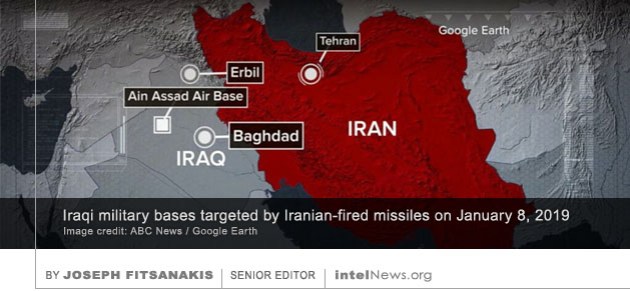
Assessing the implications of Iran’s missile attack on Iraqi military bases

Iran IraqThe missiles that targeted American troops in Iraq a few hours ago offer significant clues about the evolving confrontation between Iran and the United States. The attack appears to have been largely symbolic —a somewhat rushed attempt to restore some of Iran’s wounded prestige following the assassination of its military commander, Qasem Suleimani. At the same time, however, it is also the prelude to a broader regional conflict that appears increasingly unavoidable.

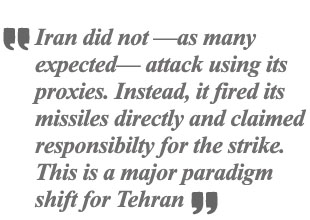
There are two notable aspects in the attack. First, the fact that Tehran did not —as many expected— take aim at American targets using its proxies in Iraq, Lebanon, or Yemen. Instead, not only did the attack come directly from Iran, but the Islamic Revolutionary Guard Corps (IRGC), of which Soleimani was a leading commander, openly claimed responsibility for it. This is a major paradigm shift for the Iranians, who in the past have taken great care to avoid giving any indication of their direct involvement in military or paramilitary attacks on their opponents. It is clear that Q QuoteSoleimani’s killing is viewed by Tehran as too insulting to be responded to indirectly. This does not mean that Tehran will not revert to its standard method of employing proxies in the future. But the fact that it consciously chose to deviate from that time-tested method is in itself extremely important.
The second notable aspect of the attack is that it was markedly muted, especially considering the many options that are available to the Iranians. According to reports, 22 ballistic missiles were fired, most of which struck two military bases housing US troops in western and northern Iraq. The number of missiles fired is surprisingly low, given that Iran possesses the largest ballistic-missile force in the entire Middle East. Additionally, it is interesting that Tehran directed its attacks against the most obvious and predictable American target in the region —uniformed US personnel stationed in what is essentially Iranian-controlled territory. These troops have been on high alert since the moment Soleimani was assassinated. It is therefore highly unsurprising that no American casualties have been reported (although Iranian state media are apparently telling their domestic audiences that “80 terrorists” died in the attack).

The fact remains that, if Iran’s leaders truly wanted to cross the point of no return, they could have attacked American diplomatic facilities in over a dozen countries in the region, including Iraq, Israel, Jordan, and many others. Alternatively, they could have directed their ire against American political and commercial targets in Saudi Arabia, of which there are countless. They could have also sent an unmistakably ominous message to the global financial markets by attacking energy facilities in the region, or by blocking maritime traffic in the Strait of Hormuz. Or they could have carried out all of the above simultaneously, thus virtually ensuring a US response, which would in turn ignite an all-out war. But they didn’t —which should be interpreted that the IRGC is not, for now, interested in going to war. Read more of this post
Cyprus issues international arrest warrants for three Israelis wanted for spying

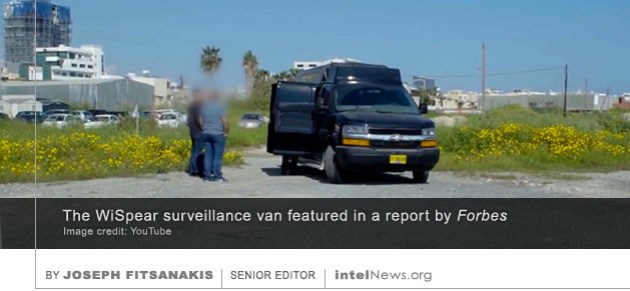
WiSpear surveillance vanThe government of Cyprus has issued international arrest warrants for three Israeli citizens, who are wanted in connection with a private security company that allegedly carried out espionage operations on the Mediterranean island. The warrants were sparked by what has become known in Cyprus as the “spy van case”.
It began on November 16, 2019, when Cypriot police arrested two local men and a woman who were registered as employees of a company called WiSpear. The firm was reportedly registered in Cyprus in 2013 and began offering services relating to communications interception and surveillance in 2017. Its owner is Tal Dilian, an Israeli former intelligence officer. WiSpear provides services to customers in Africa, the Gulf and Southeast Asia, but not to the government of Cyprus, or to Israel.

The company became widely known on the island following a promotional interview given by Dilian to Forbes, during which he allowed a film crew to tour a surveillance van (pictured) belonging to WiSpear. Dilian told the Forbes reporters that the van —a remodeled ambulance— had been fitted with over $9 million worth of surveillance equipment and could intercept Internet-based applications and telephone messages. The report became viral in Cyprus and prompted calls for an investigation into WiSpear.

On Thursday, the Cypriot government issued international arrest warrants for three Israeli citizens, including Dilian and Shahak Avni, a prominent member of Cyprus’ Jewish community. All are believed to be in Israel, and it is doubtful that they will ever be extradited to Cyprus. The Israeli government has not commented on the case. WiSpear said on December 26 that it was “cooperating fully with Cypriot law enforcement”.

Author: Joseph Fitsanakis | Date: 7 January 2020 | Permalink

Analysis: Soleimani’s killing was tactically flawless, but was it strategically wise?

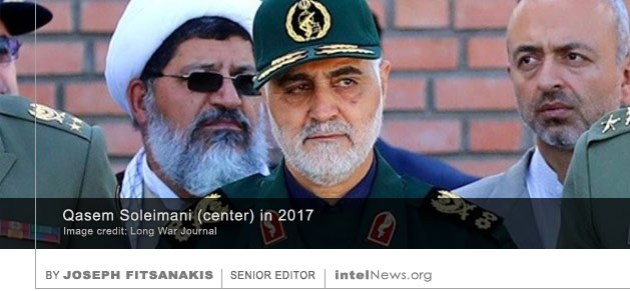
Qasem SoleimaniBy assassinating Qasem Soleimani, a Shia celebrity and the Middle East’s most influential military leader, US President Donald Trump has made the most fateful decision of his presidency to date. Tehran has no option but to respond. When it does, the way that Mr. Trump and his administration handle the situation will largely determine the future of the Middle East and the fate of his presidency. In the meantime,Quote it is becoming increasingly clear that victory, if and when it comes, will not be unblemished for whomever claims it.
Mr. Trump’s decision to assassinate General Soleimani was shocking because it was unexpected. It must be remembered that, not only has this president based his entire political program on his desire to end America’s decades-long military engagement in the Middle East, but he had also in recent months signaled his desire to negotiate with Tehran. In the summer he said he wanted to “make Iran rich again, let them be rich, let them do well, if they want”, adding that no regime change was necessary. In December, following a surprise prisoner exchange between the US and Iran, Mr. Trump tweeted: “Thank you to Iran on a very fair negotiation. See, we can make a deal together!”. The news prompted one notable expert to speak of “a very positive step, because it’s the first time under the Trump Administration that Iran and the US have agreed on anything”. That was on December 8, just 25 days before Soleimani’s Quoteassassination. And yet, while publicly thanking Iran, Trump was likely formulating plans to kill its leading general.
Why did the president do it? To some extent, one should not dismiss his argument that he wanted to put an end to the slow tit-for-tat escalation of tensions in the Middle East, before it boiled over. He wanted to make Iran listen. Writing in The Washington Times just hours after Soleimani’s assassination, former CIA official Charles Faddis noted that Mr. Trump’s decision honored US President Theodore Roosevelt’s famous dictum, “speak softly and carry a big stick”. Your adversary is more willing to listen to you if he is able to “see the big stick, and he needs to understand you will wield it”, wrote Faddis. A few hours later, David Petraeus, former director of the US Central Intelligence Agency, described Mr. Trump’s decision to kill Soleimani as “a very significant effort to reestablish deterrence, which obviously had not been shored up by the relatively insignificant responses up until now”. Read more of this post

Analysis: Middle East on verge of new regional war as US kills top Iran general

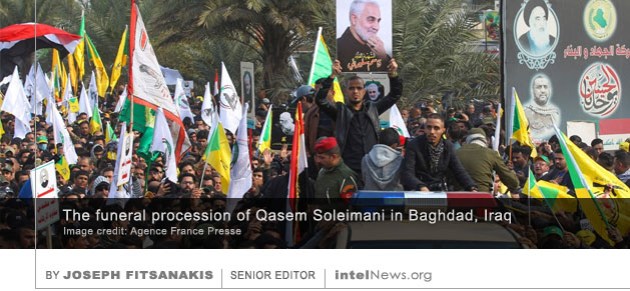
Qasem SoleimaniIn an act whose implications are impossible to overstate, the United States has assassinated General Qasem Soleimani, arguably Iran’s second most powerful official. In the early hours of this morning, the entire Middle East stood on the verge of a regional war as the US Department of Defense announced it killed Soleimani in a “defensive action […] aimed at deterring future Iranian attack plans”. But Soleimani’s killing will be seen by the Iranian government as nothing short of an official declaration of war. Tehran’s next move will determine the precise form this new war will take.
The United States, Israel and Saudi Arabia have targeted Soleimani for assassination for over a decade. In 2019 alone, Iran reported over half a dozen alleged plots to kill the general, the most recent of which was in early October. Soleimani’s killing is therefore not surprising. Moreover, Washington’s move rests on a number of crucial calculations by the White House, which help explain why US President Donald Trump made the decision to kill Soleimani, and why he did so now.
In the not-too-distant past, some of America’s tactical security goals aligned with Soleimani and his Quds Force —an elite unit inside the Islamic Revolutionary Guard Corps, which is tasked with exporting the Iranian Revolution abroad. The Iranian paramilitary unit helped Washington deal with the Afghan Taliban in the days after the 9/11 attacks, and its proxies in Iraq and Syria helped the US and its allies deliver fatal blows to the Islamic State. But in doing so, Tehran solidified its power within Iraq, turning its government into a satellite of Iran. The rise of the Popular Mobilization Forces (PMF), the Iranian-supported militias in Iraq, is largely a replay of the rise of Hezbollah, Iran’s paramilitary proxy in Lebanon, in the 1980s. Having painted themselves into a corner, America’s political leadership had to act. It chose to do so by essentially ‘decapitating’ the Quds Force, which is the main conduit between Iran and the PMF. It is worth noting that Abu Mahdi al-Muhandis, the deputy head of the PMF, was also killed in the same strike. Washington’s hope is that these killings can somehow prevent —or at least curtail— the Lebanization of Iraq. Read more of this post

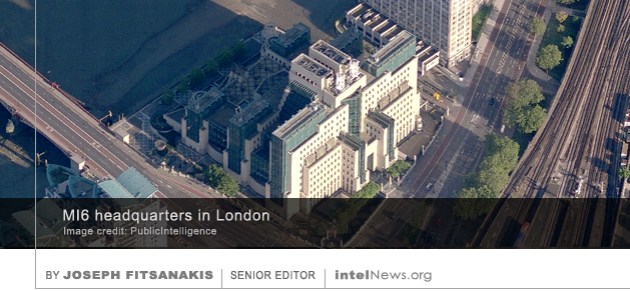
Floor plans of MI6 headquarters in London ‘temporarily lost’ by contractor

MI6The floor plans of the headquarters of MI6, Britain’s foreign-intelligence agency, were temporarily lost by a contractor, an incident that led to a temporary lockdown of the building and the termination of the contract, according to media reports. The alleged incident took place at 85 Albert Embankment, a distinctive-looking building that has served since 1994 as the headquarters of MI6 —known officially as the Secret Intelligence Service, or SIS. The imposing structure is located on the bank of the River Thames alongside Vauxhall Bridge in downtown London.
Up until a few weeks ago, sections of the building were reportedly being refurbished by Balfour Beatty, a multinational construction services company based in London. Balfour Beatty employs over 25,000 workers worldwide and is known as a major British government contractor. According to reports, the company produced several floor plans of the sections of the MI6 headquarters that it had been hired to refurbish. The floor plans were kept in a secure location inside the MI6 building, and were accessible only to cleared Balfour Beatty employees.

A few weeks ago, however, over 100 pages of floor plans went missing, according to the British tabloid The Sun, which first reported the story. The alleged incident prompted a lockdown of the building, said the paper, even though the missing papers were not technically classified. They did, however, contain sensitive information about the layout of the MI6 headquarters, including information about entry and exit points, security features, and other potentially sensitive details.

After a while, “many” of the missing documents were found inside the building, said The Sun. The BBC’s security correspondent Gordon Corera said later that “[m]ost, but not all, of the documents were recovered” inside the building. It was eventually determined that the papers had gone missing due to “carelessness, rather than any hostile activity”, said The Sun, and the Balfour Beatty workers were allowed to leave the building. However, the company has reportedly been removed from the project as a result of what The Sun described as a “shocking security gaffe”.

The Sun and the BBC reached out to Balfour Beatty for comment, but were told that the company could not comment on sensitive matters involving government projects. The British Foreign Office also said that it did not comment on matters involving intelligence.

Author: Joseph Fitsanakis | Date: 30 December 2019 | Permalink

ISIS forces now patrolling nearly all of northern Iraq, says intelligence official

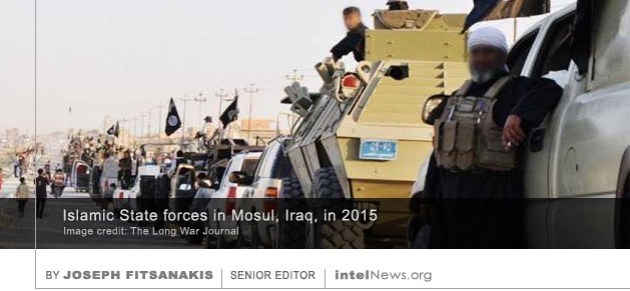
ISIS IraqThe Islamic State has regrouped, rearmed and refinanced itself, and its forces are now actively patrolling nearly all of northern Iraq, according to a senior intelligence official in Iraq’s Kurdistan region. The Islamic State, which is also known as Islamic State of Iraq and Syria (ISIS), used to control territory in the Levant that equaled the size of Germany. But its forces were pushed back by an international coalition of state armies and militias, a development that prompted several heads of governments, including United States President Donald Trump, to announce that ISIS had been defeated.

However, senior military and intelligence officials been warning in recent years that ISIS is far from defeated. In an new article published on Sunday, the BBC reports that Kurdish intelligence officials see ISIS as a resurgent organization. The report relies heavily on the views of Lahur Talabany, the head of Iraqi Kurdistan’s Information Protection Agency, which serves as the primary security and counterterrorism organization of Iraq’s Kurdistan Regional Government.

Talabany told the BBC that ISIS is today “like al-Qaeda on steroids”. The group has “better techniques, better tactics and a lot more money at their disposal” than the al-Qaeda of old, he said. The abundance of financial resources allows ISIS to “buy vehicles, weapons, food supplies and equipment”, said Talabany, adding that he is not sure about the precise source of the funds.

In addition to utilizing its strong finances, ISIS has exploited an ongoing dispute between the Kurds of northern Iraq and the central government in Baghdad, which has left large regions of north-central Iraq without an effective government presence. The militant group’s forces are therefore able to carry out daily patrols over “a huge territory, from Diyala to Mosul, which encompasses nearly all of northern Iraq”, said Talabany.

A large portion of ISIS’s forces appear to be based in Iraq’s Hamrin Mountains, which are riddled with deep caves and ravines. But the group maintains nearly 10,000 fighters all over Iraq, said Talabany, of which 5,000 operate as members of sleeper cells and another 5,000 are armed and active members of ISIS.

Author: Joseph Fitsanakis | Date: 24 December 2019 | Permalink

Russian security services honor members of the Cambridge spy ring with plaque

Guy BurgessThe intelligence service of Russia has openly honored two British members of the so-called Cambridge Five spy ring, who caused great controversy during the Cold War by defecting to Moscow. The intelligence services of the Soviet Union recruited five Enlishmen, H.A.R. ‘Kim’ Philby, John Cairncross, Donald Maclean, Anthony Blunt, as well as an unnamed fifth person, to spy for them in the 1930s. All five were recruited while they were promising young students at Britain’s elite Cambridge University, and entered the diplomatic and security services in order to supply Moscow with classified information about Britain and its allies.
In 1951, shortly before they were detained by British authorities on suspicion of espionage, Burgess and Maclean defected to the Soviet Union. They both lived there under new identities and, according to official histories, as staunch supporters of Soviet communism. Some biographers, however, have suggested that the two Englishmen grew disillusioned with communism while living in the Soviet Union, and were never truly trusted by the authorities Moscow. When they died, however, in 1963 (Burgess) and 1983 (Maclean), the Soviet intelligence services celebrated them as heroes.

On Friday, the Soviet state recognized the two defectors in an official ceremony in the Siberian city of Samara, where they lived for a number of years, until the authorities relocated them to Moscow. Kuibyshev, as the city was known during Soviet times, was technically a vast classified facility where much of the research for the country’s space program took place. While in Kuibyshev, Burgess and Maclean stayed at a Soviet intelligence ‘safe house’, where they were debriefed and frequently interrogated, until their handlers were convinced that they were indeed genuine defectors.

At Friday’s ceremony, officials unveiled a memorial plaque at the entrance to the building where Burgess and Maclean lived. According to the Reuters news agency, the plaque reads: “In this building, from 1952-1955, lived Soviet intelligence officers, members of the ‘Cambridge Five’, Guy Francis Burgess and Donald Maclean”. On the same day, a letter written by Sergei Naryshkin, head of Russia’s Foreign Intelligence Service (SVR), one of the institutional descendants of the Soviet-era KGB, appeared online. In the letter, Naryshkin said that Burgess and Maclean had made “a significant contribution to the victory over fascism [during World War II], the protection of [the USSR’s] strategic interests, and ensuring the safety” of the Soviet Union and Russia.

Last year, Russian officials named a busy intersection in Moscow after Harold Adrian Russell Philby. Known as ‘Kim’ to his friends, Philby was a leading member of the Cambridge spies. He followed Burgess and Maclean to the USSR in 1963, where he defected after a long career with the British Secret Intelligence Service (MI6).

Author: Joseph Fitsanakis | Date: 22 December 2019 | Permalink

Son of Russian spies posing as Canadians gets to keep Canadian citizenship

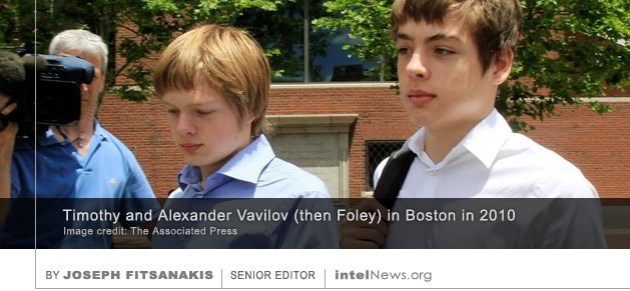
Vavilov FoleyThe son of a Russian couple, who fraudulently acquired Canadian citizenship before being arrested for espionage in the United States, has won the right to keep his Canadian citizenship, which was effectively annulled when his parents were found to be Russian spies.
Tim and Alexander Vavilov are the sons of Donald Heathfield and Tracey Foley, a married couple arrested in 2010 under Operation GHOST STORIES —a counterintelligence program run by the US Federal Bureau of Investigation. Following their arrest, their sons, who allegedly grew up thinking their parents were Canadian, were told that their parents were in fact Russian citizens and that their real names were Andrei Bezrukov and Elena Vavilova. Their English-sounding names and Canadian passports had been forged in the late 1980s by the KGB, the Soviet Union’s primary external intelligence agency.

Since their parents’ arrest on espionage charges, the two brothers, who were born in Canada, have been involved in a prolonged legal battle to have their Canadian citizenship reinstated. The latter was rescinded when it became clear that their parents’ Canadian passports were fraudulent. According to the Canadian Citizenship Act, children born in Canada to “employees of a foreign government” are not entitled to Canadian nationality. But the brothers have argued that they were 20 and 16 when their parents were arrested and were unaware of their double identities. It follows, their lawyers have argued, that they cannot be punished for their parents’ crimes.

In June of 2017, Canada’s Federal Court of Appeal overturned the decision of a lower court and ordered the government to reinstate Alexander Vavilov’s Canadian citizenship. But the Canadian government appealed the decision of the Federal Court of Appeal, which sent the case to the Supreme Court of Canada. The government claimed that the Vavilov brothers should be denied Canadian citizenship because their parents were, effectively, secret employees of a foreign government. The two Russian spies may not have been accredited by the Canadian state as foreign employees, it says, but they were in reality “dedicated to serving their home country, except in their case, the employment was carried out clandestinely”.

On Thursday, however, Canada’s Supreme Court sided with Alexander Vavilov’s lawyers and ordered that he can keep his Canadian citizenship. This decision, which has effectively upheld the earlier decision of the Federal Court of Appeal, almost certainly means that Alexander’s brother, Tim, will also have his Canadian citizenship reinstated.

Author: Joseph Fitsanakis | Date: 20 December 2019 | Permalink

Allegations of espionage rock Credit Suisse, as more employees come forward

Credit SuisseCredit Suisse, one of the world’s most powerful banking firms, says it has opened an investigation into claims that it paid private investigators to spy at individuals, just two months after a similar scandal involving espionage and surveillance rocked the company.
In October of this year, two senior Credit Suisse executives resigned amidst a high-stakes espionage scandal, which may have prompted a suicide. The alleged target of the espionage was Iqbal Khan, the former Chief Executive Officer (CEO) of Credit Suisse’s wealth-management division. Khan alleged that he was spied on by private investigators, paid for by Credit Suisse, after leaving the firm. One of the private investigators involved in the case, described as “an external security expert” who mediated between Credit Suisse and the investigation firm, committed suicide.

At the time, Credit Suisse described the surveillance on Khan as “strictly an isolated incident”. However, on December 11, The Wall Street Journal published allegations by another Credit Suisse executive, Colleen Graham, who said that she had been spied on after leaving her job at the firm. She alleged that she underwent three days of intensive surveillance by persons unknown in July of 2017. Credit Suisse was dismissive of Graham’s claims, saying that they were baseless.

But on Wednesday the firm announced the launching of a new probe after a third employee, who used to work directly under Credit Suisse Chief Executive Officer Tidjane Thiam, alleged that he too had been spied on. The allegations were made by Peter Goerke, and were the subject of a headline article by the respected Swiss daily Neue Zürcher Zeitung. The article was accompanied by documents and photographs submitted by Goerke, which are said to support his claims.

There are now concerns that spying on former and current employees may have been a standard operating procedure at Credit Suisse. In an article published on Wednesday, The Wall Street Journal said that the alleged incidents “highlight the ethical and reputational pitfalls companies encounter when they physically monitor employees”.

Author: Joseph Fitsanakis | Date: 19 December 2019 | Permalink

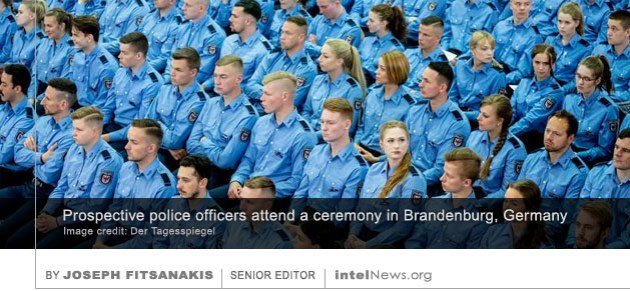
German government to hire 600 new officers to help monitor far-right activity

German Federal Criminal Police OfficeThe German government has announced plans to hire hundreds of new police and intelligence officers, in order to step up its monitoring of violent far-right groups in the country. The announcement came at a press conference hosted on Tuesday in Berlin by Horst Seehofer, Germany’s Interior Minister.
Seehofer told reporters that the Federal Office for the Protection of the Constitution —BfV, Germany’s domestic intelligence and counterterrorism agency— would hire 300 new officers whose job will be to focus on domestic far-right extremism. The German Federal Criminal Police Office will hire an additional 300 offers for the same purpose, added Seehofer. With these additional 600 officers, federal authorities will be able to increase their monitoring of far-right political groups, football fan clubs, far-right websites, and other hubs of far-right activity, said the minister.

German authorities estimate that there are 12,000 committed far-right extremists in the country who are willing and able to carry out violent attacks inside Germany or abroad. However, nearly 50 percent of actual attacks by adherents of far-right ideologies that have taken place in Germany in recent years have been carried out by individuals who were not on the radar of the police and intelligence services.

In addition to hiring 300 new intelligence officers, the BfV will set up a new “Central Office for Far Right Extremism in Public Service”, whose task will be to uncover adherents of far-right ideologies working in government agencies. The new office will concentrate its investigations on the police, the military and other government bodies.

During his press conference on Tuesday, Minister Seehofer stressed that the intensification of investigations into far-right terrorism would not happen at the expense of probing political violence from the far left and Islamist extremists.

Author: Joseph Fitsanakis | Date: 18 December 2019 | Permalink

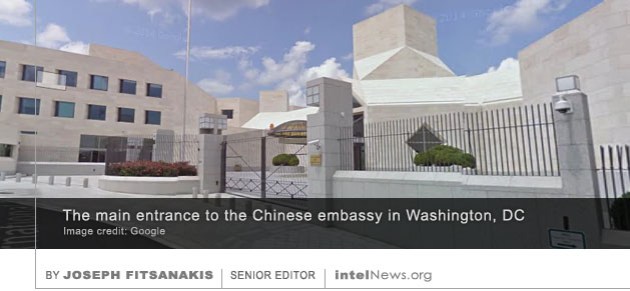
US expels Chinese diplomats for the first time since 1987

Chinese embassy in the United StatesThe United States quietly expelled two Chinese diplomats in October of this year, a move that neither Washington nor Beijing chose to make public, according to a report published on Sunday. If true, the incident would signify the first known expulsions of Chinese diplomatic personnel from the US since 1987.
The incident was reported by The New York Times, which cited “six people with knowledge of the expulsions”. It said that the expulsions were triggered by an incident that took place in September in the US state of Virginia. It involved at least two Chinese diplomats stationed in Washington, who allegedly attempted to enter “a sensitive installation” near the city of Norfolk. The paper did not name the installation, but said that it belongs to the US Armed Forces and is also used by members of Special Operations forces.

According to the American side, a car carrying the Chinese diplomats and their spouses drove up to one of the checkpoints of the military installation. Upon realizing that the car’s passengers did not have permission to enter the base, the guard at the checkpoint asked the driver to proceed through the gated entry and immediately turn around, thus exiting the base. But the car allegedly drove straight into the base and did not slow down after military personnel pursued it. It came to a stop only after several fire trucks blocked its way.

Once apprehended, the car’s passengers claimed that their knowledge of English was limited and had thus misunderstood the instructions given to them by the guard at the entrance to the base. The New York Times reported that this explanation was echoed by associates of the Chinese diplomats, who said that they were on “a sightseeing tour when they accidentally drove onto the base”.

But US officials told The Times they are skeptical of that explanation, and suspect the Chinese diplomats were trying to assess the physical security of the installation. Moreover, at least one of the Chinese diplomats was allegedly an intelligence officer operating under diplomatic cover —a clue that heightened the skepticism of American officials.

Interestingly, although it complained about the expulsions of its diplomats following the incident in Virginia, Beijing did not retaliate, as is customary in such cases. Therefore, no American diplomats or intelligence officers have been expelled from China in response to Washington’s move. The last time the US expelled Chinese diplomats from its soil was in 1987, when two employees of the Chinese embassy in Washington —almost certainly intelligence officers operating under diplomatic cover— were declared personae non gratae.

Author: Joseph Fitsanakis | Date: 16 December 2019 | Permalink

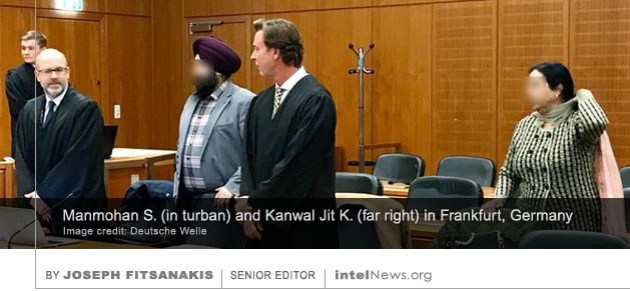
Germany convicts married couple of spying for Indian intelligence service

Manmohan S. Kanwal Jit K.A court in Frankfurt has found a married couple guilty of spying in Germany on behalf of India’s external intelligence service. Due to Germany’s strict privacy laws, the couple have been identified only as 50-year-old Manmohan S. and his wife, Kanwal Jit K., who is 51.
According to the prosecution, Manmohan S. was recruited by India’s Research and Analysis Wing (RAW) in January of 2015. His wife joined his intelligence-collection activities in July 2017. Following their arrest, the couple told German authorities that they held regular meetings with a RAW case officer who was serving as a diplomat in the Indian consulate in Frankfurt. They also said they were paid nearly $8,000 for their services.

The two convicted spies said at their trial that they were tasked to spy on adherents of the Sikh religion and members of the Kashmiri expatriate community in Germany. The central European country is believed to host as many as 20,000 Indian Sikhs, many of whom openly proclaim secessionist aspirations. Many Sikhs in India and abroad campaign for the creation of a Sikh state in parts of northwestern India and Pakistan, which they call Khalistan. India is also concerned about the secessionist aspirations of Kashmiris, a predominantly Muslim population of 10 million that lives in the region of Jammu and Kashmir. Delhi has long claimed that expatriate groups living in Europe and the United States provide funding for secessionist groups that operate in the region.

On Thursday, Frankfurt’s Higher Regional Court found the couple guilty of conducting illegal espionage activities on German soil. It handed Manmohan S. a one-and-a-half-year suspended jail sentence, while Kanwal Jit K. was given a fine that equates to 180 days of income.

Author: Joseph Fitsanakis | Date: 13 December 2019 | Permalink

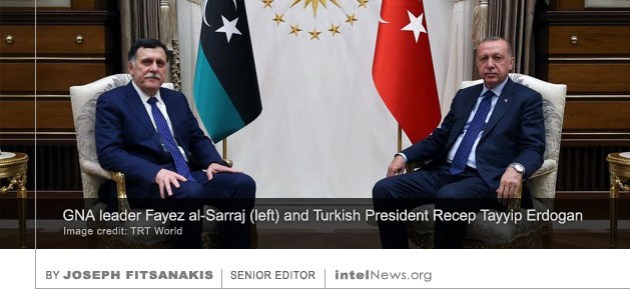
Turkey offers to send troops to Libya as tensions rise with Greece, Egypt

Turkey LibyaTurkish President Recep Tayyip Erdoğan has said his country is prepared to deploy troops to Libya, just days after Ankara surprised analysts by announcing an agreement with the embattled Libyan government in Tripoli. The Turkish-Libyan agreement has spurred angry reactions from Israel, Greece and Egypt, all of which are competing with Turkey for control of newly discovered gas fields in the eastern Mediterranean seabed.

The Turkish-Libyan agreement merges the two countries’ Exclusive Economic Zones (EEZ) and ostensibly prevents other players in the area, including Greece, Egypt, Israel and Cyprus, from drilling for natural gas without the consent of Ankara and Tripoli. However, according to Greece, the agreement disregards the presence of several Greek islands —including the largest one, Crete— in the Turkish-Libyan EEZ. Athens says that it views the Turkish-Libyan agreement as a direct claim against its territory. Last week the Greek government summarily expelled the Libyan ambassador from the country, marking a dramatic deterioration in the historically close relationship between Athens and Tripoli.

To further-complicate matters, several European countries, as well as Russia and the United States, do not support the Tripoli-based Government of National Accord (GNA), with which Turkey has signed its agreement. Instead, they support the Libyan National Army (LNA), which is commanded by Field Marshal Khalifa Haftar, an old adversary of the Libyan leader Muammar al-Gaddafi. Haftar lived in the United States under Washington’s protection for several decades before returning to Libya in 2011. The LNA, which is based in eastern Libya, is also supported by Saudi Arabia, the United Arab Emirates, and other American allies in the Persian Gulf.

It follows that, if Turkey deploys troops to Libya, it may be entering a collision course with several of its North Atlantic Treaty Organization (NATO) allies. Ankara’s move will also be confronted by Russia, which is purported to have troops in eastern Libya. On Tuesday, however, Turkish President Erdoğan seemed determined to proceed with his plan. In a speech at a university in Ankara, the Turkish leader proclaimed that, “if Libya were to make a request, we would send a sufficient number of troops”, adding that “there is no hurdle” to doing so “after the signing of the security agreement” between Ankara and Tripoli.

This is the first time that Turkey has secured an agreement with a regional ally in the matter of energy exploration rights. Previously, Greece, Israel, Egypt and Cyprus struck a deal to coordinate their gas exploration activities, and eventually supply Europe with Israeli and Cypriot natural gas via a projected gas pipeline that would pass through Greece. But the Turkish move raises doubts about the prospects of such a project, with some analysts even speculating whether centuries-old rivals Greece and Turkey may be getting closer to war.

In a speech on Monday, Greek President Prokopis Pavlopoulos warned Ankara that “Greece will defend its borders [and] territory”. Meanwhile European Union leaders met on Monday behind closed doors to discuss the imposition of sanctions on Turkey as punishment for disputing the maritime territorial boundaries of Cyprus, a European Union member.

Author: Joseph Fitsanakis | Date: 11 December 2019 | Permalink

Victor Sheymov, among Cold War’s most important KGB defectors, dies at 73

Victor SheymovVictor Ivanovich Sheymov, who is often referred to as one of the most important intelligence defectors of the Cold War, has reportedly died in the American state of Virginia. He was one of the most senior officials in the Soviet Union’s Committee for State Security (KGB) to ever defect to the West, and revealed important KGB secrets to the United States.


Sheymov was born in 1946 to a family of elite Soviet scientists. His father was an engineer and his mother a doctor specializing in cardiology. A gifted mathematician and student-athlete, Sheymov was recruited into the KGB almost as soon as he graduated from the elite Bauman Moscow State Technical University, where he majored in engineering. By his early 30s, Sheymov had risen to the rank of major under the KGB’s Eighth Chief Directorate, which handled secret communications systems. He oversaw a large unit that monitored the flow of information between the KGB’s headquarters and the agency’s operatives around the world. In later years, Sheymov was assigned code-breaking and counter-espionage tasks, and oversaw the preparation of daily classified briefings for the Politburo —the Communist Party’s highest policy-making body.

But in the 1970s Sheymov grew disillusioned with Soviet politics, and began to feel slighted by the infighting and incompetence inside the KGB. While visiting Poland on KGB business, he volunteered his services to the Central Intelligence Agency (CIA) by walking into the US embassy in Warsaw. The CIA eventually gave him the cryptonym CKUTOPIA and, after verifying his senior status inside the KGB, exfiltrated him to the United States along with his wife and 5-year-old daughter. His was the first known instance of a successful CIA exfiltration of a defector from Soviet territory.

After spending several months being debriefed and polygraphed at a CIA safe house, Sheymov and his family were given new identities and US citizenship. But the defector decided to emerge from hiding in 1990, as the USSR was dissolving. In his book about his espionage work and defection, titled Tower of Secrets, Sheymov said he informed the CIA about the KGB’s unsuccessful plots to assassinate Pope John Paul II and about the successful operation to assassinate Afghan President Hafizullah Amin in 1979. His insights were also instrumental in the decision of the US State Department to demolish the US embassy in Moscow, due to fears about the presence of listening devices planted inside the building’s walls by Soviet builders. The building was eventually replaced with another structure built by vetted American workers.

Sheymov was awarded the US Intelligence Medal and lived the rest of his life in America, where he headed a computer security company. He died on October 18 in Vienna, Virginia, but his death was not publicly reported until this week. Sheymov’s wife told reporters that he died from health complications arising from chronic pulmonary disease.

Author: Joseph Fitsanakis | Date: 10 December 2019 | Permalink