Analysis: Should government spies target foreign firms?
June 12, 2014 3 Comments
 By JOSEPH FITSANAKIS | intelNews.org
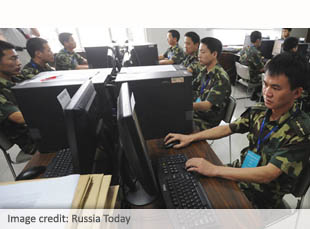
Last month, the government of the United States indicted five officers of the Chinese People’s Liberation Army with conspiracy to commit computer fraud, economic espionage, and theft of trade secrets, among other charges. In indicting the five PLA officers, the US Department of Justice went to great pains to ensure that it did not accuse the suspects of engaging in cyberespionage in defense of China’s national security. What sparked the indictments was that the accused hackers allegedly employed intelligence resources belonging to the Chinese state in order to give a competitive advantage to Chinese companies vying for international contracts against American firms. In the words of US Attorney General Eric Holder, the operational difference between American and Chinese cyberespionage, as revealed in the case against the five PLA officers, is that “we do not collect intelligence to provide a competitive advantage to US companies, or US commercial sectors”, whereas China engages in the practice “for no reason other than to advantage state-owned companies and other interests in China”. I recently authored a working paper that was published by the Cyberdefense and Cybersecurity Chair of France’s Ecole Spéciale Militaire de Saint-Cyr, in which I argued that the American distinction between public and private spheres of economic activity is not shared by PLA. The Chinese see both state and corporate cyberespionage targets as fair game and as an essential means of competing globally with the United States and other adversaries. In the paper, I argue that Beijing sees the demarcation between state and private economic activity as a conceptual model deliberately devised by the US to disadvantage China’s intelligence-collection ability. Read more of this post














Opinion: Iraq is like South Vietnam in 1963 – the US should walk away
July 1, 2014 4 Comments
As I watch the dramatic collapse of the Federal government of Iraq, I keep telling myself that I cannot possibly be the only person noticing the remarkable political resemblance between the Iraq of 2014 and the South Vietnam of 1963. Just like government of Iraq today, the Republic of South Vietnam, which had been set up with direct American support flowing France’s exit from Indochina in 1954, faced increasing domestic opposition that was both political and religious. In Iraq today it is the Sunni Muslims who have taken up arms against the Shiite-controlled government of Prime Minister Nouri al-Maliki. The South Vietnamese President, Ngo Dinh Diem, a westernized Vietnamese Catholic, whose family had been proselytized to Christianity in the 17th century, was shunned by South Vietnam’s Buddhist majority. The latter became increasingly agitated in opposition to the American supported government in Saigon, which they saw as alien and fundamentally anti-Vietnamese. Diem’s response was to intensify internal repression in South Vietnam. He unleashed the country’s secret police, controlled by his shadowy brother, Ngo Dinh Nhu, against the Buddhist community. In the summer of 1963, Buddhist monks began resorting to self-immolation in a desperate attempt to draw public attention to their repression by Diem’s paramilitaries. Nhu’s wife, the fashionable Madame Nhu, shocked public opinion by dismissing the incidents as just some “drugged monks barbecuing themselves”. Washington immediately distanced itself from her comments, and increasingly from Diem.
In the summer of 1963, President John F. Kennedy, a personal friend of Diem, publicly accused the government in Saigon of having “lost touch” with the Vietnamese people and condemned the harsh repression of the Buddhist community. In private, Kennedy had gone a step further, instructing the Central Intelligence Agency and his Ambassador to Vietnam, Henry Cabot Lodge, to begin consulting with the South Vietnamese military about the possibility of deposing Diem. By that time, the Diem regime had become immensely unpopular in South Vietnam. Read more of this post
Filed under Expert news and commentary on intelligence, espionage, spies and spying Tagged with Analysis, Henry Cabot Lodge, history, Iraq, Iraq War, Joseph Fitsanakis, Madame Nhu, Ngo Dinh Diem, Ngo Dinh Nhu, Nouri al-Maliki, South Vietnam, Vietnam War