Updated: France arrests, then releases, alleged assassin of Jamal Khashoggi
December 8, 2021 1 Comment
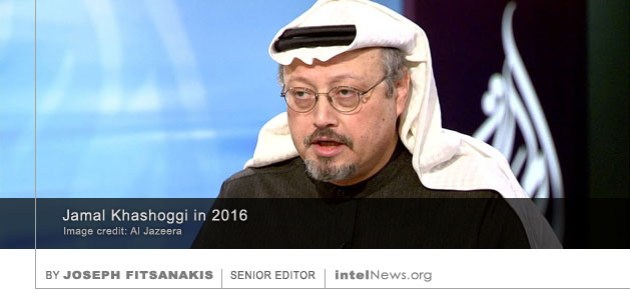 AN ALLEGED MEMBER OF the assassin squad that killed and dismembered Saudi journalist Jamal Khashoggi in Turkey in 2018, is reportedly under arrest in France, where he was caught trying to board an international flight. Khashoggi, 59, was a Saudi government adviser who became critical of the Kingdom’s style of governance. He moved to the United States and began criticizing Saudi Arabia from the pages of The Washington Post. He was killed on October 2, 2018, by a 15-member Saudi hit squad while visiting the Saudi consulate in Istanbul, Turkey. He had gone there to be issued a certificate of divorce from his former wife in Saudi Arabia.
After several weeks of vehemently denying any role in Khashoggi’s killing, the Saudi government eventually admitted that the journalist was killed inside the Saudi consulate in Istanbul. One of Khashoggi’s alleged killers is Khaled Aedh Alotaibi (or al-Otaibi), a 33-year-old member of the Saudi Royal Guard Regiment, whose mission is to protect the Saudi royal family. Alotaibi has been barred from entering several Western countries, including the United States and the United Kingdom. But Saudi Arabia has rejected a request by Turkey to extradite him to face charges in a Turkish court. The oil kingdom argues that Alotaibi was not among a group of “rogue” intelligence officers” who killed Khashoggi, and have since been punished under Saudi law.
Yesterday several French media outlets reported that Alotaibi had been arrested at the Paris Charles de Gaulle Airport at 9:30 am local time, as he was about to board a commercial flight to the Saudi capital Riyadh. He was apparently traveling under his real passport and not under an assumed identity. He has since been placed under judicial detention, while French authorities are trying to confirm that he is the same person who is wanted for the killing of Khashoggi. If this is confirmed, Alotaibi will be facing a preliminary hearing this week, and a French court will have to decide whether he will be extradited to Turkey.
In a statement published late on Tuesday, the Saudi embassy in France dismissed Alotaibi’s arrest as “a case of mistaken identity” and repeated the official Saudi government stance that all those who participated in Khashoggi’s murder have already faced justice in Saudi Arabia. It is worth noting that Alotaibi’s arrest occurred just days after French President Emmanuel Macron became the first major Western leader to openly meet with Saudi Arabia’s Crown Prince Mohamed Mohammad Bin Salman. The de-facto ruler of the country is believed by many to have ordered Khashoggi’s assassination.
Update: Early on Wednesday, French prosecutors said that the warrant issued by Turkey for the arrest of Alotaibi did not apply to the individual arrested on Tuesday. In a statement released to the press, the prosecutor’s office said: “Extensive checks on the identity of this person showed that the warrant did not apply to him. [Therefore] he was released”.
► Author: Joseph Fitsanakis | Date: 08 December 2021 | Permalink
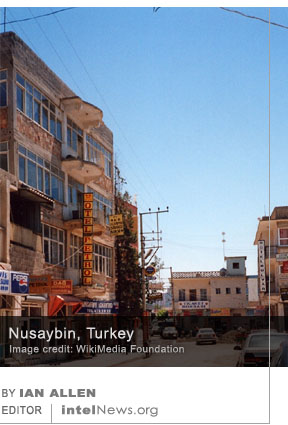 TURKISH AUTHORITIES HAVE LAUNCHED an investigation after a makeshift explosive device was found under the car of a police officer guarding an open-air speech by President Recep Tayyip Erdoğan. The rally took place on Saturday in Siirt, a Kurdish-majority town located about 90 miles from the Turkish-Syrian border. The town has a symbolic significance for Erdoğan, as it is the hometown of his wife, Emine Erdoğan, and was his constituency for four years. In 2003 he won a by-election there and entered the Turkish Grand National Assembly as a member.

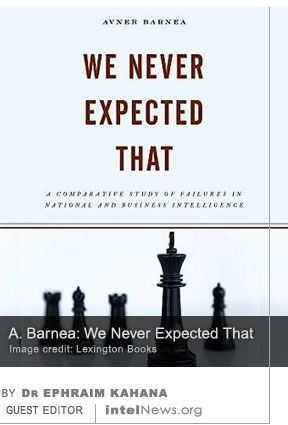 IN HIS NEW BOOK, We Never Expected That: A Comparative Study of Failures in National and Business Intelligence (Lexington Books), Dr. Avner Barnea has coined two new terms in the field of strategic surprise. One is diffused surprise and the other is concentrated surprise, two terms that help us to better understand why intelligence failures occur. In a diffused surprise there is difficulty in identifying the intelligence target and therefore the chance of a surprise increases; while in a concentrated surprise the intelligence target is usually a recognized organization. At the same time, the mistake lies in the assessment of the target’s abilities and intentions.
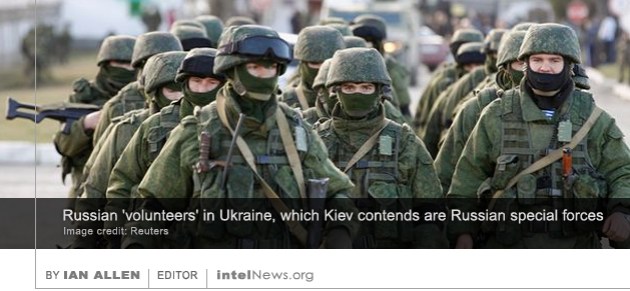 INTELLIGENCE OFFICIALS IN THE United States are becoming increasingly convinced that Russia is contemplating extensive military action in Ukraine, according to Western insiders. Russian troop concentrations near the Ukrainian border have been “large and unusual” for several weeks,
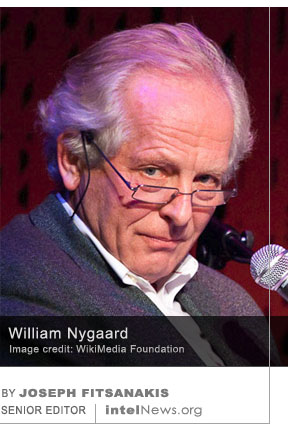 THE GOVERNMENT OF NORWAY has pressed charges against two men, among them a former diplomat in the Iranian embassy in Oslo, for the attempted murder of a high-profile Norwegian publisher in 1993. The case centers on an attempt against the life of William Nygaard, a Norwegian publisher and former director of the Norwegian Broadcasting Corporation.
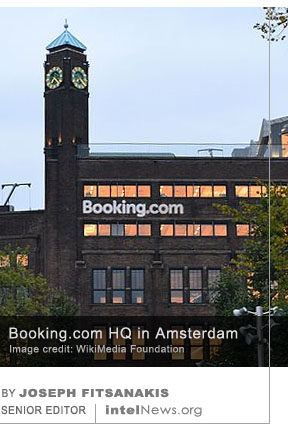 A HACKER WHO TARGETED a major Dutch-based reservations website has ties to intelligence agencies in the United States, according to a new report. The claim was made on Wednesday by three Dutch investigative journalists, Merry Rengers, Stijn Bronzwaer and Joris Kooiman. In a lengthy







 intelNews.org
New book claims former Irish head of government was Provisional IRA informant
December 9, 2021 by Joseph Fitsanakis Leave a comment
From the mid-1960s and until his retirement in the early 1990s, Haughey was a towering —and controversial— figure in Irish politics. He was first elected to the Dáil Éireann (Ireland’s parliament) in 1957 with Fianna Fáil, one of Ireland’s two major centrist political parties. Throughout his career, he served as Taoiseach from 1979 to 1981, for a short period in 1982, and from 1987 until his retirement in 1992. He also held scores of ministerial appointments in the 1970s and 1980s.
Haughey’s political career almost ended in 1970, when the so-called ‘arms crisis’ nearly brought down the Irish government. It was sparked by allegations that leading members of the Irish government were involved in a conspiracy to smuggle weapons to British-held Northern Ireland, in an effort to support the activities of the IRA. During the ensuing investigation, Haughey was found to have met with Cathal Goulding, who as chief of staff for the IRA. Consequently, Haughey was among several cabinet ministers who were either fired or voluntarily resigned in the aftermath of the arms crisis.
During the lengthy trial that followed the explosive allegations, Haughey claimed that his meeting with Goulding was nothing more than an unplanned encounter. He was eventually found not guilty. But many were doubtful about his innocence, and there were numerous claims that the Irish government —even the Taoiseach at the time— were fully aware and supportive of the conspiracy.
Now a new book by O’Connor, titled Political Betrayal: How Charlie Haughey Acquired €70 Million, claims that Haughey was closer to the IRA than even his staunchest critics realized. The allegations are based on what the author says are documents from the archives of the Special Branch Unit of the Garda Síochána, the police service of Ireland. The documents allegedly reveal that Haughey was routinely sharing classified information to the IRA, including warnings about government spies that operated within the organization.
In one instance, Haughey allegedly reached out to the IRA for assurances that they would not harm famous English artists who were living in Ireland at the time. Several artists moved there in the 1970s in order to take advantage of the country’s laws guaranteeing tax-free status for artists. This scheme was the brainchild of Haughey, and he was eager to ensure that it did not backfire. Among the famous artists who had taken advantage of these laws was the English journalist and novelist Frederick Forsyth, author of —among other books— The Day of the Jackal, who was a critic of the IRA. According to O’Connor, Haughey feared that the IRA might harm or kidnap Forsyth. But the militant group assured Haughey that Forsyth would not be harmed.
Haughey eventually left politics in 1992, when the government he was leading at the time was found to have illegally wiretapped the telephone lines of at least three investigative journalists. He never returned to politics. Despite his ungraceful fall from power, Haughey continues to be revered among Fianna Fáil supporters in Ireland today.
► Author: Joseph Fitsanakis | Date: 09 December 2021 | Permalink
Filed under Expert news and commentary on intelligence, espionage, spies and spying Tagged with book news and reviews, Charlie Haughey, informants, Ireland, Kevin O'Connor, News, Provisional IRA