Analysis: The Islamic State is far from dead; it is regrouping and rebranding itself

Islamic State ISISIn a recent series of interviews to promote his new book, Anatomy of Terror, former FBI special agent and current counterterrorism expert Ali Soufan insists that the Islamic State remains potent and dangerous. Speaking last week to the British newspaper The Guardian, Soufan warned that, even though the Islamic State was unable to hang on to its self-described caliphate in the Middle East, the group has ample opportunities to regroup. In the days of al-Qaeda, “we only had one vacuum, in Afghanistan”, from where Osama bin Laden’s organization operated from and spread its message, said Soufan. “Now we have so many vacuums —Syria, Yemen, Libya, northern Nigeria, Tunisia, the Philippines— and it’s expanding. That’s very dangerous”, he warned.

Soufan, a well-read analyst and complex thinker, who today presides over The Soufan Group and oversees the Soufan Foundation, is right to warn against the notion that the Islamic State is on its way out. The group’s meteoric rise marked a watershed moment in the modern history of militant Sunni Islam. Even if it is militarily annihilated —a prospect that is far from certain— its physical absence will in no way erase its impact and influence among its millions of supporters and sympathizers. In fact, experts warn that the group is —like al-Qaeda before it— proving to be resilient and able to withstand intense military pressure from its enemies. Currently, all signs show that the Islamic State is actively reorganizing under the command of its leader, Abu Bakr al-Baghdadi. The prolonged absence of the Iraqi-born al-Baghdadi has prompted wild speculation about this supposed demise or severe incapacitation. There are even some who claim that he was killed by an Islamic State faction in an internal coup.

But most intelligence agencies agree that al-Baghdadi —and his core lieutenants— remain very much alive and well. Three weeks ago, The Washington Post cited anonymously a “senior United States counterterrorism official” who confirmed that, by all indications, al-Baghdadi was alive and was coordinating the group’s activities in its last strongholds in eastern Syria. This is supported by communications intercepts, detainee interrogations and statements by informants, said The Post. It is important to note that Al-Baghdadi continues to have alongside him some of the militant group’s most hardened commanders, most of whom were trained in intelligence and military tactics during the reign of Saddam Hussein. Under their guidance, retreating Islamic State forces are leaving behind cell-based formations of underground fighters in areas that are liberated by the fragile US-led coalition. Read more of this post

Most government hackers now target cell phones, not computers, experts say

Cell Phone - IAThe majority of government-sponsored hacking now targets cell phones, not personal computers, according to researchers who say that political dissidents are especially targeted by totalitarian regimes around the world. Until 2015, most government-sponsored hacking operations were directed against the personal computers of targeted individuals. However, experts tell The Wall Street Journal that as of this year cell phones have become a far more lucrative target than personal computers in government-sponsored hacking operations. Researchers with Lookout Mobile Security, a security software company based in the United States, say that detected phone-hacking operations that are believed to be sponsored by governments have increased by a factor of 10 in the first five months of this year, compared to 2015.

According to Lookout, the increase in hacking operations targeting mobile phones reflects the proliferation of smartphone usage around the world, as well as the increase in consumption of cell phone software. Government-sponsored hackers usually compromise their targets’ cell phones through malicious software disguised as cell phone applications. The Wall Street Journal also reports that the software needed to build malicious software for cell phones has become cheaper and more readily available. Compromising a target’s cell phone provides hackers with information that is far more personal and sensitive than what can be found on a personal computer. The paper quotes Mike Murray, Lookout’s vice president of security research, who says: “It is one thing to compromise someone’s computer. It’s another thing to have a listening device that they carry around with them 24 hours a day”. Compromised phones become immensely powerful espionage tools, explains Murray.

Many of the individuals whose cell phones are targeted by governments are activists or dissidents who campaign for political or economic reforms in their countries. Their cell phones are targeted in systematic hacking campaigns by countries like Ethiopia, the United Arab Emirates, Cambodia, and Mexico, said Lookout. The Wall Street Journal cites Raj Samani, chief scientist for the antivirus firm McAfee, who claims that nearly 11 percent of cell phones worldwide were infected with some kind of malware in 2017. That statistic is likely to rise significantly by the end of 2018, says Samani.

Author: Ian Allen | Date: 08 June 2018 | Permalink
US evacuates more diplomats from China over ‘abnormal sounds and symptoms’

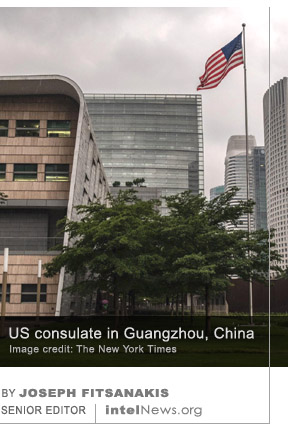
US consulate in GuangzhouThe United States has evacuated at least two more diplomatic personnel from its consulate in the Chinese city of Guangzhou, after they experienced “unusual acute auditory or sensory phenomena” and “unusual sounds or piercing noises”. The latest evacuations come two weeks after the US Department of State disclosed that a consulate worker in Guangzhou had been flown home for medical testing, in response to having experienced “subtle and vague, but abnormal, sensations of sound and pressure”.

The evacuations from China have prompted comparisons to similar phenomena that were reported by US diplomatic personnel in Cuba in 2016. Last September, Washington recalled the majority of its personnel from its embassy in Havana and issued a travel warning advising its citizens to stay away from the island. These actions were taken in response to allegations by the US Department of State that at least 21 of its diplomatic and support staff stationed in Cuba suffered from sudden and unexplained loss of hearing, causing them to be diagnosed with brain injuries. In April, the Canadian embassy evacuated all family members of its personnel stationed in Havana over similar health concerns.

US State Department sources told The New York Times on Wednesday that the two latest evacuees were among approximately 179 American diplomats and consular personnel stationed in Guangzhou, one of China’s largest commercial hubs. The city of 14 million, located 70 miles north of Hong Kong, hosts one of Washington’s six consulates in China. The building that houses the US consulate was presented to the public in 2013 as a state-of-the-art construction, which, as The Times reports, is “designed to withstand electronic eavesdropping and other security and intelligence threats”. The paper said that one Guangzhou consular employee that was evacuated this week is Mark A. Lenzi, who works as a security engineering officer. He is reported to have left China along with his wife and two children. An unnamed senior US official told The Times that a State Department medical team arrived in Guangzhou on May 31, and is currently examining all diplomatic personnel and their families.

Author: Joseph Fitsanakis | Date: 07 June 2018 | Permalink

Facebook shared user data with Chinese firm despite warnings by US intelligence

HuaweiThe online social media company Facebook shares data about its users with a Chinese telecommunications company that has been flagged in United States government reports as a threat to security. The New York Times revealed on Tuesday that Facebook has been routinely giving access to the private data of its users to four Chinese companies since at least 2010. The paper said that the data-sharing agreement with Lenovo, Oppo, TCL, and Huawei Technologies, has its roots in 2007. That was the year when Facebook began an effort to entice cell phone hardware and software manufacturers to include Facebook-friendly apps and features in their products. As part of the agreement, Facebook gave cell phone manufacturers access to its users’ private data, including “religious and political leanings, work and education history and relationship status”, said the Times.
However, several sources in the United States, United Kingdom, Australia and other governments, have repeatedly flagged Huawei as a company that is uncomfortably close to the Chinese government and its intelligence agencies. In 2011, the US Open Source Center, which acts as the open-source intelligence arm of the Office of the Director of National Intelligence, became the first US government agency to openly link Huawei with the Chinese intelligence establishment. It said that Huawei relied on a series of formal and informal contacts with the Chinese People’s Liberation Army and the Ministry of State Security, which oversee and administer China’s military and civilian intelligence apparatus. In 2013, the British government launched an official review of Huawei’s involvement in the UK Cyber Security Evaluations Centre in Oxfordshire, England, following a British Parliament report that raised strong concerns about the Chinese company’s links with the government in Beijing. And last year the Australian government expressed concern about Huawei’s plan to provide high-speed Internet to the Solomon Islands, a small Pacific island nation with which Australia shares Internet resources.

In a statement, Facebook said that all data shared with Huawei remained stored on users’ phones and was not downloaded on the Chinese’ company’s private servers. It also said that it would “phase out” the data-sharing agreement with Huawei by the middle of June. The Times noted on Tuesday that Facebook has been officially banned in China since 2009. However, the social media company has been trying to make a comeback in the Chinese market, by cultivating close links with Chinese Communist Party officials. Facebook founder Mark Zuckerberg visited China in October of last year, and met with Chinese Premier Xi Jinping and other senior officials.

Author: Joseph Fitsanakis | Date: 06 June 2018 | Permalink

Television program about the Mossad prompts controversy, strong denials in Israel

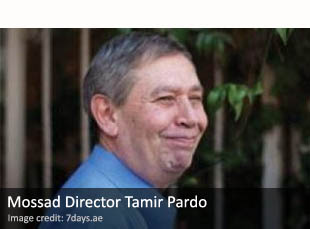
Tamir PardoIsraeli officials have denied reports that the head of the country’s internal security service was asked by the prime minister to spy on the director of the Mossad intelligence agency and the head of the military. The denials were prompted by allegations that will be made in full on Thursday, when the latest installment of the investigative news program Uvda (Fact) will be aired on Israel’s Channel 12 television channel. According to the program, the Israeli Prime Minister Benjamin Netanyahu requested that the personal phones of senior Israeli security officials, including those of the heads of the Mossad and the military, be wiretapped for security reasons.
The investigative news program reported on May 31 that the “unprecedented” request has its roots in a “major secret program” that was launched by the Israeli government in 2012. The program required a major transformation of the country’s intelligence budget, staffing and resources. Although numerous individuals from nearly every facet of the Israeli intelligence community had been briefed on the project, the Israeli prime minister was concerned about leaks to the media. He therefore kept his cabinet in the dark about the program, and did not consult with the Knesset, or even the members of the Knesset’s Subcommittee on Intelligence and Secret Services, which is required by law to be kept fully informed about Israeli intelligence operations.

Uvda further alleges that in 2013 Netanyahu convened an extraordinary meeting of senior officials, which included the participation of the attorney general, the head of the Shin Bet (Israel’s domestic security service) and others. It was during that meeting, according to Uvda, when Netanyahu allegedly approached Yora Cohen, the then-director of the Shin Bet, and asked him to “monitor the partners of the secret project”. When asked what he meant, Netanyahu allegedly said that the directors of the Israel Defense Forces (IDF) and the Mossad should have their telephones monitored for possible unauthorized leaks to the media. Two names mentioned during that meeting, according to Uvda: Tamir Pardo, head of the Mossad, and Benny Gantz, the IDF’s chief of staff. Both men were new at their posts. Eventually, however, when Cohen took Netanyahu’s request to senior officials at the Ministry of Defense, “they were shocked and rejected it”, Uvda reports.

On Sunday, Cohen took the unusual step of issuing a denial of Uvda’s allegations, calling “reports in the media” about the prime minister having instructed him to “specifically wiretap Gantz and Pardo […] untrue”. The Office of the Prime Minister also denied the Uvda report, describing it in a statement as “utterly baseless”. The statement went on to say that Uvda’s allegations represented “a total distortion of systemic efforts that are made from time to time to safeguard sensitive information related to Israel’s security”. Also on Sunday, Prime Minister Netanyahu directly criticized comments made by Pardo on the same program, which the Israeli leader saw as damaging to the reputation of the Mossad. Pardo told Uvda that “the fun part” about working for the Mossad was that the agency is “basically a crime syndicate with a license”. Netanyahu took exception to those comments on Sunday, saying that “the Mossad is not a criminal organization. It is a superb organization that does sacred work in the fight against terrorism and other threats to the state of Israel. We all salute it”.

Author: Joseph Fitsanakis | Date: 04 June 2018 | Permalink

Opinion: Bizarre fake murder plot points to Ukrainian state’s recklessness, unreliability

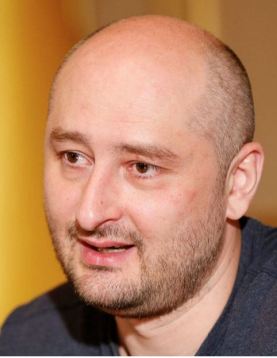
Arkady Babchenko

Arkady Babchenko

Western audiences were treated to a small taste of the bizarreness of Eastern European politics this week, when a Russian journalist who had reportedly been assassinated by the Kremlin, made an appearance at a live press conference held in Kiev. On Tuesday, Ukrainian media reported that Arkady Babchenko, a Russian war correspondent based in Ukraine, had been shot dead outside his apartment in the Ukrainian capital. A day later, after Babchenko’s murder had prompted global headlines pointing to Russia as the most likely culprit, Babchenko suddenly
appeared alive and well during a press conference held by the Security Service of Ukraine (SBU). The SBU then said that Babchenko’s killing had been staged in an attempt to derail a Russian-sponsored plan to kill him. The bizarre incident concluded with Babchenko meeting on live television with Ukrainian President Petro Poroshenko, who praised him as a hero. Later that night, the Russian journalist wrote on his Facebook page that he planned to die after “dancing on [Russian President Vladimir] Putin’s grave”.

Welcome to Ukraine, a strange, corrupt and ultra-paranoid state that is on the front lines of what some describe as a new Cold War between the West and Russia. Like the Cold War of the last century, the present confrontation is fought largely through information. The Russian government, which appears to be far more skillful than its Western adversaries in utilizing information for political purposes, immediately sought to capitalize on the Babchenko case. In fact, this baffling and inexplicable fiasco may be said to constitute one of the greatest propaganda victories for the Kremlin in years.

Ever since accusations began to surface in the Western media about Moscow’s alleged involvement in the 2016 presidential elections in the United States, Russia has dismissed these claims as “fake news” and anti-Russian disinformation. When Sergei and Yulia Skripal were poisoned in England in March, the Kremlin called it a false-flag operation. This is a technical term that describes a military or intelligence activity that seeks to conceal the role of the sponsoring party, while at the same time placing blame on another, unsuspecting, party. Most Western observes reject Russia’s dismissals, and see the Kremlin as the most likely culprit behind the attempt to kill the Skripals.

As one would expect, Russia stuck to its guns on Tuesday, when the world’s media announced the death of Arkady Babchenko in the Ukraine. Moscow claimed once again that we were dealing here with a false flag operation that was orchestrated by anti-Kremlin circles to make Russia look bad at home and abroad. It turns out that Moscow was right. Babchenko’s “murder” was indeed a false flag operation —admittedly a sloppy, shoddy and incredibly clumsy false flag operation, but a false flag operation nonetheless. Moreover, Babchenko’s staged killing could not possibly have come at a worse time for Ukraine and its Western allies. In the current environment, global public opinion is extremely sensitive to the phenomenon of ‘fake news’ and disinformation. Within this broader context, the Ukrainian state and its intelligence institutions have placed themselves at the center of an global disinformation maelstrom that will take a long time to subside. In doing so, the government of Ukraine has irreparably harmed its reputation among the general public and in the eyes of its Western allies. The Kremlin could not possibly have asked for a better gift from its Ukrainian adversaries.

The amateurishness and recklessness of some Eastern European countries that the West sees as allies in its confrontation with Russia, such as Ukraine, Poland, Hungary, and others, would be humorous if it were not so dangerous. The manifest idiocy of the Babchenko fake plot also poses serious questions about the West’s policy vis-à-vis  Russia. It is one thing for the West to be critical of the Kremlin and its policies —both domestic and foreign. It is quite another for it to place its trust on governments and intelligence services as those of Ukraine, which are clearly unreliable, unprofessional, and appear to lack basic understanding of the role of information in international affairs.

Author: Joseph Fitsanakis | Date: 01 June 2018 | Permalink

Chinese influence in New Zealand threatens intelligence-sharing, says Canadian report

CSIS canadaChina’s influence in New Zealand is so extensive that it threatens the traditionally close intelligence contacts between New Zealand and its Western allies, according to a report written by the Canadian spy agency. Since World War II, New Zealand has been a member of what is sometimes referred to as the UK-USA Security Agreement. Known also as the UKUSA Agreement or the Five Eyes alliance, the pact, which was strengthened in 1955, provides a multilateral framework for intelligence cooperation between the United Kingdom, the United States, Canada, Australia, and New Zealand. But a new report produced by Canadian intelligence warns that Chinese political and economic influence in New Zealand is making it difficult for the Pacific Ocean island country to continue to operate within the framework of the agreement.

The report, entitled China and the Age of Strategic Rivalry, was authored by experts at the Canadian Security Intelligence Service (CSIS). It contains a summary of views expressed by participants at an academic outreach workshop that was organized in Canada by the CSIS. In a section focusing on Chinese “interference in democratic systems”, the report suggests that, despite its small size, New Zealand is “valuable to China […] as a soft underbelly through which to access Five Eyes intelligence”. In recent years, claims the report, Beijing has adopted “an aggressive strategy” that has sought to co-opt political and economic elites in New Zealand as a means of influencing political decision making in the country. As part of that process, China seeks to gain advantages in trade and business negotiations, suppress negative views of China, facilitate espionage and control the views of the Chinese expatriate community in New Zealand, according to the report. Ultimately, Beijing seeks to “extricate New Zealand from […] its traditional [military and intelligence] partners]” as a means of asserting its regional and —eventually— global influence, the report concludes.

In a separate but connected development, it emerged this week that China expert Peter Mattis told an American Congressional committee last month that New Zealand’s position in the Five Eyes alliance was tenuous due to China’s influence. Mattis, a former China analyst for the United States Central Intelligence Agency, was speaking before the US-China Economic and Security Review Commission, a group of experts that advise the US Congress. He told the Commission that the influence of the Chinese Communist Party in New Zealand is so deep that it raises questions about whether the Pacific Ocean country can continue to share intelligence with the other members of the Five Eyes alliance.

On Wednesday, New Zealand’s Prime Minister Jacinda Ardern emphatically dismissed questions about her country’s role in the Five Eyes alliance. She told reporters in Wellington that the issue of New Zealand’s Five Eyes membership had “never been raised” with her “or anyone else” by Five Eyes partners. Ardern added that her government received its information “from official channels, not opinions expressed at a workshop”.

Author: Joseph Fitsanakis | Date: 31 May 2018 | Permalink

Pakistan bars its former spy chief from leaving the country over controversial book

Asad DurraniPakistan has officially barred a former director of its powerful intelligence agency from leaving the country, after he co-authored a controversial book with his Indian counterpart. Asad Durrani is a retired Pakistani Army general who served as director-general of Pakistan’s Directorate for Military Intelligence between 1988 and 1989. From 1990 to 1992, he served as director of the Inter-Services Intelligence Directorate, arguably Pakistan’s most powerful government institution. Durrani, 77, has been severely criticized in some Pakistani circles for co-authoring a book entitled The Spy Chronicles: RAW, ISI and the Illusion of Peace, with his Indian counterpart, A.S. Daulat. Daulat, 78, headed India’s Research and Analysis Wing from 1999 to 2000.
The book, which was edited by the widely respected Indian journalist Aditya Sinha, has prompted heavy criticism of its two co-authors in nationalist circles in the two rival regional powers. But Durrani’s position became more tenuous on Monday, after the government of Pakistan announced that he had been placed under formal investigation. Pakistani Army spokesman Major General Asif Ghafoor told reporters in Islamabad on Monday morning that the revelations made in Lieutenant General Durrani’s book would be investigated by a formal court of inquiry, headed by a three-star general. He also said that Durrani had been urgently summoned to the Pakistani Army’s headquarters to answer allegations that he violated the Pakistani military’s code of conduct. Additionally, Ghafoor announced that Durrani had been placed on an official government-administered “exit control list”, which means that he is not allowed to leave Pakistan until further notice.

The Pakistani armed forces have not explained the precise reasons why Durrani is under investigation. His book makes several controversial allegations relating to Islamabad’s intelligence operations. A large part of the book contains details about Pakistan’s systematic efforts to foment armed unrest in the heavily Muslim Indian state of Kashmir, for instance by funding and training a host of Islamist paramilitary organizations that operate in the disputed region. The book also claims that the Pakistani government was aware of the whereabouts of Osama bin Laden in 2011, and that it cooperated closely with the United States to kill the co-founder of al-Qaeda. Islamabad has consistently denied allegations that it knew of bin Laden’s hideout in the city of Abbottabad, and that it gave permission to US Special Forces troops to raid his compound. If Durrani is charged with having violated the Pakistani military’s code of conduct, he could face a minimum of two years in prison.

Author: Joseph Fitsanakis | Date: 30 May 2018 | Permalink

France arrests two intelligence officers on charges of spying for China

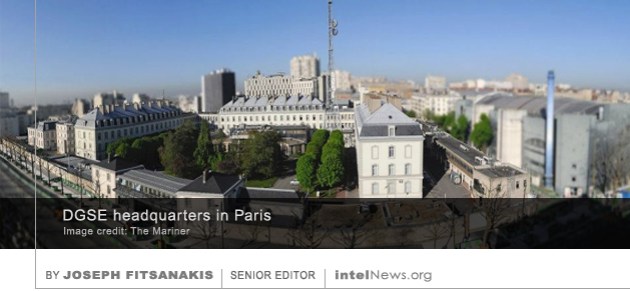
dgse franceFrance has confirmed the arrest of two French intelligence officers who are accused of spying for the Chinese government. It appears that the two officers were captured and charged in December. However, their arrests were not publicized at the time, because French counterintelligence officials wanted to avoid alerting more members of a possible spy ring, which some say may include up to five French citizens. It was only last Friday, a day after French media published leaked reports of the arrests, that the French government spoke publicly about the case.
France’s Minister of the Armed Forces, Florence Parly, told France’s CNews television on Friday that two French intelligence officers were “accused of extremely serious acts of treason” against the French state. The two officers had been charged with delivering classified information to a foreign power”, she said. Parly added that the spouse of one of the officers was also being investigated for participating in acts of espionage on behalf of a foreign country. When asked to identify the country that the two officers are accused of spying for, the minister refused to respond. But the Agence France Presse news agency cited an anonymous “security source”, who said that the two intelligence officers were being suspected of spying for China and that they had been captured following a sting operation by French counterintelligence officers.

French television station TFI1 said on Friday that both spy suspects are officers in the General Directorate of External Security (DGSE), France’s primary external intelligence agency. The station added that at least one of the two suspects was stationed at the embassy of France in Beijing when French counterintelligence became aware of the alleged espionage. According to some reports, the two suspects had retired from the DGSE by the time they were arrested, but committed their alleged espionage while still in the service of the spy agency. French government officials have refused to provide information about the length of the alleged espionage or the nature of the classified information believed to have been compromised. Additionally, no information is available about whether the two alleged spies were working in cooperation with each other. The BBC asked China last week about the arrests in France, but the Chinese Ministry of Foreign Affairs said it was not aware of the incident.

Author: Joseph Fitsanakis | Date: 28 May 2018 | Research credit: E.W. and P.C.  | Permalink

High-level MI6 spy inside al-Qaeda writes book detailing his work

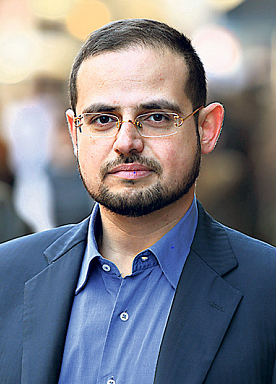
Aimen Dean, a.k.a. Ramzi

Aimen Dean, a.k.a. Ramzi

A Saudi-born man, who some refer to as the most valuable British-run spy inside al-Qaeda, has authored a soon-to-be-published book about his experiences. Aimen Dean, known in al-Qaeda circles simply as ‘Ramzi’, became radicalized in the first half of the 1990s in response to the Bosnian War. At that time, he traveled from his home country of Saudi Arabia to Bosnia, where he joined large numbers of foreign Muslim fighters who fought in support of Bosnian-Muslim forces. In subsequent interviews, Dean has said that he continues to view his participation in the Bosnian War as an “ethical and moral” act in defense of a “defenseless population”. Following the end of the Bosnian War, Dean joined many foreign-born fighters who followed al-Qaeda co-founder Osama bin Laden to Afghanistan. While there, he pledged allegiance to bin Laden and gained his trust.

Dean’s task in Afghanistan was to train new al-Qaeda recruits in Islamic theology and history. But he was also tasked with combat duties, which included bomb-making. He witnessed the drastic shift in al-Qaeda’s raison d’être from a group ostensibly fighting to defend Muslims under attack, to a center of a violent campaign against the West. Dean has stated that during his first period in Afghanistan, he sincerely believed that the West was involved in a systematic campaign to destroy Islam and Muslims. Gradually, however, Dean’s views began to conflict with those of al-Qaeda’s leaders. He especially objected to the use of suicide bombers and the deliberate targeting of civilians by al-Qaeda fighters. His disillusionment with al-Qaeda peaked in August of 1998, when the organization targeted the United States embassies in Kenya and Tanzania in coordinated strikes.

During a leave of absence from al-Qaeda’s Afghanistan stronghold, Dean was approached by the United Kingdom’s Secret Intelligence Service, more commonly known as MI6. He says that he quickly agreed to work as a spy for the British agency and did so from 1998 until 2007, when he claims that his cover was blown. Dean has now written a book, co-authored with two CNN reporters, Paul Cruickshank and Tim Lister. Entitled Nine Lives: My Time As MI6’s Top Spy Inside al-Qaeda, the book is due to appear in stores on June 7.

Author: Ian Allen | Date: 25 May 2018 | Permalink

US alerts its diplomatic staff in China over ‘abnormal sounds and symptoms’

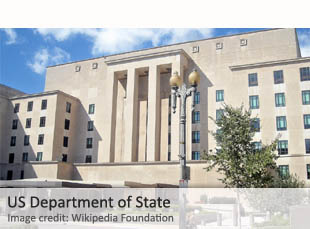
US Department of StateThe United States Department of State has warned its personnel stationed in China of the danger of experiencing “unusual acute auditory or sensory phenomena accompanied by unusual sounds or piercing noises”. The warning, issued on May 23, has prompted comparisons to similar phenomena that were reported by US diplomatic personnel in Cuba in 2016. Last September, Washington recalled the majority of its personnel from its embassy in Havana and issued a travel warning advising its citizens to stay away from the island. These actions were taken in response to allegations made by the United States that at least 21 of its diplomatic and support staff stationed in Cuba suffered from sudden and unexplained loss of hearings, causing them to be diagnosed with brain injuries. In April, the Canadian embassy evacuated all family members of its personnel stationed in Havana, over similar health concerns.
Now a similar warning has been issued by the US Department of State for its staff stationed in China. In a statement, the Department said that a member of staff at its consulate in the Chinese city of Guangzhou reported experiencing “subtle and vague, but abnormal, sensations of sound and pressure”. The unnamed individual reportedly suffered these physical symptoms between late 2017 and April 2018, said the statement. At that time, the individual was flown back to the US where they eventually were diagnosed with “mild traumatic brain injury”. The statement went on to state that the cause of these symptoms remains unknown, and that the US government has no information about other such incidents affecting Americans in China.

Late on Wednesday, however, speaking before the Committee on Foreign Affairs of the US House of Representatives, US Secretary of State Mike Pompeo said that the incident in China was “medically similar” to the 2016 incidents in Cuba. Some US government sources have blamed these medical symptoms on unspecified “sonic weapon attacks” from a foreign country, aimed at US diplomatic facilities.  But Washington has so far refrained from accusing China of having a role in such attacks, either in Cuba or in China itself. Pompeo said on Wednesday that Washington had dispatched a medical team to Guangzhou to inspect American diplomats stationed there. The Chinese government said yesterday that it was probing the incident “in a very responsible manner” and “would protect the lawful rights and interest of foreigners in China”. However, China’s Minister of Foreign Affairs, Wang Yi, warned that the case in Guangzhou should not be “magnified, complicated or even politicized” by Washington.

Author: Joseph Fitsanakis | Date: 23 May 2018 | Research credit: Nikki P. | Permalink

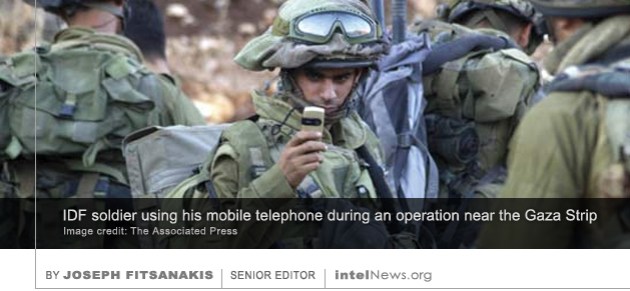
Spy collection program using fake mobile phone apps linked to Pakistani military

Cellular telephoneThe Pakistani military is suspected of having orchestrated a lucrative intelligence collection campaign using mobile phones, which targeted diplomats from India, Israel and Australia, as well as from North Atlantic Treaty Organization (NATO) member countries such as the United States and Britain. Others targeted in the operation include officials from Iraq, Iran and the United Arab Emirates. News of the alleged spy operation was published earlier this month by Lookout Mobile Security, a security software company based in the United States.
The company said that the perpetrators of the operation managed to hack into a number of diplomats’ phones by creating a number of fake applications for Android and iOS mobile phone systems. The applications, called Tangelo (for iOS) and Stealth Mango (for Android), took control of mobile phone devices once their owners downloaded them through fake third-party app stores advertising online. According to Lookout, the two apps were designed by a consortium of freelance software developers who have close links with the Pakistani military establishment. The technical report published by Lookout points to the use of IP addresses that lead to a server housed in Pakistan’s Ministry of Education in the country’s capital, Islamabad. Lookout also said that it managed to trace the identity of the person who was the main developer of the two fake mobile phone applications. He is reportedly a full-time government employee who “moonlights as a mobile app developer”. The group that built the fake apps is known for creating legitimate apps, said Lookout, but also works for hire creating surveillanceware for mobile phone systems. In the past, the same group has been found to target military and civilian government officials in India, according to Lookout.

In its technical report, the Lookout security team describes how the Pakistani hackers collected a variety of data from their victims, by having it stealthily transmitted from compromised mobile phones to servers in Islamabad. The data included photos and videos, lists of contacts, logs of phone calls and texts, as well as detailed calendar entries. German and Australian diplomats had their travel plans stolen, and a letter from the United States Central Command to Afghanistan’s assistant minister of defense for intelligence was also acquired by the hackers. The latter also gained access to the contents of an entire database of pictures of traveler passports —many of them diplomatic— from the Kandahar International Airport in southern Afghanistan. The report said it was impossible to know for certain when Tangelo and Stealth Mango were first developed and utilized. However, the most recent version of the apps was released in April of this year.

Author: Joseph Fitsanakis | Date: 22 May 2018 | Permalink

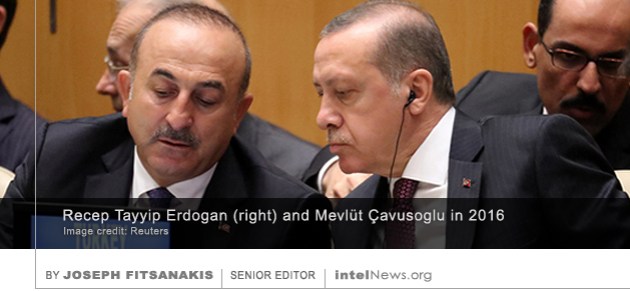
Spy agencies warn Turkish president of assassination attempt during Bosnia visit

Erdogan and CavusogluA number of European intelligence agencies have reportedly warned the Turkish government of a possible assassination attempt against the country’s president, Recep Tayyip Erdoğan, during an official state visit to Bosnia and Herzegovina. On Sunday the Turkish leader embarked on a week-long visit to the Balkans, beginning with Bosnia, which along with Albania is seen as Turkey’s strongest political ally in Europe. During his visit to Bosnia, Mr. Erdoğan is scheduled to meet with Bakir Izetbegovic, one of the country’s three presidents. He is also scheduled to address a rally of expatriate Turks in the Bosnian capital Sarajevo, held in support of his ruling Justice and Development Party.

On Saturday night, Turkey’s state-owned TRT broadcaster reported that the Turkish president’s delegation had been warned about a possible assassination attempt against him. According to TRT, the information came initially from the intelligence services of the Republic of Macedonia, another state of the former Yugoslavia, which, like Bosnia, has a large Muslim population. Turkish intelligence were reportedly warned that a group of militant opponents of Mr. Erdoğan living in the Balkans were planning to kill him, said the report. It was allegedly followed by similar warnings issued by unnamed “Western intelligence agencies”. TRT did not provide further details about the alleged plot, but said that an “in-depth investigation” was underway by Turkish intelligence.

The Turkish president is facing one of the most direct challenges of his political career in less than two weeks, when Turks will go to the polls to elect a new parliament and —potentially— a new president. Some political commentators believe that, come June 2, Mr. Erdoğan may be removed from power after 15 years in the country’s leadership. But members of his government appeared unphased. One of them, Deputy Prime Minister Bakir Bozdag, tweeted on Saturday that warnings about Mr. Erdoğan’s life were “not new, and have always been there. Our President Recep Tayyip Erdogan is not a person who will be afraid of the threats and change his policy”, wrote Mr. Bozdag. And he continued: “Those, who have not understood that yet, are fools”.

Author:  Joseph Fitsanakis | Date: 21 May 2018 | Permalink

NATO obtained Soviet Novichok nerve agents through German intelligence in 1990s

Sergei SkripalSome North Atlantic Treaty Organization (NATO) member states obtained access to the Soviet Union’s so-called ‘Novichok’ nerve agents in the 1990s, through an informant recruited by German intelligence, according to reports. NATO countries refer to ‘Novichok-class’ nerve agents to describe a series of weaponized substances that were developed by the Soviet Union and post-Soviet Russia from the early 1970s to at least 1993. They are believed to be the deadliest nerve agents ever produced, but Moscow denies their very existence. A type of Novichok agent, described by British scientists as A234, is said to have been used in March of this year by the person or persons who tried to kill Sergei Skripal in Salisbury, England. Skripal is a former Russian military intelligence officer who spied for Britain in the early 2000s and has been living in England ever since he was released from a Russian prison in 2010.
On Thursday, two German newspapers, Die Süddeutsche Zeitung and Die Zeit, and two regional public radio broadcasters, WDR and NDR, said that the NATO alliance has had access to the chemical composition of Novichok nerve agents since the period immediately following the collapse of the USSR in 1991. Specifically, the reports claimed that the access was gained through a Russian scientist who became an informant for the German Federal Intelligence Service, known as the BND. The scientist struck a deal with the BND: he provided the spy agency with technical information about the Novichok agents in exchange for safe passage to the West for him and his immediate family. Initially, the German government was reluctant to get its hands on material that was —and remains— classified as a weapon of mass destruction by international agencies. But eventually it asked for the chemical composition of the Novichok nerve agents and even acquired samples from the Russian informant.

According to media reports, the BND proceeded to share information about the chemical composition of the Novichok nerve agents with key NATO allies, including Sweden, France, Britain and the United States. The sharing of such a sensitive substance was approved by the then German Chancellor Helmut Kohl, said the reports. In the following years, a handful of NATO countries proceeded to produce what media reports described as “limited quantities” of Novichok agents, reportedly in order to experiment with various defense measures against them and to produce antidotes. Russia has denied accusations that it was implicated in Skripal’s poisoning and has argued that other countries, some of them NATO members, have the capacity to produce Novichok agents.

Author: Joseph Fitsanakis | Date: 18 May 2018 | Permalink

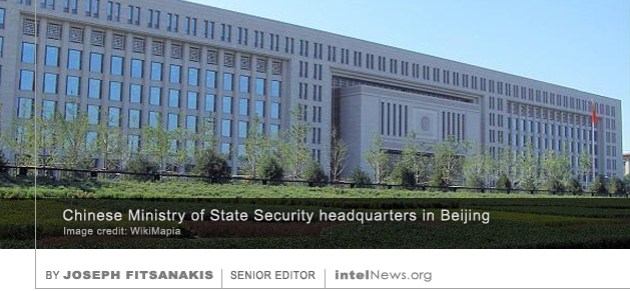
China gave ex-CIA officer “hundreds of thousands of dollars in cash” to spy on US

 Chinese Ministry of State SecurityChinese intelligence operatives gave a former officer of the United States Central Intelligence Agency “hundreds of thousands of dollars in cash” in exchange for carrying out espionage, according to court papers. The Federal Bureau of Investigation arrested Jerry Chun Shing Lee, 53, on January 15, accusing him of possessing classified information that included lists of real names of foreign assets and addresses of CIA safe houses. Lee, 53, was reportedly arrested after a lengthy FBI sting operation, which included creating a fictional job in the US in order to entice Lee to travel to New York from Hong Kong, where he had been living after leaving the CIA in 2007.

Lee is now scheduled to appear before a US circuit court judge on Friday morning, in order to be officially charged with one count of conspiracy to deliver national defense information to aid a foreign government and two counts of unlawfully retaining information pertaining to national defense. According to the indictment, in April of 2010 Lee met two officers of China’s Ministry of State Security. The meeting allegedly took place in Shenzhen, a city in southern China that borders Hong Kong. During that encounter, the indictment claims that Lee was offered “a gift of $100,000 in cash” in exchange of providing the Ministry of State Security with information about his career in the CIA. He was also told by the two Chinese intelligence officers that China would “take care of him for life” if he continued to cooperate with them.

In May of 2010, Lee deposited about $17,000 into one of his HSBC accounts in Hong Kong. Court documents allege that the deposit was the first of many that followed, and that they amounted to “hundreds of thousands of dollars”. These deposits continued to occurr until the end of 2013, when Lee made his last substantial cash deposit in Hong Kong. Throughout that time, Lee received regular written instructions from the Ministry of State Security, asking him to provide information about CIA operations. Lee did so at least 21 times, says the indictment. In one instance, he drew the floorplan of a CIA facility abroad and gave it to the Chinese, according to the indictment. Lee is expected to plead not guilty on Friday.

Author: Joseph Fitsanakis | Date: 16 May 2018 | Permalink