EU recalls envoy to Moscow over Skripal poisoning, more expulsions may follow
March 23, 2018 4 Comments
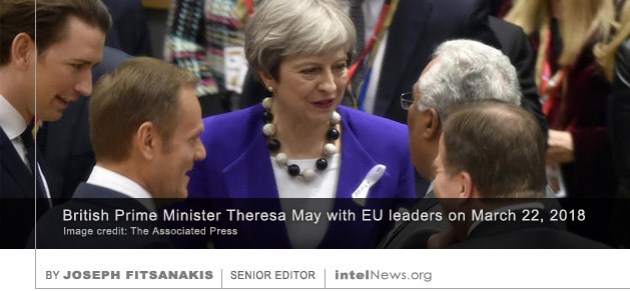 The European Union has recalled its ambassador to Moscow in an apparent response to the poisoning of Sergei Skripal, a Russian double agent, who was attacked with a nerve agent in England earlier this month. Skripal, 66, and his daughter Yulia, 33, remain in critical condition in hospital, nearly three weeks after being poisoned with a nerve agent that British scientists say belongs to Russia’s Cold-War-era chemical stockpiles. Moscow has angrily rejected claims that Skripal, who spied for Britain in the early 2000s, was on a Kremlin-approved hit-list of defectors. But British Prime Minister Theresa May traveled to Brussels on Thursday to brief European Union heads of state about the attack on Skripal.
The summit concluded in the early hours of Friday with the publication of a joint statement, signed by every participating head of state, backing the British claims and expressing outrage at Moscow’s alleged use of a military-grade nerve agent on British soil. The statement said that EU leaders “agree with the United Kingdom government’s assessment that it is highly likely that the Russian Federation is responsible” for the attack on the Skripals. “There is no plausible alternative explanation”, said the statement, and described the attack on the two Russians as a “grave challenge to our shared security”. The statement will be seen as a foreign-policy triumph by London, as Britain has been contacting EU governments seeking from them a direct condemnation of Russia and possible diplomatic actions in response to the alleged attack.
The jointly authored statement also said that the EU would recall its ambassador to Moscow, effective immediately. Markus Ederer, a German diplomat who represents the EU in the Russian capital, will be leaving Russia “for a month of consultations”, in what appears to be a symbolic act of protest by the Europeans. However, some EU members threatened further action and said that they would “coordinate on the consequences to be drawn in the light of” future Russian actions on the matter of the Skripals. In statements made to reporters early on Friday, German Chancellor Angela Merkel said that there may be “further punitive measures” against Russia, adding that they would be coordinated among EU states.
Some media reported that at least five EU member states were considering expelling undeclared Russian intelligence officers from their soil in response to the alleged Russian attack in England. They are said to include France, Lithuania and Poland. The London-based newspaper Daily Telegraph reported that Russia was in danger of having its Western European spy network dismantled in response to the attack on the Skripals. Some EU countries, however, including Italy and Greece, appeared less interested in taking action against Russia. The Greek Prime Minister, Alexis Tsipras, said on Thursday that his government expressed its “solidarity with the United Kingdom”, but that the EU had to investigate what happened in England on March 4.
► Author: Joseph Fitsanakis | Date: 23 March 2018 | Permalink
 With
With 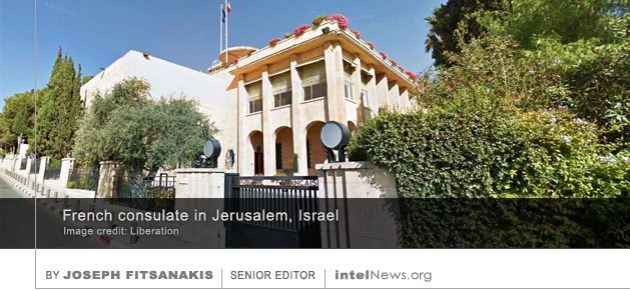 An employee of France’s consulate in Jerusalem is under arrest for allegedly smuggling weapons from the Gaza Strip to the West Bank, according to French media reports, which have been confirmed by Israel. The consular employee has been identified by the Shin Bet, Israel’s domestic security agency, as Romain Franck, 23. He reportedly worked as a driver at the consulate, a job he managed to secure through a prestigious “international volunteer” program sponsored by the French government. The elite program allows recent French college graduates to gain work experience in various countries around the world. Although he had a relatively junior post at the French consulate, Franck carried a diplomatic passport, which allowed him to move through international borders without being searched, due to his diplomatic immunity privileges.
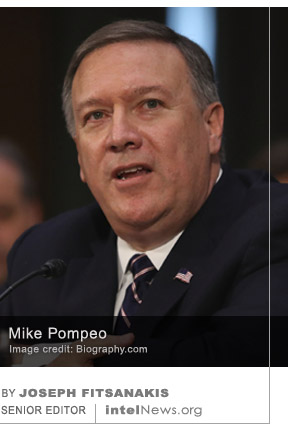 The Central Intelligence Agency has reportedly established back channels for negotiation between the United States and North Korea, which the Department of State is now using to communicate with Pyongyang. Rex Tillerson, who was summarily fired as US Secretary of State by President Donald Trump last week, was famously in favor of diplomatic negotiations between the US and North Korea. The White House had resisted and even publicly criticized Tillerson’s views. Ironically, Tillerson was fired just as his pro-diplomacy views on North Korea are being adopted by the White House.
 On March 21, the Dutch public cast their vote about the new Intelligence and Security Services Act, in Dutch
 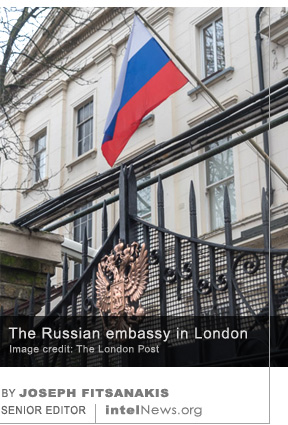 As expected, Moscow snubbed the British government’s demand for information into how a Russian-produced military-grade nerve agent ended up being used in the streets of Salisbury, England. As British Prime Minister Theresa May addressed the House of Commons on Wednesday afternoon, Sergei Skripal continued to fight for his life in a hospital in southern England. His daughter, Yulia, was also comatose, having been poisoned with the same Cold-War-era nerve agent as her father. This blog has
  the latest expulsions are dwarfed by the dramatic expulsion in 1971 of no fewer than 105 Soviet diplomats from Britain, following yet another defection of a Soviet intelligence officer, who remained anonymous.
 The nerve agent that poisoned a Russian double spy in England last week may have been smeared on his car’s door handle, according to sources. Sergei Skripal, 66, and his daughter Yulia, 33, are in critical condition after being
  The British prime minister said on Monday that it was “highly likely” the nerve agent used to attack a Russian defector in England last week was developed by Russia. But sources in London told the BBC that the British government would not invoke Article 5 of the North Atlantic Treaty Organization (NATO), which states that an attack on one member of the alliance is an attack on all. Theresa May was referring to an
 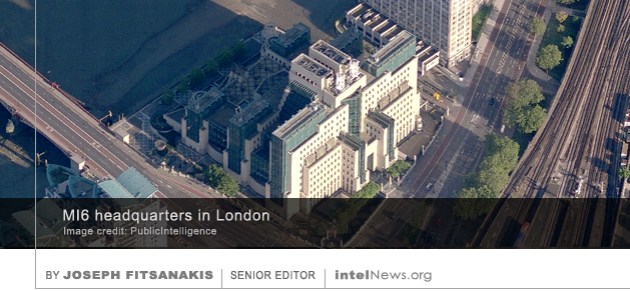 The British secret services have begun tightening the physical security of dozens of Russian defectors living in Britain, a week after the attempted murder of former KGB Colonel Sergei Skripal in southern England. The 66-year-old double spy and his daughter, Yulia, were found in a catatonic state in the town of Salisbury on March 4. It was later determined that they had been attacked with a nerve agent. Russian officials have vehemently denied that the Kremlin had any involvement with the brazen attempt to kill Skripal. But,
 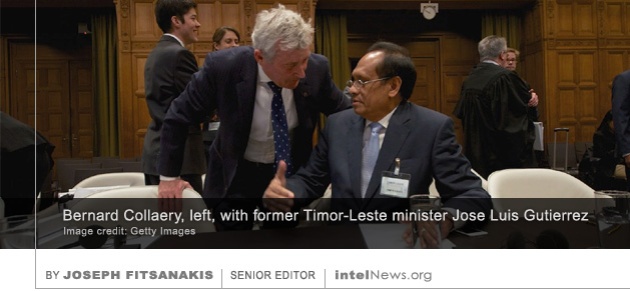 Australia continues to deny freedom of movement to a former intelligence officer who revealed that Canberra bugged government offices in the small island nation of Timor-Leste, in an effort to secure a lucrative oil deal. The former intelligence officer, known only as “Witness K.”, is believed to be a former director of technical operations in the Australian Secret Intelligence Service (ASIS), Australia’s foreign-intelligence agency. In 2013, he publicly objected to an intelligence-collection operation that targeted the impoverished Pacific island nation of Timor-Leste, known also as East Timor.
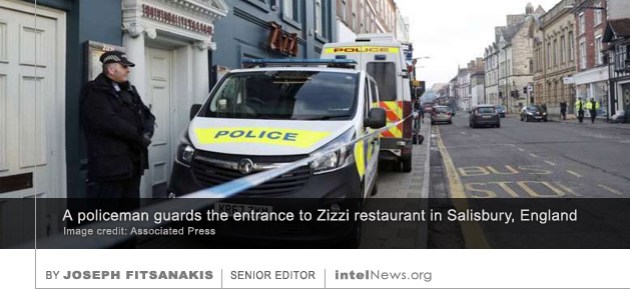 Most state-sponsored assassinations tend to be covert operations, which means that the sponsoring party cannot be conclusively identified, even if it is suspected. Because of their covert nature, assassinations tend to be extremely complex intelligence-led operations, which are designed to provide plausible deniability to their sponsors. Consequently, the planning and implementation of these operations usually involves a large number of people, each with a narrow set of unique skills. But —and herein lies an interesting contradiction— their execution is invariably simple, both in style and method. The
  Skripal, who continued to provide his services to British intelligence as a consultant while living in the idyllic surroundings of Wiltshire. Like the late Russian defector Alexander Litvinenko, who died in London of radioactive poisoning in 2006, Skripal entrusted his personal safety to the British state. But in a country that today hosts nearly half a million Russians of all backgrounds and political persuasions, such a decision is exceedingly risky.
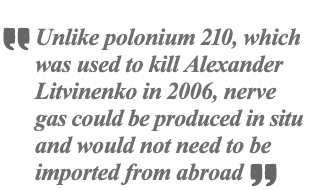 from abroad. It is, in other words, a simple weapon that can be dispensed using a simple method, with little risk to the assailant(s). It fits the profile of a state-sponsored covert killing: carefully planned and designed, yet simply executed, thus ensuring a high probability of success.
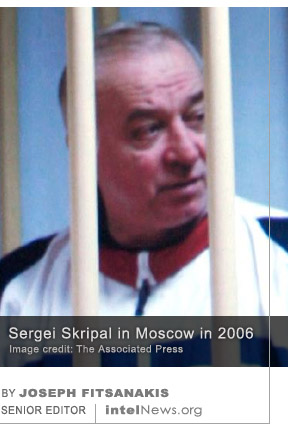 Britain’s counterintelligence service is nearing the conclusion that a foreign government, most likely Russia, tried to kill a Russian double spy and his daughter, who are now fighting for their lives in a British hospital. Sergei Skripal, 66, and his daughter Yulia Skripal, 33, are said to remain in critical condition, after falling violently ill on Sunday afternoon while walking in downtown Salisbury, a picturesque cathedral city in south-central England. Skripal arrived in England in 2010 as part of a large-scale
 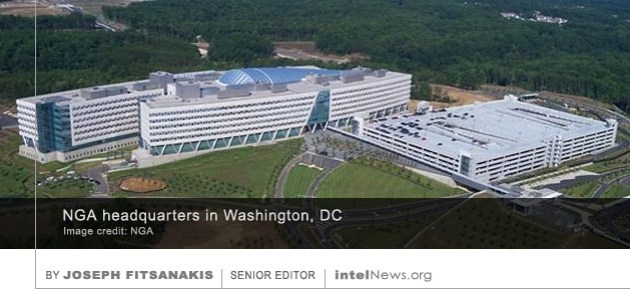 The National Geospatial-Intelligence Agency (NGA), one of America’s most secretive spy organizations, will work with a number of human-rights groups to monitor human rights in North Korea, according to a senior NGA official. Formed in 1996 as the National Imagery and Mapping Agency, the NGA operates under the supervision of the US Department of Defense. It is tasked with supporting US national security by collecting, analyzing and distributing geospatial intelligence. It also performs a combat-support mission for the Pentagon. The agency collects most of its data from satellites, surveillance aircraft and unmanned surveillance drones. Headquartered in a vast 2.3 million square foot building in Washington, the NGA is known for its secretive nature and rarely makes headlines.
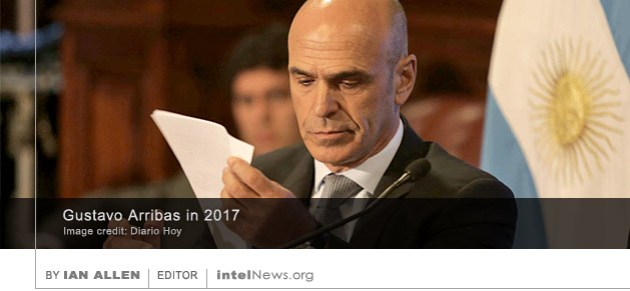 The director of Argentina’s spy agency has been accused by security officials in Brazil of being implicated in a multi-million dollar money-laundering scandal that involves dozens of senior officials across Latin America. The allegations were made in the context of the so-called “operation car wash”, known in Portuguese as Operação Lava Jato. The term refers to a money-laundering probe that began in 2014, following allegations of illegal financial practices by a number of private import-export companies in Brazil. Soon, however, Lava Jato led to the exposure of large-scale corruption, nepotism and bribing practices at the core of Brazil’s state-owned oil company Petrobras. Today, four years later, the constantly expanding investigation has implicated nearly 200 people —many of them well-known politicians— in numerous Latin American countries, including Mexico, Peru and Venezuela.








Report from Holland: Cable-bound interceptions and ‘dragnets’
March 24, 2018 by intelNews Leave a comment
That prohibition of bulk cable tapping is not the only thing that makes Dutch intelligence services different from those of many other countries. Probably the biggest difference is the fact that the Wiv applies to both foreign and domestic operations, as if the two secret services were responsible for both domestic security and foreign intelligence.
The General Intelligence and Security Service (Algemene Inlichtingen- en Veiligheidsdienst, or AIVD) covers the civilian domain, and focuses at Jihadist terrorism, radicalization, rightwing and leftwing extremism, counter-intelligence and countering cyber threats. This is mostly domestic, but the AIVD also has a small branch that gathers foreign intelligence from and about a select range of countries. The Military Intelligence and Security Service (Militaire Inlichtingen- en Veiligheidsdienst, or MIVD) covers military issues, and is therefore more foreign-orientated than its civilian counterpart. The MIVD is responsible for the security of Dutch armed forces and for collecting foreign intelligence in military matters, while at the same time providing support of Dutch military missions abroad, like for example in Mali. When it comes to Signals Intelligence (SIGINT), the AIVD and MIVD combined their efforts in a joint unit called the Joint SIGINT Cyber Unit (JSCU), which became operational in 2014. The JSCU is responsible for most of the technical interception capabilities, from traditional wiretaps to cyber operations. The JSCU is not allowed to conduct offensive cyber operations. The latter are conducted by the Defence Cyber Command (DCC) of the Dutch armed forces. Read more of this post
Filed under Expert news and commentary on intelligence, espionage, spies and spying Tagged with Analysis, civil liberties, communications interception, intelligence legislation, Netherlands