Russian journalist who wrote about mercenaries’ deaths in Syria is found dead
April 17, 2018 Leave a comment
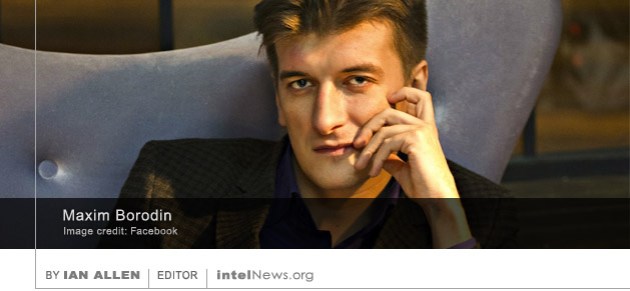 A Russian investigative journalist, who wrote a series of articles about Russian soldiers-for-hire in Syria, has died after falling from the balcony of his apartment in western Siberia. Some of his colleagues say they suspect foul play. Maxim Borodin wrote for Novy Den (New Day) an investigative online magazine. In the past few weeks, Novy Den published a series of probing articles by Borodin about the activities of Russian mercenaries working for the Syrian President Bashar al-Assad. Borodin was one of just a handful of Russian journalists who reported on claims that more than 200 Russian mercenaries were killed in Syria on February 7.
According to the United States government, the Russians were part of a 500-strong Syrian government force that crossed the Euphrates River and entered Kurdish-controlled territory in Syria’s northeastern Deir al-Zour region. American-supported Kurdish forces in the area, which include embedded US troops, responded with artillery fire, while US military aircraft also launched strikes against the Syrian government forces. The latter withdrew across the Euphrates after suffering heavy losses, including at least 200 Russian troops. The incident was subsequently confirmed by the Kremlin, which said that the Russians were contractors and were not members of the Russian armed forces. Borodin wrote that the Russian mercenaries were employed by the Wagner Group, an arms-for-hire company owned by Yevgeny Prigozhin, a billionaire with close ties to the Russian President Vladimir Putin. Prigozhin’s name is included in the most recent list of Russian oligarchs that are subject to economic sanctions imposed by the US government.
Last Thursday, just weeks after writing his exposé about the Wagner Group, Borodin was found by neighbors at the foot of the building that houses his apartment in Yekaterinburg, Russia’s fourth largest city. The journalist was taken to a local hospital, where he later died from his injuries. The American news network CNN said it spoke to Valery Gorelykh, a local Russian Interior Ministry official, who said that no foul play was suspected in Borodin’s death. The door of his apartment had been locked from the inside and there were no signs of struggle, said Gorelykh. He went on to say that the most likely explanation for Borodin’s death was that he slipped and fell off the balcony while smoking a cigarette.
But some of Borodin’s colleagues and friends question the verdict of accidental death. Vyacheslav Bashkov, a close friend of the deceased, said Borodin had called him in a frantic state in the early morning hours of April 11. He said his apartment had been surrounded by armed security personnel wearing ski masks, one of whom had climbed on his balcony and appeared to be waiting for a court order so that he could search Borodin’s apartment. But an hour later, Borodin called Bashkov again, this time to let him know that the armed men had been conducting a training exercise and that they never entered his apartment after all. Another colleague of Borodin, Novy Den editor-in-chief Polina Rumyantseva, said she did not believe Borodin had committed suicide.
► Author: Ian Allen | Date: 17 April 2018 | Permalink
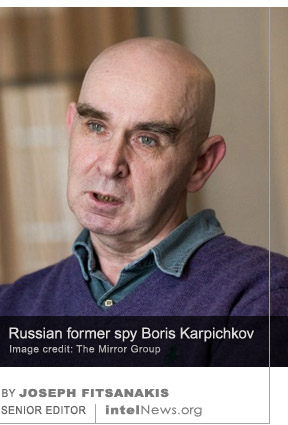 A former officer in the Soviet KGB, who now lives in the United Kingdom, is to be questioned by British police after alleging that there is a link between the recent poisoning of Sergei Skripal and the mysterious death of a British intelligence officer in 2010. There has been extensive media coverage in the past month of the poisoning of Sergei Skripal, a Russian former military intelligence officer who spied for Britain in the early 2000s and has been living in England since 2010. Nearly every European country, as well as Canada, Australia and the United States,
 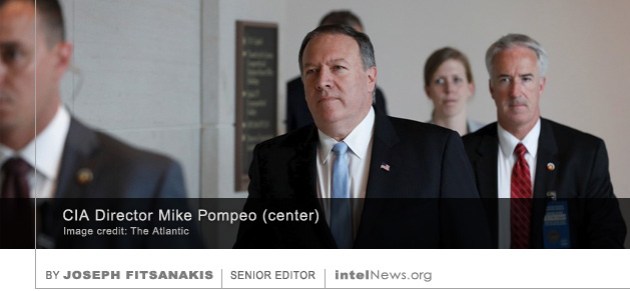 The outgoing director of the Central Intelligence Agency, Mike Pompeo, appeared on Thursday to confirm reports from last February that United States troops killed more than 200 Russian soldiers in Syria.
 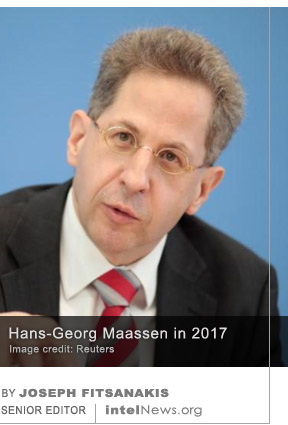 The head of Germany’s domestic intelligence agency has warned of security risks resulting from Chinese direct investment in high-technology German and other European companies. Since 2012, Hans-Georg Maassen has served as director of the Federal Office for the Protection of the Constitution, Germany’s domestic security and counterintelligence agency.
 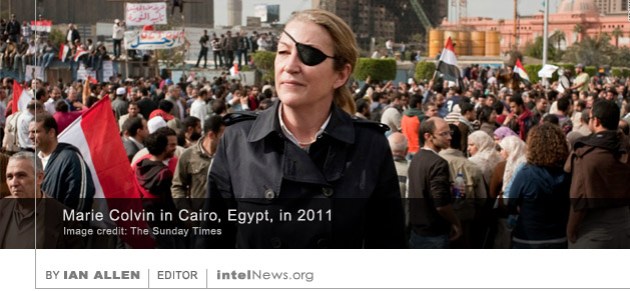 The Syrian government tracked down and killed American journalist Marie Colvin in order to stop her from reporting about the Syrian Civil War, according to a Syrian intelligence officer who has defected to Europe. Colvin was an experienced war correspondent who worked for The Sunday Times. The British newspaper sent her to Syria soon after the outbreak of the war. From there, she gave live interviews to media outlets such as CNN and the BBC. But on the morning of February 22, 2012, Colvin was killed along with French war photographer Remi Ochlik. Their death came when Syrian government forces repeatedly shelled a media center in the city of Homs, which housed the two reporters.
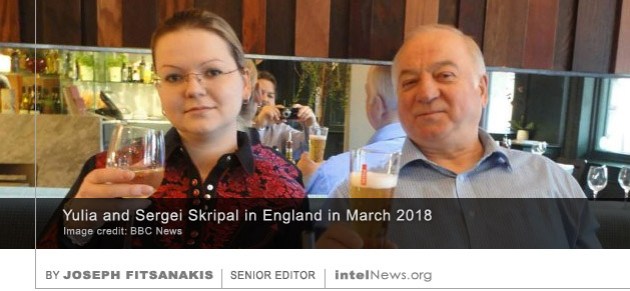 The British government may relocate Sergei Skripal, the Russian double spy who appears to have survived an assassination attempt in England, to the United States, in an effort to protect him from further attacks. The BBC
 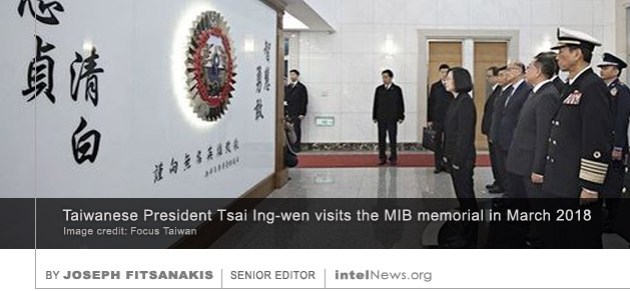 The government of Taiwan has acknowledged publicly for the first time that a Chinese major general, who was executed by Beijing in 1999 for espionage, was indeed one of its spies. The military officer was Liu Liankun, a logistician for the Chinese People’s Liberation Army, who headed its Department of General Logistics. However, China arrested Liu for espionage in 1999, and accused him of having spied for Taiwan for five years, in exchange for money. At the time, Taiwan denied that Liu spied on its behalf and refused to acknowledge that it had any role in the major general’s alleged espionage activities.
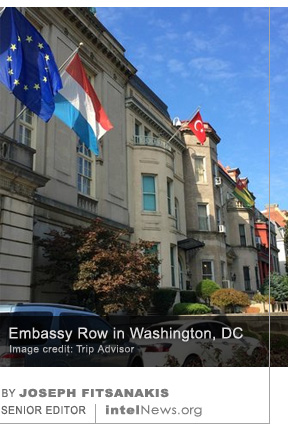 The United States government has for the first time admitted publicly that it has detected devices known to be used by foreign intelligence services to spy on cellular communications in the nation’s capital. Known commonly as Stingrays, after a leading hardware brand, these devices are primarily used by government agencies, including law enforcement. But they can be purchased by anyone with anywhere from $1,000 to $200,000 to spare. They work by simulating the activity of legitimate cell towers and tricking cell phones into communicating with them. That allows the users of these cellphone-site simulators to monitor the physical whereabouts of targeted cell phones. Some of the more expensive Stingray models can intercept the actual content of telephone conversations and can even plant Trojans on the compromised phones of unsuspecting users.
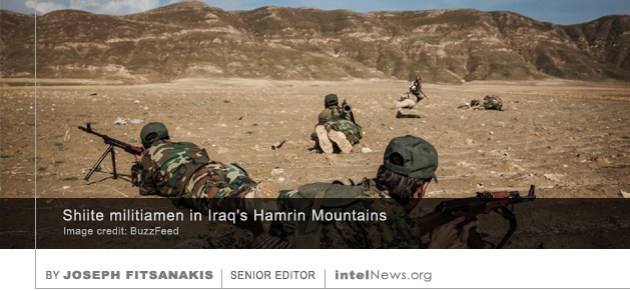 The collapse of the Islamic State of Iraq and Syria is giving rise to a host of successor groups, which are quickly regrouping, recruiting members and launching increasingly sophisticated attacks against government forces, according to experts. A military victory in the war against ISIS was officially declared by the Iraqi government in December of last year. In recent weeks, United States President Donald Trump has repeated his government’s claim that American forces are “knocking the hell out of ISIS”. The Sunni militant group, which rose to prominence in 2014 after conquering much of Syria and northwestern Iraq, is clearly on the retreat, having lost every major urban center that it used to control. However, the collapse of the organization has led to the emergence of numerous insurgent groups that are quickly forming in Iraq and Syria.
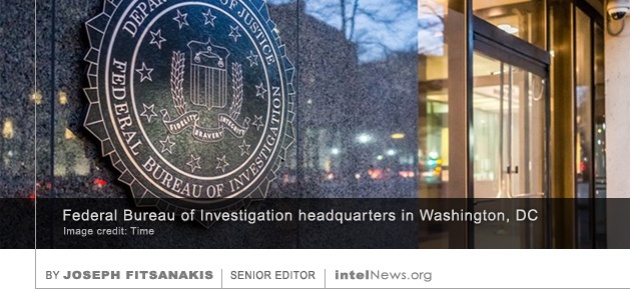 A surge in the activity of Russian intelligence personnel on United States soil has caused American spy agencies to rehire retired Russia specialists,
 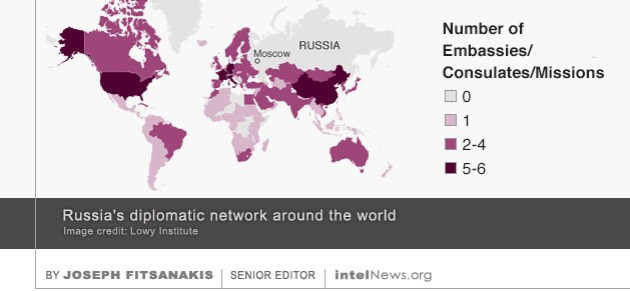 Though unprecedented in size, the recent expulsions of over 150 diplomats by nearly 30 countries and organizations around the world have hardly made a dent on Russia’s huge diplomatic footprint. The
  Britain secured the largest expulsion of Russian diplomats in history by sharing “unprecedented degrees of intelligence” with dozens of foreign countries about the attempted killing of former spy Sergei Skripal. Nearly 30 countries and international organizations, including the European Union and the North Atlantic Treaty Organization, have expelled or refused to accredit over
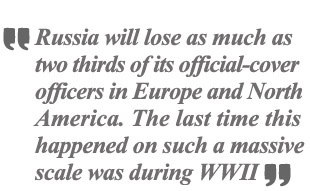
 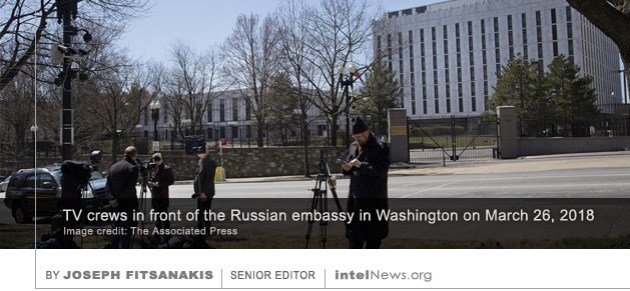 Relations between Russia and much of the West reached a new low on Monday, with the expulsion of over 100 Russian diplomats from two dozen countries around the world. The unprecedented expulsions were publicized on Monday with a series of coordinated announcements issued from nearly every European capital, as well as from Washington, Ottawa and Canberra. By the early hours of Tuesday, the number of Russian diplomatic expulsions had reached 118 —not counting the 23 Russian so-called “undeclared intelligence officers” that were expelled from Britain last week. Further expulsions of Russian diplomats are expected in the coming days.
 predecessor, Barack Obama, and his Secretary of State Hillary Clinton, who is known for her hardline anti-Russian stance. In Europe, the move to expel dozens of Russian envoys from 23 different countries —most of them European Union members— was a rare act of unity that surprised European observers as much as it did the Russians.
 Sergei Skripal, the Russian double agent who was poisoned with a military-grade nerve agent in England earlier this month, wrote to the Kremlin asking to return to Russia, according to one of his old school friends. Skripal, 66, and his daughter Yulia, 33, remain in critical condition in hospital, three weeks after being








Canada evacuates diplomats’ families from Cuba, citing mysterious brain injuries
April 18, 2018 by Joseph Fitsanakis 2 Comments
Since that time, the US Department of State has said that 21 of its diplomatic and support staff have been diagnosed with brain injuries. In response to these concerns, Washington recalled the majority of its diplomats from Havana last September and issued a travel warning advising its citizens to stay away from the island. Now the Canadian embassy has said it will evacuate all family members of its personnel stationed in Havana, according to the BBC. The government of Canada is believed to have made the decision to evacuate its citizens after it confirmed that at least 10 members of diplomatic families living on the island had been found to suffer from “unexplained brain symptoms”, according to Canadian government officials. These include regular spells of dizziness and nausea, as well as difficulty in concentrating on tasks.
Interestingly, Canadian experts have dismissed theories, emanating mostly from the US, that the mysterious brain symptoms come from a mysterious covert weapon that emits sonic waves. But some Canadian experts have said that the symptoms suffered by the diplomats and their families may point to a new illness, whose cause remains unknown. Cuba has dismissed repeated allegations by Washington that it allowed a third party —possibly Russia—to conduct sonic attacks against Western diplomats on the island. Cuban officials have described the allegations as tricks in a game of “political manipulation” that has been concocted by the White House to damage the bilateral relationship between the US and the government of the Caribbean island.
► Author: Joseph Fitsanakis | Date: 18 April 2018 | Permalink
Filed under Expert news and commentary on intelligence, espionage, spies and spying Tagged with Canadian embassy in Cuba, Cuba, diplomacy, News, United States, US embassy in Cuba