Brazil builds direct Internet cable to Europe to avoid US spying
November 3, 2014 5 Comments
 By JOSEPH FITSANAKIS | intelNews.org
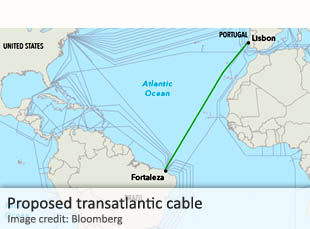
The government of Brazil is to construct a transatlantic cable across the Atlantic Ocean in order to avoid having its Internet traffic to and from Europe intercepted by American intelligence agencies. According to reports, the fiber-optic cable will stretch for 3,500 miles from the northeastern Brazilian city of Fortaleza to the Portuguese capital Lisbon. It will cost the Brazilian government in excess of US$185 million, but it will allow the country’s existing Internet traffic to and from Europe to travel without going through cables owned by American service providers. According to Brazilian officials, the construction of the cable is among several steps announced by the Brazilian government aimed at disassociating its communications infrastructure from American companies. The move follows revelations made last year by American defector Edward Snowden that the US National Security Agency specifically targeted Brazilian President Dilma Rousseff’s personal communications as part of its intelligence-collection efforts targeting Brazil. In response to the revelations, Rousseff cancelled a planned official state visit to Washington and accused the US of having committed “a breach of international law and an affront” against Brazil’s sovereignty. The planned fiber-optic cable connection to Europe will be overseen by Telecomunicacoes Brasileiras SA, Brazil’s state-owned telecommunications conglomerate, known commonly as TeleBras. The company’s president, Francisco Ziober Filho, said in an interview last week that none of the $185 million that will be spent on the project will end up in the pockets of American companies. For over a year, experts have been warning that the Snowden revelations about the extent of the NSA’s global communications-interception activities might undermine the American telecommunications sector, insomuch as it could undercut America’s role and influence in global Internet governance. Many countries, Brazil included, are beginning to actively reconsider their dependence on US-managed Internet networks that host the content of social media sites, cloud computing databases, or telecommunications exchanges. Read more of this post


















Retired Israeli generals, spy directors, urge peace talks with Arabs
November 4, 2014 by Joseph Fitsanakis Leave a comment
A record number of over 100 retired Israeli military commanders, police commissioners and directors of the Mossad spy agency have urged the government of Israel to initiate unconditional peace talks with its Arab neighbors. In an open letter addressed to Israeli Prime Minister Benjamin Netanyahu, 106 signatories from the ranks of Israel’s security and intelligence community have urged the Israeli leader to “initiate a diplomatic process” aimed at achieving peace with the Palestinians. All but five of the signatories are veterans of the Israel Defense Forces with the rank of brigadier or major general. The remaining five are former directors of the Mossad —Israel’s covert-action agency— and former commissioners of Mishteret Yisra’el, Israel’s national police force. The initiative was spearheaded by Major General Amnon Reshef (ret.), a former commander of Israel’s Armored Corps and decorated veteran of the 1973 Arab–Israeli War. He was joined by dozens of his former comrades-in-arms, including Major General Eyal Ben-Reuven, who warned in an interview aired last Friday that Israel is on a “steep slope toward an increasingly polarized society and moral decline”. He attributed this trend to the purported “need to keep millions of people under occupation on claims that are security-related”, but are in reality machinations by weak political leaders within Israel. Ben-Reuven told Israel’s Channel 2 News that Israel had the ability and the means to achieve a two-state solution with the Palestinians that would drastically increase regional security. But it was failing to do so, he said, due to “weak leadership” inside Israel. Referring to Prime Minister Netanyahu, Ben-Reuven said he suffers from “some kind of political blindness that drives him to scare himself and us”. The action by the 106 former security and intelligence leaders was described by Israeli newspaper Ha’aretz as “the largest-ever joint protest by senior Israeli security personnel”. In their letter, the signatories argue that peace with the Palestinians “is not a question of left or right. What we have here is an alternative option for resolving the conflict […] with the Palestinians, which have failed time and again”. And they continue addressing Mr. Netanyahu directly: “We expect a show of courageous initiative and leadership from you. Lead, and we will stand behind you”. The Israeli prime minister promotes the view that Palestinian statehood would threaten Israel’s national security under the geopolitical conditions that are currently prevalent in the region.
Filed under Expert news and commentary on intelligence, espionage, spies and spying Tagged with Amnon Reshef, diplomacy, Eyal Ben-Reuven, Israel, Mossad, Palestine