Russia evacuating its citizens from Syria: A political turning point?

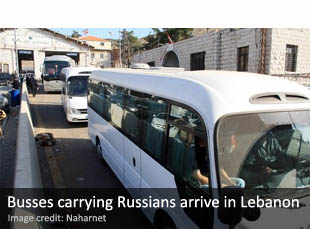
Busses carrying Russians arrive in LebanonBy JOSEPH FITSANAKIS | intelNews.org |
In a move that surprised observers, the government of Russia began on Tuesday to evacuate its citizens from Syria. Late on Tuesday afternoon, four chartered busses carrying nearly a hundred Russians, mostly women and children, arrived at the Jdaidet Yabous border crossing, which links Syria with Lebanon. As soon as they stepped on Lebanese soil in Masnaa, which is located five miles west of Jdaidet Yabous, the evacuees were met by an official from the Russian embassy in Beirut, who had been waiting for them for several hours. Russian officials dismissed rumors that this is the beginning of a mass evacuation of Russian citizens from Syria. But international observers described this development as “the strongest indication yet” that Moscow is acknowledging the eventual collapse of the regime in Damascus. Russia has persisted in its role as the strongest international backer of the regime of Syrian President Bashar al-Assad since 2011, when the Syrian uprising against his government began. But many view the Kremlin’s move to evacuate some of its citizens as “a turning point in its view of the civil war” in the Middle Eastern country. According to reports by the Associated Press, the Russians onboard the buses, which had been chartered by the Russian government, appeared to have been briefed to avoid contact with the press at the border crossing. Many covered the bus windows closest to them with curtains so as not to be photographed by journalists, and most refused to speak with press crews. The few who spoke publicly said without exception that they were simply traveling to Russia “to visit relatives”. The evacuees were taken to Beirut, where they have been scheduled to board two airplanes chartered by the Russian government, headed for Moscow. Read more of this post

Korea spy gave North data on 10,000 defectors living in South

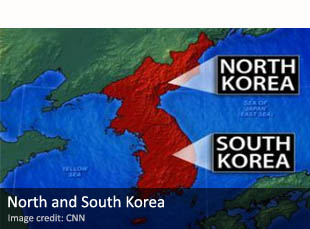
North and South KoreaBy JOSEPH FITSANAKIS | intelNews.org |
An employee of the South Korean government has been detained for allegedly providing North Korea with detailed resettlement information on over 10,000 North Korean defectors living in the South. The 33-year-old man, who has been identified simply as “Mr. Yu”, was arrested on January 11 by South Korea’s National Intelligence Service. The NIS, which leads South Korea’s intelligence community, described Yu’s activities as “an unusual breach of the South Korean civil service”. The detainee is accused of providing Pyongyang with a “complete list” of thousands of North Korean defectors living in South Korean capital Seoul. The list is said to include information such as the defectors’ resettlement addresses and employment information among other personal data. Interestingly, the accused spy is himself a North Korean defector, according to South Korean news outlets. A trained surgeon, he is said to have been a member of North Korea’s social elite before defecting to the South on foot via China, in 2004. Seven years later, in 2011, he joined the Seoul city municipal government, where he was tasked with providing assistance and services to the thousands of North Korean defectors living in the South Korean capital and surrounding areas. According to reports, Yu was arrested after the NIS discovered that he made frequent trips to China and came to suspect that he might have crossed into North Korea on several occasions during his trips. South Korean counterintelligence investigators are currently trying to determine whether the accused spy entered South Korea with the intention of conducting espionage on behalf of Pyongyang. Read more of this post

German intelligence report sees US leading global energy contest

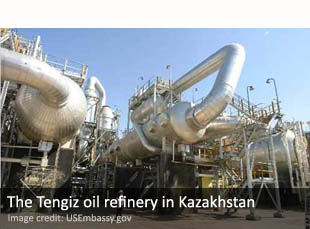
The Tengiz oil refinery in KazakhstanBy JOSEPH FITSANAKIS | intelNews.org |
A leaked geopolitical study authored by German intelligence sees the United States as the primary beneficiary of the world’s drastically changing energy balance. The report, which was produced by the German Federal Intelligence Service (Bundesnach- richtendienst, or BND) was leaked to the Reuters news agency and accessed by Germany’s Frankfurter Allgemeine Zeitung. It sides with other recent estimates, notably by the International Energy Agency, which suggest that the domestic oil production of the United States might exceed that of Russia and Saudi Arabia by the year 2020. The BND estimates that, through the technique popularly known as fracking (using pressurized fluid to cause horizontal fractures on underground rock layers), the US will be able to exploit oil and natural gas reserves on its territory that were previously considered inaccessible. This could transform the US from the world’s largest energy importer of energy to a net exporter of both oil and natural gas. According to the report, such a massive transformation of the global energy import-export balance could have “particularly dramatic consequences” in the realm of international relations. Most crucially, it could transform the existing balance of power between the US and China. Specifically, German intelligence analysts forecast that, as the US becomes increasingly self-sufficient in energy, it will limit its import of oil and natural gas to its neighboring countries, namely Canada and Mexico. This could potentially lead the US to gradually disengage from the Middle East, allowing Washington’s foreign policy “increased freedom of action” vis-à-vis energy-rich Arab nations and Israel. At the same time, more Middle Eastern oil will find its way to China, as the Far-Eastern country will emerge as the world’s largest importer of energy. Read more of this post

Announcement: Calling All Undergraduate Students of Intelligence

The Security and Intelligence Studies JournalBy JOSEPH FITSANAKIS | intelNews.org |
The academic study of security and intelligence used to be considered strictly a graduate-level preoccupation. Today, however, it is routinely encountered in undergraduate curricula and constitutes one of the fastest growing programs in the humanities. There is thus no reason for undergraduate students with a serious interest in security and intelligence to wait until graduate school before publishing their scholarly work. To satisfy the increasing undergraduate interest in this field of study, the Security and Intelligence Studies program at King College in Bristol, Tennessee, is launching The Security and Intelligence Studies Journal. It is the world’s first undergraduate scholarly journal focusing exclusively on themes of intelligence, security, counterterrorism, geopolitics and international relations. The Security and Intelligence Studies Journal is committed to highlighting outstanding undergraduate research that critically examines the current domestic and international security landscape. The theme for the journal’s first issue, which is scheduled for publication in late April 2013, is: “security challenges in the 21st century”. The theme’s elaboration, which can be found on the journal’s website, is as follows: “As our globalized society trudges deeper into the labyrinth of the 21st century, innumerable challenges threaten the security of the world. From collapsing economic markets, to multifaceted geopolitical tensions between Western and developing nations, to the ominous rise of militant ideologies, the intertwined destinies of nations transform local problems into global challenges and local struggles into international conflicts. The Security and Intelligence Studies Journal calls on interested authors to explore a 21st-century security challenge, and propose creative and innovative solutions, within the context of democratic political institutions”. The deadline for submissions of relevant scholarly papers of up to 3,000 words in length has been set for February 28, 2013. We encourage undergraduate students from around the world with a serious scholarly interest in security and intelligence to contact the journal by visiting its website or emailing the editors at KCSIS@king.edu, to express their interest in submitting a paper. Collaborative works are welcome. We also kindly ask academics to forward this call for papers to their undergraduate students.

Sophisticated cyberespionage operation focused on high-profile targets

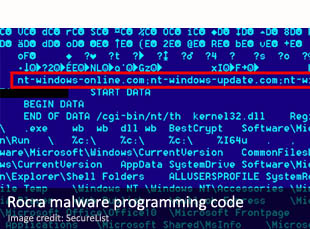
Rocra malware programming codeBy JOSEPH FITSANAKIS | intelNews.org |
After Stuxnet and Flame, two computer programs believed to have made cyberespionage history, another super-sophisticated malware has been uncovered, this time targeting classified computer systems of diplomatic missions, energy and nuclear groups. The existence of the malware was publicly announced by Russian-based multi-national computer security firm Kaspersky Lab, which said its researchers had identified it as part of a cyberespionage operation called Rocra, short for Red October in Russian. The company’s report, published on Monday on Securelist, a computer security portal run by Kaspersky Lab, said that the malware has been active for at least six years. During that time, it spread slowly but steadily through infected emails sent to carefully targeted and vetted computer users. The purpose of the virus, which Kaspersky Lab said rivals Flame in complexity, is to extract “geopolitical data which can be used by nation states”. Most of the nearly 300 computers that have so far been found to have been infected belong to government installations, diplomatic missions, research organizations, trade groups, as well as nuclear, energy and aerospace agencies and companies. Interestingly, the majority of these targets appear to be located in Eastern Europe and former Soviet republics in Central Asia. On infected computers located in North America and Western Europe, the Rocra virus specifically targeted Acid Cryptofiler, an encryption program originally developed by the French military, which enjoys widespread use by European Union institutions, as well by executive organs belonging to the North Atlantic Treaty Organization. Read more of this post

Closed-door trial of Soviet/Russian sleeper agents starts in Germany

The Anschlags' house in MeckenheimBy JOSEPH FITSANAKIS | intelNews.org |
A married couple accused of spying on Germany on behalf of the Soviet Union and Russia for over two decades has gone on trial in Stuttgart. Andreas Anschlag, 54, and his wife, Heidrun, 48, were arrested in October 2011 by GSG-9, the elite counter-terrorism and special operations unit of the German Federal Police. They were later charged with having spied since at least 1990 for the Soviet KGB’s First Chief Directorate and its post-Soviet successor organization, the SVR. German federal prosecutors also accuse the couple of document forgery, since their Austrian passports, which they used to enter West Germany from Mexico in 1988 (Andreas) and 1990 (Heidrun) are believed to be counterfeit. There is also speculation that the couple’s surname may in fact be an alias given to them by their intelligence handlers. Upon entering West Germany in 1988 and 1990, the Anschlags initially settled in Aachen, on the German-Belgian border, before moving to Meckenheim, a small town with a population of less than 30,000 located a few miles southwest of Bonn. They concentrated on blending into German society, while raising their son daughter and leading what their neighbors describe as a “discreet life”. Over the years, they managed to recruit a number of informants, including a Dutch diplomat identified by authorities in Holland only as ‘Raymond P’. The diplomat, who was arrested last June, is believed to have given the Anschlags nearly 500 classified documents originating from the German armed forces, the North Atlantic Treaty Organization and the European Union. Read more of this post

US providing intelligence support to French forces in Mali

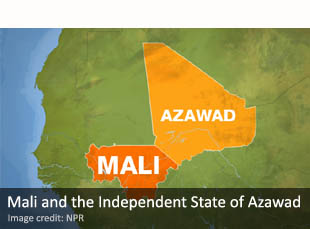
Mali and the Independent State of AzawadBy IAN ALLEN | intelNews.org |
The United States is providing intelligence support to hundreds of French troops that entered the West African nation of Mali last week, according to American and French officials. On January 11, at least 400 French soldiers entered Mali from French military bases in neighboring Burkina Faso and Chad, in what the French Ministry of National Defense has codenamed Opération SERVAL. The French intervention was sparked by the conflict in northern Mali, which erupted in 2012. In January of that year, Tuareg tribesmen formerly employed by the late Libyan leader Muammar al-Gaddafi teamed up with a host of local Islamist groups, including the Movement for Oneness and Jihad in West Africa (MUJWA) and Ansar Dine (Defenders of the Faith). Guided by members of the al-Qaeda Organization in the Islamic Maghreb (AQIM), these groups rapidly seized Mali’s massive northern region (which they call ‘the Independent State of Azawad’), where they are said to have imposed a strict version of Islamic sharia law. Last week’s intervention by the French military came to many as a surprise, though not to intelNews leaders, who have known for a while that Paris had been lobbying Western officials to help it launch a military intervention in the West African country. It now appears that Western countries are indeed helping France’s military operations in Mali. Outgoing US Defense Secretary Leon Panetta told reporters on Monday that the Pentagon is gathering intelligence for the benefit of French forces. The US, said Panetta, has “a responsibility to go after al-Qaida wherever they are” and ensure that its members do not “establish a base of operations” in West Africa. He added that Washington is considering widening its support to Paris by providing “logistics, surveillance and airlift capability”. Read more of this post

Iran secretly sold ‘untold quantities’ of ammo to African warring groups

Two of the 'mystery cartridges'By JOSEPH FITSANAKIS | intelNews.org |
An independent report has concluded that some of Africa’s most brutal conflicts are currently being fuelled by “untold quantities” of Iranian-manufactured small-arms ammunition. The ire of weapons-trafficking researchers is usually directed at the ‘heavyweights’ of the global arms-trade, including Russia, China, the United States, and France, among other countries. It appears, however, that Iran’s state-owned weapons manufacturer has been selling ammunition throughout Africa since at least 2006 via a secret network of distributors. According to The New York Times, a group of arms-trafficking experts from the United Nations, Amnesty International, the Federation of American Scientists, and other bodies, has found that Iran began selling ammunition to African clients in 2006 or earlier. On that year, a new brand of ammunition rounds for Kalashnikov assault rifles started appearing in armed clashes in Kenya, Uganda, and Darfur (now South Sudan). By 2010, the same type of cartridges had been found in Guinea, Ivory Coast and the Democratic Republic of Congo. More recently, says The Times, similar cartridges were discovered in the hands of groups in Niger connected with Al-Qaeda in the Islamic Maghreb. Suspiciously, the cartridges bore no factory code and their packaging had been deliberately constructed to obscure the identity of the manufacturer. However, according to the expert study, it is now considered “beyond dispute” that the Ammunition and Metallurgy Industries Group, a subsidiary of Iran’s state-owned and operated Defense Industries Organization, is the source of the mysterious cartridges. It is worth pointing out that many of the governments or militias that have been found to use Iranian ammunition are officially subject to UN resolutions that bar arms transfers to the countries or territories in which they operate. Read more of this post

Turkey peace talks halted as Kurdish activists are assassinated in Paris

Sakine Cansiz with Abdullah Öcalan in 1995By JOSEPH FITSANAKIS | intelNews.org |
The future of peace talks between the Turkish government and the country’s Kurdish minority appeared uncertain yesterday, after three female Kurdish activists were found murdered execution-style in downtown Paris, France. The murders marked the first-ever killings in Europe of senior members of the Kurdistan Workers’ Party (PKK), which operates as the primary political and paramilitary agent of Turkey’s Kurdish population. According to reports from France, a gun fitted with a silencer was used to kill two of the women in the back of the neck and the third one in the stomach.

One of the dead, Leyla Sönmez, was a Kurdish activist responsible for Kurdish diplomatic relations in France. Another, Fidan Doğan, who was also a French citizen, was the Paris representative of the Kurdistan National Congress (KNK), which operates as Kurdistan’s government-in-exile based in Brussels, Belgium. But the most prominent victim of the triple murder is Sakine Cansiz, co-founder of the PKK, who is described as a “legend” among party activists. Cansiz who was present at PKK’s founding in 1978, was imprisoned by the Turkish government in the 1980s and given political asylum in France in 1998. Read more of this post

Iran official in secret visit to Egypt to discuss ‘new spy agency’

Qassem SuleimaniBy JOSEPH FITSANAKIS | intelNews.org |
A senior Iranian intelligence official paid a secret visit to Egypt earlier this month, allegedly to discuss the establishment of a new intelligence service controlled by the Muslim Brotherhood. Several Egyptian newspapers, including the quality broadsheet Al-Masry Al-Youm, said that the Iranian official was Qassem Suleimani, commander of Quds Force, a unit inside the Islamic Revolutionary Guard Corps, which is specifically tasked with exporting the Iranian Revolution abroad. The Quds Force has traditionally constituted the primary channel of communication between the government of Iran and a host of international groups allied to it, including Hezbollah in Lebanon and Hamas in Palestine. Suleimani is said to have traveled incognito to Cairo at the personal invitation of Egyptian President Mohammed Mursi, who is also a leading member of the Muslim Brotherhood. The group, which was legalized in Egypt after the 2011 revolution, is the Egyptian branch of a Pan-Islamic political and social movement that assumed control of the government after the ousting two years ago of Egyptian longtime dictator Hosni Mubarak. According to reports from Egypt, Suleimani met with “senior officials” in the Egyptian capital, including President Mursi’s chief adviser on foreign affairs, Issam al-Haddad, as well as prominent members of the Muslim Brotherhood. Al-Masry Al-Youm said the Iranian commander discussed plans to develop a new civilian intelligence service in post-Mubarak Egypt, which will be answerable to the government of the country. The apparent plan of the Muslim Brotherhood is to create a brand new spy service that will operate outside the control of Egypt’s military, which currently commands the bulk of the country’s intelligence community. Read more of this post

How did the US know that Syria was about to use chemical weapons?

Regional map of SyriaBy IAN ALLEN | intelNews.org |
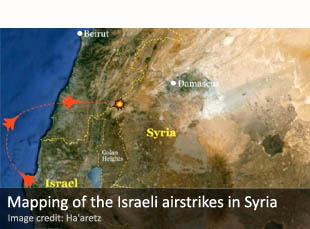
Early last December, United States President Barack Obama issued a surprise warning to the government of Syria, saying that if it made “the tragic mistake” of using chemical weapons against rebel forces, there would be “immediate consequences”. Most observers took this as a clear indication that the US was prepared to intervene militarily in the ongoing Syrian civil war. Today, a month after Obama’s December ultimatum, one question is still in need of an official answer: namely, how did the United States come to suspect that the Syrians were contemplating using chemical weapons? An article by The New York Times‘ Eric Schmitt and Dave Sanger suggests that Washington was alarmed in late November by a tip-off from Israeli intelligence. According to The Times, the Israelis shared with officials at the US Department of Defense a series of satellite images showing Syrian government troops transporting tank-loads of chemicals to at least two storage sites along the country’s border with Jordan. The paper, which says it confirmed this information by speaking to “half a dozen military, intelligence and diplomatic officials”, claims that Syrian troops were ordered to load sarin nerve gas onto dozens of 500-pound bombs. The plan was for the bombs to be secretly transported by land to military air bases and from there onto planes, pending final approval by Syrian President Bashar al-Assad. According to the Israelis, the bombs could be airborne less than two hours after Assad’s order. By the time the information from the Israelis reached President Obama, American military commanders realized they had been caught by surprise, as there was no time to act in the two hours that it would take the Syrians to deploy the bombs. Read more of this post

Obama’s National Security Nominations: Nothing to See Here

Chuck Hagel, Barack Obama, John BrennanBy I. ALLEN and J. FITSANAKIS | intelNews.org |
The deluge of reports that are flooding the news media about the national security nominations of United States President Barack Obama is both natural and understandable. The Departments of State and Defense, as well as the Central Intelligence Agency, are among the critical components of the American government, especially in matters of foreign policy. Yet much of the commentary on the nominations of John Kerry for State, Chuck Hagel for the Pentagon, and John Brennan for the CIA, is unduly over-dramatizing what is essentially a routine story. To begin with, it is clear that, in selecting Kerry, Hagel and Brennan for the nominations, the President’s priority was to surround himself with people he knows and trusts. Knowledgeable observers point out that all three nominees come from Obama’s most trusted circle of friends and —if appointed— will allow the President to stay well “within his comfort zone” as he begins his second term in office. In this sense, Obama selected the three candidates, not with some major policy shift in mind, but in order to ensure continuity and permanence in his foreign policy.

Take John Brennan, for instance: an Arabic-speaking career officer in the CIA, who has served the Agency in various positions for over 25 years. It is undeniable that, since 2008, Brennan has been instrumental in shaping the thinking behind the Obama administration’s targeted killings program using unmanned drones. According to some analysts, he has been the White House’s “most important adviser for shaping the campaign of drone strikes”. As intelNews explained recently, Washington’s unmanned drone program will continue and most likely expand, but this has little to do with Brennan. As an excellent analysis of Brennan’s nomination (by the Council on Foreign Relations’ Micah Zenko) points out, the CIA’s targeted killing program “has become institutionalized” with a momentum of its own, which ensures its sustainability, “making it far bigger than any one person —even John Brennan”.

Read more of this post

Analysis: Will 2013 Be the Year of the Unmanned Drone?

Predator droneBy JOSEPH FITSANAKIS | intelNews.org |
As United States President Barack Obama prepares to enter his fifth year in office, one may be excused for thinking that his administration’s response to insurgency warfare essentially boils down to one thing: the joystick. This is the means by which Washington’s unmanned aerial vehicle (UAV) fleet is remotely guided, usually from the safety of ground control stations located thousands of miles away from selected targets. Even prior to last November’s Presidential election, Obama administration officials declared in every possible way that the drone campaign would remain a permanent feature of the White House’s counterinsurgency campaign. Not only that, but it seems increasingly apparent that when, on November 19, 2012, Defense Secretary Leon Panetta announced that America’s UAV fleet would expand, he meant it both in terms of raw numbers and geographical reach. Africa appears now to be high on the list of UAV targets. The US is currently busy establishing a large network of small air bases located in strategic locations throughout the continent, in what US observers have termed a “massive expansion” of US covert operations in Africa. Read more of this post

Revealed: German neo-Nazi who helped Palestinians was CIA agent

Willi Pohl, a.k.a. Willi VossBy JOSEPH FITSANAKIS | intelNews.org |
A German far-right militant, whose animosity against Jews led him to aid Palestinians kill Israeli athletes in the 1972 Munich massacre, says he was later recruited by the United States Central Intelligence Agency. Willi Pohl, also known as Willi Voss, 68, was arrested by German authorities a few weeks after Palestinian terrorist group Black September stormed the Olympic village in Munich and took hostage 11 Israeli athletes. All of them were eventually killed by their captors during a botched escape attempt at the nearby Fürstenfeldbruck airport. Voss, who was a known neo-Nazi activist at the time, was charged with possession of weapons and providing logistical support to the Black September militants. However, after his sentence was suspended, Voss managed to secretly emigrate to Beirut, Lebanon, where he was recruited as an agent of Jihaz el-Razd, the intelligence service of the Fatah, the main group in the Palestine Liberation Organization. But in 1975, while on a PLO mission in Belgrade, Yugoslavia, he decided to switch sides. He made the decision after discovering that the car he and his girlfriend were transporting on behalf of the PLO from Beirut to Belgrade contained weapons and highly unstable explosives. He says that the PLO had apparently failed to mention the existence of the hidden items when they asked him to transport the car to Europe. According to Voss’ new book, which has just been published in Germany under the title UnterGrund (Underground), the guns and explosives were discovered by customs officers in Romania (then Rumania); but because at that time the communist country was an ally of the PLO, Voss and his girlfriend were allowed to travel to Belgrade, minus the car and the weapons. Read more of this post

Year in Review: The 10 Biggest Spy-Related Stories of 2012

Happy New YearBy J. FITSANAKIS and I. ALLEN | intelNews.org |
Ever since we launched this website in 2008, we have been monitoring daily developments in the highly secretive world of intelligence and espionage, striving to provide an expert viewpoint removed from sensationalism and conspiratorial undertones. In the past year, we witnessed our fair share of significant intelligence-related stories, some of which made mainstream headlines, while others failed inexplicably to attract the attention of the news media industry. In anticipation of what 2013 may bring, we decided to take a look back to the year that just ended by compiling a list of what we think are the ten most important security- and intelligence-related developments of the past 12 months. The stories below are listed in reverse order of importance. Do you agree with our choices? Have we missed something important? Share your thoughts.

10. South African spy officials faked threats to increase budget. The historical tendency of spy agencies to overstate security threats in order to secure governmental funds is hardly novel. But officials in the South African Secret Service appear to have gone a step further: they allegedly paid some of their informants to make bogus threats against the government, in order to prompt an increase in counterterrorist funding. The bogus threats were allegedly aimed at creating “a false impression of imminent, unprecedented attacks on black people and African National Congress (ANC) members”. Incredibly, or perhaps predictably, nobody from the Secret Service has been fired in connection with this scandal.

Read more of this post