After dropping charges, US prosecutors broaden indictment against Saudi spies

TwitterTwo days after dropping charges against three Saudi men for spying on American soil, United States prosecutors submitted a new indictment that restates the two original charges and adds five more. The original complaint was filed by the Federal Bureau of Investigation in November of last year in San Francisco, California. It accused three men of “acting as unregistered agents” of Saudi Arabia since 2015. The phrase is used in legal settings to refer to espionage.

According to the FBI, the Saudi government allegedly contacted Ali Alzabarah, a 35-year-old San Francisco-based network engineer working for Twitter. Ahmed Almutairi (also known as Ahmed Aljbreen), a “social media advisor” for Saudi Arabia’s royal family, arranged for Alzabarah to be flown to Washington to meet an unidentified member of the Saudi dynasty. He and another Twitter employee, 41-year-old Ahmad Abouammo, were allegedly given money and gifts by the Saudi government. These were given in return for the email addresses, IP addresses and dates of birth of up to 6,000 Twitter users who had posted negative comments about the Saudi royal family on social media.

Earlier this week, however, US government prosecutors filed a motion to drop the charges against the three men. The two-page filing did not offer a reason behind this sudden decision by the US government. Interestingly, however, it included a request to have the charges against the three men dismissed “without prejudice”, meaning that the US government could decide to file new charges against them in the future.

This has now happened, as the US government has filed fresh charges against the three men. In addition to the two original charges, the men have now been charged with acting as agents for a foreign government without notifying the US attorney general. They have also been charged with conspiracy to commit wire fraud, committing wire fraud and money laundering, aiding and abetting, and destroying, altering or falsifying records in a federal investigation. The indictment also specifies the financial rewards Abouammo allegedly received from the Saudi government in return for his services. These included a wire transfer for $200,000 to a shell company and associated bank account in Lebanon, as well as a luxury watch valued at $20,000.

Author: Joseph Fitsanakis | Date: 30 July 2020 | Permalink

Without explanation, US dismisses charges against Saudis caught spying on US soil

Twitter IAIn a surprising move, the United States government is seeking to dismiss espionage charges it filed last year against three men, including a member of staff of Saudi Arabia’s royal family, who were caught spying on American soil. Last November, the Federal Bureau of Investigation filed a complaint in San Francisco, accusing the three men of “acting as unregistered agents” of Saudi Arabia. The phrase is used in legal settings to refer to espionage.

According to the FBI, the charges stemmed from an investigation that lasted several years and centered on efforts by the oil kingdom to identify and silence its critics on social media. In 2015, the Saudi government allegedly reached out to Ali Alzabarah, a 35-year-old network engineer working for Twitter, who lived in San Francisco. The complaint alleges that Ahmed Almutairi (also known as Ahmed Aljbreen), who worked as a “social media advisor” for Saudi Arabia’s royal family, arranged for Alzabarah to be flown from San Francisco to Washington to meet with an unidentified member of the Saudi dynasty.

Alzabarah, along with another Twitter employee, 41-year-old Ahmad Abouammo, were allegedly given money and gifts by the Saudi government in return for supplying it with private information about specific Twitter users, according to the FBI complaint. The information provided by the two Twitter employees to the Saudi authorities allegedly included the email addresses, IP addresses and dates of birth of up to 6,000 Twitter users, who had posted negative comments about the Saudi royal family on social media. Special Agents from the FBI’s Settle field office arrested Abouammo at his Seattle home. However, Alzabarah managed to flee the United States along with his family before the FBI was able to arrest him, and is believed to be in Saudi Arabia. The FBI issued a warrant for his arrest.

In a surprising move, however, US government prosecutors have now filed a motion to drop the charges against the three men. The motion, filed on Tuesday in San Francisco, is asking for permission from the judge in the case to have all charges against the three men dismissed “without prejudice”, meaning that the US government could decide to file new charges against them in the future. The two-page filing does not offer a reason behind this sudden decision by the US government. The Bloomberg news service, which reported the news on Tuesday, said it inquired about this case by calling and emailing the Saudi Embassy in Washington, the San Francisco US Attorney’s office, and Twitter. It received no responses.

Author: Ian Allen | Date: 29 July 2020 | Permalink

Turkish spy agency hid Islamist views of candidates for CIA-funded Syrian rebel group

Free Syrian ArmyTurkey’s spy agency systematically downplayed the Islamist views of men seeking to join a Syrian rebel group, which was supported by the United States Central Intelligence Agency on account of its moderate leanings. The United States began to fund and train the Free Syrian Army (FSA) soon after it was established in 2011. The group said its mission was to depose the Syrian President Bashar al-Assad and institute a Western-style multiparty democracy in Syria.
By 2015, much of the recruitment and vetting for the FSA was taking place in Turkish regions bordering northern Syria, where thousands of opponents of al-Assad’s regime had fled with their families. The CIA relied on its Turkish counterpart, the National Intelligence Organization, known as MİT, to recruit and conduct initial vetting of FSA volunteers from Syrian refugee camps. The MİT was desperately short of personnel for such a large-scale operation, and reached out to the Turkish Special Forces Command for assistance. Eventually, Special Forces Command officers were put in charge of reaching out to potential FSA volunteers and vetting them. Successful candidates would then be forwarded to the CIA.

One such officer was Lt. Murat Aletirik, who vetted dozens of FSA volunteers in 2015 and 2016. However, he was arrested following the failed coup of July 15, 2016, and was tried for alleged participation in armed insurrection against the Turkish government. During his testimony in 2018, which was leaked this week, Lt. Aletirik told the court that he and his fellow officers were issued guidelines by the MİT on how to select fighters for the CIA-funded program.

According to Lt. Aletirik, the MİT guidelines centered on whether FSA candidates were “sympathetic towards the [Kurdistan Workers’ Party, known as] PKK, the [Democratic Union Party, or] PYD, or offshoots of the PKK”. These groups support autonomy for the Kurds, a non-Turkish and non-Arab ethnic group in the Middle East. Turkey, along with the European Union and the United States, classify the Turkish-based PKK as a terrorist organization. Turkey claims that the PYD, which operates in Syria, is also a terrorist group. However, Washington supports and funds the PYD, and even worked with its militias in the war against the Islamic State.

According to Lt. Aletirik, the MİT guidelines had little to say about how to filter out potential FSA volunteers who were found to harbor sympathies for Salafi-Jihadist groups, such as the Islamic State, al-Qaeda, or al-Nusra. In fact, said Lt. Aletirik, he and his fellow officers had instructions to downplay such findings and forward candidates to the CIA, so long as they did not have pro-Kurdish sympathies. It is believed that, eventually, the CIA caught on to this, and began turning down hundreds of FSA candidates that had been vetted by the Turkish military. This slowed down the vetting process tremendously, with only a fraction —possibly fewer than 10 percent— of all candidates joining the CIA-run program.

In 2017, the United States shut down the program, reportedly after a direct order was issued by President Donald Trump. Today the FSA is almost completely supported and funded by the Turkish state. Locals often refer to it tongue-in-cheek as the “Free Syrian Turkish Army”.

Author: Joseph Fitsanakis | Date: 28 July 2020 | Permalink

World can’t stop Iran from going nuclear, says former Mossad chief

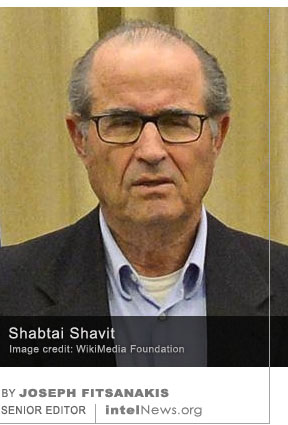
Shabtai ShavitShabtai Shavit, one of the longest-serving directors of the Israeli spy agency Mossad, has said that Israel and the world cannot stop Iran from developing a nuclear arsenal, and should focus instead on establishing a deterrence mechanism. Shavit, who is now 80, rose through the ranks of the secretive intelligence agency and became its director in 1989, under Labor Party leader Yitzhak Rabin. He stepped down in 1996 and was succeeded by Danny Yatom.
Shavit has rarely spoken since his retirement from the intelligence world. But earlier this month he gave an interview to David Horovitz, founding editor of The Times of Israel Newspaper. The former spy chief’s book, Head of the Mossad, which was published in Hebrew in 2018, is expected to become available in English in September. Horovitz said he spoke to Shavit on June 2 of this year. The English-language translation of the interview was published by The Times of Israel on July 8.

In the interview, Shavit is sharply critical of Israel’s Prime Minster, Benjamin Netanyahu, whom he accuses of “not making decisions as a statesman”. Instead of being statesmanlike, says Shavit, Netanyahu makes decisions on matters such as Israel’s national security, or the coronavirus, with reference to his trial for alleged corruption. Under Netanyahu’s leadership, says Shavit, Israel’s standing “is among the worst in decades” internationally, with the exception of the United States. But that alliance is also in doubt, as President Donald Trump’s re-election in November —a prospect Shavit calls “a catastrophe for the United States and the world”— is doubtful.

On the issue of Iran, Shavit says he is obligated to speak, not as politician or other public figure, but as an intelligence officer, and thus consider the worst possible outcome for Israel. He argues that the worst-case scenario is that Tehran will refuse to abandon its ambition to develop a nuclear arsenal. If Iran decides to pursue that goal with full speed, it would be very difficult —even impossible— for Israel to avert such an eventuality. However, the Jewish state could potentially deter Iran from using a nuclear weapon, he argues.

For this to happen, Israel must recognize that Iran’s prime rationale “is not necessarily: ‘I want to have a bomb in order to drop it on Tel Aviv’”, says Shavit. On the contrary, its prime rationale is to elevate its “influence and status” in the region, primarily vis-à-vis Saudi Arabia, Turkey and Israel. Additionally, the regime in Tehran is seeking to develop nuclear weapons in order to attain what Shavit calls “immunity” from a potential military attack by the United States.

Once Israel recognizes that Iran is not necessarily intent on destroying the Jewish state, it can stop trying to prevent Tehran from building nuclear weapons, and seek instead to deter it from using them. It can do so, says Shavit, by convincing the Iranians that “Iran will cease to exist” if it decides to make use of its nuclear arsenal. This policy of deterrence can be exercised no matter whether the clerics remain in charge in Tehran, or whether they are removed from power by the Islamic Revolutionary Guard Corps —something that Shavit believes is possible.

Author: Joseph Fitsanakis | Date: 27 July 2020 | Permalink

Britain to ‘modernize’ counterespionage laws following criticism from parliament

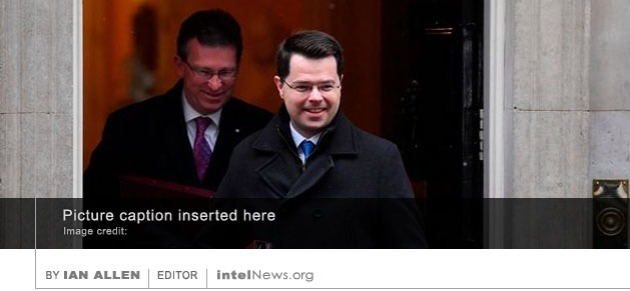
James BrokenshireSenior United Kingdom officials have said the country will seek to “modernize” its laws on counterespionage, after a long-awaited parliamentary report criticized the government for failing to stop Russian spy operations. Earlier this week saw the release of the report by the British Parliament’s Intelligence and Security Committee. The report [.pdf] focuses on Russia. It concludes that British intelligence agencies remain incapable of combating espionage and psychological operations by Russian spy agencies, of which many aim to influence British politics on a mass scale.

On Wednesday Britain’s Minister of State for Security, James Brokenshire, pushed back against the report’s findings that the government had failed to manage the thread posed by Russian intelligence activities on British soil. Speaking during an extraordinary meeting of parliament to discuss the report, Brokenshire rejected claims that a succession of British conservative administrations went out of their way to avoid investigating Russian spy activities. He claimed that the activities of the Kremlin remained one of Britain’s “top national security priorities”. During the same meeting, British Prime Minister Boris Johnson told members of parliament that “no country in the Western world is more vigilant in countering Russia” than the United Kingdom.

Some government officials said the government now plans to implement a new Espionage Bill, which is currently in the drafting stage, and is expected to provide the authorities with more powers to combat foreign espionage. Additionally, Whitehall is considering initiating a large-scale review of the Official Secrets Act and redrafting it so as to include a foreign agent registration clause. The proposed clause would resemble the Foreign Agent Registration Act in the United States, which requires those working or lobbying on behalf of a foreign government —except accredited diplomats— to register with the authorities.

This would allow British authorities to arrest, deport or imprison those found working on behalf of foreign powers, even if they are never caught committing espionage or transmitting classified information to a foreign entity.

Author: Ian Allen | Date: 23 July 2020 | Permalink

Analysis: British report into Russian meddling leads to uncomfortable conclusions

British parliamentBritain is abuzz today with news of the long-awaited release of the Parliament’s report [.pdf] into Russian meddling in British politics. The report is the work of the Parliament’s Intelligence and Security Committee. Since 2013, the Committee has been appointed to oversee the work of Britain’s intelligence agencies. Almost all of its meetings are conducted behind closed doors, and its reports are vetted by the spy agencies prior to release. By law, the Committee cannot make its reports public without previously submitting them for approval to the Office of the Prime Minister.

In the past it has taken no more than 10 days for the Committee’s reports to be approved by the prime minister. This particular report, however, which concerns —among other things— Russian meddling into British politics, took considerably longer. It was given to the prime minister on October 17. But by November 6, when parliament was dissolved in preparation for the election that brought Boris Johnson to power, it had not been approved. It finally came out yesterday, after numerous and inexplicable delays. Many speculated that the government did not want to deal with the uncomfortable conclusions in the report.

Like all reports of its kind, this one will be politicized and used by Britain’s major parties against their rivals. But behind the politicking, the report makes for uncomfortable reading indeed. It shows that, not just British, but Western intelligence agencies as a whole, remain incapable of combating online psychological operations from foreign state actors —primarily Russia— aiming to influence Western politics on a mass scale.

This is ironic, because Western spy agencies used to be really good on Russia. In fact, during the Cold War that is all they did. Many years have passed since then, and many leading Western experts on Russia have either retired or died. Additionally, the attacks of September 11, 2001, turned the attention of Western spy agencies to terrorism by groups like al-Qaeda, and away from Russia. Meanwhile, back in Moscow, President Vladimir Putin, a former KGB officer, rebuilt the state and sought to reclaim Russia’s lost international prestige. This plan includes a page from the old KGB playbook: destabilizing Western nations through psychological operations that accentuate existing extremist tendencies from the left or right. Read more of this post

Austrian financier dubbed ‘world’s most wanted man’ hiding under Russian protection

Jan MarsalekAn Austrian financier, who disappeared following the outbreak of a massive financial scandal in Germany last month, and is wanted by several Western spy agencies, is reportedly hiding under Russian protection. The financier, Jan Marsalek, dubbed by some as “the world’s most wanted man”, is connected with the sudden collapse of Wirecard AG in Germany last month.

Wirecard (est. 1999) was a German provider of financial services, such as mobile phone payment processing and other electronic payment transaction systems. The company also issued physical and virtual credit and pre-paid cards. But on June 25, the company declared itself insolvent, after an audit revealed that nearly €2 billion ($2.3 billion) in cash deposits were missing from its accounts. Soon afterwards, the company’s share value lost over 70 percent of its value and its management team, including its chief executive officer, Markus Braun, stepped down.

On June 22, Braun was arrested, and a criminal investigation was launched following reports that the missing €2 billion probably never existed in the first place. Meanwhile, German police sought to arrest Marsalek, who had worked as Wirecard’s chief operating officer since 2010. Marsalek, 40, was also in charge of Winecard’s operations in Asia and specifically the Philippines, where the fictitious €2 billion was reportedly deposited.

On June 18, after getting fired from his job, Marsalek told colleagues that he was leaving immediately for Manilla, in order to track down the missing funds and clear his name. However, he never arrived there, as he seemed to disappear into thin air on the way. An investigative report by The Financial Times revealed that Marsalek never made use of his airline ticket to the Philippine capital, and that the immigration records that showed him entering the country and then flying from there to China had been forged. This was later confirmed by the Philippines government.

According to the investigative website Bellingcat, Marsalek never went to the Philippines, but instead fled to Belarus via Estonia. By the time he arrived in Minsk, the Austrian financier was reportedly “a person of interest” to at least three Western spy agencies, and is now believed to have links to Russian intelligence. Bellingcat said Marsalek has made over 60 trips to Russia since 2010, in some cases staying on Russian soil for just a few hours before flying back to Germany. He is also wanted by several European governments on charges of embezzlement and fraud.

On Sunday, German financial newspaper Handelsblatt said Marsalek had been located in Russia and was allegedly staying at a villa outside Moscow, under the protection of Russian military intelligence. The newspaper claimed that the Austrian financier was being protected by officers of the Main Directorate of the General Staff of the Russian Armed Forces, which is commonly known as GRU. According to Handelsblatt, the current tension in relations between Russia and Belarus made it “too risky” for the Kremlin to keep Marsalek in the Belarussian capital. The decision was therefore made to secretly transport him to Moscow.

The German newspaper said it found out about Marsalek’s whereabouts from sources including “financiers, judges and diplomats”. On Monday the Russian government said it had no information about Marsalek’s current whereabouts. It also denied that the Austrian financier has any ties to its intelligence services.

Author: Joseph Fitsanakis | Date: 21 July 2020 | Permalink

US military records 22 percent increase in COVID-19 cases in one week

COVID-19 PentagonUnited States military officials are raising concerns about the rate of increase of COVID-19 cases in the Armed Forces, which appears to be growing at twice the national rate. Last week, the Department of Defense said that the number of its personnel that contracted the virus rose by 22 percent compared to the week before. The spike is even bigger in the Marine Corps, which saw a 30 percent increase last week.

Nearly 30,000 Department of Defense affiliated personnel —which includes civilians, contractors and dependents of employees— have contracted the virus since the first case of a military service member with COVID-19 made news in February. It took just over six weeks for 10,000 COVID-19 cases to be recorded among Pentagon personnel. But the number has now doubled in half that time, according to The Military Times.

What concerns American military planners is that the rapid rise in positive coronavirus cases is occurring despite the implementation of strict guidelines for wearing face coverings, practicing social distancing and restricting the movement of military personnel outside bases. Part of the problem is that many of the southern states that are currently seeing a rapid rise in COVID-19 cases, such as Texas, Florida, Georgia and Arizona, are home to large military bases.

Meanwhile, Kris Alexander, who recently retired after serving as a COVID-19 crisis planner at NORTHCOM in Colorado Springs, warned on Sunday that the virus is likely to spread even faster in the ranks of the military and National Guard during the upcoming hurricane season. He writes that the coronavirus has incapacitated volunteer organizations, like the Red Cross, whose trained disaster responders are usually older in age. The lack of volunteers, says Alexander, would necessitate the use of the National Guard in case of a natural disaster, which would likely stretch the already stretched National Guard to the breaking point. The next step, he says, would require the mobilization of troops under the US Army’s Defense Support to Civil Authorities mission.

“But the real problems would come after their exposure to the virus in the disaster zone”, says Alexander. Active-duty forces would do their best to help in a possible disaster zone, but many of them would likely contract the virus and bring it back to their bases, including to the military doctors who cater to the needs of Department of Defense personnel. Such a scenario would cause major spikes of the virus among military and security personnel by the end of the year, according to Alexander.

Author: Ian Allen | Date: 20 July 2020 | Permalink

News you may have missed #911

HamasAnalysis: The outstanding issue of the Libyan intelligence services. The post of Chief of the Libyan Intelligence Service of Tripoli’s Government of National Accord (GNA) is still vacant. Therefore, this is an optimal situation for the Head of Tripoli’s government, who is currently pro tempore Director of the GNA agencies, while the struggle for the next Intelligence Service director is intensifying.

Hamas admits one of its number spied for Israel before defecting. Hamas deputy leader Moussa Abu Marzouk has confirmed Arabic media reports that Hamas commander Mohammad Abu Ajwa collaborated with and subsequently defected to Israel. The defection was first reported by Al-Arabiya, which said that Israel’s Mossad spy agency had recently facilitated the escape of senior commander Mohammad Abu Ajwa. According to Al-Arabiya, Abu Ajwa had previously led Hamas’s naval special forces.

Russia used US intelligence to target dissidents in Europe. Russia routinely exploited a US policy of increased information sharing to target Chechen dissidents, according to three law-enforcement and intelligence officials in Europe. The practice emerged after the Trump administration backed a policy of sharing more secret information with Russia, in hope of strengthening relations.

Belgium knew about Russian bounty offered to Taliban, defense minister says

Belgian German AfghanistanBelgium’s spy services were aware of financial rewards that Russia allegedly offered to the Taliban in exchange for killing American and other Western troops in Afghanistan, according to Belgium’s defense minister. Late last month, three leading American newspapers, The New York Times, The Washington Post and The Wall Street Journal alleged that the White House had been briefed about an alleged Russian bounty program that was in existence in Afghanistan. According to the allegations, the Main Directorate of the General Staff of the Russian Armed Forces, known as GRU, had offered Taliban fighters financial rewards in exchange for killing American and other North Atlantic Treaty Organization (NATO) troops. Both the White House and the Kremlin denied the allegations, with US President Donald Trump dismissing them as “fake news” and “a hoax”.

On Wednesday, Philippe Goffin, who serves as Belgium’s Minister of Foreign Affairs and Minister of Defense, told the Belgian Federal Parliament that his office was aware of the Russian bounty program. The minister was speaking before the parliament’s Committee on National Defense, where he responded to questions from committee members. According to Goffin, he had been briefed on the matter by the General Intelligence and Security Service (SGRS), Belgium’s military intelligence organization. He said the SGRS was “aware of Russian support for the Taliban in Afghanistan” and offered evidence that “confirmed Russian interference there”. He added that the Belgian intelligence services had linked “only one incident” to the Russian bounty program. It had occurred in April of 2019, and had resulted in the deaths of three American soldiers, he said.

Belgium is a founding member of NATO and hosts the alliance’s headquarters in its capital, Brussels. The country until recently participated in the NATO joint force in Afghanistan, but recalled its troops home in May due to the coronavirus pandemic.

Author: Joseph Fitsanakis | Date: 17 July 2020 | Permalink

In major victory over Pentagon, CIA is authorized to expand offensive cyber operations

Trump CIA - JFThe United States Central Intelligence Agency was secretly authorized by the White House in 2018 to drastically expand its offensive cyber operation program —a development that some experts describe as a significant development for the secretive spy agency. However, the move has reportedly not pleased the Department of Defense, which sees itself as the primary conduit of American offensive operations in cyberspace.

The two-year-old authorization was disclosed by Yahoo News, which cited “former US officials with direct knowledge of the matter” in its report. The website said the authorization came in the form of a presidential finding. A presidential finding, also known as a Memorandum of Notification, refers to a directive, which is authored by the president of the US and is given to the intelligence committees of Congress. Its purpose is to explain the reasoning behind a covert operation that is to be carried out abroad. Following that disclosure by the president, government funds can be appropriated for use in that operation or series of operations.

According to Yahoo News, the 2018 presidential finding provides the CIA with “more freedom in both the kinds of operations it conducts and who it targets”, when it comes to covert action carried out online. The goal of the White House was to enable the CIA to unleash a series of offensive measures against “a handful of adversarial countries”, which include North Korea, Iran, China and Russia, according to the report. Such offensive operations differ substantially from those typically carried out by CIA personnel on cyberspace, which focus on clandestine information collection. In contrast, offensive operations aim to disrupt, sabotage or even destroy targeted systems.

In addition to enhancing the scope of the CIA’s cyber operations, the presidential directive is also believed to make it easier for the agency to target non-state actors and agencies, including financial intuitions, charities, news media, or businesses. Such targets may be attacked when they are found to be operating on behalf of adversarial intelligence agencies. Moreover, it makes it easier for the spy agency to leak secret information about targeted adversaries to media organizations, a tactic that Russian spy services are believed to have utilized in the past.

The Yahoo News report notes that the presidential directive is seen as a major victory for the CIA in its long bureaucratic battle with the Department of Defense. The latter has traditionally been entrusted by the US government with carrying out offensive cyber operations. There are also questions about potential operational overlap between the CIA and the Pentagon, as the two actors may at times be attacking the same targets. This brings up the issue of inter-agency coordination between two bodies, which has not always been smooth in the past.

Yahoo News said it submitted “an extensive list of questions” to the CIA, but the agency declined to comment. The National Security Council, which oversaw the drafting of the alleged presidential finding, did not respond to questions stemming from the news report.

Author: Joseph Fitsanakis | Date: 16 July 2020 | Permalink

Catalan pro-independence leader’s phone hacked using Israeli spy software

Roger TorrentThe personal smartphones of leading Catalan pro-independence politicians were hacked using a highly invasive software built by a controversial Israeli firm, according to an investigative report by two newspapers. The revelation is likely to reignite a tense row between Madrid and pro-independence activists in one of the country’s wealthiest regions, which led to a major political crisis in 2017.

An estimated 50 percent of the population of the autonomous Spanish region of Catalonia wishes to secede from Spain. However, Madrid refused to recognize the legitimacy of an independence referendum organized by secessionist activists in 2017. The stalemate led to massive protests throughout the country, which were marred by violence and thousands of arrests, as Spain faced its deepest political crisis since the 1970s. In response to the protests, the central government suspended Catalonia’s autonomous status and arrested many of the independent movement’s leaders. Many of them have been given lengthy jail terms, while others remain abroad and are wanted by the Spanish government for promoting insurrection.

On Monday, British newspaper The Guardian and Spanish newspaper El País revealed the results of a joint investigation, according to which the smartphones of senior Catalan pro-independence politicians were targeted by hackers in 2019, and possibly even earlier. Among them was Roger Torrent, who serves as the speaker of the Parliament of Catalonia. The newspapers said he had been alerted to the hacking by cybersecurity employees of WhatsApp, a Facebook-owned company whose application was allegedly used by the hackers to take control of Torrent’s phone.

The software that was allegedly used to hack the Catalan politicians’ phones was Pegasus. It was built by NSO Group, an Israeli software development company that specializes in surveillance technologies. According to WhatsApp, which sued NSO Group in 2019, NSO Group specifically developed the Pegasus hacking platform to enable its users to exploit flaws in WhatsApp’s servers and to gain access to the telephone devices of targeted individuals. Pegasus allegedly allows its users to covertly operate a compromised phone’s camera and microphone. Read more of this post

Iraq’s leading expert on paramilitary groups assassinated in Baghdad

Hisham al-HashimiA leading Iraqi expert on paramilitary groups has been shot dead outside his home in Baghdad, raising concerns that the Iraqi government is unable to curtail the activities of militias in the country. Hisham al-Hashimi, 47, was a Baghdad University-educated historian, who rose to prominence in post-Ba’athist Iraq as an expert on paramilitary groups in the country. He was seen as a leading local authority on the Islamic State and advised the United States-led coalition on the group’s inner workings.

Starting in 2018, al-Hashimi focused his research on the rise of the Popular Mobilization Forces, a collection of over 150,000 armed members of around 40 different Shi’a militias, who helped the Iraqi government defeat the Islamic State in 2017. The Iranian-supported PMF proved instrumental in reclaiming territory taken by ISIS. However, it has since refused to acknowledge the authority of the central government in Baghdad and retains its weaponry and power.

In recent years, Al-Hashimi emerged as a vocal critic of the PMF and made regular appearances on Iraqi television to discuss the group, its tactics and goals. He taught courses on counterterrorism and advised the Iraqi government, as well as several foreign diplomats and journalists. In recent months, al-Hashimi had reportedly told relatives and friends that he believed the Shi’a militias were “out to get him”, and expressed fears for his life. He had contemplated leaving Baghdad and moving to Kurdish-controlled northern Iraq.

According to news reports, al-Hashimi was shot dead by two gunmen on a motorcycle, as he was leaving his home in north Baghdad. According to eye-witnesses, the gunmen shot al-Hashimi five times before leaving the scene of the crime. The terrorism expert was taken to a nearby hospital, where he was pronounced dead two hours later.

In a statement, Iraq’s newly installed Prime Minister, Mustafa al-Kadhimi, said his administration wound be launching a nationwide manhunt to find al-Hashimi’s killers. However, Monday’s assassination is widely seen as yet another sign that the Iraqi government is unable to control the PMF, and especially its most powerful wing, the Kita’ib Hezbollah (KH). Many were surprised late last month, when Iraqi counterterrorism forces moved to arrest 14 KH members for the first time since the group’s founding. However, all but one of those arrested were released in less than a week, with many accusing al-Kadhimi’s government of backing down out of fear or suffering repercussions by the militias.

Author: Joseph Fitsanakis | Date: 14 July 2020 | Permalink

France sentences former intelligence officers to prison for spying for China

DGSE FranceA court in Paris has sentenced to prison two former employees of France’s external intelligence agency, who were accused of spying for the government of China. A third person, the wife of one of the accused, was also handed a jail sentence.

The two men have been identified in media reports only as “Henri M.”, 73, and “Pierre-Marie H.”, 69. They are both reportedly former employees of France’s Directorate-General for External Security, known as DGSE. The service operates as France’s equivalent of the United States Central Intelligence Agency. Additionally, “Laurence H.”, reportedly the wife of Pierre-Marie H., stood accused of “concealing property derived from espionage on behalf of a foreign power, which is likely to harm the fundamental interests of the nation”.

Pierre-Marie H. was arrested in late 2017 while transiting between flights at Zurich airport. He was found to be carrying on him a large amount of undeclared cash, which was reportedly given to him by his Chinese handler, following a meeting on “an island in the Indian Ocean”. Henri M. served as DGSE station chief in Beijing, where he was officially listed as the second secretary at the French embassy there. However, he was recalled to Paris less than a year after his arrival in China, for having an affair with the ambassador’s Chinese interpreter. After his retirement in 2003, Henri M. reportedly moved to China, where he married the interpreter and settled in the southern Chinese island of Hainan. He was arrested by French authorities in 2017.

Both men stood accused of “delivering information to a foreign power” and by doing so “damaging the fundamental interests of the French nation”. French officials described the cases of the two men as “extremely grave”. Their trial took place behind closed doors. On Monday, the court sentenced Pierre-Marie H. to 12 years in prison. Henri M. was given an 8-year prison sentence. Laurence H. was sentenced to 4 years in prison, with a 2-year suspension.

Author: Joseph Fitsanakis | Date: 13 July 2020 | Permalink

News you may have missed #910

Ajit DovalIn-fighting erupts between Syrian intelligence and army in Damascus. Violent clashes broke out between Syrian regime intelligence forces and local militias affiliated with the army’s 4th Division and national defense in Damascus’ countryside, local media sources reported. Sporadic fighting reportedlhy broke out for the third consecutive day in the Daf Al-Shouk region between militiamen affiliated with the 4th Division and the national defense on the one hand, and security formations from the Palestine Branch of the Syrian military intelligence on the other. This came after the 4th Division and the national defense refused to hand over their weapons and end the military tasks assigned to them in the region.

India gold smuggling case sparks political row. A political row has broken out in India after gold was found being smuggled into the country in diplomatic baggage. Customs officials at the international airport in the southern state of Kerala found more than 30kg (66lb) of gold hidden inside bathroom fittings. The package was addressed to the United Arab Emirates’ consulate in Thiruvananthapuram. The UAE has denied any knowledge of the package and said a former local employee had been arrested. Local reports suggest another person has also been detained.

The ex-spy who brought India and China back from the brink. It takes nerves of steel and a cool wit to negotiate a truce in the face of a grave provocation – such as the brutal killing of 20 soldiers – and getting two nuclear-armed rivals to pull back from the brink of a full-scale confrontation. But that’s what Ajit Doval (pictured), India’s national security adviser, managed to do as he walked a diplomatic tightrope in recent talks with Chinese officials.