Analysis: Secret Service failed Trump because it can’t keep up with the growing threat
July 15, 2024 13 Comments
 THE UNITED STATES SECRET Service is among the world’s most prestigious law enforcement agencies. Its institutional experience in protecting US presidents and presidential candidates dates to 1901. Given its high-stakes protective mission —safeguarding the executive leadership of the world’s most powerful nation— the agency has historically placed emphasis on flawlessness: it simply can’t afford to fail.
Yet it did just that on Saturday in Butler, Pennsylvania. Presidential candidate Donald Trump did not survive the attempted assassination because his Secret Service detail neutralized the threat to his safety in time. Instead he survived because the shooter, 20-year-old Thomas Matthew Crooks, from the small suburb of Bethel Park in Pittsburgh, missed. How are we to explain this abject failure by one of the world’s most venerated law enforcement agencies?
POLICING IN A DEMOCRACY
Unlike tyrannical regimes, where law enforcement is nearly omnipresent, policing functions in democratic societies are relatively limited. They rely on what can be essentially described as a numbers game. Under this model, the effectiveness of policing functions inherently rests on the assumption that the vast majority of the population will comply with legal norms voluntarily, and that it will do so most of the time.
Thus, the sustainability of law and order in democratic societies hinges, not just on the capabilities of the enforcement agencies, but significantly on the general populace’s commitment to uphold the rule of law. This tacit social contract allows law enforcement agencies to operate with a relatively small logistical footprint. It also allows police forces to focus their efforts on a relatively small number of individuals, or groups, who do not adhere to the law.
WIDESPREAD BREAKDOWN
The US has relied on this model of policing since the Civil War. However, this model tends to falter once a substantial segment of the population refuses to voluntarily adhere to legal conventions. In such a scenario, the sheer number of non-compliant individuals can overwhelm the policing system, leading to a widespread breakdown in law and order.
The US has witnessed such incidents with alarming intensity in recent years. Examples include the 2014 Bundy standoff and the 2016 occupation of the Malheur National Wildlife Refuge by armed groups of anti-government extremists. It also witnessed the —often gratuitously violent— George Floyd protests, as well as the armed occupation of the Capitol Hill neighborhood of Seattle, Washington, in 2020.
Most notably, America witnessed widespread civil disobedience on January 6, 2021, when thousands of frenzied Trump supporters stormed the US Capitol and attempted to bring an end to the Constitutional order in one of the world’s oldest democracies. In addition to exposing the fragility of American democracy, the January 6 attack drew attention to the ineffectiveness of the state’s policing functions, thus further-eroding public trust and compliance.
AMERICANS ARE EMBRACING VIOLENCE
There is no denying that Americans are viewing violence as an element of national politics with an alarming rate. Last summer, a survey conducted by the University of Chicago’s Project on Security and Threats revealed that 4.4 percent of the adult population of the US —12 million Americans— believed that violence was justified to restore Donald Trump to power. Granted, very few of those survey responders would actually be willing to act on such extreme beliefs. But even a mere 1 percent of those 12 million people who appear to endorse violence in support of Trump amounts to 120,000 individuals. That’s an enormously large number of radicalized Americans. Read more of this post
 THE FORMER DIRECTOR OF the Netherlands’ intelligence service has been

 THE UNITED STATES DEPARTMENT of Defense ran a secret psychological operation on multiple social media platforms, aimed at undermining Chinese-manufactured vaccines against COVID-19. The controversial campaign was met with objections by several U.S. government officials, but continued for over a year, spanning both the Trump and Biden administrations.
 A RUSSIAN WOMAN IS under arrest in Denmark, reportedly in connection with a surreptitious legal fund that is allegedly connected to intelligence operations conducted by the Kremlin. The Danish Security and Intelligence Service (PET)
  AN INVESTIGATION HAS BEEN launched in France after a Ukrainian-born Russian national reportedly detonated explosives in a hotel room near Paris, suffering severe burns in the process.
  FRENCH POLICE ARRESTED THREE foreign nationals on Monday, accusing them of having deposited five coffins draped in French flags at the foot of the Eiffel Tower. The flags bore the inscription “French Soldiers of Ukraine”, while the coffins were found to contain sacks of plaster, according to
  THE SPY CONFLICT BETWEEN China and the United Kingdom escalated last week, as the Chinese government accused a married couple of carrying out espionage missions on behalf of British intelligence. In a rare statement to the press, China’s Ministry of State Security (MSS)
  THE 5TH SYMPOSIUM ON the Law of Intelligence Services (Symposium zum Recht der Nachrichtendienste) took place in Berlin, Germany, on March 21-22. In view of the
  SEVERAL CASES OF CHINESE espionage have been
 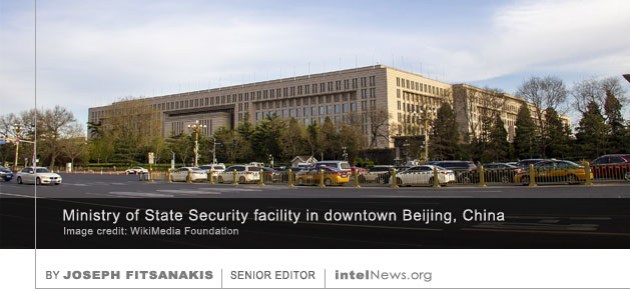 AUTHORITIES IN GERMANY HAVE arrested a sixth person in less than a month, in connection with three separate cases of espionage orchestrated by Russian or Chinese intelligence. Last Tuesday, police in the east German city of Dresden arrested an assistant to a leading politician of the far-right Alternative für Deutschland party (AfD). The assistant, who is a dual German-Chinese citizen, is accused of spying for Chinese intelligence, while the far-right politician who employed him is also being investigated, according to reports.
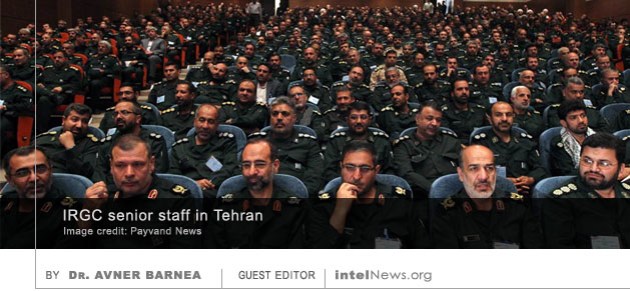 THE TARGETED KILLING OF Hassan Mahdawi, a high-ranking member of Iran’s Islamic Revolutionary Guards Corps (IRGC) and the commander of the Quds Force in Syria and Lebanon, was carried out by Israel on April 1, 2024. The actual assassination was based on precise operational intelligence, while Israel’s assessment of Iran’s response was wrong.
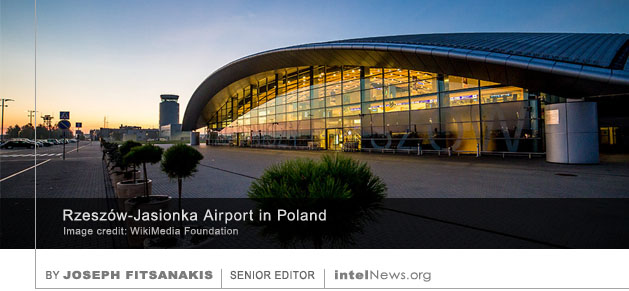 AUTHORITIES IN GERMANY and Poland have charged three individuals with working on behalf of Russian military intelligence in planning acts of sabotage and assassination on European soil. One of the plots allegedly involved an effort to assassinate Ukrainian President Volodymyr Zelenskyy. Another aimed to sabotage commercial airport facilities that are being managed by the United States military.






 intelNews.org
Ex-CIA analyst accused of spying for South Korea had prior warnings from FBI, CIA
July 22, 2024 by Joseph Fitsanakis 3 Comments
Terry joined the CIA in 2001 but resigned in 2008, allegedly “in lieu of termination” because her employer “had ‘problems’ with her contact with” officers from South Korea’s National Intelligence Service (NIS). After leaving the CIA, Terry worked briefly for the National Security Council and the National Intelligence Council, before transitioning to academia. Her most recent post was that of a senior fellow at the Council on Foreign Relations, where she became known as an exert on East Asian affairs with a focus on the Korean Peninsula. For over a decade, Terry has made frequent appearances on television and radio, as well as on several podcasts. She is married to the Washington Post columnist Max Boot.
The Department of Justice accuses Terry of failing to register under the Foreign Agents Registration Act and deliberately conspiring to violate that law, thus effectively operating as an unregistered agent of a foreign power. The indictment claims that Terry was gradually recruited by the NIS, beginning in 2013, two years after she stopped working for the United States government. Terry allegedly continued to work for the NIS for a decade, during which she was handled by NIS intelligence officers posing as diplomats in South Korea’s Washington embassy and permanent mission to the United Nations in New York.
It is alleged that throughout that time Terry provided her NIS handlers with access to senior US officials, disclosed “nonpublic US government information” to the NIS, and promoted pro-South Korean policy positions in her writings and media appearances. In return, Terry is alleged to have received luxury goods, free dinners at expensive restaurants, and nearly $40,000 in “covert” funding, nominally to operate a public policy program on Korean affairs. It is worth noting that, according to the unsealed indictment, the Federal Bureau of Investigation warned Terry that she should be wary of being approached by NIS officers seeking to offer her funding. Read more of this post
Filed under Expert news and commentary on intelligence, espionage, spies and spying Tagged with CIA, espionage, Max Boot, National Intelligence Service (South Korea), News, South Korea, Sue Mi Terry, United States