Was Dubai ruler’s daughter kidnapped by UAE and Indian Special Forces?

Sheikha LatifaThe international advocacy group Human Rights Watch has joined calls for information on the whereabouts of Sheikha Latifa, a member of the royal family of the United Arab Emirates, who some say was abducted in international waters by Emirati and Indian special forces. Princess Latifa, 32, is the daughter of Sheikh Mohammed bin Rashid Al Maktoum, ruler of the Emirate of Dubai and Prime Minister of the UAE. But she has fallen out with the royal family and has repeatedly issued public calls for democratic reforms and more rights for women. In 2002, when she was just 18, she attempted to leave the UAE but was forcibly repatriated by her father’s bodyguards. In recent years, Princess Latifa has continued to vocalize her opposition to her father’s rule, whom she has accused of deploying “death squads” to suppress dissent within the UAE royal family.
It is believed that on February 24, Princess Latifa was joined by Tiina Jauhiainen, a Finnish martial arts instructor who has lived and worked in the Middle East, with the aim of implementing an elaborate escape plan. The two women traveled to neighboring Oman and used jet skis to transport themselves to international waters. There they boarded a yacht captained by Hervé Jaubert, a French former intelligence officer who also has United States citizenship. Jaubert became internationally known in 2009 for escaping from the UAE without a passport, after authorities there accused him of owing money to investors. Jaubert’s yacht, The Nostromo, sailed from the Arabian Gulf toward India with the two women and three Filipino crew members onboard. On February 26, Princess Latifa posted several messages on social media, including a video in English, explaining her reasons for leaving her home country. But soon afterwards, The Nostromo went missing while sailing toward the coastal Indian state of Goa. It didn’t reappear again until March 20, when it sailed for Sri Lanka with its captain and crew, but without the two women on board.

Jaubert has since told reporters that his ship was intercepted in international waters by “two unmarked speedboats” carrying between six and eight commandos. They used stun guns and smoke grenades to neutralize the yacht’s crew, which they proceeded to handcuff and blindfold. The soldiers then took the two women. Notably they spoke to Princess Latifa in English, prompting Jaubert to conclude that they were Indian, not Arab. Some reports later claimed that a minimum of five Indian and Emirati warships, as well as two military airplanes and a helicopter, participated in the attack on The Nostromo. Jauhiainen, who was eventually released and is now back in Europe, confirmed Jaubert’s account.

But the Indian authorities have rejected these claims, arguing that they have no knowledge of such a military or paramilitary operation off the coast of Goa. Human Rights Watch recently issued a formal call on the Indian and Emirati governments to reveal the precise whereabouts of Princess Latifa, who has not been seen since the raid. “Failure to disclose the whereabouts and status of the princess could qualify as an enforced disappearance, given the evidence suggesting that she was last seen as UAE authorities were detaining her”, said the international advocacy group. The government of the UAE has not responded to media requests for comment.

Author: Joseph Fitsanakis | Date: 07 May 2018 | Permalink

Pakistan denies it plans to release doctor who helped CIA find bin Laden

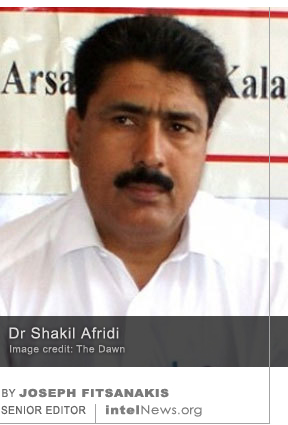
Dr Shakil AfridiAuthorities in Pakistan have dismissed rumors that a medical doctor who helped the United States Central Intelligence Agency find and kill al-Qaeda founder Osama bin Laden in 2011 is to be released from prison. Dr. Shakil Afridi was arrested in 2011, soon after bin Laden was killed in a CIA operation in the Pakistani city of Abbottabad. In the weeks following the CIA raid, it emerged that a team of local doctors and nurses had helped the American spy agency confirm bin Laden’s presence in the compound. The team of nearly 20 healthcare workers participated in a fake vaccination scheme carried out in Abbottabad, whose true purpose was to collect DNA samples from the residents of the compound where the CIA believed bin Laden was hiding.

Pakistani authorities fired 17 healthcare workers who participated in the CIA scheme and arrested its head, Dr. Afridi. Bizarrely, Dr. Afridi was arrested for having alleged links with an Islamist group that operates in the region, known as Lashkar-e-Islam. He then faced charges for alleged medical malpractice, which, according to the prosecution, resulted in the death of one of his patients. He is currently serving a 33-year prison sentence in Pakistan’s northwestern border city of Peshawar. Ever since his arrest, the US has pressured Pakistan to release Dr. Afridi, and Pakistani media often publish sensational reports about alleged covert attempts by the CIA to free the imprisoned medical doctor. Last week, Dr. Afridi was transported by helicopter from Peshawar to a jail near the village of Adiala, located near Pakistan’s border with the Indian region of Kashmir. Dr. Afridi’s move, which took place amid heavy security, sparked rumors in the media that the alleged CIA agent was about to be released and transported to America.

But on Thursday, Muhammad Faisal, a spokesman for Pakistan’s Ministry of Foreign Affairs, dismissed intense media speculation that Dr. Afridi was about to be released. He also denied that Islamabad was attempting to swap Afridi with Pakistani nationals living in the US, including Aafia Siddiqui, who is serving an 86-year prison term in the US for killing an American soldier in Afghanistan. Additionally, Faisal described as “nonsense” media reports of an alleged failed CIA attempt to organize a jailbreak in Peshawar, in order to free Dr. Afridi.

Author: Joseph Fitsanakis | Date: 4 May 2018 | Permalink

Senior North Korean counterintelligence official believed to have defected

Chilbosan HotelOne of North Korea’s most senior intelligence officials, who played a major role in building Pyongyang’s nuclear weapons program, has disappeared and is believed to have defected to France or Britain, according to sources. South Korean media identified the missing official as “Mr. Kang”, and said he is a colonel in North Korea’s State Security Department (SSD), also known as Ministry of State Security. Mr. Kang, who is in his mid-50s, enjoyed a life of privilege in North Korea, because he is related to Kang Pan-sok (1892-1932), a leading North Korean communist activist and mother to the country’s late founder, Kim Il-sung.
According to South Korean reports, Kang was in charge of North Korea’s counter-espionage operations in Russia and Southeast Asia, including China. He is also believed to have facilitated secret visits to Pyongyang by foreign nuclear scientists, who helped build North Korea’s nuclear weapons program. In recent years, Kang was reportedly based in Shenyang, the largest Chinese city near the North Korean border, which is home to a sizeable ethnic Korean population. According to reports, Kang led Unit 121, an elite North Korean hacker group based in Shenyang, with the aim of carrying out cyber-attacks without implicating North Korea. The South Korean-based DailyNK website said on Wednesday that Kang had been based at the Zhongpu International Hotel in Shenyang (until recently named Chilbosan Hotel), which has historically been operated through a joint Chinese-North Korean business venture and is known to host numerous North Korean government officials.

But according to DailyNK, Kang disappeared from Shenyang in February and is now believed to have defected, possibly “to France or Great Britain”. The Seoul-based website said Kang took “a lot of foreign currency with him” as well as “a machine capable of printing American dollars”. Following Kang’s disappearance, the government in Pyongyang launched a worldwide manhunt for him, sending at least 10 agents to assassinate him before he is given political asylum in the West, said DailyNK. Pang’s family, including his wife and children, are believed to still be in Pyongyang.

Author: Joseph Fitsanakis | Date: 3 May 2018 | Permalink

Another US diplomat detained in Pakistan over traffic accident that injured two

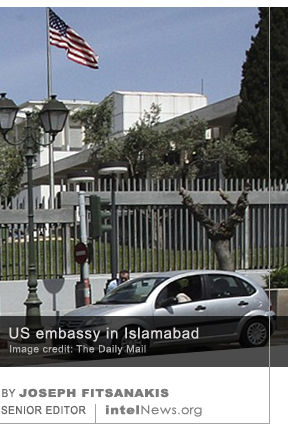
US embassy Islamabad PakistanAnother American diplomat was detained in Pakistan last week, following the second serious traffic accident involving United States diplomatic personnel in Islamabad in less than a month. The incidents are said to be contributing to ongoing diplomatic tensions between the United States and Pakistan. Many in the South Asian country remain angry about a controversial episode in 2011, when a Central Intelligence Agency officer serving at the US consulate in Lahore killed two men by shooting them in the head with a Glock pistol. The CIA officer, Raymond A. Davis, told Pakistani police that the two men had tried to rob him. He was eventually released from detention due to his diplomatic immunity, but only after the personal intervention of the then Secretary of State John Kerry, and after Washington offered monetary compensation to the two dead men’s families.

In the latest incident, Pakistani authorities detained an American diplomat on Sunday, after his Toyota SUV ran over two men riding on a motorcycle in Islamabad. The diplomat, identified in Pakistani media as the US embassy’s Second Secretary Chad Rex Ausburn, was accused by police of having been involved in a hit-and-run incident in the Pakistani capital. According to local reports, Ausburn refused to emerge from his vehicle immediately following the accident, but eventually stepped out and identified himself to police officers. They then took him into custody and impounded his vehicle, which is believed to belong to the US embassy. Ausburn was released once the Pakistani Ministry of Foreign Affairs confirmed his diplomatic status, which grants him immunity from prosecution. The two men injured in the accident are said to be in stable condition at a nearby hospital. Police have reportedly charged the driver of the motorcycle with reckless driving.

However, Pakistani authorities have also charged Taimur Iqbal Pirzada, a security adviser for the US embassy in Islamabad, with seeking to obstruct the police investigation into Sunday’s incident. Pirzada stands accused of trying to stop police officers from detaining Ausburn and impounding his vehicle. He was released on bail on Monday and is currently awaiting trial. US State Department spokesman Nolen Johnson told The New York Times on Monday that the issue involving Ausburn had been “resolved” and that the US government had been “in close contact with Government of Pakistan officials on this matter”. This past April, Pakistani authorities barred another American diplomat from leaving the country, after the car he was driving was involved in an accident in Islamabad, which left a motorcyclist dead. The US embassy’s military attaché, Colonel Joseph E. Hall, remains in Pakistan. Authorities there have demanded that the US Department of State rescinds his diplomatic immunity, so he can face a criminal trial. But the US government has so far refused to grant Islamabad’s request.

Author: Joseph Fitsanakis | Date: 01 May 2018 | Permalink | Research credit: C.F.

Report reveals deeper CIA role in 1963 Vietnam coup and Diem’s assassination

Ngo Dinh DiemA newly declassified report by the Inspector General of the United States Central Intelligence Agency reveals that the South Vietnamese generals who overthrew President Ngo Dinh Diem in 1963 used CIA money “to reward opposition military who joined the coup”. Acknowledging that “the passing of these funds is obviously a very sensitive matter”, the CIA Inspector General’s report contradicts the sworn testimony of Lucien E. Conein, the CIA liaison with the South Vietnamese generals. In 1975, Conein told a United States Senate committee that the agency funds, approximately $70,000 or 3 million piasters, were used for food, medical supplies, and “death benefits” for the families of South Vietnamese soldiers killed in the coup.
The report (.pdf), one of the 19,000 JFK assassination documents released by the US National Archives on Thursday, also contains new details about the South Vietnamese generals’ decision to assassinate Diem that contradict a conclusion of the coup’s history written by the CIA station in Saigon. The majority of the generals, said the CIA at the time, “desired President Diem to have honorable retirement from the political scene in South Vietnam and exile”. According to a newly declassified portion of the 49-page document written by the CIA’s Inspector General, an unidentified field-grade South Vietnamese officer who provided the CIA station with pictures of the bloodied bodies of Diem and his brother and advisor, Ngo Dinh Nhu, said that “most of the generals” favored their immediate execution: “The ultimate decision was to kill them. A Captain Nhung was designated as executioner”.

A redacted version of the Inspector General’s report, dated May 31, 1967, was released by the National Archives in November 2017. In that version of the report, the paragraphs related to the use of CIA funds and the generals’ decision to murder Diem were excised.

* William J. Rust is the author of four books about US relations with Southeast Asia countries during the cold war, including Kennedy in Vietnam. He is currently completing a book about US relations with Indonesia.


CIA seeking new ways to protect officers’ secret identities online, says official

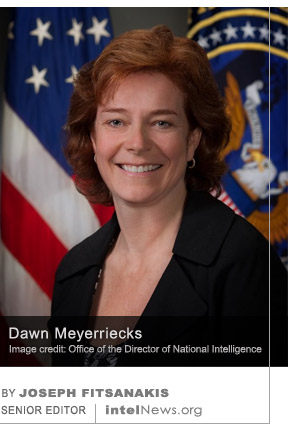
Dawn MeyerriecksIn a rare public appearance on Sunday, a senior member of the United States Central Intelligence Agency discussed ways in which ongoing technological changes pose challenges to concealing the identities of undercover operatives. Dawn Meyerriecks worked in industry for years before joining the CIA in 2013 as deputy director of the agency’s Directorate of Science and Technology. On April 22, she delivered one of the keynote speeches at the 2018 GEOINT Symposium. The meeting was held in Tampa, Florida, under the auspices of the Virginia-based United States Geospatial Intelligence Foundation, which brings together government agencies and private contractors.

In her speech, Meyerriecks discussed what she described as “identity intelligence”, namely the detailed piecing of a person’s identity from data acquired from his or her online activity and digital footprint left on wireless devices of all kinds. This data, combined with footage from closed-circuit television (CCTV) systems and other forms of audiovisual surveillance, poses tremendous barriers to clandestine operations, said Meyerriecks. Today, around 30 countries employ CCTV systems with features so advanced that they render physical tracking of human operatives unnecessary, she added. She went on to warn that the combination of these advanced systems with all-encompassing digital networks in so-called smart cities, as well as with the Internet of things, pose serious threats to the CIA’s ability to operate in secret. Abandoning the online grid is not a solution, said Meyerriecks, because doing so draws attention to the absentee. “If you have […] a six figure or low seven figure income, and you own no real estate, you don’t have any health [or] life insurance policies to speak of, you turn your cell phone off every day from 8:00 to 5:00, who do you work for?”, she said.

These technological challenges will not put an end human intelligence, but they are forcing “a sea of change” in the so-called “patterns of life” of clandestine operatives, said Meyerriecks. These operatives “are going to have to live their cover in a whole different way”, she said without elaborating. Ironically, technology may provide solutions to these challenges, for instance through phone apps that fake the geospatial coordinates of the device —“a growing area of research”, she remarked. Another example of a technological solution to the problem is the use of artificial intelligence algorithms to map CCTV camera networks in urban centers. These maps can help clandestine personnel avoid areas where camera networks are present, noted Meyerriecks.

Author: Joseph Fitsanakis | Date: 25 April 2018 | Permalink

Norwegian retiree jailed in Russia says he was ‘misused’ by Norway spy agency

Frode BergA Norwegian retiree, who was arrested in northern Russia late last year on charges of spying, acted as a courier for the Norwegian Intelligence Service (NIS), according to his lawyer. Last December, intelNews reported on the arrest of Frode Berg, 62, from Kirkenes, a small town in Norway’s far north, located near the Russian border. Berg retired in 2014 after nearly 25 years of service in the Office of the Norwegian Border Commissioner, a government agency that operates under Norway’s Ministry of Justice and Public Security. Following his retirement, Berg traveled regularly to Russia and helped organize a number of joint Norwegian-Russian community events, including athletic competitions and art festivals. But he is currently in a Russian jail and faces a long prison sentence if convicted on espionage charges.

On Tuesday, however, The Washington Post said it spoke to Berg’s lawyer, Brynjulf Risnes. On a telephone line from Oslo, Risnes told the paper that his client had come to believe that he had been “misused” by the NIS, and that he said so during a court session in Moscow earlier this year. “We are quite convinced”, said Risnes, “that this is a real Norwegian spy story”. The lawyer told The Post’s Anton Troianovski that his client had met a man named “Jorgen”, who worked for the NIS. He asked Berg to carry some envelopes during his frequent trips to Russia. Berg eventually came to realize that the envelopes contained operational instructions for Norwegian intelligence assets inside Russia, and sometimes money —up to €3,000 at times. He did as he was told “between two and five times”, said Risnes, in full knowledge that he was operating as a courier for the NIS.

However, when Berg began to have second thoughts about his activities, fearing arrest, “Jorgen” pressured him to continue, according to Risnes. At one point, the NIS representative asked Berg: “Don’t you want to be a good Norwegian?”. In doing so, the NIS effectively pressured Berg to continue acting as a courier by dismissing his hesitations as groundless and failed to inform him about the real risks involved in acting as an intelligence courier inside Russia. Risnes told The Post that no charges have yet been filed against Berg by Moscow, and that the 62-year-old retiree’s supporters back in Kirkenes hope that he could be exchanged for Russian spies held in Norway. But such persons are not known to exist at the moment and, according to Torbjorn Brox Webber, a Kirkenes resident and supporter of Berg, a spy swap is unlikely to “happen for a lot of time — for many years”.

Author: Joseph Fitsanakis | Date: 25 April 2018 | Permalink

Hamas accuses Mossad of assassinating Palestinian engineer in Malaysia

Fadi al-Batsh Fadi AlbatshMilitants in the Gaza Strip have accused Israel of assassinating a Palestinian engineer based in Malaysia, who was shot dead on Saturday by unknown assailants riding motorcycles. The victim has been identified as Dr. Fadi M. al-Batsh, 35, from the town of Jabalia in the Gaza Strip, a Palestinian enclave controlled by the militant group Hamas. Al-Batsh is believed to have completed undergraduate and Master’s degrees in electrical engineering at the Islamic University of Gaza. In 2011 he enrolled as a PhD student at the University of Malaya in Kuala Lumpur, from where he subsequently received his doctorate in electrical engineering. He was then employed as a lecturer by the University of Kuala Lumpur’s British Malaysian Institute. The Institute is located in the Jalan Gombak neighborhood of the Malaysian capital, where al-Batsh lived with his wife and three children. Some reports from Israel said that al-Batsh worked on drone technology and that he had authored scientific articles on the development of drone technology, as well as on the technical specifications of transmitters used to remotely control drones.

Local reports said al-Batsh was gunned down at around 6:00 a.m. on Saturday morning as he was walking from his home to a nearby mosque for early-morning prayers. Footage taken from nearby security cameras shows that al-Batsh was shot by two men riding on a large BMW 1100cc motorcycle, who waited for him to arrive at the scene for at least 20 minutes before opening fire. Malaysian police said the Palestinian man was pronounced dead at the scene, having sustained wounds from 14 bullets in the chest and head. A subsequent report by local police authorities said the incident was being treated as a “targeted killing”, not as a terrorist attack, because the assassins appeared to focus solely on al-Batsh while ignoring several bystanders that were present.

Shortly after al-Batsh’s killing some reports identified him as a relative of Khaled al-Batsh, a senior official in the Palestinian Islamic Jihad. A subsequent statement published by Hamas-affiliated media said al-Batsh was a commander in the Izz ad-Din al-Qassam Brigades, Hamas’ military wing. The militant group described him as a “loyal member” and called him a “shahid” (martyr), who was “assassinated by the hand of treachery”. The Gaza-based group also vowed retaliation against Israel and the Mossad intelligence agency.

Malaysian authorities said on Sunday that they did not rule out anything, including the possibility that al-Batsh may have been killed by militants belonging to the Islamic State. Malaysia’s Deputy Prime Minister, Ahmad Zahid Hamidi, said that the possible involvement of “foreign agents” in al-Batsh’s killing was also being looked at. He added that the two main suspects behind the killing were believed to be “white, European-looking men”. On Monday, Malaysian police released facial composites of the two suspects, based on eyewitness testimonies. An accompanying press release said the two suspects were “around 1.80 meters tall, well built, had fair complexions, and were believed to be of Middle Eastern or Western descent”.

Author: Joseph Fitsanakis | Date: 23 April 2018 | Permalink | Research credit: R.B. and C.F.

Britain launched first-ever military-style cyber campaign against ISIS, says spy chief

Jeremy FlemingFor the first time in its history, the United Kingdom has launched its first-ever military-style cyber campaign against an adversary, according to the director of the country’s primary cyber security agency. The target of the campaign was the Islamic State, the militant Sunni Muslim group that is also known as the Islamic State of Iraq and Syria (ISIS). The existence of the all-out cyber war was announced last week by Jeremy Fleming, the newly appointed director of the Government Communications Headquarters (GCHQ), Britain’s signals intelligence organization. Fleming, a former Security Service (MI5) officer, was speaking at the CYBERUK2018 conference, held in the northern English city of Manchester. It was his first public speech as director of GCHQ.

Fleming told his Manchester audience that the cyber operation that targeted ISIS was a “major offensive campaign” that seriously hampered the group’s ability to launch and coordinate both physical and online attacks against its enemies. The campaign also prevented ISIS from using its “normal channels” online to spread its message, effectively suppressing the group’s propaganda efforts, said Fleming. The new GCHQ director noted that large parts of the cyber operation against ISIS were “too sensitive to talk about”. But he added that the methods used to combat the Sunni Muslim group’s online operations were so aggressive that they “even destroyed equipment and networks” used by ISIS members. He did not specify what he meant by “destroyed equipment”, but his comment brought to mind the so-called Stuxnet virus, which was discovered by researchers in 2010. The virus appeared to have been designed by what experts described as “a well-resourced nation-state”, with the aim of sabotage sensitive hardware components found in centrifuges used by the Iranian government in its nuclear program.

During his Manchester speech, Fleming claimed that the British cyber war against ISIS was conducted in compliance with existing international legal frameworks. He added, however, that the “international doctrine governing the use [of cyber weapons] is still evolving”. The GCHQ director admitted that Britain’s cyber capabilities “are very powerful”, but argued that “we only use them in line with domestic and international law, when our tests of necessity and proportionality have been satisfied, and with all the usual oversight in place”.

Author: Joseph Fitsanakis | Date: 20 April 2018 | Permalink | Research credit: K.B.

Canada evacuates diplomats’ families from Cuba, citing mysterious brain injuries

Embassy of Canada in Havana, CubaThe government of Canada has announced plans to evacuate family members of its diplomats serving in Cuba, because of medical issues caused by an alleged espionage-related technological device. These concerns have persisted among United States and Canadian diplomatic staff since the fall of 2016, when several members of staff at the US embassy in Havana reported suffering from sudden and unexplained loss of hearing. Eventually, their symptoms became so serious that some American diplomats decided “to cancel their tours early and return to the United States”, according to the Associated Press, which published this story in August of 2016.

Since that time, the US Department of State has said that 21 of its diplomatic and support staff have been diagnosed with brain injuries. In response to these concerns, Washington recalled the majority of its diplomats from Havana last September and issued a travel warning advising its citizens to stay away from the island. Now the Canadian embassy has said it will evacuate all family members of its personnel stationed in Havana, according to the BBC. The government of Canada is believed to have made the decision to evacuate its citizens after it confirmed that at least 10 members of diplomatic families living on the island had been found to suffer from “unexplained brain symptoms”, according to Canadian government officials. These include regular spells of dizziness and nausea, as well as difficulty in concentrating on tasks.

Interestingly, Canadian experts have dismissed theories, emanating mostly from the US, that the mysterious brain symptoms come from a mysterious covert weapon that emits sonic waves. But some Canadian experts have said that the symptoms suffered by the diplomats and their families may point to a new illness, whose cause remains unknown. Cuba has dismissed repeated allegations by Washington that it allowed a third party —possibly Russia—to conduct sonic attacks against Western diplomats on the island. Cuban officials have described the allegations as tricks in a game of “political manipulation” that has been concocted by the White House to damage the bilateral relationship between the US and the government of the Caribbean island.

Author: Joseph Fitsanakis | Date: 18 April 2018 | Permalink

Russian journalist who wrote about mercenaries’ deaths in Syria is found dead

Maxim BorodinA Russian investigative journalist, who wrote a series of articles about Russian soldiers-for-hire in Syria, has died after falling from the balcony of his apartment in western Siberia. Some of his colleagues say they suspect foul play. Maxim Borodin wrote for Novy Den (New Day) an investigative online magazine. In the past few weeks, Novy Den published a series of probing articles by Borodin about the activities of Russian mercenaries working for the Syrian President Bashar al-Assad. Borodin was one of just a handful of Russian journalists who reported on claims that more than 200 Russian mercenaries were killed in Syria on February 7.

According to the United States government, the Russians were part of a 500-strong Syrian government force that crossed the Euphrates River and entered Kurdish-controlled territory in Syria’s northeastern Deir al-Zour region. American-supported Kurdish forces in the area, which include embedded US troops, responded with artillery fire, while US military aircraft also launched strikes against the Syrian government forces. The latter withdrew across the Euphrates after suffering heavy losses, including at least 200 Russian troops. The incident was subsequently confirmed by the Kremlin, which said that the Russians were contractors and were not members of the Russian armed forces. Borodin wrote that the Russian mercenaries were employed by the Wagner Group, an arms-for-hire company owned by Yevgeny Prigozhin, a billionaire with close ties to the Russian President Vladimir Putin. Prigozhin’s name is included in the most recent list of Russian oligarchs that are subject to economic sanctions imposed by the US government.

Last Thursday, just weeks after writing his exposé about the Wagner Group, Borodin was found by neighbors at the foot of the building that houses his apartment in Yekaterinburg, Russia’s fourth largest city. The journalist was taken to a local hospital, where he later died from his injuries. The American news network CNN said it spoke to Valery Gorelykh, a local Russian Interior Ministry official, who said that no foul play was suspected in Borodin’s death. The door of his apartment had been locked from the inside and there were no signs of struggle, said Gorelykh. He went on to say that the most likely explanation for Borodin’s death was that he slipped and fell off the balcony while smoking a cigarette.

But some of Borodin’s colleagues and friends question the verdict of accidental death. Vyacheslav Bashkov, a close friend of the deceased, said Borodin had called him in a frantic state in the early morning hours of April 11. He said his apartment had been surrounded by armed security personnel wearing ski masks, one of whom had climbed on his balcony and appeared to be waiting for a court order so that he could search Borodin’s apartment. But an hour later, Borodin called Bashkov again, this time to let him know that the armed men had been conducting a training exercise and that they never entered his apartment after all. Another colleague of Borodin, Novy Den editor-in-chief Polina Rumyantseva, said she did not believe Borodin had committed suicide.

Author: Ian Allen | Date: 17 April 2018 | Permalink

Russian ex-spy sees link between Skripal and GCHQ officer found dead in 2010

Boris KarpichkovA former officer in the Soviet KGB, who now lives in the United Kingdom, is to be questioned by British police after alleging that there is a link between the recent poisoning of Sergei Skripal and the mysterious death of a British intelligence officer in 2010. There has been extensive media coverage in the past month of the poisoning of Sergei Skripal, a Russian former military intelligence officer who spied for Britain in the early 2000s and has been living in England since 2010. Nearly every European country, as well as Canada, Australia and the United States, expelled Russian diplomats in response to the attack on the Russian former spy, which has been widely blamed on the Kremlin.

But eight years ago, another mysterious attack on a spy in Britain drew the attention of the world’s media. Gareth Williams, a mathematician in the employment of Britain’s signals intelligence agency, GCHQ, had been seconded to the Secret Intelligence Service (MI6), Britain’s external intelligence agency, to help automate intelligence collection. He had also worked with United States agencies, including the Federal Bureau of Investigation and the National Security Agency. But his career came to an abrupt end in August 2010, when he was found dead inside a padlocked sports bag at his home in Pimlico, London. It remains unknown whether his death resulted from an attack by assailants.

Last weekend, however, Boris Karpichkov, a former intelligence officer in the Soviet KGB and its post-Soviet successor, the FSB, said that Williams was killed by the Russian state. Karpichkov, 59, joined the KGB in 1984, but became a defector-in-place for Latvian intelligence in 1991, when the Soviet Union disintegrated. He claims to have also spied on Russia for French and American intelligence. In 1998, carrying two suitcases filled with top-secret Russian government documents, and using forged passports, he arrived with his family in Britain, where he has lived ever since. In an interview with the British tabloid newspaper The Sunday People, Karpichkov said that Williams was killed by Russian intelligence operatives with an untraceable poison substance, because he had discovered the identity of a Russian agent within his agency, the GCHQ. According to Karpichkov, Williams had befriended the mole, codenamed ORION by the Russians, and had realized that he was working for the Russians. The mole then allegedly told his Russian handler, a non-official-cover officer with an Eastern European passport, codenamed LUKAS, that Williams had grown suspicious. Read more of this post

Outgoing CIA director acknowledges US killed ‘couple of hundred’ Russians in Syria

Mike PompeoThe outgoing director of the Central Intelligence Agency, Mike Pompeo, appeared on Thursday to confirm reports from last February that United States troops killed more than 200 Russian soldiers in Syria. According to sources from the US Pentagon, the armed confrontation took place on February 7, when a 500-strong Syrian government force crossed the Euphrates River and entered Kurdish-controlled territory in Syria’s northeastern Deir al-Zour region. US-supported Kurdish forces in the area, which include embedded American troops, responded with artillery fire, while US military aircraft also launched strikes on the Syrian government forces. The latter withdrew across the Euphrates after suffering heavy losses. The US side estimated at the time that over 100 attackers had been left dead, with another 200-300 injured. The toll later rose to several hundred dead.

At a press conference held soon after the armed clash, US Secretary of Defense James Mattis refused to discuss the matter, which he referred to as “perplexing”. Bloomberg said at the time that American officials were “in talks” with Russian counterparts “in search of an explanation for what happened”. On Thursday, however, Pompeo appeared to acknowledge that US troops killed hundreds of Russians in Deir al-Zour. The outgoing CIA director was speaking before a committee of the US Senate, during a hearing pertaining to his nomination to serve as the next US secretary of state. He was making the point that the administration of US President Donald Trump had maintained a hardline policy on Russia. After referring to the recent expulsions of 60 Russian diplomats from the US, Pompeo said: “in Syria, now, a handful of weeks ago the Russians met their match. A couple of hundred Russians were killed”.

Pompeo’s comments were seen by the media as an acknowledgement by a senior US government official of the incident in Deir al-Zour, which has remained shrouded in mystery since it happened. Later in his speech, Pompeo said that the Kremlin had “not yet gotten the full message about US determination to block aggression from Moscow. We need to continue to work at that”, he said.

Author: Joseph Fitsanakis | Date: 13 April 2018 | Permalink

German spy chief warns against Chinese investment in German hi-tech firms

Hans-Georg MaassenThe head of Germany’s domestic intelligence agency has warned of security risks resulting from Chinese direct investment in high-technology German and other European companies. Since 2012, Hans-Georg Maassen has served as director of the Federal Office for the Protection of the Constitution, Germany’s domestic security and counterintelligence agency. Speaking to reporters on Wednesday, Maassen said his agency had noticed an inverse correlation between cyber-espionage attacks on Germany by Chinese actors and the acquisition of German technology firms by Chinese companies. German counter-intelligence officials were puzzled, he said, about a dramatic reduction in Chinese cyber-espionage activities in 2016. But they eventually realized that cyber-espionage operations had been replaced by “lawful methods”, he said, such as direct takeovers of German hi-tech firms by Chinese companies.

The purpose of these takeovers was “to gain access to German technical know-how”, added Maassen. He went on to say that “industrial cyberespionage is no longer needed if an actor can simply exploit liberal economic regulations to buy companies, and then proceed to disembowel them, essentially cannibalize them, to gain access to their know-how”. The spy chief noted that Germany did not object to foreign investment and the free flow of capital from all countries, including China. However, he added, “certain direct investments in specific technologies can compromise domestic security”. Maassen mentioned several examples in his presentation, including the takeover of Kuka, a German robotics firm, by a Chinese investor in 2016. He said that in the past few months alone, Chinese companies have attempted to purchase stakes in 50Hertz, a German energy grid operator, German car manufacturer Daimler, and Cotesa, a German aerospace contractor.

In response to a question from a journalist about policy coordination between Germany and the European Union, Maassen said that Germany, France and Italy have been pressuring Brussels to update and modernize its screening procedures against foreign takeovers of companies that are involved in manufacturing and selling “sensitive technologies”. He noted that a new EU-wide screening mechanism should be in place by the end of 2018.

Author: Joseph Fitsanakis | Date: 12 April 2018 | Permalink

Syria sought out and assassinated American journalist, former spy says

Marie ColvinThe Syrian government tracked down and killed American journalist Marie Colvin in order to stop her from reporting about the Syrian Civil War, according to a Syrian intelligence officer who has defected to Europe. Colvin was an experienced war correspondent who worked for The Sunday Times. The British newspaper sent her to Syria soon after the outbreak of the war. From there, she gave live interviews to media outlets such as CNN and the BBC. But on the morning of February 22, 2012, Colvin was killed along with French war photographer Remi Ochlik. Their death came when Syrian government forces repeatedly shelled a media center in the city of Homs, which housed the two reporters.

In 2016, the San Francisco-based Center for Justice and Accountability filed a lawsuit against the government of Syrian President Bashar al-Assad, claiming that Colvin’s death was deliberate and wrongful. The lawsuit is supported by Colvin’s family in the United States. Court records unsealed on Monday include a sworn testament by a Syrian former intelligence officer who has defected and now lives under a new identity in an undisclosed European country. The defector, codenamed ULYSSES, said that Colvin was assassinated by the Assad government as part of a concerted effort to hunt down Western journalists and local media correspondents. The ultimate purpose of the plan was to hinder international reporting about the war. The plan was allegedly carried out by the Syrian military under the guidance of the country’s Military Intelligence Directorate. Many of the reporters targeted for assassination were reporting from the city of Homs, where Colvin was killed.

According to ULYSSES, Syrian government forces began targeting the Homs media center after they found out that foreign journalists had managed to enter the city’s western sector from nearby Lebanon. They then employed a mobile satellite interception system to capture the journalists’ communications, which in turn revealed their precise location. At that point, Syrian troops were ordered to fire several missiles at the building housing the journalists, in full knowledge that Colvin and Ochlik were inside. In his testimony, ULYSSES claimed that Syrian intelligence officials “celebrated” when they were told that Colvin had been killed. He identified eight senior Syrian officials who he said were involved in planning the American journalist’s alleged assassination. One of them, said ULYSSES, was Maher al-Assad, President Assad’s brother, who leads the 4th Armored Division of the Syrian Army, considered as one of the staunchest pro-government parts of the Syrian military. Testimonies in the case continue this week.

Author: Ian Allen | Date: 10 April 2018 | Permalink