Russia retains massive global diplomatic footprint despite recent expulsions
March 30, 2018 1 Comment
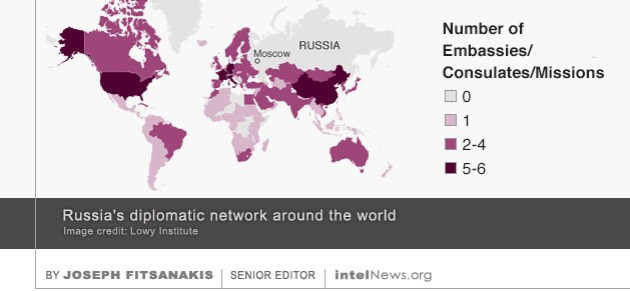 Though unprecedented in size, the recent expulsions of over 150 diplomats by nearly 30 countries and organizations around the world have hardly made a dent on Russia’s huge diplomatic footprint. The coordinated expulsions were announced last week in response to Britain’s allegation that the Kremlin tried to kill a Russian former spy living in England. Sergei Skripal, 66, who spied for Britain in the early 2000s, and has been living in England since 2010, is fighting for his life after being poisoned with what London claims was a military-grade nerve agent. Nearly every European country, as well as Canada, Australia and the United States, expelled Russian diplomats in response to the attack on Skripal.
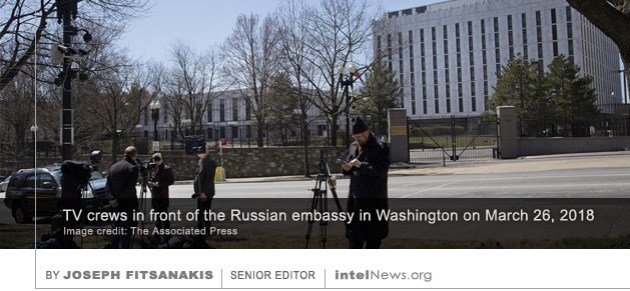
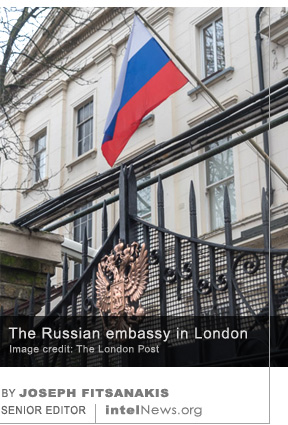
The largest share of the expulsions came from the United States, where the White House announced that 60 Russian diplomats had been ordered to leave by the end of the week. The majority of these diplomats are posted at the Russian embassy in Washington and consulate in New York. At least a dozen more are serving in Russia’s permanent mission at the United Nations in New York. On Thursday, several US media outlets said that all 60 Russians told to leave the US are undeclared intelligence officers serving under diplomatic cover. Fox News quoted an unnamed “senior administration official” in the US as saying that “these are not diplomats that we expelled […]. They are intelligence officers […] operating under diplomatic cover”. The official added that the Russians were expelled because they “were engaging in activities that were not commensurate with their diplomatic roles and functions”. That description is often used by governments to allude to diplomats who are in fact engaging in espionage or other intelligence-related activities.
But in an analysis piece written for the BBC, Alex Oliver, research director at the Lowy Institute in Australia, points out that the 150 diplomats expelled in recent days are but “a tiny part” of Russia’s massive diplomatic presence around the world. With 242 diplomatic posts around the world, Russia has the world’s fourth largest diplomatic footprint, behind the United States, China and France. Several thousand Russian diplomats are stationed at any one time in 143 Russian embassies, 87 consulates, and about a dozen other diplomatic missions in nearly every country in the world. Of these, approximately 170 serve in the United States. The 60 expulsions announced last week by the US government, will still leave Russia with over 100 accredited diplomats in America —many of whom are presumably intelligence officers. Earlier today, Moscow announced that it would expel 60 American diplomats, as well as nearly 100 more diplomats for other countries. The White House said that it may choose to respond with further expulsions of Russian diplomatic personnel.
► Author: Joseph Fitsanakis | Date: 26 April 2018 | Permalink
 Britain secured the largest expulsion of Russian diplomats in history by sharing “unprecedented degrees of intelligence” with dozens of foreign countries about the attempted killing of former spy Sergei Skripal. Nearly 30 countries and international organizations, including the European Union and the North Atlantic Treaty Organization, have expelled or refused to accredit over
  Relations between Russia and much of the West reached a new low on Monday, with the expulsion of over 100 Russian diplomats from two dozen countries around the world. The unprecedented expulsions were publicized on Monday with a series of coordinated announcements issued from nearly every European capital, as well as from Washington, Ottawa and Canberra. By the early hours of Tuesday, the number of Russian diplomatic expulsions had reached 118 —not counting the 23 Russian so-called “undeclared intelligence officers” that were expelled from Britain last week. Further expulsions of Russian diplomats are expected in the coming days.
 predecessor, Barack Obama, and his Secretary of State Hillary Clinton, who is known for her hardline anti-Russian stance. In Europe, the move to expel dozens of Russian envoys from 23 different countries —most of them European Union members— was a rare act of unity that surprised European observers as much as it did the Russians.
 Sergei Skripal, the Russian double agent who was poisoned with a military-grade nerve agent in England earlier this month, wrote to the Kremlin asking to return to Russia, according to one of his old school friends. Skripal, 66, and his daughter Yulia, 33, remain in critical condition in hospital, three weeks after being
  For the past year, the Netherlands has had a new law governing its two secret services, the AIVD and the MIVD. The new Intelligence and Security Services Act (Wet op de inlichtingen- en veiligheidsdiensten or Wiv) was and still is heavily criticized, especially because it allows untargeted access to cable-bound telephone and internet traffic. Under the previous law, which dates from 2002, the intelligence services were only allowed to conduct bulk interception of wireless transmissions, like satellite and radio communications —besides of course the traditional targeted telephone and internet taps aimed at individual targets.
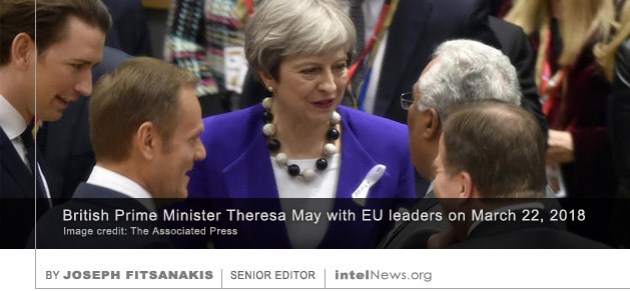 The European Union has recalled its ambassador to Moscow in an apparent response to the poisoning of Sergei Skripal, a Russian double agent, who was attacked with a nerve agent in England earlier this month. Skripal, 66, and his daughter Yulia, 33, remain in critical condition in hospital, nearly three weeks after being poisoned with a nerve agent that British scientists say belongs to Russia’s Cold-War-era chemical stockpiles. Moscow has angrily rejected claims that Skripal, who spied for Britain in the early 2000s, was on a Kremlin-approved hit-list of defectors. But British Prime Minister Theresa May traveled to Brussels on Thursday to brief European Union heads of state about the attack on Skripal.
 With
With 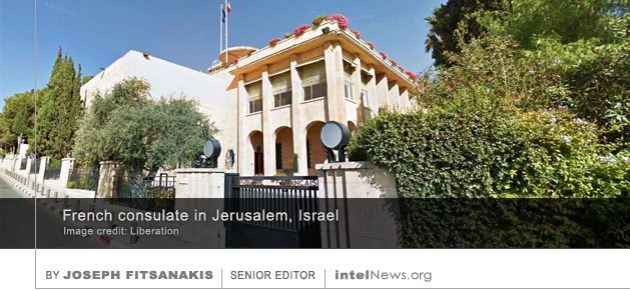 An employee of France’s consulate in Jerusalem is under arrest for allegedly smuggling weapons from the Gaza Strip to the West Bank, according to French media reports, which have been confirmed by Israel. The consular employee has been identified by the Shin Bet, Israel’s domestic security agency, as Romain Franck, 23. He reportedly worked as a driver at the consulate, a job he managed to secure through a prestigious “international volunteer” program sponsored by the French government. The elite program allows recent French college graduates to gain work experience in various countries around the world. Although he had a relatively junior post at the French consulate, Franck carried a diplomatic passport, which allowed him to move through international borders without being searched, due to his diplomatic immunity privileges.
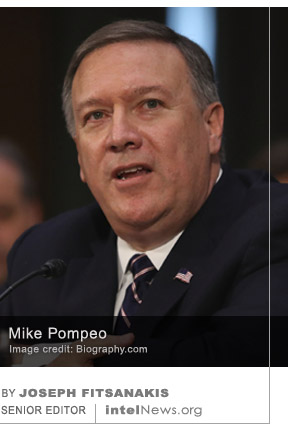 The Central Intelligence Agency has reportedly established back channels for negotiation between the United States and North Korea, which the Department of State is now using to communicate with Pyongyang. Rex Tillerson, who was summarily fired as US Secretary of State by President Donald Trump last week, was famously in favor of diplomatic negotiations between the US and North Korea. The White House had resisted and even publicly criticized Tillerson’s views. Ironically, Tillerson was fired just as his pro-diplomacy views on North Korea are being adopted by the White House.
 On March 21, the Dutch public cast their vote about the new Intelligence and Security Services Act, in Dutch
  As expected, Moscow snubbed the British government’s demand for information into how a Russian-produced military-grade nerve agent ended up being used in the streets of Salisbury, England. As British Prime Minister Theresa May addressed the House of Commons on Wednesday afternoon, Sergei Skripal continued to fight for his life in a hospital in southern England. His daughter, Yulia, was also comatose, having been poisoned with the same Cold-War-era nerve agent as her father. This blog has
  the latest expulsions are dwarfed by the dramatic expulsion in 1971 of no fewer than 105 Soviet diplomats from Britain, following yet another defection of a Soviet intelligence officer, who remained anonymous.
 The nerve agent that poisoned a Russian double spy in England last week may have been smeared on his car’s door handle, according to sources. Sergei Skripal, 66, and his daughter Yulia, 33, are in critical condition after being
  The British prime minister said on Monday that it was “highly likely” the nerve agent used to attack a Russian defector in England last week was developed by Russia. But sources in London told the BBC that the British government would not invoke Article 5 of the North Atlantic Treaty Organization (NATO), which states that an attack on one member of the alliance is an attack on all. Theresa May was referring to an
 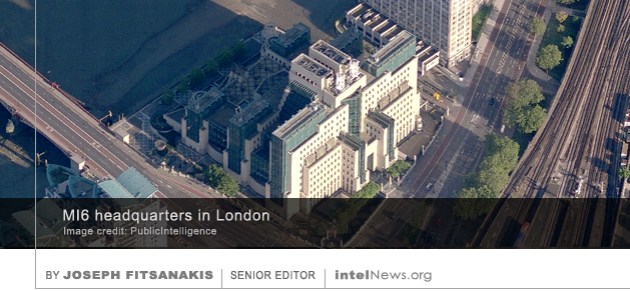 The British secret services have begun tightening the physical security of dozens of Russian defectors living in Britain, a week after the attempted murder of former KGB Colonel Sergei Skripal in southern England. The 66-year-old double spy and his daughter, Yulia, were found in a catatonic state in the town of Salisbury on March 4. It was later determined that they had been attacked with a nerve agent. Russian officials have vehemently denied that the Kremlin had any involvement with the brazen attempt to kill Skripal. But,






 intelNews.org
Surge in Russian spy activity prompts US agencies to bring back retired officers
April 2, 2018 by Joseph Fitsanakis Leave a comment
Soviet spy agencies have a long history of assassinating defectors, called ‘wet operations’ in Russian spy parlance. But such activities were considerably scaled back after the 1970s. However, many claim that the rise of Vladimir Putin to power brought back these tactics, and that Moscow may now be investing more time and money in ‘wet operations’ training. Stein quoted one anonymous Russian defector living in the US as saying that it would be “easy [for Russian spy services] to find us if they are really determined”. It usually takes an email, text or phone call to friends or relatives back in Russia for Moscow to start tracking the physical whereabouts of defectors. In other cases, family members of defectors may be followed by Russian intelligence personnel while visiting the US to reunite with relatives, said the US-based defector.
The same source told Stein that suspected Russian intelligence personnel had been spotted by US counterintelligence teams surveilling the neighborhoods where Russian defectors reside. To address what they see as an “uptick in Russian activity […] over the past two years”, the FBI and the Central Intelligence Agency “have been bringing people out of retirement” with expertise on Russian intelligence operations, Stein reports. The veteran intelligence correspondent also spoke to retired CIA officers, who did not rule out an attempt by Russian intelligence to carry out a ‘wet operation’ on American soil. Stein contacted the CIA and the FBI, asking them to respond to these concerns. He said the CIA declined to comment, while the FBI did not return his messages.
► Author: Joseph Fitsanakis | Date: 01 April 2018 | Permalink
Filed under Expert news and commentary on intelligence, espionage, spies and spying Tagged with assassinations, counterintelligence, Jeff Stein, News, Russia, United States