Iranian military official says West used lizards to spy on Iran’s nuclear program

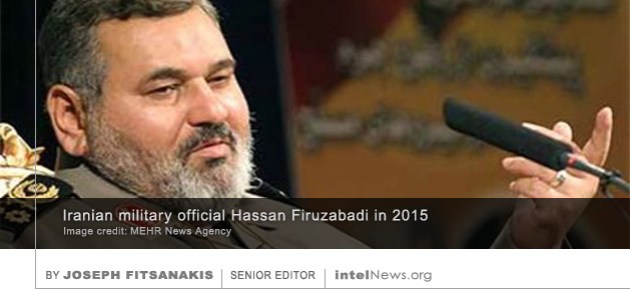
Hassan FiruzabadiThe former chief of staff of Iran’s Armed Forces has said that foreign governments used different species of lizards, including chameleons, to spy on the Iranian nuclear program. The claim was made by Hassan Firuzabadi, a veteran Iranian military official, who from 1989 to 2016 served as the chief of staff of the Iranian Armed Forces —the most senior military post in the Islamic Republic. Since his retirement in 2016, Firuzabadi has served in a number of key consultancy roles and is currently a senior military advisor to Ayatollah Ali Khamenei, Iran’s reform-minded supreme leader.

On Tuesday, the Iranian Labor News Agency (ILNA), a pro-reformist news and analysis outlet, published a lengthy interview with Firuzabadi. The former military strongman was speaking in response to reports earlier this week that a prominent Iranian-Canadian environmental campaigner had died in prison, allegedly of suicide. Kavous Seyed Emami, 63, was a professor of sociology, director of the Persian Wildlife Heritage Foundation, and political activist. He was arrested with seven of his colleagues on January 24 and charged with espionage. On February 9, Emami’s family said that they had been informed by authorities of his death in prison, reportedly as a result of suicide. The news was later confirmed by Iran’s chief prosecutor. Emami’s family, as well as numerous environmental campaigners and activists, dispute the government’s claims of suicide as a cause of his death.

But in his interview published on ILNA’s website, Firuzabadi claimed that environmental activists with links to foreign countries have in the past been found to engage in espionage against the Islamic Republic. He told the news outlet that some years ago Iranian authorities arrested a group of foreigners who were visiting Iran to raise funds for Palestinian political prisoners. He added that among the foreigners’ possessions authorities found “a species of desert reptile, like a chameleon”, which puzzled them. Firuzabadi then said that, “following studies” on the lizards, Iranian authorities concluded that their skin “attracts atomic waves”. They therefore concluded that the foreigners were in fact “nuclear spies” who had entered Iran in order to “find out where [in the country] are uranium mines and where the government is engaged in nuclear-related activities”. Firuzabadi also said that many foreigners who are engaged in environmental activism “are not even aware of the fact that they are actually spying” on Iran.

But Western scientists and science reporters dismissed Firuzabadi’s claims as fantastical. On Tuesday, John Timmer, science editor for the United States-based technology and science website Ars Technica, called the Iranian military official’s claims “insane” and added that there was “no scientific evidence that reptiles […] are effective as Geiger counters”.

Author: Joseph Fitsanakis | Date: 16 February 2018 | Research credit: C.F. | Permalink

Presidential candidate accuses Mexican government of political policing

Ricardo AnayaA high-profile presidential candidate in Mexico accused the government of political policing after he caught an agent of the country’s intelligence agency trailing him during a campaign trip. The candidate, Ricardo Anaya, is a rising rightwing politician who previously served as president of Mexico’s Chamber of Deputies and leader of the largest opposition group in the country, the National Action Party. In December of last year, Anaya announced his candidacy for the presidency, for which he will compete in July. His primary opponents are the center-leftist Andres Manuel Lopez Obrador, and José Antonio Meade of the ruling Institutional Revolutionary Party (PRI).
Opposition candidates have long accused the PRI of using state intelligence agencies to spy on them. The accusations surfaced again this week, after Anaya claimed that he was illegally followed by a government intelligence officer during an election campaign trip in Veracruz. The rightist politician said the officer, who was not wearing a uniform, followed his campaign car in a black sports utility vehicle. On Tuesday, Anaya’s campaign team publicized a video showing the presidential candidate walking up to the intelligence officer and asking him who he was. In the video, the officer says he works for Mexico’s National Center for Security and Investigation (CISEN) and claims he is there to protect the candidate from security threats. The officer is then told by Anaya that he never requested a security detail, but responds that he is simply following orders issued by his superiors.

On Wednesday, Mexico’s Secretary of the Interior, Alfonso Navarrete, told reporters that the man in the video is indeed a longtime intelligence employee of CISEN. But he added that the officer’s mission had been to “report potential mishaps” and to protect Anaya from possible attacks by Mexico’s notorious drug cartels. When he was told by reporters that Anaya had not asked to be protected by CISEN, Navarrete claimed that he thought the candidate had been notified by the government about CISEN’s “discreet presence” in his campaign. The interior secretary then said that the incident had been a mistake, and that CISEN simply failed to notify Anaya of its activities. But Anaya dismissed Navarrete’s claims as lies and said he had been followed by other CISEN officers since the beginning of his campaign.

Author: Joseph Fitsanakis | Date: 15 February 2018 | Permalink

Conflicting reports of Russian fighters killed by US forces in Syria

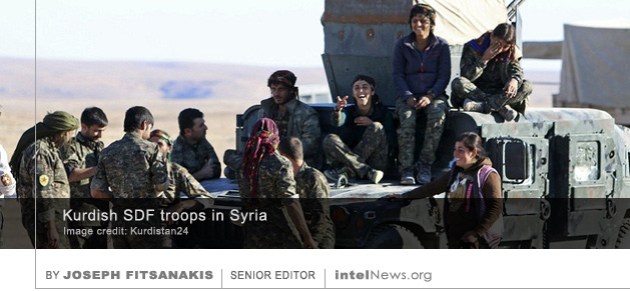
Kurdish SDF There are conflicting reports of Russian and Ukrainian fighters having been killed by American forces in northeastern Syria, with some sources claiming that up to 200 Russians and Ukrainians, most of them private contractors working for the Syrian government, were left dead in clashes last week. If such reports are accurate, they could point to the most lethal American-Russian confrontation since the end of World War II.
According to the United States Department of Defense, the armed confrontation took place on February 7. On that day, a 500-strong Syrian government force crossed the Euphrates River and entered Kurdish-controlled territory in northeastern Syria. A Pentagon spokesman, Colonel Thomas F. Veale, told reporters last week that the pro-government forces crossed the Euphrates near the town of Khursham, in Syria’s Deir al-Zour region. The town is firmly held by the Syrian Democratic Forces (SDF), a Kurdish armed faction that is supported by the US. Veale said that the Syrian government forces advanced in a “battalion-sized formation supported by artillery, tanks, multiple-launch rocket systems and mortars”. The SDF force in the area, which includes embedded American troops, responded with artillery fire, while US military aircraft also launched strikes on the government forces. The latter withdrew across the Euphrates after suffering heavy losses. The US side estimates that over 100 attackers were left dead, with another 200-300 injured. There were allegedly no SDF fatalities during the clash.

On February 8, CBS News cited an unnamed US Pentagon official, who claimed that Russians were among the dead in Deir al-Zour. The BBC said that “at least two Russians” were killed in the attack, while The New York Times raised the toll to “perhaps dozens”. But US news network Bloomberg claimed that over 200 Russians and pro-Russian Ukrainian mercenaries were among the dead. Citing anonymously “three Russians [and] one US official […] familiar with the matter”, the network said that most of the fatalities were Russian and Ukrainian private contractors who were fighting in Syria in support of the government of President Bashar al-Assad. These reports mark the first known instance of Russian citizens killed by American forces in Syria. If the Bloomberg account is accurate, the Deir al-Zour clash could be the most extensive armed confrontation between Americans and Russians since the end of World War II.

Bloomberg said that it spoke by phone to one Russian military contractor who said that “dozens of his wounded men” were still receiving treatment at military hospitals in Russia. On February 8, the Syrian government accused Washington of carrying out a “brutal massacre” in Deir al-Zour, but said nothing about foreign fighters. A statement by the Russian Ministry of Defense said that 25 Syrian troops were hurt in the attack, but denied that Russian soldiers had participated in the February 7 clashes. Speaking on behalf of the Kremlin, Russian government spokesman Dmitry Peskov said that Moscow only tracked casualty data about its official military forces stationed in Syria. He added that no Russian forces were stationed in Deir al-Zour. At a press conference last week, US Secretary of Defense James Mattis refused to discuss the matter, which he referred to as “perplexing”. Bloomberg said that American officials were “in talks” with Russian counterparts “in search of an explanation for what happened”.

Author: Joseph Fitsanakis | Date: 14 February 2018 | Research credit: N.L. | Permalink

Latvian citizen arrested for allegedly spying for Russia

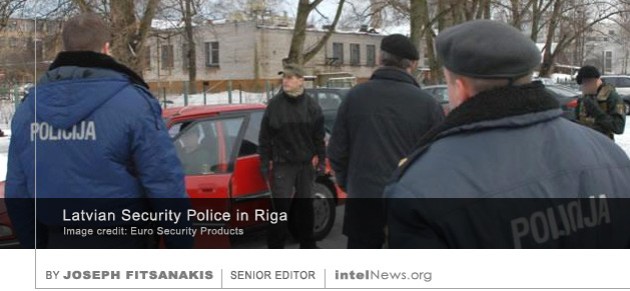
Latvian Security PoliceThe Latvian Security Police have announced the arrest of a man who is suspected of spying for a foreign country, with some reports claiming it is Russia. The Latvian state-owned news agency, LETA, said late last month that the man, who has not been named, was arrested by Security Police officers on Tuesday, December 19, 2017. However, the arrest was not announced by Latvian authorities until recently. A statement issued by government authorities in Riga said that the man’s arrest had been followed by searches at several different properties in the Latvian capital.

The detainee, who is reportedly a Latvian national, is being investigated for espionage and has already been charged with illegally possessing a firearm. A court in the Latvian capital ruled last week that the suspect should be remanded in custody. Initially, the Security Police refused to identify the detainee or reveal the name of the country that he allegedly spied for. But some private Latvian news outlets, who are believed to be close to the government, said on the morning of February 7 that the detainee worked for the Russian state. One report claimed that the man was tasked with collecting military-related information from the region of Latvia that borders Russia. He would then share the information with his Russian handlers, according to the report. On February 8, the Security Police confirmed that the detainee was indeed suspected of working for Russia. According to the agency, he gave his Russian handlers information about the National Armed Forces, Latvia’s military force.

Also on February 8, Latvian authorities warned the country’s citizens that they should remain vigilant. A government statement said that Moscow was intensely interested in collecting classified information about Latvia and that the Russian secret services preferred to recruit Latvians when the latter visited Russia. Reports late last week said that, if found guilty of spying, the detained man could face up to 14 years in prison.

Author: Joseph Fitsanakis | Date: 12 February 2018 | Permalink

India arrests commando instructor who fell for Pakistani honey trap on Facebook

Garud Commando ForceIndian authorities have arrested an Indian Air Force officer for allegedly giving classified documents to two Pakistani spies on Facebook, who posed as women interested in him. The officer has been named as Arun Marwaha, a wing commander stationed at the Indian Air Force headquarters in Delhi. Marwaha, 51, is a para-jumping instructor who trains members of India’s Garud Commando Force —the Special Forces unit of the Indian Air Force. He was reportedly due to retire in 2019.

According to Indian government investigators, several months ago Marwaha was befriended by two Facebook users who claimed to be Indian women. He began chatting regularly with them on Facebook and eventually on the popular cell phone messenger service WhatsApp. Within weeks, Marwaha’s WhatsApp exchanges with the women had become intimate in nature. Before long, the Indian Air Force instructor was providing the women with classified documents in return for intimate photos of themselves. Media reports state that the classified documents related to special operations, some involving cyberwarfare, and space reconnaissance. Government investigators claim that Marwaha’s Facebook contacts were in fact male officers of Pakistan’s Inter-Services Intelligence (ISI), who targeted Marwaha in a carefully planned honey trap operation.

According to reports, the breach caused by Marwaha was discovered last month, at which time the internal security branch of the Indian Air Force launched an investigation. Marwaha was questioned for over a week before turning over his case to Delhi Police, who arrested him on Thursday. He has reportedly been charged under India’s Official Secrets Act and is facing a jail sentence of up to 14 years. Meanwhile, the Indian Air Force is investigating whether other officers have fallen victims to similar honey trap operations by Pakistan’s ISI on Facebook.

Author: Ian Allen | Date: 09 January 2018 | Permalink

US immigration and customs agency seeks to join Intelligence Community

Immigration and Customs Enforcement ICEThe United States Immigration and Customs Enforcement (ICE) is reportedly seeking to join the Intelligence Community, which includes the Central Intelligence Agency, the Defense Intelligence Agency, and other intelligence-focused arms of the federal government. Currently, ICE is a federal law enforcement that operates under the umbrella of the Department of Homeland Security. It consists of two components: Homeland Security Investigations, which probes cross-border criminal activity, including drugs and weapons trafficking, money laundering and cybercrime; and Enforcement and Removal Operations, whose mission is to find and capture undocumented aliens.

But some senior ICE officials have been exploring the possibility of joining the US Intelligence Community. According to The Daily Beast, which reported the alleged plans, the officials believe that by joining the Intelligence Community, ICE will become privy to intelligence that will assist in its mission. They also claim that membership in the Intelligence Community would afford ICE “greater prestige, credibility and authority” within the federal government. The Daily Beast reports that ICE’s effort to join the Intelligence Community began during the administration of US President Barack Obama. However, it has picked up steam following the election of President Donald Trump. Some believe that President Trump would be willing to sign an executive order that would incorporate ICE in the Intelligence Community.

Some civil liberties watchdogs, however, are weary of such plans. They claim that ICE is a domestic law enforcement agency and should not have access to practices and techniques used by spy agencies like the CIA or the National Security Agency. The latter frequently break the laws of foreign countries in pursuit of their mission, which is to steal foreign intelligence. These agencies are characterized by a different culture, say critics, which is not respectful of legal constraints. But supporters of ICE’s proposed inclusion into the Intelligence Community argue that there are several law enforcement agencies that are already members of the Intelligence Community. Notably, the Federal Bureau of Investigation and the Drug Enforcement Administration —both law enforcement agencies— belong to the Intelligence Community.

The Daily Beast said it contacted ICE but a spokesperson refused to comment on the story. The Department of Homeland Security did not return emails and phone calls about the proposal to include ICE in the Intelligence Community.

Author: Joseph Fitsanakis | Date: 08 February 2018 | Permalink

Ex-spy chief claims Palestinian officials worked with CIA to wiretap opponents

Telephones PalestineThe former head of the Palestinian Authority’s spy agency claims that the Palestinian government in the West Bank worked with the United States Central Intelligence Agency to wiretap thousands without court authorization. Tawfiq Tirawi, who headed the Palestinian General Intelligence from its founding in 1994 to 2008, has filed an official complaint against the Palestinian Authority and is calling for a criminal investigation into the alleged wiretaps. The complaint has also been signed by Jawad Obeidat, who is the president of the West Bank’s Bar Association. It is based on a leaked 37-page document that surfaced last month on the social networking application WhatsApp. The document was leaked by an anonymous individual who claims to have worked for a surveillance unit in the Palestinian Preventive Security Service, the Palestinian Authority’s domestic security service.

The leaked document appears to show that the Palestinian Preventive Security Service reached out to the CIA in 2013 asking for assistance with installing a communications surveillance system in the West Bank. The CIA agreed to provide the system in exchange for access to the intercepted data. The two agencies installed the interception system in the summer of 2014 and initiated what appears to have been a large-scale operation that included thousands of telephone subscribers. Initial targets of the operation included members of Hamas —the Palestinian group that controls the Gaza Strip— as well as members of the Iran-supported Islamic Jihad Movement in Palestine. But, according to the Associated Press, over time the targets of the program expanded to include “thousands of Palestinians, from senior figures in militant groups to judges, lawyers, civic leaders and political allies of Abbas”. The list of targets included Tirawi and Obeidat, who filed the official complaint on Tuesday.

The anonymous leaker of the document said he decided to quit his job and reveal the information about the intercepts after US President Donald Trump shifted Washington’s policy on Israel’s capital, by officially recognizing Jerusalem as the capital of the Jewish state. Earlier in February, the Palestinian Authority dismissed the leaked document as “nonsense” and said it was part of a large conspiracy that sought to harm Palestinian interests. The CIA refused to comment on the allegations.

Author: Joseph Fitsanakis | Date: 07 February 2018 | Permalink

Swiss trying to change image as Europe’s spy hub, say officials

Federal Intelligence Service SwitzerlandOfficials in Switzerland say new laws enacted in recent months will help them change their country’s image as one of Europe’s most active spy venues. For decades, the small alpine country has been a destination of choice for intelligence officers from all over the world, who use it as a place to meet assets from third countries. For example, a case officer from Britain’s Secret Intelligence Service (MI6) will travel to Switzerland to meet her Algerian agent. She will exchange money and documents with him before she returns to Britain and he to Algeria, presumably after depositing his earnings into a Swiss bank account.

There are multiple reasons that explain Switzerland’s preferred status as a meeting place for spies and their handlers. The country is suitably located in the center of Europe and is a member of the European Union’s Schengen Treaty, which means that a passport is not required to enter it when arriving there from European Union member-states. Additionally, the country features an efficient transportation and telecommunication infrastructure, and its stable political system offers predictability and security, despite the limited size and strength of its law enforcement and security agencies. Perhaps most important of all, the Swiss have learned not to ask questions of visitors, many of whom flock to the country to entrust their cash to its privacy-conscious banking sector.

But, according to the Swiss Federal Intelligence Service (FIS), foreign spies and their handlers should find another venue to meet in secret. Speaking to the Sunday edition of Switzerland’s NZZ newspaper, FIS spokeswoman Isabelle Graber said she and her colleagues were aware that their country is a venue for meetings between intelligence operatives from third countries. Such meetings have “continued to rise in the last few years” and include “everyone from security agency employees to freelancers”, as “the market in trading secrets has exploded”, she said. That trend, added Graber, has led to a corresponding rise in meetings aimed at exchanging information for money. Many such meetings take place throughout Switzerland, she noted, and are “in violation of Swiss sovereignty and can lead to operations against the interests of the nation”.

In the past, said Graber, FIS was unable to prevent such activities on Swiss soil, due to pro-privacy legislation, which meant that the agency’s ability to combat foreign espionage in Switzerland was “far more limited than in other countries”. However, said the intelligence agency spokeswoman, the law recently changed to permit FIS to break into homes and hotels, hack into computers, wiretap phones, and implement surveillance on individuals believed to be spies or intelligence officers of foreign countries. Armed with the new legislation, the FIS is now “working hard to clear up third-country meetings [and] to prevent these from happening or at least disrupt them”, said Graber. Several times this year alone, FIS had forward information about “third-country meetings” to judicial authorities in Switzerland, she said.

Author: Ian Allen | Date: 06 February 2018 | Permalink

North Korea used Berlin embassy to acquire nuclear tech, says German spy chief

North Korean embassy in BerlinNorth Korea used its embassy in Berlin to acquire technologies that were almost certainly used to advance its missile and nuclear weapons programs, according to the head of Germany’s counterintelligence agency. For many decades, Pyongyang has used a sophisticated international system of procurement to acquire technologies and material for its conventional and nuclear weapons programs. These secret methods have enabled the country to evade sanctions placed on it by the international community, which wants to foil North Korea’s nuclear aspirations.

But according to Hans-Georg Maassen, director of Germany’s Federal Office for the Protection of the Constitution (BfV), at least some of the technologies used by North Korea to advance its nuclear program were acquired through its embassy in Berlin. Maassen admitted this during an interview on ARD television, part of Germany’s national broadcasting service. The interview will be aired on Monday evening, but selected excerpts were published on Saturday on the website of NDR, Germany’s national radio broadcaster. Maassen was vague about the nature of the technology that the North Koreans acquired through their embassy in Berlin. But he said that North Korean diplomats and intelligence officers with diplomatic credentials engaged in acquiring so-called “dual use” technologies, which have both civilian and military uses. These, said Maassen, were acquired “with a view to [North Korea’s] missile program and sometimes also for the nuclear program”.

Maassen noted that the BfV had evidence of North Korean diplomats in Berlin attempting to procure dual use technologies as late as 2016 and 2017. “When we notice such actions, we prevent them”, said the BfV director, adding that in 2014 his agency prevented a North Korean diplomat from acquiring equipment that could have been used to develop chemical weapons. However, “we simply cannot guarantee that we are able to detect and block each and every attempt”, said Maassen.

Author: Ian Allen | Date: 05 February 2018 | Permalink

Espionage threat is greater now than in Cold War, Australian agency warns

ASIO AustraliaForeign intelligence collection and espionage threats against Australia are greater today than at any time during the Cold War, according to a senior Australian intelligence official. The claim was made on Wednesday by Peter Vickery, deputy director general of the Australian Security Intelligence Organisation (ASIO), the country’s primary counterintelligence agency. He was speaking before a parliamentary committee that is considering aspects of a proposed bill, which aims to combat foreign influence on Australian political and economic life. If enacted, the bill would require anyone who is professionally advocating or campaigning in favor of “foreign entities” to register with the government. Several opposition parties and groups, including the Catholic Church, have expressed concern, saying that the bill is too broad and could curtail the political and religious freedoms of Australians.

But ASIO has come out strongly in favor of the proposed bill. Speaking in parliament on Wednesday, Vickery warned that Australia is today facing more threats from espionage than during the Cold War. “Whilst [the Cold War] was obviously a very busy time” for ASIO, said Vickery, his agency’s assessment is that Cold War espionage was “not on the scale we are experiencing today” in Australia. During the Cold War, ASIO was cognizant and aware of the major adversaries, he added. But today, the espionage landscape features “a raft of unknown players”, many of whom operate on behalf of non-state actors, said Vickery. The phenomenon of globalization further-complicates counterintelligence efforts, he added, because foreign espionage can be conducted from afar with little effort. Vickery noted that espionage and foreign influence in Australia “is not something that we think might happen, or possibly could happen. It is happening now against Australian interests in Australia and Australian interests abroad”. He also warned that the public knows little about the extent of espionage and foreign-influence operations taking place “at a local, state and federal level” throughout the country.

Earlier this week, the Catholic Church of Australia came out in opposition to the proposed legislation, which it sees as too broad. The religious denomination, which represents approximately 20 percent of the country’s population, said that the bill was too broad and could force Australian Catholics to register as agents of a foreign power. Technically, the Catholic Church is headquartered at the Vatican, which would make the organization a foreign entity under the proposed bill, the Church said in a statement.

Author: Joseph Fitsanakis | Date: 01 February 2018 | Permalink

Taliban pose open threat to 70% of Afghanistan, BBC study finds

TalibanThe Taliban have an open and constant presence in 70 percent of Afghanistan, according to an extensive study undertaken by the BBC, which was conducted over several months in every corner of the country. The report comes nearly 17 years after a military coalition led by the United States invaded Afghanistan in response to the attacks of September 11, 2001. Since then, Western forces, most of them members of the North Atlantic Treaty Organization, have spent countless lives and billions of dollars in an effort to defeat the Pashtun-led insurgency of the Taliban. American forces in the country, which at the end of 2009 numbered close to 100,000 troops, were reduced to a force of fewer than 8,000 by 2014, when US President Barack Obama declared the war over.

But the BBC study has found that the Taliban have grown in strength since the US military withdrawal, and are now more powerful than at any time in the past decade. The BBC said that it carried out the study between August and November of 2017, with the help of a large network of reporters who spoke to more than 1,200 local sources. Thousands of interviews were conducted either in person or by telephone with Afghans across the country, and every report of a Taliban-related violent incident was cross-referenced with as many as six other sources, said the BBC. The interviews covered every one of Afghanistan’s 399 districts, using a representative sample from both urban and rural areas.

The findings were described by one expert, Kate Clark, co-director of the Kabul-based Afghanistan Analysts Network, as “shocking”. They show that more than half of Afghanistan’s population resides in areas that are either mostly controlled by the Taliban, or where Taliban forces are openly and regularly active. The group is now in complete control of 14 Afghan districts, which represent 4 percent of the country’s territory. But they maintain an open armed presence in another 263 districts, which represent a further 66 percent of Afghan territory. No open Taliban presence was reported in 122 districts (30 percent of Afghanistan), but the BBC cautioned that many attacks by the Taliban are not reported by the locals. The statistics published in the study show that the Taliban have managed to establish strongholds far beyond their traditional strongholds of southeastern Afghanistan. They are now openly active in much of central, western, and even northern Afghanistan, where their power had been limited in the past.

The BBC reported that the Afghan government dismissed the findings of the study, arguing that its forces are in control of most areas in the country. The US government has not commented on the BBC study. US President Donald Trump said last week that his representatives would not hold talks with the Taliban, and announced that 1,000 more American troops would be sent to the country.

Author: Joseph Fitsanakis | Date: 31 January 2018 | Permalink

China hacked African Union computer servers for five years, report claims

African UnionChinese spies hacked the computer servers of the African Union headquarters in the Ethiopian capital Addis Ababa, which the Chinese government funded and built as a gift to the organization, a French newspaper has claimed. Beijing donated $200 million toward the project and hired the state-owned China State Construction Engineering Corporation to build the tower, which was completed in 2012. Since then, the impressive 330 feet, 19-storey skyscraper, with its reflective glass and brown stone exterior, has become the most recognizable feature of Addis Ababa’s skyline. The majority of the building material used to construct the tower was brought to Ethiopia from China. Beijing even paid for the cost of the furniture used in the impressive-looking building.

However, according to the Paris-based Le Monde Afrique newspaper, African Union technical staff found that the computer servers housed in the organization’s headquarters were secretly communicating with a server facility in Shanghai, China. The secret communications reportedly took place at the same time every night, namely between midnight and 2 in the morning. According to Le Monde Afrique, the African Union servers forwarded data to the servers in Shanghai from 2012, when the building opened its doors, until early 2017.

Interestingly, even though the organization was allegedly notified about the breach by its technical staff in January of 2017, there has been no public reaction on record. However, according to Le Monde Afrique, African Union officials took immediate steps to terminate the breach. These included replacing the Chinese-made servers with new servers purchased with African Union funds, without Beijing’s mediation. Additionally, new encryption was installed on the servers, and a service contract with Ethio Telecom, Ethiopia’s state-owned telecommu- nications service provider, which uses Chinese hardware, has been terminated.

On Monday, China’s Ministry of Foreign Affairs dismissed the French newspaper’s allegations as “baseless” and “complete nonsense”. A statement issued by the ministry said that Beijing would “in no way interfere with the internal policies of African countries or do anything that would hurt their interests”.

Author: Joseph Fitsanakis | Date: 30 January 2018 | Permalink

Dutch spies identified Russian hackers who meddled in 2016 US election

Cozy BearDutch spies identified a notorious Russian hacker group that compromised computer servers belonging to the Democratic Party of the United States and notified American authorities of the attack, according to reports. In 2016, US intelligence agencies determined that a Russian hacker group known as Cozy Bear, or APT29, led a concerted effort to interfere in the US presidential election. The effort, which according to US intelligence agencies was sponsored by the Russian government, involved cyber-attacks against computer systems in the White House and the Department of State, among other targets. It also involved the theft of thousands of emails from computer servers belonging to the Democratic National Committee, which is the governing body of the Democratic Party. The stolen emails were eventually leaked to WikiLeaks, DCLeaks, and other online outlets. Prior descriptions of the Russian hacking in the media have hinted that US intelligence agencies were notified of the Russian cyber-attacks by foreign spy agencies. But there was no mention of where the initial clues came from.

Last Thursday, the Dutch current affairs program Nieuwsuur, which airs daily on Holland’s NPO 2 television, said that the initial tipoff originated from the AIVD, Holland’s General Intelligence and Security Service. On the same day, the Dutch newspaper De Volkskrant published a detailed account of what it described as AIVD’s successful penetration of Cozy Bear. According to these reports, AIVD was able to penetrate Cozy Bear in mid-2014, before the hacker group intensified its campaign against political targets in the US. Citing “six American and Dutch sources who are familiar with the material, but wish to remain anonymous”, De Volkskrant said that the AIVD was able to detect the physical base of the Cozy Bear hackers. The latter appeared to be working out of an academic facility that was adjacent to Moscow’s Red Square. The AIVD team was then able to remotely take control of security camera networks located around the facility. Eventually, the Dutch team hacked into another security camera network located inside the buildings in which the hackers worked. They soon began to collect pictures and footage of Cozy Bear members, which they then compared with photos of “known Russian spies”, according to De Volkskrant.

The paper said that the AIVD team continued to monitor Cozy Bear’s activities until at least 2017, while sharing intelligence with the Central Intelligence Agency and the National Security Agency in the US. The intelligence was allegedly instrumental in alerting US spy agencies about Russian government-sponsored efforts to meddle in the 2016 presidential election. Several newspapers, including The Washington Post in the US and The Independent in Britain, contacted the AIVD and the MIVD —Holland’s military intelligence agency— over the weekend. But the two agencies said they would not comment on reports concerning Cozy Bear.

Author: Joseph Fitsanakis | Date: 29 January 2018 | Research credit: E.J. & E.K. | Permalink

News you may have missed #894: Economic warfare edition

Ali bin Smaikh al-Marri►►This website has covered extensively the ongoing diplomatic war between Qatar, widely seen as an Iranian ally, and a coalition of Arab countries led by Saudi Arabia. In July of last year, the Saudi-led coalition —namely the United Arab Emirates, Egypt and Bahrain— broke relations with Qatar and imposed a commercial embargo on the small oil kingdom, which they accuse of supporting Iran and Iranian-backed militant groups in the region. On January 8, the National Human Rights Committee of Qatar accused Saudi Arabia and its allies of carrying out a “unilateral, abusive, arbitrary” and illegal economic blockade. The head of the committee, Ali bin Smaikh al-Marri, said that the Saudi-led blockade amounted to “economic warfare”. Does he have a point? Does economic warfare constitute a tangible part of the arsenal of modern nations, or is it a fantastical concept with little relation to reality?

►►Giuseppe Gagliano, director of the Centro Studi Strategici Carlo De Cristoforis in Italy, argues that economic warfare has been practiced for centuries. While examining the concept of economic intelligence in contemporary French strategic thinking, Professor Gagliano, explains that the concept of economic warfare has deep historical roots. He argues that, in its contemporary form, economic warfare originates in the period immediately after the end of World War II. Traditionally, it has defensive and offensive applications: Nations strive to limit outsourcing in order to preserve their industrial resources; at the same time, they seek to conquer international markets and, when able, resources. Although outsourcing has played a major role in economic warfare, the financial crisis of 2008 significantly upped the stakes and renewed the central role of the state in economic warfare theory and practice, argues Gagliano.

►►It should perhaps be noted that economic warfare does not operate simply an appendage to traditional warfare. In fact, it often takes place in the absence of traditional warfare, or indeed between wars. David Katz, senior analyst at the United States Special Operations Command and a career Foreign Service Officer, argues that economic warfare can, if used substantially and effectively, deter proxy warfare. In an article [pdf] published last year in Parameters, the quarterly journal of the United States Army War College, Katz suggests that the principles of economic warfare could be used “independently and within campaigns” by state actors. He also argues that the US should not hesitate to employ economic warfare to preempt the non-traditional warfare capabilities of its adversaries.

Author: Ian Allen | Date: 26 January 2018 | Permalink

Britain to set up intelligence unit to combat ‘fake news’ by foreign states

Theresa MayThe British government has announced that it will form a new intelligence unit tasked with preventing the spread of so-called “fake news” by foreign states, including Russia. The decision was revealed earlier this week in London by a government spokesman, who said that the new unit will be named “National Security Communications Unit”. The spokesman added that the unit will be responsible for “combating disinformation by state actors and others”. When asked by reporters whether the effort was meant as a response to the phenomenon often described as “fake news”, the spokesman said that it was.

According to The Times newspaper, the proposal for a National Security Communications Unit was presented during a scheduled meeting of the country’s National Security Council earlier this week. It was put forward by its strongest proponent, Sir Mark Sedwill, Britain’s former ambassador to Afghanistan and current national security adviser to the government. The unit will be directly accountable to the Cabinet Office, the government department that is responsible for providing support to the Prime Minister and her Cabinet. It will be staffed with professionals from Britain’s intelligence and security agencies, but will also rely on contributions from external experts in cybersecurity, communications and public relations. The unit will also include a “rapid response unit” that will be tasked with countering “fake news” in real time, according to The Times.

The move follows a similar development in the United States. In December of 2016, the then President Barack Obama signed a new law that designated $160 million to set up a government center for “countering foreign propaganda and disinformation”. The law, entitled “Countering Foreign Propaganda and Disinformation Act”, authorized the departments of State and Defense to work with other federal agencies in establishing the new body. According to a statement by the White House, the goal of the Center would be to collect and analyze “foreign government information warfare efforts” and to “expose and counter foreign information operations” directed against “US national security interests”.

On Wednesday it was announced in London that the British Secretary of Defense, Gavin Williamson, will be providing further details about the National Security Communications Unit in a speech to the House of Commons “within the next few days”.

Author: Joseph Fitsanakis | Date: 25 January 2018 | Permalink