FBI arrests two more members of hacker group that targeted CIA director

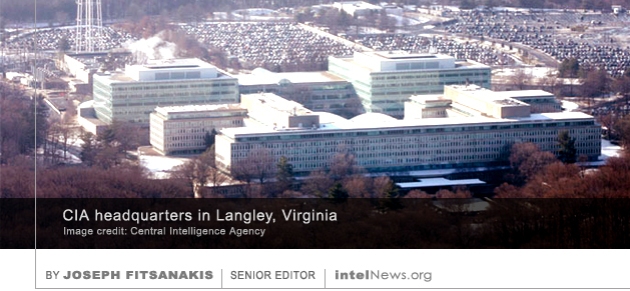
Computer hackingTwo more members of a computer hacker group that targeted senior United States intelligence officials, including the director of the Central Intelligence Agency, have been arrested by the Federal Bureau of Investigation. The arrests of Justin Liverman, 24, and Andrew Boggs, 22, took place on Thursday in Morehead City and North Wilkesboro, in the US state of North Carolina. They are accused by the FBI of being members of Crackas With Attitude (CWA) an international group of computer hackers that specialized in targeting American intelligence and law enforcement officials.

Last October, the international whistleblower website WikiLeaks published personal emails and documents belonging to CIA Director John Brennan. The documents included a 47-page application for security clearance that Brennan had submitted to the US government a few years earlier. It was apparently found on his personal America Online (AOL) email account, which had been hacked by the CWA hacker group. Members of the group, who are all in their late teens or early 20s, routinely employed a method known as ‘social engineering’ to gain access to their victims’ information. The method refers to impersonating technicians or other service provider company personnel to gain access to private email or telephone accounts.

CWA members used these techniques to target dozens of senior US government officials from October 2015 until February 2016. Their targets included the Director of National Intelligence James Clapper and the Deputy Director of the FBI, Mark Giuliano. The hackers also gained access to electronic databases belonging to the US Department of Justice, from where they obtained the names, personal telephone numbers and home addresses of nearly 30,000 employees of the FBI and the Department of Homeland Security. That information was eventually published online by the hacker group.

In February, a 16-year-old hacker known as ‘Cracka’, who is the purported ringleader of CWA, and whose name cannot be released due to his young age, was arrested in the East Midlands region of Britain. It is believed that information on the teenager’s electronic devices eventually led the FBI to the capture of Liverman and Boggs. The two men have been charged with computer crime and are expected to appear in court in the US state of Virginia next week.

Author: Joseph Fitsanakis | Date: 09 September 2016 | Permalink

Palestinian leader Mahmoud Abbas was KGB agent, researchers claim

Mahmoud Abbas

Mahmoud Abbas

Two Israeli researchers claim that a document from the archives of the Cold-War-era KGB identifies the current president of the Palestine Authority, Mahmoud Abbas, as a Soviet agent. The document was found in the United Kingdom, and was smuggled out of Russia by a former senior archivist of the Soviet KGB. Abbas is the leader of the largely secular Palestinian group Fatah, which controls the West Bank. Unlike Hamas, which is designated a terrorist group by Israel and its allies, Fatah is seen by Tel Aviv as the legitimate representative of the Palestinian people. That is disputed by Hamas, a religiously inspired group, which controls the Gaza Strip and maintains a tense relationship with Fatah and Abbas himself.

The allegation about Abbas’ past emerged on Wednesday in the Israeli media, after two local academic researchers disclosed the contents of a KGB document discovered at Cambridge University’s Churchill Archives Centre in Britain. The researchers, Gideon Remez and Isabella Ginor, of the Truman Institute at the Hebrew University of Jerusalem, said the document dates from 1983. It was found among thousands of similar documents that were secretly smuggled out of Russia in the early 1990s by British intelligence, following the defection of Vasili Mitrokhin, an archivist in the First Chief Directorate of the KGB during the Cold War. Some of the documents later formed the basis of a two-volume edition on the activities of Soviet intelligence, which was edited by Cambridge University Professor Christopher Andrew.

According to Remez and Ginor, the document identifies Mahmoud Abbas as a “KGB agent” based in Damascus, Syria, codenamed krotov, which in Russian means ‘mole’. Abbas was born in Palestine in 1935, but his family fled to Syria in 1948, following the establishment of the state of Israel and the outbreak of the first Arab-Israeli war. The young Abbas grew up in Damascus, where he went to university and joined the local branch of the PLO, the Palestinian Liberation Organization, of which Fatah is a member. If true, the allegation that Abbas worked for the KGB will not come as a surprise to observers of Palestinian politics. For most of the Cold War, the PLO was known to be close to Moscow, while Abbas was intimately involved with the Palestinian-Soviet Friendship Association, a pro-Moscow group that was widely seen as an agent of communist influence in the Palestinian territories. But the document from the Mitrokhin archives may be the first concrete evidence that Abbas was handled by the KGB.

Palestinian officials quickly dismissed the document on Wednesday as a fabrication and a deliberate slander. Mohammed al-Madani, a member of the central committee of Fatah, and a close associate of Abbas, said the allegation was part of a “clear effort to damage [Abbas] by various actors, including the government of Israel”.

Author: Joseph Fitsanakis | Date: 08 August 2016 | Permalink

FBI warns against alleged Russian campaign to destabilize US elections

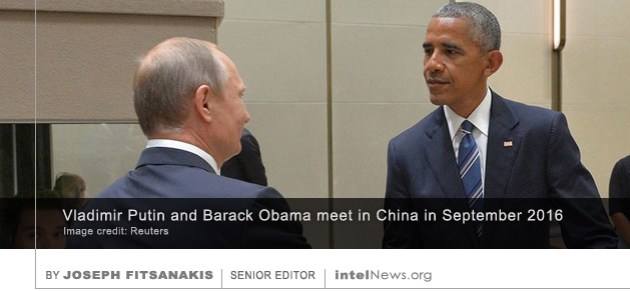
Putin and ObamaThe Federal Bureau of Investigation is among several intelligence agencies in the United States that have expressed concerns about an alleged Russian campaign to destabilize November’s presidential elections. The Washington Post, which revealed the FBI’s concerns on Monday, claimed that Moscow recently launched an “active measures” operation aimed at covertly sabotaging the integrity of the US election process. Russia’s goal, said the paper, was to “counter US leadership and influence in international affairs”, thus subverting America’s image, especially in countries of the former Eastern Bloc or former Soviet republics.

According to The Post, the FBI and other US intelligence agencies have “no definitive proof” that Moscow is attempting to promote public distrust in American political institutions. But there are strong indications that have made this topic “a priority” for intelligence officials from the FBI, the Department of Homeland Security, the National Security Agency and the Central Intelligence Agency, said the paper. These indications include the hack of the computer systems at the Democratic National Committee, the official governing body of the US Democratic Party, which was revealed in June. The hack resulted in the disclosure of over 20,000 internal emails and led to the resignation of Debbie Wasserman-Schultz, the DNC’s Chairwoman. According to The Post, the hack is “not yet officially ascribed by the US government to Russia”, but US intelligence officials are convinced that Moscow was behind it.

The DNC hack prompted the FBI to send a so-called “flash alert” to US election officials in July, urging them to remain vigilant against “attempts to penetrate election systems”, which have been detected in several states, according to the report. The unprecedented FBI alert did not expressly name Russia as a national-security threat, nor did it give details of electoral sabotage. But it urged state election officials to “be on the lookout for intrusions into their election systems”. Citing unnamed intelligence officials, The Post said that the investigation into alleged Russian operations against the US Presidential election is being coordinated by James Clapper, the US Director of National Intelligence.

Author: Joseph Fitsanakis | Date: 07 August 2016 | Permalink

Czech spy service accuses Russia of waging ‘information war’

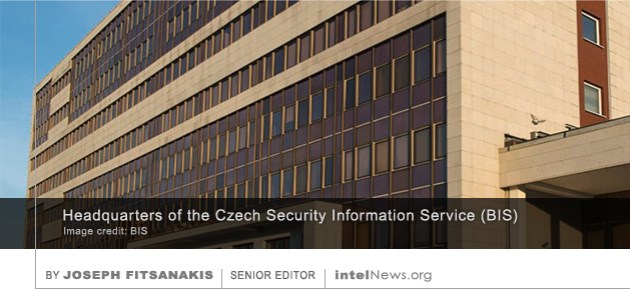
Czech Security Information ServiceThe intelligence agency of the Czech Republic has accused Russian spy services of waging a “war of information” aimed at destabilizing the eastern European country. The agency has also warned that Russia continues to maintain a large intelligence presence in the Czech Republic, 25 years after the country, which was formerly known as Czechoslovakia, exited the Soviet sphere of influence and joined the European Union (EU) and the North Atlantic Treaty Organization (NATO).

These claims are included in the annual report of the Security Information Service of the Czech Republic, known as BIS. The report, which was published on Thursday, singles out Russia and China for allegedly operating the two most active intelligence apparatuses in the Czech Republic today. It also claims that Russia’s embassy in Prague, which exceeds in size that of any other country in the Czech capital, serves as a base for dozens of spies. The latter are among the 140 diplomatic personnel stationed at the Russian embassy, operating under diplomatic cover, according to BIS.

In addition to collecting intelligence and recruiting spies, Russia’s undercover efforts in the Czech Republic focus on “creating or promoting inter-societal and inter-political tensions” in the country, said the report. That is allegedly one in many ways, including covert support for domestic extremist and populist organizations –both rightwing and leftwing, according to BIS. There are also organizations in the country, described by the Czech intelligence agency as parts of a network of “puppet” groups, which tend to hold consistently pro-Russian stances on domestic and international issues. They are also highly critical of NATO and the EU, and promote the view that, like Britain, the Czech Republic should seek to exit the EU.

The report suggests that the main focus of the current phase of the alleged “information war” is to advertise the Russian viewpoint on the civil wars in Ukraine and Syria. However, “the infrastructure created for achieving these goals will not disappear with the end of the two conflicts” and “can be used to destabilize or manipulate Czech society […] at any time, if Russia wishes to do so”, the report states.

Author: Joseph Fitsanakis | Date: 02 September 2016 | Permalink

Monitoring continues as Libya’s chemical weapons are shipped to Germany

ISIS LibyaAs United States air strikes and special-forces operations continue in Libya, Libya’s Government of National Accord deputy prime minister, Mussa al-Koni, confirmed on Tuesday that their remaining chemical weapons left over from the Gaddafi era has been shipped to Germany for safekeeping. The process was supervised by the United Nations, based on UN Security Council Resolution 2298 (2016) adopted on July 22. The concern was the Islamic State getting their hands on the chemical stockpile that was stored in the central Jafa area, about 140 miles south of Sirte, where pro-government forces are currently fighting Islamic State militants.

Islamic State forces acquiring CBRN from Africa or producing it while in the region has been a continuous concern. Islamic State and other militant organizations are expanding throughout Africa’s 11.67 million mi². These groups can be very innovative and resourceful. As the Egyptian delegation highlighted in a UN Security Council debate on the proliferation of weapons of mass destruction last week, the Islamic State and other groups have already caused destruction in Iraq, and possibly also in Syria by using chemical weapons. The Egyptians and other African countries see a real possibility of these weapons spreading further in Libya and from there to the Horn of Africa or elsewhere on the continent. The final departure of Gaddafi’s stockpile is welcome news, but Islamist militants know how to acquire such weapons, are trying to produce them and know how to cross borders.

African intelligence and law enforcement agencies are alert to these and other new threats. Intelligence reports have indicated groups such as al-Qaeda in the Maghreb (AQIM) have made multiple attempts to manufacture poison, gas, biological and radioactive agents. Training camps, particularly in the Sahel area, specialized in biological and chemical weapons are known to exist. Many African nations have put their national interests aside to counter cross border Islamist or criminal threats. In late September 2010, Algeria set up a regional intelligence center in Algiers, bringing together the countries of the region to fight against militant groups, including CBRN trafficking. Similar centers around the continent exist like Kenya’s common intelligence centre in Nairobi used for joint training on investigation skills and on ways to protect borders. The center also is used to monitor and address threats posed by militant groups in Kenya, Uganda, Rwanda and South Sudan. A more recent regional intelligence center, similar to Kenya’s, was established in Kampla, Uganda, which is supported by the African Union and seeks to prevent possible attacks by militant groups.

Another concern the Centers and domestic African intelligence agencies are investigating is the recruitment of African youth by Islamist groups.  “[The Islamic State] has attracted about 5,000 Africans to join them in Iraq and Syria. Some of them are from the East Africa Community and IGAD regions”, proclaimed the African Union Commissioner for Peace Security Smail Chergui in July 2015.

Author: Scott Firsing is an adjunct professor at the University of North Carolina Wilmington

CIA agent was among Watergate burglars, documents reveal

Watergate One of the men caught burglarizing the offices of the United States Democratic Party in 1972, a ploy that led to the resignation of President Richard Nixon, was an agent of the Central Intelligence Agency, according to a newly declassified document. The revelation is included in a narrative history of the Watergate scandal, produced over 40 years ago by the CIA to assess its own role in the affair. It recounts the events of the early morning hours of June 17, 1972, when a security guard saw five men dressed in black breaking into the headquarters of the Democratic National Committee at the Watergate office complex in Washington, DC. When the five men were arrested by police, it was discovered that one of them was connected with the Committee for the Re-Election of the President, a fundraising organization set up by US President Richard Nixon. The remaining four burglars had CIA contacts. They included E. Howard Hunt, a retired CIA operations officer who in 1961 had played a leading role in the failed Bay of Pigs invasion. It was eventually discovered that the burglary had been authorized by President Nixon himself, as part of a broader program to sabotage his political opponents.

Soon after the Watergate scandal erupted, the CIA produced an internal report entitled “CIA Watergate History – Working Draft”. Much of the 150-page document was authored by CIA officer John C. Richards, who had firsthand knowledge of the Watergate scandal. When Richards died unexpectedly in 1974, the report was completed by a team of officers based on his files. A few years ago, a Freedom of Information Act request was filed by Judicial Watch, a conservative legal watchdog, which petitioned to have the document released. The release was approved by a judge in early 2016 and was completed in July.

Despite numerous reductions throughout, the document gives the fullest public account of the CIA’s role in the Watergate scandal. Its pages contain the revelation that one of the men arrested in the early hours of June 17, 1972, was an active CIA agent. The man, Eugenio R. Martinez, has been previously identified as an “informant” of the CIA —a term referring to an occasional source. But the newly released document refers to Martinez as an agent —an individual who is actively recruited and trained by a CIA officer acting as a handler. It also states that Martinez was on the payroll of the agency at the time of his arrest, making approximately $600 per month in today’s dollars working for the CIA. Additionally, Martinez, a Cuban who had participated in the Bay of Pigs invasion, retained his contacts with the CIA and kept the agency updated about the burglary, his arrest and the ensuing criminal investigation.

Interestingly, the internal document reveals that the CIA was contacted about Martinez by the Watergate Special Prosecution Force, which was set up by the Department of Justice to investigate the scandal. But the CIA’s General Counsel, John S. Warner, told the prosecutors that it was against the CIA’s code of practice to turn over an agent, and that “under no circumstances” would the CIA agree to do so. Senior CIA officials, including its then Director, Richard Helms, continued to refuse to cooperate with investigators, including agents of the Federal Bureau of Investigation, even after President Nixon’s resignation.

Martinez, who is reportedly in his mid-90s and lives in Miami, Florida, has never spoken publicly about this role in the Watergate scandal or his alleged contacts with the CIA.

Author: Joseph Fitsanakis | Date: 31 August 2016 | Permalink

Conflicting details on Iranian nuclear negotiator arrested for espionage

Iran nuclear negotiationsIranian officials have confirmed reports from earlier this month that a member of the country’s team of nuclear negotiators has been arrested for engaging in espionage for a foreign country. But there are conflicting details about the case in Iranian media reports. Rumors about the identity of the individual began to circulate on August 16, after the office of the Iranian prosecutor announced that a dual national with Iranian citizenship had been arrested for spying on Tehran for a foreign intelligence service. The individual was not named, but some reports connected him with Britain’s Secret Intelligence Service, known as MI6.

On Sunday, Iran’s judiciary spokesman, Gholamhossein Mohseni Ejeie, identified the man as Abdolrasoul Dorri Esfahani. Ejeie was specifically asked about the espionage case during his weekly press conference, and responded saying that an “espionage infiltration” had indeed been detected and that “legal action” was being taken against Esfahani. He did add, however, that the arrest and concurrent investigation had not yet resulted in a case that could stand in court, thus Esfahani had been released on bail. When asked whether Esfahani would be charged, Ejeie said that official charges had not been filed, because “the charge against [Esfahani] has not been proven yet”. He implied, however, that charges would eventually be filed.

There are also conflicting reports about Esfahani’s background and involvement with the Iranian government. Early reports suggested that he is a dual citizen of Canada and Iran. But subsequent reports stated that he holds both Iranian and British passports, and that he had been recruited by MI6. Some unconfirmed reports claimed that Esfahani received payments from both British and American intelligence agencies. What appears more certain is that Esfahani is an accountant with some involvement in the financial aspects of the recent nuclear negotiations between Iran and foreign powers. It is also believed that he was not a core member of Iran’s negotiating team, but provided a supporting role on financial aspects of the negotiations.

The recently concluded negotiations, were aimed at bridging the differences between the Islamic Republic and a group of nations that have come to be known as P5+1, representing the five permanent members of the United Nations Security Council plus Germany. In March 2015, Hossein Motaghi, a media advisor to the Iranian president Hassan Rouhani, who was in Switzerland to cover the negotiations, defected and filed an application for political asylum in Switzerland.

Author: Joseph Fitsanakis | Date: 30 August 2016 | Permalink

US denies it plans to free top intelligence analyst who spied for Cuba

Ana Belen MontesThe White House has no plans to release an American former military analyst who spied for the government of Cuba, according to an official letter sent to a member of the United States Congress. The denial came weeks after some media reports in Miami and Cuba suggested that Washington was examining a request by Havana to release Ana Belen Montes, an American intelligence analyst and expert on Cuba, who is serving a 25-year prison sentence for spying on the United States on behalf of Cuba.

Montes, who is the daughter of an American military doctor, grew up in Kansas. In 1985 she joined the Defense Intelligence Agency, a US Department of Defense body that collects and analyzes military-related information abroad. Montes quickly distinguished herself in the DIA, and by the mid-1990s she was seen as one of the US government’s most knowledgeable and capable Cuba experts. She was the main author of nearly every major assessment on Cuba that was produced by the US Intelligence Community in the 1990s. But on September 21, 2001, Montes was arrested by the Federal Bureau of Investigation and charged with having committed espionage for Cuba. During her trial, US government prosecutors argued that Montes had been recruited by Cuban intelligence before she joined the DIA, and that she eventually compromised every US intelligence collection program targeting the Caribbean island. The former DIA analyst was also accused of having given Havana the identities of US intelligence officers who had secretly operated in Cuba. In 2002, Montes was sentenced to 25 years in prison, after pleading guilty to having committed espionage throughout her 16-year career at the DIA.

But in recent months, there has been speculation that Montes could be released and allowed to relocate to Cuba. In return, Havana would reportedly extradite to the US Assata Shakur, a former member of militant black nationalist groups in the United States, who is wanted for the 1973 murder of a state trooper in the state of New Jersey. Shakur, whose birth name is JoAnne Deborah Byron, escaped from an American prison in 1979 and resurfaced in Cuba in 1984. The island’s socialist government gave Shakur political asylum, but the FBI has designated her a terrorist.

The rumors about a possible exchange between Montes and Shakur prompted US Representative Devin Nunes, a Republican from California, who chairs the House Permanent Select Committee on Intelligence, to voice concern. In a letter to US President Barack Obama, Nunes urged against Montes’ release. The Congressman described the imprisoned former intelligence analyst as “one of the most brazen traitors in US history” and remarked that she “richly deserved her 25-year prison sentence, and must serve every day of it”. According to El Nuevo Herald, Nunes received a written response from the US Department of State, which said that “the United States government has no intention of releasing or exchanging Montes”. According to the Florida-based, Spanish-language newspaper, the State Department letter “assured” Nunes that it was “responding on the president’s behalf”, suggesting that the Obama administration has no plans to release Montes.

Author: Joseph Fitsanakis | Date: 29 August 2016 | Permalink

Turkey has more spies in Germany than Stasi had during Cold War: expert

Turks in GermanyThe Turkish intelligence service currently employs more operatives in Germany than the East German spy agency did at the height of the Cold War, according to a German expert on espionage. The comment was made following the disclosure that Turkey maintains close to 6,000 informants and other intelligence operatives in Germany. An unnamed German security official told German newspaper Die Welt on Monday that the informants are operational throughout Germany and are handled by Turkey’s National Intelligence Organization, known as MİT.

According to Die Welt, many of these informants are tasked with keeping tabs on Germany’s large Kurdish community, which Ankara views as domestic threats to Turkish national security. More recently, however, MİT operatives in Germany have been instructed to infiltrate groups of supporters of the charismatic Muslim cleric Fethullah Gülen who lives in the United States. A former ally of Turkish President Recep Tayyip Erdoğan, Gülen and his millions of supporters around the world now oppose the Turkish government and are described as terrorists by Ankara. President Erdoğan has personally accused “Gülenists” of orchestrating the failed July 15 coup in Turkey. In addition to infiltration, MİT informants in Germany are allegedly engaged in psychological operations against perceived opponents of the Turkish government, and sometimes engage in blackmail and intimidation of targeted individuals or groups, according to Die Welt.

Erich Schmidt-Eenboom, one of Germany’s best known independent researchers on intelligence, and a widely published author, said he was surprised that the number of alleged MİT operatives in Germany is this high. If the number of 6,000 operatives is accurate, said Schmidt-Eenboom, it would place the MİT above the level of the Stasi during the Cold War. He was referring to the Ministry for State Security, the intelligence agency of communist-era East Germany, which was known for its extensive networks of informants during the Cold War. Schmidt-Eenboom said that, according to Stasi records, the agency handled approximately 10,000 operatives in West Germany, a country that at the time had a population of 60 million. In contrast, the 6,000 MİT operatives in Germany are primarily tasked with monitoring the Turkish and Kurdish immigrant community there, which numbers no more than 3 million. Consequently, said Schmidt-Eenboom, there are 500 potential human targets for each present-day MİT operative, whereas there were 6,000 West German citizens for every Stasi operative during the Cold War.

The article in Die Welt did not specify whether the alleged MİT informants are paid agents or simply supporters of the Turkish government who have volunteered their services. As intelNews reported earlier this week, some members of the German Bundestag’s Committee on Parliamentary Oversight, including its chairman, Clemens Binninger, plan to launch an official investigation into the activities of Turkish intelligence in Germany. Of particular interest to the committee is the alleged cooperation between German and Turkish intelligence agencies following the failed coup in Turkey this past July.

Author: Joseph Fitsanakis | Date: 26 August 2016 | Permalink

Did domestic snooping by Canadian spy agency increase 26-fold in a year?

CSE Canada - IAThe volume of domestic communications that were intercepted by Canada’s spy agency increased 26 times between 2014 and 2015, according to a recently released report by a government watchdog. The same report states that intercepted information about Canadian citizens, which is given to Canada’s spy agency by the intelligence organizations of other Western countries, has increased so much that it now requires an elaborate mechanism to analyze it. When asked to explain the reasons for these increases, Canadian government officials said they could not do so without divulging secrets of national importance.

Information about these increases is contained in the latest annual report by the Office of the Commissioner of the Communications Security Establishment. The body was set up in 1996 to review the operations of the Communications Security Establishment (CSE). Founded in 1946, CSE is Canada’s primary signals intelligence agency. It is responsible for interception foreign communications while at the same time securing the communications of the Canadian government. The Office of the Commissioner monitors CSE’s activities and ensures that they conform with Canadian law. It also investigates complaints against the CSE’s conduct of and its officers.

Canadian law forbids the CSE from intercepting communications in which at least one of the parties participating in the exchange is located in Canada. If that happens, the message exchange is termed “private communication” and CSE is not allowed to intercept it, unless it gets written permission from Canada’s National Defense minister. Such permission is usually given only if the interception is deemed essential to protect Canadian national security or national defense. If a “private communication” is inadvertently intercepted, CSE is required to take “satisfactory measures” to protect the personal privacy of the participant in the exchange that is located inside Canada.

According to the CSE commissioner’s report for 2015, which was released in July, but was only recently made available to the media, CSE intercepted 342 “private communications” in 2014-2015. The year before, the spy agency had intercepted just 13 such exchanges. The report states that all 342 instances of interception during 2014-2015 were either unintentional or critical for the protection of Canada’s security. It further states that the reason for the huge increase is to be found in “the technical characteristics of a particular communications technology and of the manner in which private communications are counted”.

Canadian newspaper The Ottawa Citizen asked the CSE commissioner, Jean-Pierre Plouffe, to explain what he meant by “technical characteristics of a particular communications technology” in his report. His office responded that the commissioner could not explain the subject in more detail, because doing so would “reveal CSE operational capabilities” and thus hurt Canada’s national security. The newspaper also contacted CSE, but was given a similar answer. Some telecommunications security experts speculate that the increase in intercepted “private communications” may be due to exchanges in social media, whereby each message is counted separately.

Author: Ian Allen | Date: 25 August 2016 | Permalink

Fake Syrian passports given to ISIS members found in Greek refugee camps

Syrian passportFake Syrian passports designed for use by members of the Islamic State trying to enter Europe have been found in refugee camps in Greece during an investigation by the law enforcement agency of the European Union (EU). Officials from Europol, the EU agency that coordinates intelligence operations against organized crime across EU-member-states, said that the fake travel documents were found during a fact-finding mission in Greek refugee camps. The mission was part of a larger investigation into the production and use of forged passports by the Islamic State, the Sunni militant group that is also known as the Islamic State of Iraq and Syria (ISIS).
According to the Italian newspaper La Stampa, which published the claim, Europol is investigating the production and distribution of fake passports by ISIS in its strongholds of Syria and Iraq, and among refugee networks in European countries like Belgium, Austria, Italy and Greece. Greece is the most widely used route into Europe by hundreds of thousands of refugees from Syria and the rest of the Middle East, who leave their countries in hopes of migrating to the prosperous countries of Western Europe. Nearly 60,000 of them have been trapped in Greece since April, when Macedonia shut down its borders, thus preventing migrants from heading north. These people have been living in refugee camps since that time, hoping for a chance to continue the journey northwards.

But in a leading article published last weekend, La Stampa claimed that ISIS is using the refugee crisis form Syria to infiltrate Europe with militants intent on launching attacks on soft targets. The militants are supplied with false identity papers, said La Stampa, primarily fake Syrian and Iraqi passports. They then use these passports to enter Greece. Their goal is to eventually travel north to countries such as Belgium, Germany, Austria or France, and claim asylum there. La Stampa quoted one unnamed Europol official as saying that fake passports “that were destined to supposed members of ISIS” had been identified in refugee camps in Greece. It has been confirmed that at least two of the perpetrators of last November’s attacks in Paris, France, which killed over 130 people, entered the EU using forged Syrian passports. The Italian daily also noted that the reliability of Turkey, from where the vast majority of Syrian refugees entered Europe in recent years, remains fragile after the failed July 15 coup, which has altered the balance of power in that country. As a result, the EU-Turkey migrant deal may collapse “at any moment”, said the paper.

Author: Joseph Fitsanakis | Date: 24 August 2016 | Permalink

Analysis of the Islamic State’s ‘wedding attack’ in Gaziantep, Turkey

Gaziantep, TurkeySaturday’s suicide bombing, which killed over 50 and injured dozens at a wedding in Gaziantep, Turkey, was without doubt the work of the Islamic State. It was yet another attempt by the militant Sunni group to discourage the Kurds from confronting it in battle, by pointing to the deadly consequences. It was also fueled by the desire for vengeance against a population that has consistently resisted the Islamic State’s ideology. Additionally, if confirmed, the use of a child as a suicide bomber by the Islamic State may form a pattern of operational activity that can lead to broader conclusions about the current state of the organization.

It has become increasingly clear in the past two years that the armed Kurdish groups in northern Syria and Iraq, as well as Kurdish peshmerga units based in Turkey, are some of the most formidable opponents of militant Jihadists on the ground. By bombing soft targets inside Turkey, the Islamic State is sending a message to the Kurds that armed opposition on the ground will carry a heavy cost at home. Contrary to initial impressions, there was nothing special about the particular wedding ceremony that was targeted on Saturday. Any wedding would have been suitable for the Islamic State’s purpose. In fact, the randomness of the attack increases its shock value by demonstrating to the local population that any activity can be attacked, even if it does not involve notables. Additionally, the specific choice of a wedding magnifies the brutality of the attack, by targeting a young couple on what is typically the happiest day of their lives. The high concentration of children among the casualties may indicate that the bomber was given specific operational instructions to attack younger participants. The clear warning here is that the disruption will leave nothing untouched –including something as ‘off-limits’ as a couple on their wedding day, or groups of children– if the Kurds continue to fight the Islamic State.

Moreover, the Islamic State is trying to widen the already deep division between the Turkish state and the Kurds, by exposing the inability of the government in Ankara to protect its Kurdish population from attacks. The Kurds already resent Turkey’s ‘soft policy’ on the Islamic State. They and the rest of the world can see that Ankara has typically viewed the government of Bashar al-Assad in Damascus as far more threatening than the continuing rise of Islamist fundamentalism. Since the failed July 15 coup, the Turkish state has begun to revise its soft stance on the Islamic State, but this comes too late to pacify the country’s infuriated Kurdish population. This latest attack will only intensify the deep anger felt by the Kurds against the Turkish state.

Initial reports indicate the possible use of a child or a teenager to carry out the Gaziantep bombing. These may or may not be accurate. They could easily be an attempt by the Kurds to further-incense international public opinion against the Islamic State. If the reports are accurate, they do not necessarily represent some sort of break from the traditional tactics of the Islamic State. According to the group’s war-fighting doctrine, there is no differentiation between men and children when it comes to what it sees as the defense of Sunni religious doctrine. Every Muslim, regardless of race, gender, or age, is required to engage in holy war. Indeed, the Islamic State has deployed children before, in warfare, executions and suicide bombings against both hard and soft targets. However, even though the use of a child to carry out the Gaziantep bombing is not in itself unique, or particularly important, it matters if it forms part of a broader pattern. If it is verified that ISIS is increasingly using children in suicide bombings, or in warfare, it may signify two things: first, that the organization is finding it difficult to recruit able-bodied men for missions. Second, that adult ISIS recruits are becoming scarcer, so the organization is trying to preserve them for decisive battles.

It may be, of course, that a child or younger teenager was selected in order to avoid security profiling by the Kurds. Still, the use of children in warfare or suicide missions can result in a large degree of unpredictability. Children may be relatively easy targets for recruiters, for the obvious reason that they are young and impressionable. Their reality can therefore be effectively altered by fantastical tales of the supernatural, which the Islamic State is very skilled at. However, children are not necessarily very dependable in war, or terrorism. They can be easily frightened, can change their mind at the last minute, and they do not stay calm under pressure. There are several recent examples of children or teenagers who were recruited for suicide operations but surrendered after changing their mind.

Ultimately, shocking massacres such as Saturday’s attack in Gaziantep cannot be prevented. They can only be limited through careful police and intelligence work. In the case of Turkey, however, this will be difficult. The country’s police, intelligence and military structures have been significantly weakened following the failed July 15 coup. Thousands of government officials, police officers, intelligence and military personnel have been fired, demoted or imprisoned. The state, which is becoming increasingly synonymous with the President Recep Tayyip Erdoğan’s AKP party, is too preoccupied with preserving its own stability to concentrate on combating the terrorist spillover from Syria.

Author: Joseph Fitsanakis | Date: 23 August 2016 | Permalink

Turkey asks German spies for help in rounding up July coup plotters

Recep Tayyip ErdoğanThe Turkish government has sent an official request to German intelligence for assistance in cracking down on the members of the so-called Gülen movement, which Ankara claims is behind July’s failed coup plot. The movement consists of supporters of Muslim cleric Fethullah Gülen, who runs a global network of schools, charities and businesses from his home in the United States. The government of Turkey has designated Gülen’s group a terrorist organization and claims it has stealthily infiltrated state institutions since the 1980s. The administration of Turkish President Recep Tayyip Erdoğan accuses Gülen’s supporters of orchestrating the July 15 coup that included an armed attack on the country’s parliament and the murder of over 200 people across Turkey.

According to German newsmagazine Der Spiegel, Turkey’s National Intelligence Organization (known by its Turkish initials, MİT) has secretly contacted its German counterpart, the Federal Intelligence Service (BND). The Turks’ request, said Spiegel, involves the provision of assistance to investigate and arrest supporters of the Gülen movement living in Germany, some of whom are German citizens. There are over three million people with Turkish citizenship, or of Turkish descent, currently living in Turkey. Citing “a dossier of classified documents”, Spiegel said that the MİT had asked the BND to investigate a list of 40 individuals for possible links to Gülen, and to extradite to Turkey another three whom Ankara claims have direct ties to the July coup. The documents also allegedly contain a request for MİT officials to pressure German lawmakers to be more critical of Gülen supporters in Germany. Requests for cooperation were also sent by MİT to nearly a dozen state governments in Germany, but all were declined, said Spiegel.

The Turkish government has arrested, fired or demoted tens of thousands of people since July, for alleged links to the Gülen movement. Some European officials, many of them German, have accused President Erdoğan of using the failed coup as an excuse to purge his opponents of all political persuasions in the country. On Sunday, the head of Germany’s Committee on Parliamentary Oversight, Clemens Binninger, said he would launch an investigation into the joint projects between German and Turkish intelligence agencies following the failed July coup. Another member of the Committee, Hans-Christian Ströbele, said he would personally set up a panel to probe any communication between German intelligence agencies and the MİT. By working closely with Turkish intelligence, German spy agencies were risking “becoming complicit in criminal activity”, said Ströbele.

Author: Joseph Fitsanakis | Date: 22 August 2016 | Permalink

More on senior North Korean diplomat who defected in London

Thae Yong-HoA high-ranking North Korean diplomat, who defected with his wife and children in London, and is now in South Korea, is from a privileged family with a long revolutionary pedigree in North Korean politics. South Korea’s Ministry of Unification confirmed on Wednesday that Thae Yong-Ho, the second-in-command at the North Korean embassy in the United Kingdom, had defected with his wife and children and had been given political asylum in South Korea. As intelNews reported earlier this week, Thae, a senior career diplomat believed to be one of North Korea’s foremost experts on Western Europe, had disappeared with his family and was presumed to have defected “to a third country”.

New information has since emerged on Thae and his family, confirming that both he and his wife are members of North Korea’s privileged elite, with decades-old connections to the ruling Workers’ Party of Korea. According to the Seoul-based JoongAng Daily, Thae’s wife, O Hye-Son, is a niece of the late O Peak-Ryong, a decorated communist guerrilla who fought Korea’s Japanese colonialists in the 1930s. O, who died in the 1980s, joined the Korean anti-Japanese struggle alongside Kim Il-Sung, founder of the Workers’ Party of Korea and first leader of North Korea. This means that O Hye-Son is also the cousin of O Peak-Ryong’s son, General O Kum-Chol, who is currently vice chairman of the General Staff of the Korean People’s Army. Thae himself is the son of Thae Pyong-Ryol, a four-star general who also fought against the Japanese in the 1930s, alongside Kim Il-Sung. In the postwar period, General Thae became a senior member of the Workers’ Party of Korea and was appointed to the Party’s powerful Central Committee. He died in 1997.

JoongAng Daily quoted an unnamed “source familiar with the matter” of Thae’s defection, who said that the diplomat’s loyalty to the North Korean leadership had been unquestioned prior to his surprise defection. Most North Korean diplomats are posted at an embassy abroad for a maximum of three years before being moved elsewhere in the world. The fact that Thae had been allowed to remain in the United Kingdom for 10 years shows his privileged status within the Workers’ Party of Korea, said the source. Additionally, the children or most North Korean diplomats are required to return to their native country after completing high school. But this did not seem to apply to Thae, whose three children were living with him in Britain even after graduating from university. This and many other clues reflect Thae’s “impeccable credentials”, said the source, which made him one of the most trusted government officials in the regime’s bureaucratic arsenal.

It is believed that Thae defected because he had been told that his tenure in London was coming to an end after a decade, and he would have to relocate to a less desirable location, or possibly recalled back to Pyongyang. Defections among North Korea’s privileged elite are rare, but have been happening increasingly frequently in the past few years. This makes some observers believe that disillusionment among Supreme Leader Kim Jong-Un’ inner circle is growing and that the North Korean regime is becoming weaker.

Author: Joseph Fitsanakis | Date: 19 August 2016 | Permalink

Senior North Korean diplomat reportedly defects in London (updated)

DPRK Embassy in LondonA senior member of North Korea’s diplomatic representation in the United Kingdom, who is considered one of his country’s leading specialists in Western European affairs, has reportedly defected “to a third country” with his family. The alleged defection was first reported on Tuesday by South Korean newspaper JoongAng Ilbo. Citing “a source with in-depth knowledge of North Korea”, the Seoul-based paper said that the diplomat had disappeared several weeks ago, and that staff at the embassy of North Korea in London had failed in attempts to find him. Later on the same day, the British state-owned broadcaster BBC identified the missing diplomat as Thae Yong-Ho.

In a brief report, the BBC said that the diplomat had lived with his wife and children in London for a decade, and that the family —especially its younger members— were very integrated in British culture and way of life. Further updates in South Korean media said Thae was serving as deputy consul at the embassy, essentially as second-in-command after Ambassador Hak Bong Hyon. It is also believed that Thae was tasked with promoting a positive image of North Korea to British audiences, and was also in charge of cultivating the embassy’s relations with the UK Korean Friendship Association, an organized group of North Korean ideological sympathizers in Britain. But some reports indicate that the alleged defector also performed intelligence tasks, such as monitoring the activities of North Korean defectors living in London.

Thae is believed to be a senior member of North Korea’s diplomatic community. He grew up in China and is fluent in Chinese and English, in addition to his native Korean. He joined North Korea’s diplomatic ranks soon after graduating from university and is said to be one of the country’s foremost experts on Western Europe. If confirmed, his defection will deliver a serious blow to North Korea’s prestige and arguably hurt its intelligence capabilities in the West. This development will also have a major impact on the operations of the Asian country’s embassy in London, which is run by only five diplomats, including the ambassador. No comments have been made on this story by the UK Foreign and Commonwealth Office, the embassy of North Korea in London, or the government of South Korea. According to JoongAng Ilbo, Thae is currently “going through procedures to seek asylum in a third country” with his family.

Update 17 Aug. 2016, 5:00 p.m. GMT: The BBC now reports that Thae has defected to South Korea and that he and his family are “under the [South Korean] government’s protection”, according to officials in Seoul. He is believed to be the most senior North Korean official to have ever defected in the history of the communist state.

Author: Joseph Fitsanakis | Date: 17 August 2016 | Permalink