Research sheds light on Japan’s wartime espionage network inside the United States
September 26, 2022 1 Comment
 MUCH HAS BEEN WRITTEN about the wartime intelligence exploits of the Allies against Japan. Such exploits range from the United States’ success in breaking the Japanese JN-25 naval code, to the extensive operations of the Soviet Union’s military intelligence networks in Tokyo. In contrast, very little is known about Japan’s intelligence performance against the Allies in the interwar years, as well as after 1941. Now a new paper by an international team or researchers sheds light on this little-studied aspect of intelligence history.
The researchers, Ron Drabkin, visiting scholar at the University of Notre Dame, K. Kusunoki, of the Japan Maritime Self-Defence Force, and Bradley W. Hart, associate professor at California State University, Fresno, published their work on September 22 in the peer-reviewed journal Intelligence and National Security. Their well-written article is entitled “Agents,  Attachés, and Intelligence Failures: The Imperial Japanese Navy’s Efforts to Establish Espionage Networks in the United States Before Pearl Harbor”.
The authors acknowledge that the history of the intelligence efforts of the Imperial Japanese Navy (IJN) has received very little attention by scholars. Consequently, it remains unexplored even in Japan, let alone in the international scholarship on intelligence. There are two main reasons for that. To begin with, the IJN systematically destroyed its intelligence files in the months leading to Japan’s official surrender in 1945. Then, following the war, fearing being implicated in war crimes trials, few of its undercover operatives voluntarily revealed their prior involvement in intelligence work.
Luckily, however, the past decade has seen the declassification of a number of Federal Bureau of Investigation (FBI) counterintelligence files relating to Japanese intelligence operations targeting the United States. Most of these files date from the 1930s and early 1940s. Additionally, a number of related documents have been declassified by the government of Mexico, which is important, given that Mexico was a major base for Japanese intelligence operations targeting the United States. Read more of this post
 THE UNPRECEDENTED GROWTH OF digital access in our time has revolutionized online user access to information. Yet, the same phenomenon is behind the growing power of individuals, groups and state actors to create and disseminate misinformation and disinformation with unprecedented intensity. In the case of misinformation, false, mistaken or otherwise misleading information is disseminated by unsuspecting users. When these actors are acting deliberately with the intention to mislead, deceive or confuse, their actions amount to disinformation.
 A NEW STUDY SHEDS light on the little-studied topic of counterintelligence operations launched against Israel by the Islamic Resistance Movement, better known as Hamas. Hamas is a Palestinian Sunni Islamist and nationalist organization with a 35-year history, which has controlled the Gaza Strip since 2007. As is typically the case with Middle Eastern non-state actors, Hamas is a complex umbrella organization that combines social-service and administrative functions with armed elements. The latter include internal policing components and a full-time military wing, as well as reserve armed forces.
 THE NORTHERN IRISH CONFLICT was a 30-year irregular war involving the government of the United Kingdom and an assortment of paramilitary groups. By the mid-1990s, when most of these groups had declared ceasefire, over 3,600 people had been killed and over 40,000 injured. The major paramilitary groups that participated in the conflict were the separatist Provisional Irish Republican Army (IRA) and Irish National Liberation Army (INLA), and the pro-UK, or ‘loyalist’, Ulster Volunteer Force (UVF) and Ulster Defence Association (UDA).
 INTELLIGENCE OBSERVERS OFTEN REFER to the Communist Party of China (CPC) as “the world’s largest secret society”. Barring brief periods of relative openness in the late 1990s and early 2000s, the closed decision-making system of the CPC has presented Western intelligence analysts with cascading intractable enigmas for over half a century. This problem has become even more pressing under the decade-long leadership of Xi Jinping, during which the imposition of rigorous counterintelligence measures have turned China into a text-book hard intelligence target.
 social media, to social-science-based quantitative studies. Sverdrup-Thygeson and Stenslie explain that the two extremes of Beijingology are invariably disconnected from what is actually happening on the ground in China, and are thus of limited value.
 RUSSIANS ARE AWARE OF the phrase “there is no such thing as a former chekist”. The term “chekist” dates from the Bolshevik-era All-Russian Extraordinary Commission (VChK, pronounced “cheka”), which was formed in 1917 as the first Soviet-era state security agency. By the 1940s, intelligence posts had come to be seen as life-long relationships between chekists and the Soviet government, which continued even after one’s retirement. In
  with reference to three Russian intelligence agencies, all of which trace their origins to the Soviet-era Cheka —namely the Foreign Intelligence Service (SVR), the Federal Security Service (FSB), and the Federal Protective Service (FSO).
 ALTHOUGH INTELLIGENCE IS A traditionally male-dominated profession, the integration of women into the field has grown exponentially in our time. The area of human intelligence (HUMINT), i.e. the use of human handlers to extract secrets through the use of human agents, is among the areas of the profession that remain most resistant to the incorporation of women. Now new research from Germany is shedding light into the understudied topic of female approaches to HUMINT.
 Researchers at a university in Israel claim to have discovered a new low-tech eavesdropping technique, which relies on sound vibrations on the glass surface of light bulbs and requires equipment costing less than $1,000. The researchers claim that the technique, which they call “lamphone”, enables eavesdroppers to intercept, in real time, audible conversations from a room located hundreds of feet away, simply by recording the vibrations that sounds create on the glass surface of a common light bulb present in the room.
 State-sponsored industrial espionage aimed at stealing foreign technical secrets may boost a country’s technological sector in the short run, but ultimately stifles it, according to the first study on the subject. The study is based on over 150,000 declassified documents belonging to the East German Ministry for State Security, known as Stasi. The now-defunct intelligence agency of communist-era East Germany was known for its extensive networks of informants, which focused intensely on acquiring technical secrets from abroad.
 A new study by a British-based organization details for the first time the views of dozens of former Islamic State fighters who have defected from the group in the past year. The study shows that most defectors were disillusioned after witnessing high levels of corruption among Islamic State members, or in response to the extreme violence perpetrated by the group against other Sunni Muslims. The research was carried out by the London-based International Center for the Study of Radicalization and Political Violence (ICSR), which said it gathered the publicly expressed views of nearly 60 Islamic State members who left the organization between August 2014 and August 2015.
 The German and Dutch governments allegedly joined forces to investigate a Russian supercomputer specialist, who studied in Germany and Holland, suspecting him of passing technical information to Russian intelligence. German weekly newsmagazine Der Spiegel, which published the report in its current issue, identified the physicist only as “Ivan A.” and said that the 28-year-old man was a member of a physics laboratory affiliated with the Max Planck Institute in the western German city of Bonn.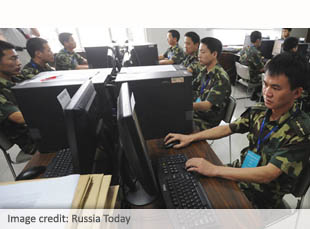









 intelNews.org
Spy agencies must regulate ethics of manipulation in HUMINT, researcher argues
November 7, 2022 by Joseph Fitsanakis 3 Comments
In an article entitled “The Good, the Bad, and the Tradecraft: HUMINT and the Ethics of Psychological Manipulation”, which was published last month in the peer-reviewed journal Intelligence and National Security, Lau argues that the concept of manipulation, which is often central in HUMINT, is nothing new. In fact, he explains, manipulation is a type of social influence that occurs naturally in human interactions, and may even have positive outcomes, depending on the case. Indeed, researchers have analyzed manipulation as a form of beneficial influence, which can help further commonly established social goals and norms. If anything, therefore, argumentative —also known as persuasive— forms of influence are normative aspects of interpersonal negotiation between humans.
COERCIVE INFLUENCE AND MANIPULATION
There is, however, a darker side, Lau explains, which relates to coercive influence —i.e. using threats or force to modify a person’s behavior. The subject becomes even more complicated when manipulation is instrumentalized as “a piece in the toolbox of HUMINT tradecraft”. The author goes on to suggest that manipulative influence in HUMINT can be distinguished between legitimate (harmless) and illegitimate (harmful). It follows that it is possible to attach a degree of ethical responsibility to the actions of case officers, or other covert operators, who engage in clandestine HUMINT activities as part of their work. Read more of this post
Filed under Expert news and commentary on intelligence, espionage, spies and spying Tagged with academic research, Analysis, ethics, HUMINT