Analysis: Iranian-Israeli proxy war flares up in Sudan

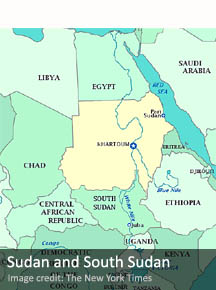
Sudan and South SudanBy JOSEPH FITSANAKIS | intelNews.org |
While much of the world focuses on the effects of hurricane Sandy in the eastern United States, the proxy war between Israel and Iran continues to flare up, this time in Africa. Last week, the government of Sudan accused Israeli of being behind a surprise bombing of a weapons factory in the Sudanese capital Khartoum. According to Sudan’s Minister of Information, Ahmed Belal Osman, four Israeli Air Force jets invaded Sudanese airspace and struck the Yarmouk military complex in Khartoum, inflicting heavy damages. There are unconfirmed claims that the factory was operated by the Iranian government and produced weapons that were smuggled through the Sinai Peninsula into the Gaza Strip, which is controlled by Palestinian group Hamas. On Tuesday, almost exactly a week after the alleged Israeli bombing took place, two Iranian warships arrived in Port Sudan, the country’s most important harbor, located on the Red Sea. The arrival of the vessels was confirmed by Iranian news agency IRNA, which said a helicopter carrier and a destroyer had docked at Port Sudan. The news agency, which is owned by the Iranian government, said the arrival of the ships was meant to contribute to anti-piracy efforts in the Red Sea. But non-Iranian news media, including British newspaper The Independent, quote observers who view the ships’ arrival in Sudan as an Iranian “show of support” for the Sudanese government. According to this explanation, Tehran’s decision to send the ships to the East African country is part of an ongoing proxy war between Iran and Israel taking place throughout the region. Read more of this post

News you may have missed #805 (analysis edition)

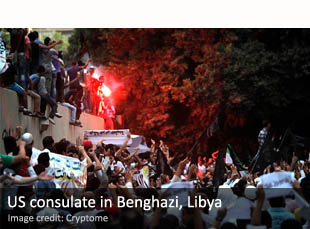
US consulate in Benghazi, LibyaBy IAN ALLEN | intelNews.org |
►►Should the US be wary of Huawei? Regular readers of intelNews know that this blog has been covering the subject of Chinese telecommunications hardware manufacturer Huawei for several years now. During the past few weeks, the United States Congress has flagged the company as being too closely associated with the Chinese intelligence establishment. Other countries have done so as well. But not everyone agrees. New York-based newspaper The Wall Street Journal said recently that “bashing Chinese companies on national security grounds seems like a risk-free strategy” for US politicians and added that, unlike Congress, American governors and mayors are eager to promote investment by Chinese companies. Moreover, Wired‘s Marcus Wohlsenemail suggests that, spies or no spies, US telecommunications companies should fear Huwaei, which is here to stay.
►►Should CIA share some of the blame for Benghazi? For the last month, the US media and Congress have been grilling the State Department for the security failures during the deadly assault on a US compound in Benghazi, Libya. But what if the State Department is the wrong target of scrutiny? According to a counter-theory advanced recently by The Washington Post‘s Dana Milbank, the CIA, not the State Department, bears some responsibility for the security lapse that led to the death of Ambassador Chris Stevens and three other Americans, but is flying under the radar due to the classified nature of its activities in Libya.
►►Could unmanned drones go rogue? Unmanned aerial vehicles, commonly known as drones, have been in the news a lot lately: the US Congress has given the green light for their use by state and local law enforcement, academic researchers, and the private sector. UAVs are rapidly becoming a new tool in patrolling US borders and in NATO military operations in Afghanistan and Pakistan. But non-state actors, including organized criminal gangs and drug cartels, may also be seeing the benefits of UAVs before too long. Read an interesting analysis piece that includes comments by intelNews‘ own Joseph Fitsanakis.

Comment: The Significance of the Killing of Lebanon’s Security Chief

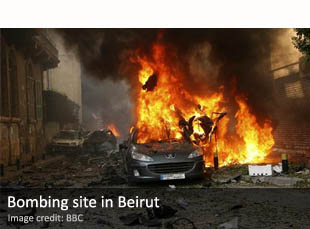
The bombing that killed Wissam al-HassanBy JOSEPH FITSANAKIS*| intelNews.org |
Perhaps the only concrete reality reflected in last week’s assassination of Lebanon’s security chief is the confusion that continues to dominate Western reporting about Lebanese politics. On Friday, Lebanese capital Beirut experienced its most powerful bombing in nearly four years, when a car laden with explosives detonated killing at least eight and injured nearly 100 people. Among the dead was Brigadier General Wissam al-Hassan, head of the intelligence section of Lebanon’s national police force, known as the Internal Security Forces (ISF).  Hassan, a career intelligence officer, was a Sunni Muslim strongly associated with Lebanon’s former Prime Minister Rafik Hariri. Hariri, who was assassinated in Beirut in 2005, was openly anti-Syrian, as was Hassan. This political identification is extremely telling in a country like Lebanon, which has existed under near-complete Syrian political and military domination for the past three-and-a-half decades. Throughout this period, the position of different actors on the Syrian question has been the core defining parameter in Lebanese politics. The same applies to Lebanese institutions. As one such institution, the ISF is widely perceived as strongly anti-Syrian, and is often considered the main rival of the Security Organ of Hezbollah, the Shiite paramilitary group that controls most of southern Lebanon. Read more of this post

Former CIA senior analyst argues in favor of US deal with Iran

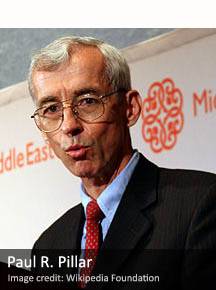
Paul R. PillarBy JOSEPH FITSANAKIS | intelNews.org |
A former senior analyst in the United States Central Intelligence Agency has come out in support of a bilateral compromise between Iran and the West on Tehran’s nuclear program. In an article published last week, Georgetown University professor Paul R. Pillar, who spent nearly three decades with the CIA, dismissed the widespread view that the differences between Iran, Israel, and the West are insurmountable. Commenting on news of a nine-step negotiation plan offered by Tehran in early October, but dismissed by Washington as “unworkable”, Pillar said the offer provided the initial steps of an “eminently achievable agreement” between the interested parties. The CIA veteran, who rose to be one of the Agency’s top analysts prior to his retirement in 2005, argued that a possible outcome of bilateral negotiations would be for Iran to curtail its enrichment of uranium to the 20 percent level in exchange for the lifting of most economic sanctions imposed on Iran by Western countries. “An agreement along these lines makes sense”, he added, “because it would meet the major concerns of each side” in the dispute. He cautioned, however, that, under such an agreement, Tehran would not only be prohibited from continuing its uranium enrichment process, but would also be required to surrender all quantities of uranium previously enriched to a level above 20 percent. Such an agreement, claimed Pillar, would mean that neither Iran nor Israel and the West would receive everything they wanted at once. Instead, the process would depend on a gradual implementation of several bilateral agreements in stages, “each side giving something and getting something at each stage”. Read more of this post

Situation Report: Is DARPA’s Phoenix Program Intelligence-Related?

DARPA's Phoenix ProgramBy TIMOTHY W. COLEMAN| intelNews.org |
The Defense Advanced Research Projects Agency (DARPA), the out-there research arm of the United States Department of Defense, is well known for it’s futuristic and bleeding-edge technology research projects. Often times, the Agency’s highflying efforts seem to protrude a motto of “failure is an option”. In fact, a 2003 article in The Los Angeles Times states that DARPA’s failure rates are between 85 and 90 percent. But this has not prevented the Agency from trying out new things, which sometimes help shape the future. It’s predecessor, Advanced Research Projects Agency, renamed DARPA in 1972, helped create what is today the Internet. Multiplexed Information and Computing Service (aka UNIX), Speech Interpretation and Recognition Interface (Siri, that female voice on your iPhone —yup, she’s a spinout from a DARPA Artificial Intelligence project called CALO), and Onion Routing (core technique for anonymous communications over computer networks, i.e. the base technology underlying Tor), were all funded, in part, by DARPA. Unsurprisingly, DARPA is at it again. The question remains, though, can the hype become a reality or will the new effort find a home in the vast majority of DARPAs forward-looking failed adventures? Read more of this post

News you may have missed #778 (analysis edition)

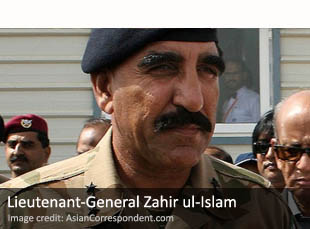
Lieutenant-General Zahir ul-IslamBy IAN ALLEN | intelNews.org |

►►Some rules restrain Mossad’s work in Iran. It is widely believed that at least four assassinations of Iranian nuclear scientists in Tehran were carried out in recent years by Mossad operatives. The perpetrators were part of an elite unit within Israeli intelligence, called Kidon, founded in 1972 to avenge the killing of 11 Israeli athletes at the Munich Olympics, by any means necessary. But veteran Israeli intelligence correspondents Dan Raviv and Yossi Melman argue that the Kidon is not technically a ‘lawless’ organization; it has to comply with a set of “unwritten regulations” adopted by Israel’s secret agencies fifty years ago.
►►Are US and Pakistani spy agencies starting to get along? The relationship between the CIA and Pakistan’s Inter-Services Intelligence (ISI) agency has been at the core of Washington and Islamabad’s alliance for over a decade now. But over the past two years, as suspicions have grown, the two sides had become near adversaries. After months of relations languishing at an all-time low, Pakistan and the US may now be opening up a fresh phase of engagement. Following US Secretary of State Hillary Clinton’s recent apology for the loss of 24 Pakistani soldiers at a border checkpoint last November, NATO supplies are rumbling through again. Washington has also released funds for Pakistani military operations it had previously withheld. And, perhaps most crucially, the two fractious allies’ top spies are said to be talking again. New ISI Director Zahir ul-Islam (pictured) visited Washington for talks earlier this month.
►►Why the US isn’t arming Syria’s opposition –yet. Up until this point, the only thing the US has owned up to is providing humanitarian assistance and communications equipment to Syrian opposition groups. A report earlier this month revealed that US President Barack Obama signed a secret “finding” in July, which allows the CIA to take action in Syria, but does not include lethal support. In other words, the US won’t be sending in Seal Team Six to take down Assad any time soon, but it is training certain groups to handle and gather intelligence. Why is that?

Situation Report: Intel-on-Demand in a Web 2.0 World (Exclusive)

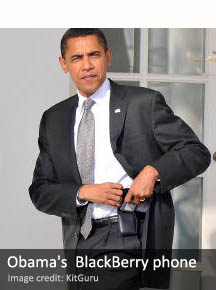
US President Barack Obama and his BlackBerry phoneBy TIMOTHY W. COLEMAN | intelNews.org |
In the United States, the President’s Daily Brief (PDB), “the highest-level intelligence analysis targeted at the key national security issues and concerns of the President”, is increasingly going digital. For that matter, so is much of the output produced by the US Intelligence Community at large. According to AOL Defense News, “The President and his top officials want and will get a single mobile device allowing them to access highly classified and unclassified data wherever they are”. The mobility feature is driven by a desire not to be tethered to a desk or a Sensitive Compartmented Information Facility (SCIF). In addition to the obvious benefits of mobility, the digitized PDB allows for a more in-depth and interactive reading of intelligence matters. In the example of the PDB, as the President reviews the nation’s most sensitive intelligence information on a specialized tablet, he can jump back and forth, click on links to take a deeper dive, see follow-up briefings, review background materials for greater context, view videos, photographs, maps and other visual aids. In fact, the PDB has gone from a static page to an interactive assessment of top intelligence concerns, landing it squarely in a quasi Web 2.0 world for the Intelligence Community. That is not to say that the President is checking Twitter, Facebook or the Rasmussen Report’s daily Presidential Tracking Poll numbers. Instead, reports indicate the digitized hardware has been scaled way down. For obvious reasons, specific details regarding the hardware’s composition and features remain classified. Read more of this post

Comment: Are US Authorities Ignoring Far-Right Terrorism?

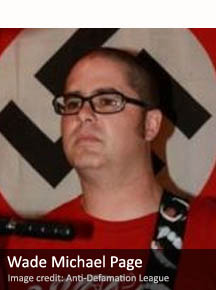
Wade Michael PageBy JOSEPH FITSANAKIS | intelNews.org |
Last month I gave a radio interview on a show syndicated on National Public Radio stations in the United States, in which I warned that American far-right extremism is growing faster than any other time since the rise of the second Ku Klux Klan in the 1920s. I specifically pointed the finger at an increasingly dangerous mix of gun culture, neo-Nazi ideology, and white-nationalist interpretations of Christianity, known collectively as Christian Identity. In the post-9/11 world, many in the West tend to be forgetful of incidents like the neo-Nazi-inspired 1995 Oklahoma City bombing —the largest terrorist attack on US soil prior to 9/11. Even recent high-profile cases, such as the 2011 Norway attacks by neo-Nazi Anders Breivik, who killed 77 people in Oslo and Utøya, have proven unable to challenge that dangerous amnesia. It follows that last Sunday’s mass shooting at a Sikh temple in Oak Creek, Wisconsin, which left seven people dead and three injured, including a police officer, poses a long-overdue opportunity for reflection.

The attacker has been identified as Wade Michael Page (pictured), 40, a former US Army soldier who had previously lived in Colorado and North Carolina. He appears to have acted alone, armed with a legally purchased 9-millimeter handgun. His record indicates that he had been issued permits in North Carolina to purchase five pistols in 2008, though he did not have permit to carry concealed weapons. It also appears that Page, who served in the US military from 1992 to 1998, was a committed neo-Nazi, who had an active role in white-power music —a bizarre subgenre of hardcore heavy metal. According to the Southern Poverty Law Center, Page led a racist white-power music band known as End Apathy, which he founded in North Carolina, after several years of playing in another band called Definite Hate. Others report that Page, who sported a shaved head in typical neo-Nazi fashion, had several Nazi-themed tattoos all over his body. Read more of this post

Guest Comment: Radio Still Medium of Choice for Many Spies

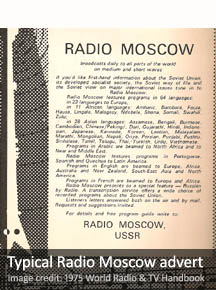
Typical Cold-War-era advert of Radio Moscow By PAUL BEAUMONT* | intelNews.org |
In 1975 whilst the Cold War was still being fought, short wave listeners were treated nightly to whatever stations they chose to listen to from wherever, propagation permitting. These broadcast stations carried a catholic mix of information, political views and insights, propaganda, religious ideology (usually with a political point) and music and other cultural statements of the government of the day. Broadcast stations with good signals were the BBC World Service, Voice of America, and Radio Moscow. But not all was as it seemed. Radio Moscow used very high powers so that those furthest from their transmitters still received signals at good strength whilst the propagation conditions ensured the frequencies were selected for the most efficient transfer of radio programs. One could sit in one’s armchair with no more than a telescopic antenna raised from the radio set and hear news from a foreign station and quickly retuning, could hear the same news but with a totally different bent. Even the music was not what it seemed, especially for two particular British spies, one being Frank Clifton Bossard, an officer with Britain’s Ministry of Defence Missile Guidance Branch, the other John Symonds, an ex-Detective Sergeant wanted in connection with Operation COUNTRYMAN.  Bossard was strapped for cash and approached the KGB, whilst finding himself overseas with no funds Symonds found himself working for the KGB as a ‘Romeo Spy’ seducing wives of diplomats for information. Interestingly MI5 denied that Symonds acted as he did and suggested such actions were a figment of John Symonds’ imagination. Read more of this post

News you may have missed #771

Shawn HenryBy IAN ALLEN | intelNews.org |

►►Analysis: Ex FBI official says foreign spies biggest online threat. Former FBI executive assistant director Shawn Henry has warned that the biggest threat online comes not from terrorists or hackers, but from foreign intelligence organizations looking to steal intellectual property. “The threat from computer attack is the most significant threat we face as a society, other than a weapon of mass destruction”, he said in his opening keynote at the Black Hat 2012 conference in Las Vegas. “Everything we do —R&D, intellectual property, and corporate strategies— is stored or transmitted electronically. The DNA of companies is available to bad guys”.
►►Taiwanese officials jailed for espionage. Two Taiwanese former officials have been sent to prison by the Taiwan High Court for leaking state secrets to China. Presidential Office official Wang Ren-bing was jailed for two years after being found guilty of passing confidential information about President Ma Ying-jeou’s May 2008 inauguration to Chinese intelligence operatives. Chen Pin-jen, a former aide of Chinese Nationalist Party (KMT) Legislator Liao Kuo-tung, was sentenced to eight months in prison for delivering the confidential information Wang gave him to China. The two were arrested in 2009.
►►Germany charges suspected Syrian spy. A spokeswoman for federal prosecutors in Germany said Sunday that they have filed charges against suspected Syrian spy Akram O., one of two men arrested on suspicion of having spied on Syrian opposition activists in Germany for several years. The two were arrested in February during a sting operation involving over 70 German counterintelligence operatives, who searched the suspects’ apartments. The spokeswoman said she could not give further details before an official confirmation is issued that the suspect and the defense team have received the indictment.

News you may have missed #769 (analysis edition)

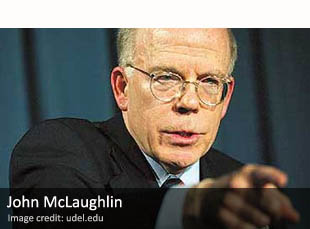
John McLaughlinBy IAN ALLEN | intelNews.org |

►►Is S. Korea’s spy agency losing its capabilities? The National Intelligence Service, South Korea’s primary external intelligence agency, is presumed to spend around US $1 billion a year, most of which it uses to spy on its northern neighbor. But when asked about the identity of the young woman who frequently accompanies new North Korean leader Kim Jong Un in his public appearances, the state intelligence agency offers no clear answer. Although it was seven months ago, at the time of Kim Jong-il’s funeral, that the woman was first spotted, the agency still does not know who she is. In the past 20 years, NIS has undergone a process of transformation to rid it of political functions. But the lingering question is: have the changes compromised the overall capabilities of the giant organization?
►►How 10 years of war has changed US spies. John McLaughlin, who was a CIA officer for 32 years and served as Deputy Director and Acting Director from 2000-2004, says he is often asked how American intelligence has changed in the 11 years since 9/11. His answer is that the changes are profound and have been transformative. Perhaps the most important thing to realize about American intelligence officers in 2012, he says, is that this is the first generation since Vietnam to have been “socialized” –that is hired, trained, and initiated– in wartime. And to a greater degree than even the Vietnam generation, their experience approximates that of their World War II forbears in the Office of Strategic Services (OSS) –the organization to which most American intelligence officers trace their professional roots.
►►Assessing the Social Media Battlefield in Syria. While the numerous insurgent factions and the Syrian security forces engage each other in combat in towns and cities to secure tangible battlefield gains, the warring parties are also waging a contentious information war in cyberspace, specifically within the virtual arena of online social media. The various strands of the opposition in Syria —political and violent— have taken to social media since the earliest stages of the uprising to advance their agendas. Analogous to their role in facilitating communication and information exchange during the wave of revolts that have been sweeping the Arab world since 2011, new media platforms such as the array of social media websites and related technologies that are available to the public at virtually little or no cost have become crucial to shaping how the crisis in Syria is portrayed and perceived.

Analysis: Bandar’s return affirms hawkish turn in Saudi foreign policy

Prince Bandar bin SultanBy JOSEPH FITSANAKIS | intelNews.org |
For over two decades, America’s relations with its most important Arab ally were primarily mediated by just one man: Prince Bandar bin Sultan, Saudi Arabia’s Ambassador to the United States from 1983 to 2005. But on June 26, 2005, Bandar, a personal friend of the Bush family, submitted his diplomatic resignation, after being recalled to Riyadh by Saudi Arabia’s King Abdullah. Almost immediately, Bandar, known for years in Washington’s diplomatic circles as a flamboyant socialite, disappeared from public view. It is said that he faced serious health problems, going in and out of hospitals. Others claim that he fell out of favor with Saudi Arabia’s autocratic ruling elite, and in 2009 there were even unconfirmed reports that he was under house arrest after allegedly trying to organize a military coup against King Abdullah. Last week, however, Bandar returned to the limelight in spectacular fashion: in a plainly worded statement, Saudi authorities announced that the Prince had been appointed Director General of the Mukhabarat Al A’amah, the Kingdom’s main intelligence agency.

To those who remember Bandar from his Washington days, which were filled with drinking and partying, it may seem incredible that the “peasant prince”, whose mother was one of Sultan bin Abdulaziz Al Saud’s countless underage concubines, is now heading Saudi intelligence, in what is perhaps the most challenging period in the Kingdom’s history. Read more of this post

News you may have missed #759 (analysis edition)

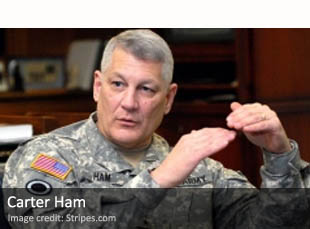
Carter HamBy IAN ALLEN | intelNews.org |
►►What goes on in the mind of a spy? An interesting article on the psychology of espionage operatives and those who handle them. It includes several insightful observations, including this one: “Just as they face outward physical dangers, agents face many inner psychological adversities. These pressures in the psyche are as taxing as physical hardships. Furthermore, while physical hazards and hardships disappear once the active espionage is over, the psychological toll can linger”. IntelNews has covered psychological and psychiatric issues around espionage before.
►►Researchers propose using decoys to detect leaks. A group or researchers working for the US Pentagon’s research wing have come up with a new plan for busting leakers: spot them by how they search, and then entice the secret-spillers with decoy documents that will give them away. Computer scientists call it it “fog computing”, and it is seen as part of a broader assault on so-called “insider threats”, launched by the Pentagon in 2010, after the WikiLeaks imbroglio. In a related development, the US federal government announced recently that it spent over $11 billion to protect its secrets last year, double the cost of classification a decade ago. The total does not include the costs incurred by the US Intelligence Community, which remains classified.
►►US General says US military spies ‘across Africa’. America’s top commander in Africa, General Carter Ham, has revealed that the US military has conducted spy operations all over the continent as part of the fight against international adversaries from al Qaeda-allied terror groups that target the homeland to suspected war criminals like Joseph Kony. “Do we collect information across Africa? Yes, we do”, the commander of US Africa Command said in a leadership conference at the Africa Center for Strategic Studies. Ham noted that US troops do at times go on “short-term deployments of capabilities” in various African nations, but always with the permission of the host country.

Analysis: The Danger in Ignoring Non-Muslim Religious Terrorism

Hutaree militia membersBy JOSEPH FITSANAKIS | intelNews.org |
Even though over a decade separates us from the tragic events of September 11, 2001, Americans continue to be heavily preoccupied with terrorism. But what is the face of terrorism in our time? Too often, the term ‘terrorist’ conjures up the stereotypical image of an Arabic-speaking Muslim male from the Middle East —viewed by many Westerners as an abstract geopolitical notion that erroneously includes Afghanistan. There is no doubt that Islamic-inspired terrorism is both very real and very dangerous. However, consciously or subconsciously associating terrorism solely with Islam is not only flawed, but also potentially dangerous for our collective security. In reality, all religious dogmas contain extremist elements. This includes religious doctrines that are widely considered peace-loving, such as Anabaptism, or even Buddhism. A case in point that is often overlooked by Westernern observers is Aum Shinrikyo, the Japanese millenarianist cult inspired by Buddhist tenets. In 1995, Aum members used sarin gas in a large-scale terrorist attack on the Tokyo subway system, which killed 13 and injured close to a thousand commuters. In later years it was revealed that, prior to engaging in chemical terrorism, Aum had become history’s first known terrorist group to actively try to acquire nuclear material for tactical purposes. It was only after failing to obtain nuclear material that Aum’s leadership turned to sarin. This past Thursday, July 5, an interview of mine was aired on this very subject, namely the current state of homegrown, religiously-inspired terrorism in the United States. Read more of this post

Comment: Did Israel assassinate senior Hamas official in Syria?

Kamel RanajaBy JOSEPH FITSANAKIS | intelNews.org |
The leadership of Hamas has accused Israel of assassinating one of its senior officials in Syria last Wednesday. The Palestinian militant group, which controls the Gaza Strip, announced late last week that the charred body of Kamel Ranaja had been found in his half-burned apartment in Syrian capital Damascus. Ranaja, known informally as Nizar Abu Mujhad, was said to have replaced the post of the late Hamas weapons procurer Mahmoud al-Mabhouh. Al-Mabhouh was killed in 2010 in Dubai, United Arab Emirates, most likely by Israeli intelligence agency Mossad. Citing French news agency Agence France Presse, Israeli newspaper Ha’aretz quoted an unnamed Hamas official as saying that “a group of people entered [Ranaja’s] home […] and killed him”, adding that “according to the information that we have gathered, the Mossad is behind the attack”. Reports from Reuters published in the British press suggest that Ranaja’s charred body “bore signs of torture” and that it had been dismembered. There are also suggestions that the group that attacked the Hamas official’s apartment took with them an unspecified volume of documents and computer files before setting the place on fire.

Read more of this post