Analysis: A Western-supported anti-Russian insurgency in Ukraine is unlikely
February 24, 2022 6 Comments
 AS THE FULL-SCALE invasion of Ukraine by the Russian Armed Forces continues to unfold, some Western commentators have begun to speculate about the possible launch of an anti-Russian insurgency by the Ukrainian population. This kind of speculation is not unreasonable. Indeed, given their enormous disparity in size and might, a symmetric confrontation between the two belligerents seems unthinkable. One simply cannot imagine that a direct military confrontation between Russian and Ukrainian military forces could result in anything other than a resounding victory for Moscow. However, although the rise of an armed anti-Russian insurgency in Ukraine is possible, it is unlikely to be large in scale, and even more unlikely to succeed.
On first glance, Ukraine seems like a textbook case for a possible insurgency. Russia aside, it is Europe’s largest country by landmass, with a population of nearly 50 million. Even under the most favorable conditions, the Russians would find it difficult to occupy and control it without the consent of the local populace. Moreover, Ukraine shares borders with seven countries, including Russia, four of which—Hungary, Romania, Slovakia and Poland—are members of the North Atlantic Treaty Organization (NATO). The geographic proximity of a host of NATO bases would easily allow Western intelligence agencies to provide the local population with war materiel, including advanced military hardware and other supplies. Lastly, due to the protracted war in Donetsk and Luhansk, the Ukrainian military has amassed significant experience in insurgency over the past decade.
However, as Brown University visiting professor Lyle Goldstein cautions in a recent article, things are never simple in war. Although no fewer than four NATO states border Ukraine, the military alliance and its leading patron, the United States, will need to exercise immense caution. In using these states to arm Ukrainian insurgents, Western powers will need to ensure a maximum degree of plausible deniability. Should Russia determine that Western countries are using these NATO powers as front-line states in a new Cold War, it could be tempted to launch military operations against them—an act that could spiral into an out-of-control multi-state war. It is also likely that these front-line NATO member-states will resist calls to be involved in this conflict, in order to avoid being dragged into a wider regional war.
Moreover, although numerous regions of Ukraine appear to be under fire at the moment, it is doubtful that the Russian military will seek to occupy the entire country. Moscow is thus unlikely to try to extend its control past the largely pro-Russian regions of eastern and east-central Ukraine. Such a strategy would ensure that Russian troops would be able to operate in a largely friendly environment. It would also make it difficult for Ukrainian insurgents to operate effectively anywhere east of Kiev. Lastly, the Russian Armed Forces have amassed substantial counter-insurgency experience in the post-Cold War era, having fought in large numbers in Chechnya and Syria, as well as in various regions of Africa through the Wagner Group.
In short, unless the Russians over-play their hand and try to take over the entire country, Western powers are likely to find it difficult to organize, support and sustain a concerted armed insurgency on Ukrainian soil. This does not mean that the ongoing Russian military campaign in Ukraine will inevitably be successful. War is inherently unpredictable, so anything can happen in the coming weeks and months. However, defeating the Russians in any military context will require many years of extremely brutal, bloody and fierce war.
► Author: Joseph Fitsanakis | Date: 24 February 2022 | Permalink
 THE DIRECTOR-GENERAL OF Pakistan’s Inter-Service Intelligence (ISI) directorate, which is one of the country’s most powerful institutions, has been replaced, following weeks of speculation. On Wednesday, a press release issued by the Pakistani military announced that Lieutenant General Faiz Hameed would step down from his post of director of ISI, and will be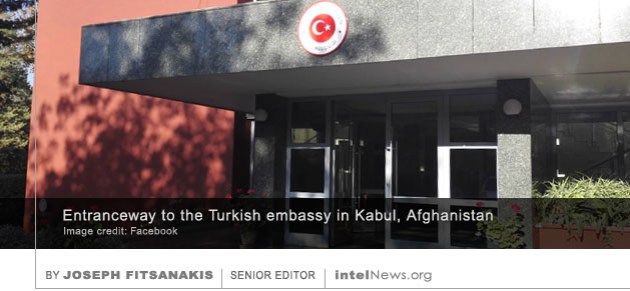



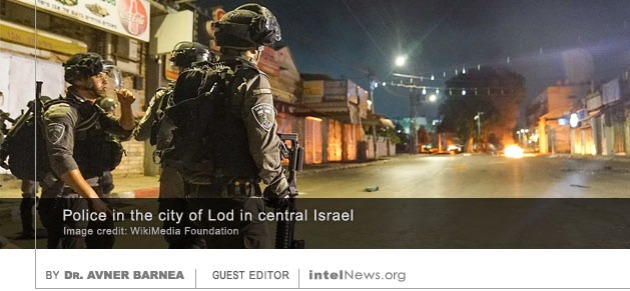
 surprised observers with its range of weapons, such as long-range missiles with a reach that is in excess of 150 miles. This constitutes a strategic surprise for Israel. So far (May 13, 2021), Hamas has fired about 1,500 missiles at Israel, most of which have been intercepted by Israel’s air defense system called the Iron Dome.
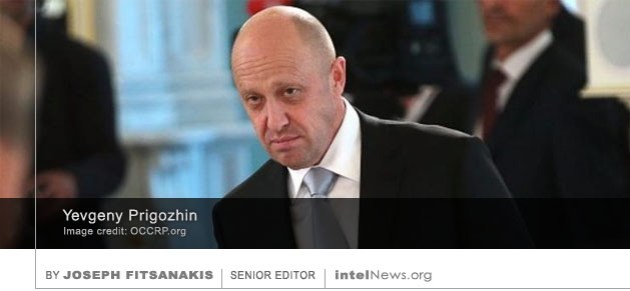 WITHOUT MUCH FANFARE LAST week, the Federal Bureau of Investigation placed on its most wanted list
 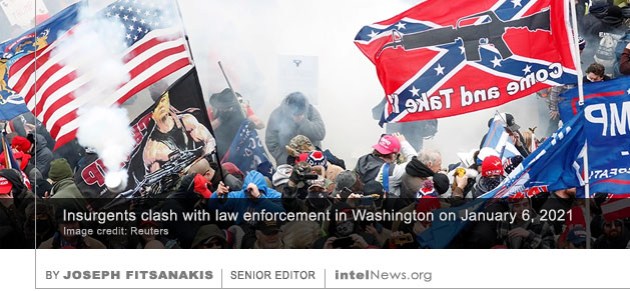 WITH DOWNTOWN WASHINGTON RESEMBLING a large military encampment, a repeat of last week’s shocking assault on the Capitol Complex is highly improbable. But America could witness escalating levels of violence across many states, as supporters of the January 6 insurrection continue to organize themselves into a coherent armed movement. Their ability to threaten American national security will depend on whether they can overcome major internal divisions. It will also be determined by the speed with which United States authorities will respond to the rise of what is quickly becoming a dangerous militant movement.
 THE INSURGENTS WHO STORMED the United States Capitol Building Complex on January 6 may have unwittingly provided cover for teams of foreign spies, who could have stolen or compromised sensitive electronic equipment. This largely neglected security-related aspect of the attack is discussed in an
  THE FEDERAL BUREAU OF Investigation and the New York Police Department gave Capitol Police officials specific warnings that supporters of United States President Donald Trump were determined to engage in serious violence on January 6, according to federal officials. The FBI even made contact with known far-right radicals across the United States in early January, and warned them not to travel to Washington for the pro-Trump rally that resulted in the bloody attack on the US Capitol,
  IF WEDNESDAY’S ATTACK ON the United States Capitol Complex was part of a coup d’état, then the American political system should be considered safe for the time being. The mob that ransacked the Capitol was disordered, leaderless, and appeared to have no coordination, or even direction. However, the broader militant movement that it represents is evolving very rapidly. If left unchecked, it will be able to turn its weaknesses into strengths and spell major trouble ahead for the already stormy waters of American politics. The nation’s law enforcement and security agencies must therefore prepare for a period of widespread insurrection, some of which will be armed and lethal in nature. Insurrectionist acts are likely to occur across the nation, and may last for months, if not longer.
 INTELLIGENCE COOPERATION BETWEEN THE United States and India has reached historic levels in the closing months of 2020, and is driven by the two countries’ mutual distrust of China. This development is particularly noteworthy for India, which has traditionally maintained a non-aligned stance in military and intelligence matters for much of its existence. New Delhi’s increasingly close relationship with Washington is








Analysis: What We Are Likely to See in the Coming Weeks in Ukraine
March 21, 2022 by Joseph Fitsanakis 6 Comments
Russia’s Original Strategy
The Kremlin’s decision to invade Ukraine was premised on a rapid military campaign, which was designed to trigger the collapse of Ukrainian President Volodymyr Zelensky’s administration within about a week. The original plan appears to have rested on quickly introducing non-conscript military units inside Kyiv, in order to force the government to flee to Lviv. At the same time, elite formations from the Main Directorate of the Armed Forces’ General Staff (GRU) and Spetsnaz (special operations forces) were sent to the Ukrainian capital to assassinate leading government figures.
Based on that assumption, Russia’s original strategy was to avoid engaging in clashes in major urban centers, barring those that are located along key transportation routes. That is because urban terrain heavily favors the defender and tends to result in mass invader casualties. The Russians can’t afford too many of those, given that the Russian expeditionary force of about 150,000 non-conscript troops is grossly insufficient to conquer—let alone occupy—a country the size of Ukraine, with a largely young population of well over 40 million. Read more of this post
Filed under Expert news and commentary on intelligence, espionage, spies and spying Tagged with 2022 Russian invasion of Ukraine, Analysis, Joseph Fitsanakis, Newstex, Russia, Ukraine