Analysis: Did the US Central Intelligence Agency lose 17 spies in Iran?

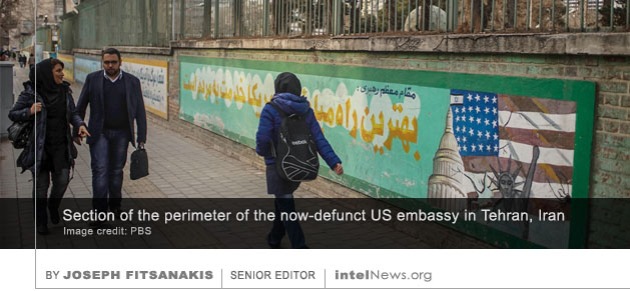
US embassy IranIf the announcements from Tehran are to be believed, the United States Central Intelligence Agency lost at least 17 spies in Iran in the months leading up to March 2019. According to Iran’s Ministry of Intelligence, the Islamic Republic busted an alleged “CIA network” operating in sensitive private sector companies and government agencies that relate to defense, aerospace and energy. At least some of the 17 alleged spies have reportedly been sentenced to death, though their exact number remains unknown.

Officials in Tehran said on Sunday that all of the purported spies are Iranian nationals and were lured by the CIA with promises of receiving visas to enter America. Others were already in possession of visas and were “blackmailed” to spy for the US in order to have them renewed by the US Department of State, according to Iranian media reports. Visa applicants were allegedly carefully selected based on their work in critical areas such as Iran’s nuclear program or defense procurement.

A government-sanctioned documentary, which aired on Iran’s state owned television on Monday, claimed that the 17 spies did not know each other, but all had been trained independently in clandestine tradecraft. This allegedly included setting up and using secret communications systems, as well as carrying out dead drops without being detected. Dead drops utilized containersQ Quote made to look like rocks, which were located “in parks and other mountainous areas” in Iran and elsewhere in the Middle East, according to Iranian officials. Some of the assets communicated with their handlers while attending science conferences through- out Europe, Africa and Asia.
The Iranian television documentary claimed that the 17 arrests had “dealt a lethal blow to US foreign intelligence”. But US President Donald Trump said in a tweet that Tehran’s allegations were “totally false” and contained “zero truth”, just “more lies and propaganda” from Tehran.

Who is right? To begin with, there is no question that the CIA recruits heavily in Iran, given that the Islamic Republic is one of America’s —indeed the world’s— primary intelligence targets. What is more, since 1979, when Washington lost its embassy in Iran, the CIA have found it more difficult to collect accurate information from inside the energy-rich country. Therefore, the need for dependable assets inside Iran has increased exponentially, and has become even more pressing now, given the importance placed on Iran by Donald Trump. Additionally, Read more of this post

Analysis: Are US border security officials ignoring terrorism threat from Canada?

Canada borderSince the election of President Donald Trump, the issue of border security between the United States and Mexico has been a major topic of national debate. But is the incessant focus on America’s southern border by the news media and politicians ignoring security concerns emanating from the country’s northern neighbor, Canada? In a thought-provoking editorial in the English-language Emirati newspaper The National, Stephen Starr employs statistics to argue that the flow of extremism from Canada into the US may represent a greater security concern for Washington than immigration flows from Mexico.
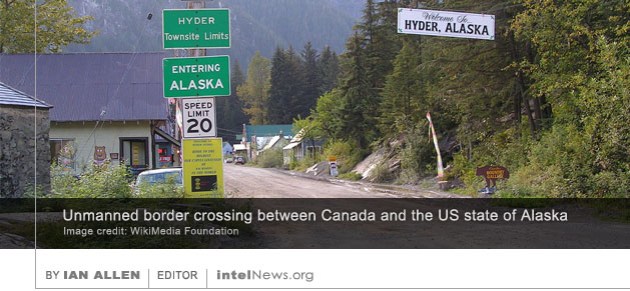
According to US government sources, six foreigners whose names featured on the Terrorist Screening Database (TSDB) —the central terrorist watchlist maintained by the Federal Bureau of Investigation’s Terrorist Screening Center— attempted to enter the US from Mexico in the first half of 2018. Starr points out that during that same period no fewer than 41 foreigners who were on the TSDB tried to enter the US from Canada. In the past three and a half years, four Canadian residents have been charged with carrying out or conspiring to carry out terrorist attacks on US soil. They include a Palestinian living in Toronto and a Tunisian living in Montreal, who planned to derail a passenger train making the journey from Ontario to New York. Both were jailed for life. Another resident of Canada, Abdulrahman el-Bahnasawy, was sentenced to 40 years in prison for trying to plant bombs in New York’s Times Square and on a New York subway train. El-Bahnasawy, who was 20 when he was sentenced, was directly guided by Islamic State handlers in the Philippines and Pakistan. Starr notes that nearly 200 Canadian citizens and residents are thought to have traveled abroad to fight for the Islamic State, and that around 60 of those are now back in Canada.

While all this is happening, the US Customs and Border Protection (CBP) agency, America’s main border control organization, which operates under the Department of Homeland Security, appears to be ignoring the country’s northern border. It is worth noting that the 5,525 mile-long border is the longest in the world, but is monitored by no more than about 2,000 CBP agents. In contrast, over 16,000 CBP agents keep tabs on America’s border with Mexico. Responding to political pressure from the White House, the CBP keeps stationing more agents to the southern border. In the meantime, requests by CBP supervisors along the Canadian border to increase their force by 200 agents remain unfulfilled. This is despite the fact that the number of people detained while trying to enter the US illegally from the Canadian province of Quebec has nearly trebled since 2015, notes Starr.

Author: Ian Allen | Date: 22 July 2019 | Permalink

ISIS could make bigger comeback than 2014 in Iraq and Syria, warns new report

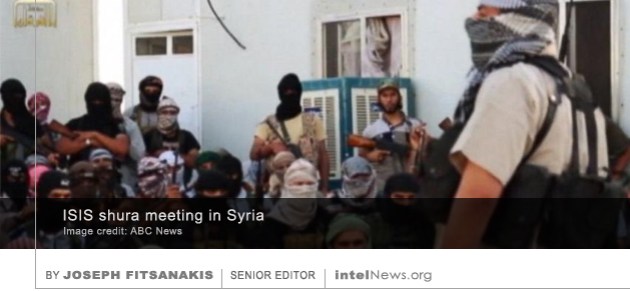
ISIS meetingThe Islamic State is capable of make a sudden comeback in the Middle East that could be “faster and even more devastating” than 2014, when the group quickly conquered territory the size of Britain, according to a new report from the Institute for the Study of War (ISW). The Washington-based think-tank’s report is based on the most recent data about the presence in the Middle East of the militant Islamist group, which is also known as the Islamic State of Iraq and Syria. The 76-page report (.pdf) is titled ISIS’s Second Comeback: Assessing the Next ISIS Insurgency, and is written by ISW’s researchers Jennifer Cafarella, Brandon Wallace and Jason Zhou.
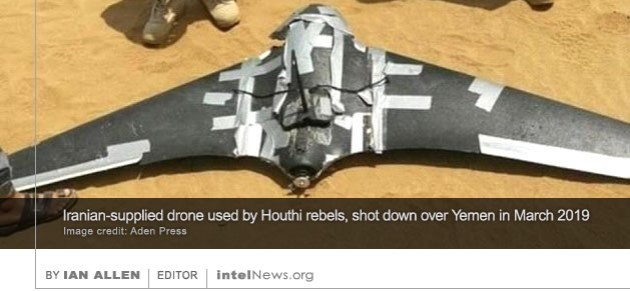
The authors claim that the Islamic State moved its forces undercover during the multinational military campaign that eventually sacked its self-proclaimed caliphate. They go on to explain that by “deliberately withdrawing and relocating may of its fighters and their families”, the group managed to preserve a large part of its fighting forces, which are “now dispersed across [Iraq and Syria] and are waging a capable insurgency”. The latter is funded through ISIS’ global finance network and armed with weapons and other war materiel that the group managed to hide in tunnel systems and other hidden facilities. Islamic State insurgents have thus been engaged in a broad and largely successful campaign to assassinate village and town elders across Iraq, and have even reestablished a sharia-based taxation system in some of Iraq’s predominantly Sunni areas. The group also retains a significant presence in Syria, where it continues to battle the Syrian regime, US-supported Kurdish forces, and other Sunni militant groups, including al-Qaeda, according to the report.

Through its widening insurgency, the Islamic State has managed to subvert Iraqi and Syrian government efforts to reintroduce a semblance of stability and safety in areas previously conquered by the militant group. In fact, not only are government forces finding it “increasingly difficult to establish durable and legitimate security and political structures” in those areas, but they should be worried about the possibility of ISIS actually reconquering territory in both countries, the report warns. The report’s authors place much of the blame for ISIS’ resurgence at Washington’s door, describing America’s hasty military withdrawal from Iraq and Syria as “a critical mistake”. In its recommendations section, the report calls on the United States to develop and implement a long-term counter-terrorism strategy against ISIS, which will combine military and community-building measures. “Another limited [military] intervention will not be sufficient” to eliminate the threat, the report’s authors claim.

Author: Joseph Fitsanakis | Date: 27 June 2019 | Permalink

Analysis: Yemen conflict shows small-drone warfare ‘is here to stay’, say experts

DroneThe current wars in the Middle East, especially the ongoing conflict in Yemen, are proof that the use of small drones in insurgencies is now a permanent phenomenon of irregular warfare, according to experts. Drones have been used in warfare in the Middle East for almost 20 years —including by outside powers like the United States. But National Public Radio’s Geoff Brumfiel reports that the wars in Iraq and Syria, and especially the war between the Yemeni government and Houthi rebels, clearly demonstrate that we have entered “a new era of drone warfare”.
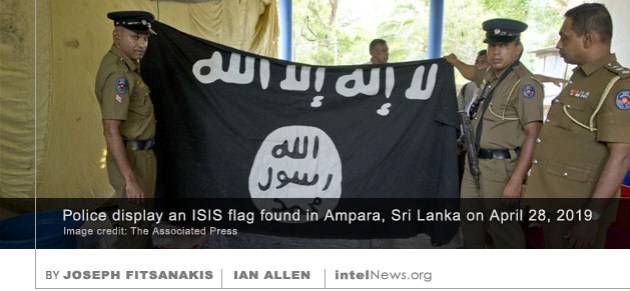
The use of off-the-shelf small drones has been increasing since 2010, with the Syrian Civil War having served as a testing ground for military uses of drones by all sides involved in the conflict. Belligerents quickly realized that the use of drones —whether remotely operated from the ground, or guided by GPS coordinates— could provide useful air power “for a fraction of the cost of fighter jets” employed by national militaries, according to Brumfiel. He quotes numerous drone warfare expects who agree that the ongoing Yemeni Civil War provides the clearest sign yet of the proliferation of drones for military and paramilitary purposes. The Houthi rebels have employed drones to attack government targets and targets such as air fields, oil installations and military bases in neighboring Saudi Arabia. Most of these drones, and the knowledge of how to modify them for military use, are given to the Houthis by Iran, according to RAND Corporation expert Ariane Tabatabai, who is quoted in Brumfiel’s article.

Iran has been developing military drone technology since the 1980s, but did not begin to employ drones outside of its airspace until 2015. The change was prompted by the emergence of the Islamic State emerged as a major Sunni threat to Shiite populations in the region. Iranian drones are now everywhere, from Iraq and Syria to Yemen. These drones, including drones used by the Houthis, are major sources of concern for conventional armies, because they are difficult to detect and destroy, according to Center for a New American Security researcher Nicholas Heras. He told Brumfiel that small drones are difficult to locate by radar, and their flight paths are far more flexible than those of airplanes. Additionally, those drones controllers can use GPS systems to “navigate through holes” in air defenses, said Heras.

Author: Ian Allen | Date: 30 May 2019 | Permalink

Analysis: Sri Lanka attacks may indicate ISIS is moving east, say experts

Sri Lanka ISISThe April 21 suicide attacks in Sri Lanka, which were claimed by the Islamic State, may indicate that the militant group is moving east in search of fertile recruiting ground, according to some observers. In the words of The New York Times’ Rukmini Callimachi and Eric Schmitt, the attacks “reminded the world in dramatic fashion that [the Islamic State] does not need to control territory to be a major threat”. In fact, as the loss of its Middle Eastern territory has forced the Islamic State to decentralize, the group has begun to turn to its peripheral affiliates further afield. These “will become more dangerous” as the core of the Islamic State weakens, according to Callimachi and Schmitt.
But the Sri Lanka attacks may also demonstrate that the Islamic State is moving further east in search of either territory to conquer or new groups of committed fighters to incorporate into its ranks. It follows that Sri Lanka is one of several East Asian countries that face major threats by the group, as the latter tries “to ignite creating fear in societies already battling so much division”, says Ash Gallagher, an American war correspondent based in East Asia. Writing for the British newspaper The Independent, Gallagher notes that not only is the Islamic State already established in Afghanistan (where it has “swallowed whole units of Taliban fighters”, according to The Times), but it is becoming increasingly powerful in the Philippines. Experts have been warning for a while that the number of foreign Islamic State fighters entering the Philippines has been growing, and the momentum they generate among local Islamist groups may prompt them to declare a new caliphate in the near future. In fact, a caliphate was declared there in May 2017 by local Islamist leaders who had previously declared their allegiance to the Islamic State. By October, government forces had defeated the so-called “East Asia Wilayah”, a self-declared overseas province of the Islamic State, by retaking Marawi, the capital city of Mindanao’s Lanao del Sur province, from Islamic State rebels. The military operation became known as “the battle of Marawi” and is thought to have been the longest urban battle in the postwar history of the Philippines. More than 1,200 people died in the five-month battle, most of them civilians. Hundreds of thousands remain displaced to this day as a result of the fighting. Read more of this post
Analysis: Who was behind the raid on the North Korean embassy in Madrid?

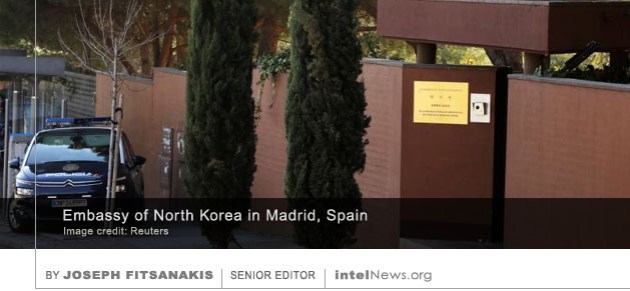
North Korea SpainAn obscure North Korean dissident group was most likely behind a violent raid on North Korea’s embassy in Madrid on February 22, which some reports have pinned on Western spy agencies, including the Central Intelligence Agency. The group, known as the Cheollima Civil Defense, is believed to be the first North Korean resistance organization to declare war on the government of Supreme Leader Kim Jong-un.
THE ATTACK

The attack took place at 3:00 in the afternoon local time in Aravaca, a leafy residential district of northern Madrid, where the embassy of North Korea is located. Ten assailants, all Southeast Asian-looking men, entered the three-story building from the main gate, brandishing guns, which were later found to be fake. They tied up and gagged the embassy’s staff, as well as three North Korean architects who were visiting the facility at the time. But one staff member hid at the embassy. She eventually managed to escape from a second-floor window and reach an adjacent building that houses a nursing home. Nursing home staff called the police, who arrived at the scene but had no jurisdiction to enter the embassy grounds, since the premises are technically North Korean soil. When police officers rang the embassy’s doorbell, an Asian-looking man appeared at the door and Q Quote 1said in English that all was fine inside the embassy. But a few minutes later, two luxury cars belonging to the North Korean embassy sped away from the building with the ten assailants inside, including the man who had earlier appeared at the front door.
Once they entered the embassy, Spanish police found eight men and women tied up, with bags over their heads. Several had been severely beaten and at least two had to be hospitalized. The victims told police that the assailants were all Korean, spoke Korean fluently, and had kept them hostage for nearly four hours. But they refused to file formal police complaints. The two diplomatic cars were later found abandoned at a nearby street. No money was taken by the assailants, nor did they seem interested in valuables of any kind. But they reportedly took with them an unknown number of computer hard drives and cell phones belonging to the embassy staff. They also stole an unknown quantity of diplomatic documents, according to reports.

POSSIBLE FOREIGN CULPRITS

Within a few hours, Spanish police had reportedly ruled out the possibility that the assailants were common thieves, arguing that the attack had been meticulously planned and executed. Also, common thieves would have looked for valuables and would not have stayed inside the embassy for four hours. Within a week, several Spanish newspapers, including the highly respected Madrid daily El País and the Barcelona-based El Periodico, pinned the raid on Western intelligence services. They cited unnamed police sources who claimed that at least two of the assailants had been identified and found to have links with the CIA. The reports also cited claims by embassy employees that the attackers interrogated them extensively about Soh Yun-sok, North Korea’s former ambassador to Madrid. Soh became Pyongyang’s chief nuclear negotiator after he was expelled by the Spanish government in 2017 in protest against North Korea’s nuclear missile tests. Read more of this post

Analysis: Women becoming growing force inside Islamic State, says expert

Islamic State womenThe role of women inside the Islamic State is growing, as the Sunni militant group is transmuting into an underground organization, according to a Harvard University terrorism expert. Since its meteoric rise in Iraq and Syria, the Islamic State has been known for advocating for strict segregation between men and women. In the early stages of the group’s emergence, combat roles were exclusively performed by men, while women’s roles were limited to childbearing and housework. But according to Vera Mironova, Visiting Scholar in the Economics Department at Harvard University, and former Associate of the International Security Program at Harvard’s Belfer Center, the Islamic State’s policy on gender roles is shifting rapidly.
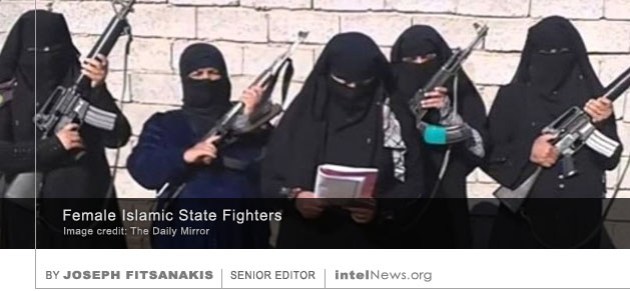
Mironova, who has carried out research in Iraq while embedded with the country’s Special Operations Forces, argues that the Islamic State has been “quietly shifting its insistence of strict gender hierarchy” and is now “allowing, even celebrating, female participation in military roles”. In an article published earlier this week in The New York Times, Mironova states that early indications of this shift were visible as early as 2017. In October of that year, ISIS publications issued calls for “women to prepare for battle”. Within a year, the group was publicly praising its women fighters and even published a video showing veiled Islamic State female fighters firing AK-47 assault rifles. The video praised women fighters for “seeking revenge for [their] religion and for the honor of [their] sisters”.

In her article, the Harvard terrorism expert says that it is not possible to estimate with accuracy the number of women who have picked up arms on behalf of the Islamic State. But she adds that interviews with Iraqi military and police officials suggest that female Islamic State fighters are now “a regular presence that no longer surprises, as it did a few years ago”. There is a tradition of fervent women supporters of the militant group that dates from its very beginning, claims Mironova. She gives the example of female radicals who insisted that their husbands or sons join the Islamic State, or who sought to marry Islamic State combatants in order to be part of “mujahedeen families”. Recently, however, the relative scarcity of male fighters in the ranks of the militant group has led to calls for females to take their place in the front lines. As the Islamic State is transmuting into an underground organization, women are also becoming more useful as covert operatives because they attract less attention by Iraqi or Syrian government troops.

In many cases, women supporters of the Islamic State who lost male family members in the ongoing war pick up arms or put on suicide vests in order to extract revenge. In other cases they do in order to secure protection, favors or money for their families from the insurgents. The fact is, says Mironova, that women fighters are becoming more prominent in the Islamic State’s combat lines and are even participating in the group’s suicide bombing campaign. The latter continues unabated in Iraq and Syria, despite the near-complete loss of the Islamic State’s territorial control, says Mironova.

Author: Joseph Fitsanakis | Date: 22 February 2019 | Permalink

Shiite militias ‘acting like mafia gangs’ in Iraq’s former ISIS-held areas

Popular Mobilization ForcesThe Shiite militias that fought in the war against the Islamic State are now “engaged in mafia-like practices” in former Islamic State strongholds, enraging Iraqi Sunnis and sparking fears of another Islamist insurgency, according to a leading article in The Washington Post.  In 2014, the meteoric rise of the Islamic State of Iraq and Syria —ISIS, later renamed Islamic State— was largely aided by Sunni Arabs’ belief that they were second-class citizens in a Shiite-dominated Iraq. Popular support for the Islamic State among Iraq’s Sunni Arab minority took the Iraqi government by surprise and almost enabled the militant group to conquer Baghdad in 2015. Today, after the destruction of the Islamic State’s self-declared caliphate, Iraq’s Shiite-dominated security and intelligence services have returned to Sunni-majority regions that were once ruled by ISIS.

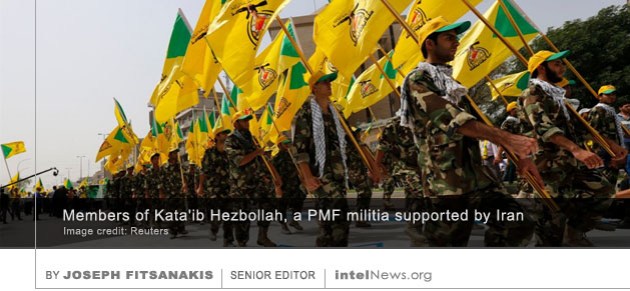
But there signs that about 50 Shiite militias, which were supported by the Iraqi state throughout the war against ISIS, are now becoming highly autonomous armed gangs that are undermining the central government in Baghdad. These militias —many of which are politically aligned with Iran— are essentially armed wings of Shiite political parties that control more than a quarter of the seats in the Iraqi parliament. In 2014, the Shiite-dominated Iraqi government attempted to utilize the power of the militias by uniting them under the umbrella of the Popular Mobilization Forces (PMF). PMF troops participated in every major front of the war against ISIS and today are an officially recognized military force with rank and salary structures that are equivalent to those of the Iraqi military and police. Technically, the PMF operate under the command of the Iraqi prime minister. In reality, however, the militias that make up the PMF are led by their respective Shiite commanders, many of whom are ideologically allied to Tehran.

The PMF militias are today in control of much of Sunni-dominated Western Iraq, which they helped retake from ISIS. According to Washington Post correspondents Tamer el-Ghobashy and Mustafa Salim, the militias are now using their newfound territorial power to make large sums of money. Various PMF militias operate countless checkpoints across Western Iraq, on roads between cities or —increasingly— within cities such as Mosul, imposing toll fees on supply trucks and even on individual motorists. The two Washington Post correspondents warn that these militia members are beginning to exhibit “mafia-like” behavior, establishing protection rackets and kidnapping motorists at night in order to release them for a fee paid by their families.

Additionally, PMF commanders make arbitrary decisions about which of the nearly 2 million Iraqi Sunnis, who were displaced in refugee camps due to the war, are allowed to return to their homes. Many of these homes and land that used to belong to Iraqi Sunnis are now being expropriated by PMF commanders, who claim that their previous owners collaborated with ISIS, often without evidence. This practice, say el-Ghobashy and Salim, is rapidly altering the demographic balance between Sunnis and Shiites throughout Western Iraq. The two authors forewarn that these mafia-like practices by the PMF are “fostering local resentments […] and revive the kind of Sunni grievances that underpinned the Islamic State’s dramatic rise three years ago”.

Author: Joseph Fitsanakis | Date: 11 January 2019 | Permalink

Islamic State issues drone bomb warning following London airport chaos

Islamic State dronesOn the heels of chaotic scenes at Britain’s Gatwick Airport, which remained closed for three days due to reported sightings of drones, the Islamic State has released images on social media showing drones carrying packages to large Western cities. The images, which appear to be PhotoShopped, have reignited concerns that the group may be close to launching attacks on civilian targets around the world using drones. Known formally as unmanned aerial vehicles (UAVs), drones have become increasingly accessible to private consumers in recent years. They range from miniature toy models that can be controlled via smartphone applications to highly sophisticated models that can carry significant loads to high altitudes.
In recent years, it has been reported that several militant groups, such as Hezbollah in Lebanon and al-Qaeda-affiliated groups in Pakistan, have made use of drone technology for surveillance and combat purposes. But observers believe that the Islamic State may have the most advanced drone arsenal of any non-state group in the world. The militant Sunni-Muslim organization launched an experimental armed drone campaign in Iraq in 2016. A year earlier, Islamic State fighters had been seen making use of commercially purchased drones for surveillance purposes in the battlefields of Iraq and Syria. In 2016, the Islamic State built several workshops to modify commercially purchased drones, and eventually to build its own models. In January 2017, the group announced the establishment of a new unit called “Unmanned Aircraft of the Mujahideen”, which operated a sizeable fleet of modified combat drones. The following month, the Islamic State claimed to have killed with the use of drones nearly 40 Iraqi soldiers in a single week. The militant group said it did so by using drones to drop three-pound mortar shells on Iraqi troop positions.

Counterterrorism specialists are concerned about what they see as the Islamic State’s “growing ambition” to use drones in the battlefield. But they doubt that the use of drones can by itself affect the outcome of battles. A much larger concern is the possibility that the Islamic State could transfer its drone knowledge outside the battlefield. It has long been confirmed that Islamic State militants have systematically discussed the possibility of deploying drones in civilian areas to drop explosives or even weaponized chemical substances. In October of this year, Federal Bureau of Investigation director Christopher Wray told the United States Congress that the threat of the use of drones by a group like the Islamic State against American tarets was “steadily escalating”. Wray said that the FBI assessed drones “will be used to facilitate an attack in the United States against a vulnerable target, such as a mass gathering”. He added that his assessment was based on several factors, such as the retail availability of the devices, the “lack of verified identification requirement to procure” drones, their ease of use, as well as the experience in the use of drones that militant groups have been amassing abroad.

Author: Joseph Fitsanakis | Date: 24 December 2018 | Permalink

Analysis: Iraq’s revenge campaign against Sunnis fuels new pro-ISIS wave

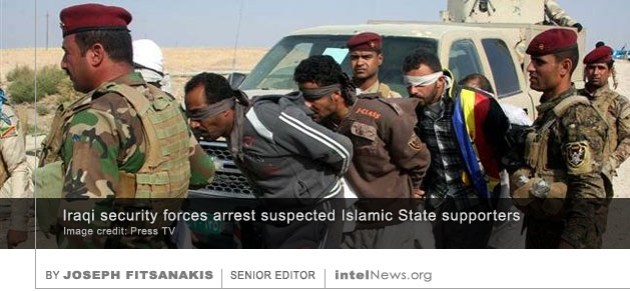
Iraq security forcesA campaign of revenge by Iraq’s Shiite-dominated government against Sunni Arabs in regions once controlled by the Islamic State is aiding Islamists and fueling another rebellion in the country, according to a new report. In 2014, the meteoric rise of the Islamic State of Iraq and Syria —ISIS, later renamed to Islamic State— was largely aided by the strong belief among Iraqi Sunnis that they were second-class citizens in a Shiite-dominated Iraq. In addition to its Sunni credentials, the Islamic State was also able to appeal to Iraqi Sunnis by portraying itself as pious, efficient and trustworthy. This image was in a sharp contrast to the widespread provincial view of politicians in Baghdad as corrupt, indifferent and ineffectual. Popular support for the Islamic State among Iraq’s Sunni Arab minority took the Iraqi government by surprise and almost enabled the militant group to conquer Baghdad in 2015.
Today, after the destruction of the Islamic State’s self-declared caliphate, Iraq’s Shiite-dominated security and intelligence services have returned to Sunni-majority regions that were once ruled by ISIS. But their systematic campaign of human-rights violations against Sunnis, whom they see as ISIS collaborators, is playing into Islamist propaganda and fueling a new wave of rebellion against Baghdad, according to a new report by the Washington-based Pulitzer Center on Crisis Reporting. The report, authored by The New Yorker staff writer Ben Taub, warns that the Iraqi government has no strategy on how to reach out to Iraq’s disaffected Sunni Arabs. Even worse, a state-sanctioned campaign of revenge and intimidation is taking place throughout western Iraq, in which “hundreds of thousands of civilians are suffering at the hands of their liberators”, says Taub.

In areas that until a few months ago were ruled by ISIS, anyone —regardless of age or sex— perceived as having previously supported ISIS is outright killed or sent to concentration camps. For Iraqi security forces, says Taub, civilians who did not flee ISIS are seen as inherently suspicious. Bearded men are often viewed as displaying evidence of ISIS support, even though the militant group had a policy of punishing any man who did not grow a beard in accordance with Quranic directives. Most of these people, says Taub, are fired from their jobs, sent to prison, or worse are executed by the dozens and even hundreds. A handful are tried in a court of law each month, but these are usually show trials with a conviction rate of 98 percent, he adds. Family members of the accused rarely show up in court, fearing immediate arrest and imprisonment, which appears to be a regular occurrence. It is “not uncommon for relatives [of accused ISIS supporters] to be rounded up by the security forces and sent to remote desert camps, where they are denied food, medical services, and access to documents”, reports Taub.

These arbitrary arrests are happening alongside an untold number of battlefield executions —many captured on video by jubilant Shiite soldiers and militia members— and killings of prisoners in detention centers. Taub quotes an anonymous senior official in the Iraqi intelligence services who says that “this is not just revenge on ISIS. It is revenge on Sunnis”. The widespread criminality and brutality of the Iraqi security and intelligence forces “plays directly into the jihadis’ narrative”, says Taub, by convincing Sunni Arabs that they “cannot live safely under a government dominated by Shiites”. Ultimately, what is at stake is “whether the Iraqi government can win over the segment of the population for whom ISIS seemed a viable alternative”, concludes Taub, and warns of the possibility of another armed rebellion against Baghdad by what is left of Iraq’s Sunni minority.

Author: Joseph Fitsanakis | Date: 18 December 2018 | Permalink

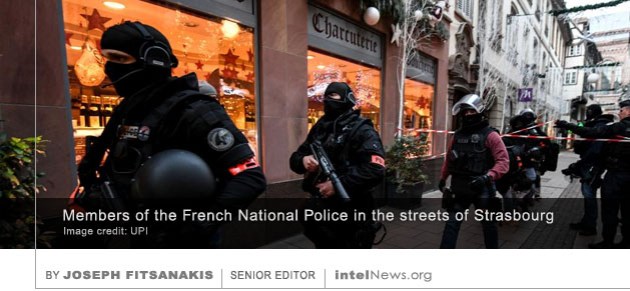
Analysis: Strasbourg attack raises serious security concerns in Europe

StrasbourgThe terrorist attack in the French city of Strasbourg on December 11 raises important security concerns for Europe’s ability to defend itself against a rapidly evolving Islamist insurgency. The attack lasted 10 minutes, from 7:50 to 8:00 p.m. on Tuesday evening, and targeted shoppers in Christkindelsmärik, a large Christmas market held annually in Strasbourg. The lone shooter, who has since been identified as Chérif Chekatt, a French citizen, was reportedly heard shouting “Allahu Akbar” (God is great) repeatedly as he opened fire on the unsuspecting shoppers. He also tried to stab some of them using a knife. Chekatt eventually exchanged fire with French soldiers and officers of the National Police before fleeing the scene of the attack in a taxi cab. Three people were declared dead at the scene, while 12 others were urgently transported to nearby hospitals. Six of them remain in critical condition. Chekatt remained at large until Thursday evening, when he was shot dead by police in Strasbourg.

It is important to stress that the choice of Strasbourg as the site of the terrorist strike was not accidental, nor was the attack spontaneous. A city and of nearly 500,000 inhabitants in its greater district, Strasbourg is one of the European Union’s de facto capitals. It hosts several European institutions, including the building of the European Parliament. Its geographical location on the French-German border epitomizes the crossroads of Franco-German cultural traditions. Its distinct character symbolizes the coexistence of Europe’s two leading powers, which forms the cornerstone of the European Union project. The majority of Strasbourg’s residents are bilingual and communicate in Alsacien, a peculiar mixture of French and German. The city also exemplifies a distinctive brand of 21st-century Christian unity through the balanced coexistence of Catholic and Protestant religious cultures. The Christkindelsmärik —the venue that was attacked on Tuesday— is Europe’s largest Christmas market and symbolizes precisely that coexistence. Providing that Tuesday’s attack was sanctioned and/or planned by the Islamic State or one of its affiliate organizations, its strong symbolism is apparent.

As Washington Examiner commentator Tom Rogan noted on Wednesday, it appears that the perpetrator of the attack was able to acquire a semi-automatic weapon, as well as grenades. Unlike the United States, accessing these types of weapons in Western Europe is exceedingly difficult. This is so especially in France, a country that has remained in a perpetual state of heightened security since the Paris attacks of November 2015. It is even more perplexing that Chekatt was able to acquire this type of weaponry, given that his name featured on the terrorism watch lists of France’s security and intelligence services. Additionally, says Rogan, one of the operational trademarks of the Islamic State centers on adhering to a sharp division between its arms procurement networks and the individuals who carry out terrorist attacks. This means that a wider Islamist network in France, Switzerland or Germany, was able to armed and possibly trained Chekatt in Europe, since the attacker is not believed to have visited the Middle East or North Africa.

Rogan also points out that Chekatt —a French-born 29-year-old petty criminal— was radicalized while serving time in prison. This raises important questions about Salafist-Jihadi radicalization networks inside Western European prison systems. The security implications of this realization inevitably widens the security considerations of Europe’s counterterrorism agencies. The latter have so far focused primarily on the danger posed by the return of European Islamic State volunteers from the Middle East. The problem, however, appears to be more complicated.

Ultimately, the Strasbourg attack demonstrates that, despite several years of concerted efforts, the ability of European counterterrorism agencies to prevent strikes by Islamist groups on European soil is limited. Meanwhile, European streets are busy during the Christmas season, with indoor and outdoor markets and festivals, concerts, as well as a host of religious observances taking place in thousands of different locations across the continent. Should Tuesday’s attack in Strasbourg mark the beginning of a sustained terrorism campaign by the Islamic State, December could prove to be a deadly month in Europe.

Author: Joseph Fitsanakis | Date: 13 December 2018 | Permalink

Four times more Sunni Islamist militants today than on 9/11, study finds

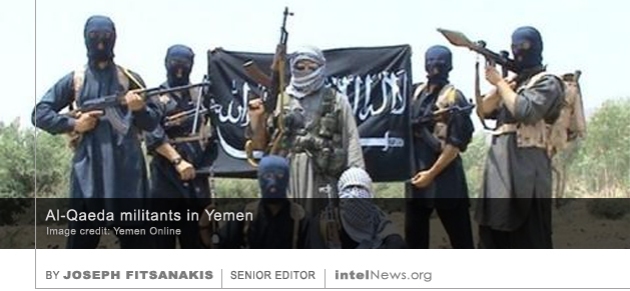
Al-Qaeda in YemenThere are four times as many Sunni Islamist militants today in the world than on September 11, 2001, despite an almost 20 year-long war campaign by the United States and its allies, according to a new report. Washington launched the ‘global war on terrorism’ in the aftermath of the 9/11 attacks that were perpetrated by al-Qaeda. In the ensuing years, American and other Western troops have engaged militarily in over a dozen countries, including Afghanistan, Iraq, Pakistan, Syria, Libya, Yemen, Somalia, Sudan, and the Philippines. But a new study by the bipartisan Center for Strategic and International Studies (CSIS) suggests that the West’s efforts to combat Sunni militancy are failing —and may even be making the problem worse. The report by the Washington-based think-tank states that the number of active Sunni Islamist militants today is as much as “270 percent greater than in 2001, when the 9/11 attacks occurred”.

Entitled “The Evolution of the Salafi-Jihadist Threat”, the 71-page report is one of the most extensive ever undertaken on this topic, drawing on information from data sets that date back nearly 40 years. It warns that, despite the rapid loss of territory suffered by the Islamic State in Iraq and Syria, armed Sunni militancy is “far from defeated”. The number of Salafi-jihadists —active proponents of armed fight against perceived enemies of Islam— has slightly declined in comparison to 2016, but it remains at near-peak levels over a 38-year period, says the CSIS report. It estimates that there are today as many as 230,000 Salafi-jihadists in almost 70 countries. Most of them are based in Syria (as many as 70,500), Afghanistan (as many as 64,000), Pakistan (up to 40,000), and Iraq (up to 15,000). Nearly 30,000 more are in Africa, primarily in Somalia, Nigeria and the Sahel region.

These fighters, and the groups they fight under, are far more resilient than Western antiterrorist strategists tend to assume, claims the report. They are also inadvertently aided by successive policy failures by the US and its closest Western allies. The latter focus primarily on the military aspects of counterterrorism campaigns, while ignoring the importance of improving local governance in territories where Sunni Islamism is rife, argues the report. Therefore, as the US and its allies continue to engage “in a seemingly endless [military] confrontation with a metastasizing set of militant groups”, they face seemingly endless waves of militants, who are becoming increasingly capable of resisting Western conventional military force. The report is available online in .pdf form, here.

Author: Joseph Fitsanakis | Date: 26 November 2018 | Permalink

Trump’s Twitter feed is ‘gold mine’ for foreign spies, says ex-CIA analyst

Trump 2016With nearly 53 million Twitter followers, United States President Donald Trump could easily be described as the most social-media-friendly American leader in our century. It is clear that Trump uses Twitter to communicate directly with his followers while circumventing mainstream media, which he views as adversarial to his policies. However, according to former Central Intelligence Agency analyst Nada Bakos, foreign intelligence agencies are among those paying close attention to the president’s tweets. Bakos spent 20 years in the CIA, notably as the Chief Targeter of the unit that tracked down Abu Musab al-Zarqawi, the founder of al-Qaeda in Iraq, which later evolved into the Islamic State of Iraq and Syria. In a June 23 editorial in The Washington Post, Bakos argues that President Trump’s “Twitter feed is a gold mine for every foreign intelligence agency”.

All intelligence agencies, explains Bakos, build psychological profiles of foreign leaders. These profiles typically rely on information collected through intelligence operations that are “methodical, painstaking and often covert”. The final product can be crucial in enabling countries to devise strategies that counter their adversaries, says Bakos. But with Trump, covert intelligence-collection operations are not needed in order to see what is on his mind, since “the president’s unfiltered thoughts are available night and day”, she claims. The former CIA analyst points out that President Trump’s tweets are posted “without much obvious mediation” by his aides and advisors, something that can be seen by the frequency with which he deletes and reposts tweets due to spelling and grammatical errors. These unfiltered thoughts on Twitter offer a “real-time glimpse of a major world leader’s preoccupations, personality quirks and habits of mind”, says Bakos.

Undoubtedly, she argues, foreign intelligence agencies are utilizing President Trump’s tweets in numerous ways while building his personality profile. The most obvious ways are by performing content analysis of his tweets, which could then be matched against information collected from other sources about major US policy decisions. Additionally, foreign intelligence agencies could identify media sources that the US president seems to prefer, and then try to feed information to these sources that might sway his views. Countries like Saudi Arabia and Russia may have done so already, claims Bakos. The US president’s views, as expressed through Twitter, could also be compared and contrasted with the expressed views of his aides or senior cabinet officials, in order to discern who he agrees with the least. It is equally useful to analyze the issues or events that the US president does not tweet about, or tweets about with considerable delay. One could even derive useful information about Trump’s sleeping patterns based on his tweets, says the former CIA analyst.

Bakos does not go as far as to suggest that the US president should abstain from social media. But she clearly thinks that the US leader’s use of social media is too impulsive and potentially dangerous from a national-security perspective. She also laments that, throughout her career in the CIA, she and her team “never had such a rich source of raw intelligence about a world leader, and we certainly never had the opportunity that our adversaries (and our allies) have now”, thanks to Trump’s incessant social media presence.

Author: Joseph Fitsanakis | Date: 03 July 2018 | Permalink

Analysis: The Islamic State is far from dead; it is regrouping and rebranding itself

Islamic State ISISIn a recent series of interviews to promote his new book, Anatomy of Terror, former FBI special agent and current counterterrorism expert Ali Soufan insists that the Islamic State remains potent and dangerous. Speaking last week to the British newspaper The Guardian, Soufan warned that, even though the Islamic State was unable to hang on to its self-described caliphate in the Middle East, the group has ample opportunities to regroup. In the days of al-Qaeda, “we only had one vacuum, in Afghanistan”, from where Osama bin Laden’s organization operated from and spread its message, said Soufan. “Now we have so many vacuums —Syria, Yemen, Libya, northern Nigeria, Tunisia, the Philippines— and it’s expanding. That’s very dangerous”, he warned.

Soufan, a well-read analyst and complex thinker, who today presides over The Soufan Group and oversees the Soufan Foundation, is right to warn against the notion that the Islamic State is on its way out. The group’s meteoric rise marked a watershed moment in the modern history of militant Sunni Islam. Even if it is militarily annihilated —a prospect that is far from certain— its physical absence will in no way erase its impact and influence among its millions of supporters and sympathizers. In fact, experts warn that the group is —like al-Qaeda before it— proving to be resilient and able to withstand intense military pressure from its enemies. Currently, all signs show that the Islamic State is actively reorganizing under the command of its leader, Abu Bakr al-Baghdadi. The prolonged absence of the Iraqi-born al-Baghdadi has prompted wild speculation about this supposed demise or severe incapacitation. There are even some who claim that he was killed by an Islamic State faction in an internal coup.

But most intelligence agencies agree that al-Baghdadi —and his core lieutenants— remain very much alive and well. Three weeks ago, The Washington Post cited anonymously a “senior United States counterterrorism official” who confirmed that, by all indications, al-Baghdadi was alive and was coordinating the group’s activities in its last strongholds in eastern Syria. This is supported by communications intercepts, detainee interrogations and statements by informants, said The Post. It is important to note that Al-Baghdadi continues to have alongside him some of the militant group’s most hardened commanders, most of whom were trained in intelligence and military tactics during the reign of Saddam Hussein. Under their guidance, retreating Islamic State forces are leaving behind cell-based formations of underground fighters in areas that are liberated by the fragile US-led coalition. Read more of this post

Opinion: Bizarre fake murder plot points to Ukrainian state’s recklessness, unreliability

Arkady Babchenko

Arkady Babchenko

Western audiences were treated to a small taste of the bizarreness of Eastern European politics this week, when a Russian journalist who had reportedly been assassinated by the Kremlin, made an appearance at a live press conference held in Kiev. On Tuesday, Ukrainian media reported that Arkady Babchenko, a Russian war correspondent based in Ukraine, had been shot dead outside his apartment in the Ukrainian capital. A day later, after Babchenko’s murder had prompted global headlines pointing to Russia as the most likely culprit, Babchenko suddenly
appeared alive and well during a press conference held by the Security Service of Ukraine (SBU). The SBU then said that Babchenko’s killing had been staged in an attempt to derail a Russian-sponsored plan to kill him. The bizarre incident concluded with Babchenko meeting on live television with Ukrainian President Petro Poroshenko, who praised him as a hero. Later that night, the Russian journalist wrote on his Facebook page that he planned to die after “dancing on [Russian President Vladimir] Putin’s grave”.

Welcome to Ukraine, a strange, corrupt and ultra-paranoid state that is on the front lines of what some describe as a new Cold War between the West and Russia. Like the Cold War of the last century, the present confrontation is fought largely through information. The Russian government, which appears to be far more skillful than its Western adversaries in utilizing information for political purposes, immediately sought to capitalize on the Babchenko case. In fact, this baffling and inexplicable fiasco may be said to constitute one of the greatest propaganda victories for the Kremlin in years.

Ever since accusations began to surface in the Western media about Moscow’s alleged involvement in the 2016 presidential elections in the United States, Russia has dismissed these claims as “fake news” and anti-Russian disinformation. When Sergei and Yulia Skripal were poisoned in England in March, the Kremlin called it a false-flag operation. This is a technical term that describes a military or intelligence activity that seeks to conceal the role of the sponsoring party, while at the same time placing blame on another, unsuspecting, party. Most Western observes reject Russia’s dismissals, and see the Kremlin as the most likely culprit behind the attempt to kill the Skripals.

As one would expect, Russia stuck to its guns on Tuesday, when the world’s media announced the death of Arkady Babchenko in the Ukraine. Moscow claimed once again that we were dealing here with a false flag operation that was orchestrated by anti-Kremlin circles to make Russia look bad at home and abroad. It turns out that Moscow was right. Babchenko’s “murder” was indeed a false flag operation —admittedly a sloppy, shoddy and incredibly clumsy false flag operation, but a false flag operation nonetheless. Moreover, Babchenko’s staged killing could not possibly have come at a worse time for Ukraine and its Western allies. In the current environment, global public opinion is extremely sensitive to the phenomenon of ‘fake news’ and disinformation. Within this broader context, the Ukrainian state and its intelligence institutions have placed themselves at the center of an global disinformation maelstrom that will take a long time to subside. In doing so, the government of Ukraine has irreparably harmed its reputation among the general public and in the eyes of its Western allies. The Kremlin could not possibly have asked for a better gift from its Ukrainian adversaries.

The amateurishness and recklessness of some Eastern European countries that the West sees as allies in its confrontation with Russia, such as Ukraine, Poland, Hungary, and others, would be humorous if it were not so dangerous. The manifest idiocy of the Babchenko fake plot also poses serious questions about the West’s policy vis-à-vis  Russia. It is one thing for the West to be critical of the Kremlin and its policies —both domestic and foreign. It is quite another for it to place its trust on governments and intelligence services as those of Ukraine, which are clearly unreliable, unprofessional, and appear to lack basic understanding of the role of information in international affairs.

Author: Joseph Fitsanakis | Date: 01 June 2018 | Permalink