German spy agency tapped Finnish phone lines in early 2000s
January 20, 2016 1 Comment
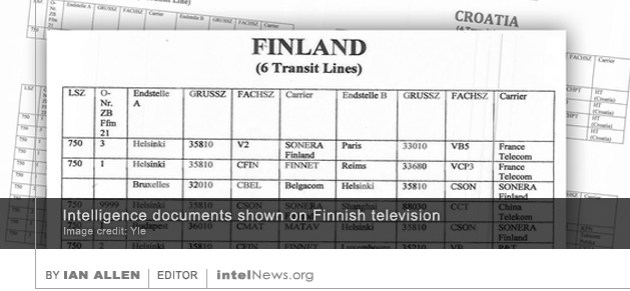 German intelligence, possibly with the collaboration of the United States, monitored communications lines connecting Finland with at least five countries in the early 2000s, according to leaked documents. The documents, aired this week by Yle Uutiset, the main news program of the Finnish Broadcasting Company (Yle), is based on information contained in “leaked German intelligence documents” that were first made public in May 2015. As intelNews reported at the time, the intelligence collection was described as a secret collaboration between Germany’s BND (Bundesnachrichtendienst) and America’s National Security Agency (NSA). According to Austrian politician Peter Pilz, who made the initial allegations, the BND-NSA collaboration was codenamed EIKONAL and was active from 2005 to 2008. Pilz said at the time that many European phone carriers and Internet service providers were targeted by the two agencies. Belgium and Switzerland have already launched investigations into EIKONAL.
Now new information provided by Yle seems to show that the secret BND-NSA collaboration targeted Finnish communications as well, focusing on at least six separate communications transit lines. The lines are believed to carry telephone call and possibly Internet traffic from Finnish capital Helsinki to a number of cities in France, Belgium, Hungary, Luxemburg, and China, said Yle Uutiset. Although the targeted lines are known to carry telephone and Internet traffic, it is unknown at this time whether EIKONAL targeted both kinds. But Yle said the interception lasted for most of the first part of the 2000s and involved large amounts of communications data.
The station contacted Tuomas Portaankorva, Inspector General of SUPO, the Finnish Security Intelligence Service. He told Yle that, speaking broadly, he was not surprised to be told that Finnish telecommunications lines had been monitored by foreign intelligence agencies, Western or otherwise. He went on to caution that, even though Finnish lines had been targeted, it was not possible to conclude that Finland was indeed the target of the surveillance operation. Yle also spoke to Vesa Häkkinen, spokesman for the from Finland’s Ministry of Foreign Affairs, who told the station that SUPO, and not the ministry, was the proper official body to be consulted about EIKONAL. “If there is reason to suspect that these actions were directed at the Finnish state”, said Häkkinen, “we would undertake appropriate action”.
► Author: Ian Allen| Date: 20 January 2016 | Permalink | News tip: Matthew Aid
 A report by Germany’s primary intelligence agency warns that internal power struggles and broader geopolitical changes are turning the Kingdom of Saudi Arabia into a major source of regional instability. The
  Germany’s foreign intelligence agency says it has evidence that the Islamic State is making use of chemical weapons in northern Iraq, according to media reports. The German Federal Intelligence Service, known as BND, says its operatives in the Middle East were able to collect biological samples from Kurdish fighters engaged in battles against the Islamic State forces. The samples pointed to chemical poisoning that most likely came from sulfur mustards, more commonly known as mustard gas. The chemical, which is banned from use in warfare by the 1993 Chemical Weapons Convention, causes skin irritation that gets progressively worse until sufferers develop debilitating blisters filled with yellow fluid.
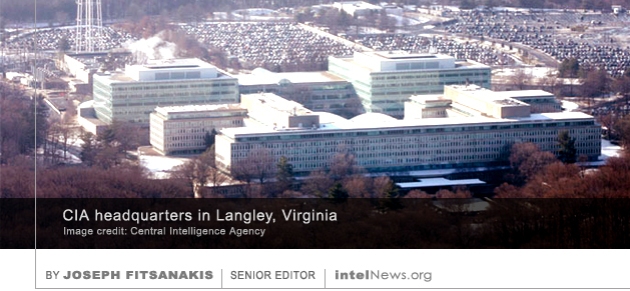 The United States Central Intelligence Agency had direct and unfiltered access to telecommunications data exchanged between German citizens, according to a new document that has surfaced in the German press. The program, codenamed GLOTAIC, was a collaboration between the CIA and Germany’s Federal Intelligence Service, known as BND. According to German newsmagazine Der Spiegel, which
 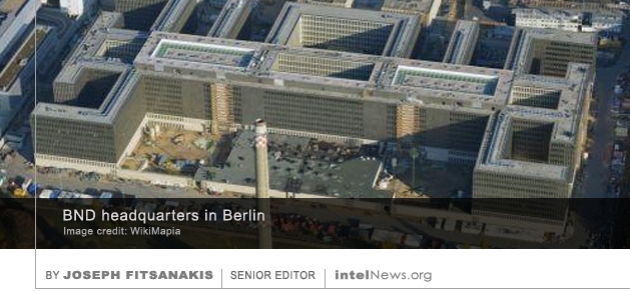 A German intelligence officer, who is accused of spying for the United States Central Intelligence Agency, has been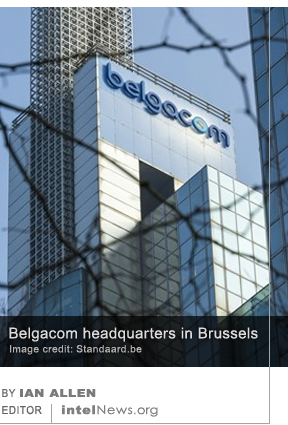
 The office of the Swiss Federal Prosecutor has launched an investigation into claims that the country’s largest telecommunications provider was spied on by a consortium of German and American intelligence agencies. The spy project was










 intelNews.org
German court sentences intelligence officer who spied for CIA
March 17, 2016 by Joseph Fitsanakis 1 Comment
On Thursday, Markus R., identified in some German media as Markus Reichel, was sentenced for selling over 200 classified German government documents to the CIA between 2008 and 2012, for which he said he received €80,000 ($90,000). During his trial, Reichel also admitted giving German government documents to personnel at the consulate of the Russian Federation in Munich in the summer of 2014. Among the documents that the former BND clerks is said to have given the CIA was a list of thousands of German intelligence operatives —including agents— stationed abroad, which contained their operational cover names and real identities. But Reichel was caught when German counterintelligence officers intercepted correspondence between him and his handlers and then used the information to set up a successful sting operation.
During his trial, Reichel issued a formal apology for engaging in espionage against the German state. He told the court that he had been motivated by boredom and by “lust for adventure”, which he said he did not get working for the BND. He also said he was frustrated by the lack of confidence that his superiors and colleagues had in him. “At the BND, I had the impression that no one trusted me with anything”, said Reichel. “But the CIA was different. You had the opportunity to prove yourself”, he added. Reichel was found guilty of treason against the German state and sentenced to eight years in prison.
► Author: Joseph Fitsanakis | Date: 17 March 2016 | Permalink
Filed under Expert news and commentary on intelligence, espionage, spies and spying Tagged with BND, CIA, double agents, espionage, Germany, lawsuits, Markus R., Markus Reichel, News, Russian consulate in Munich, triple agents