News you may have missed #724
May 7, 2012 Leave a comment
 By IAN ALLEN | intelNews.org |
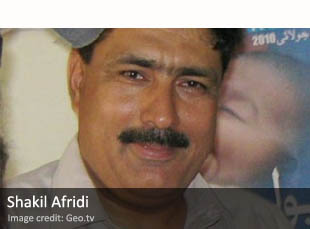
►►Aid group denies link to US intelligence in Pakistan. Aid group Save the Children denied accusations it has ties to US intelligence agencies in Pakistan. The organization’s denial came shortly after Dr. Shakil Afridi, a doctor the CIA recruited to help in the search for Osama bin Laden, told Pakistani interrogators that Save the Children played a role in his becoming involved with the CIA. Following Afridi’s interrogation, the Pakistani government banned some Save the Children members from leaving the country and aid supplies –including medical supplies– have been blocked by customs.
►►Is MI6 double spy’s case linked with Gareth Williams’ death? In 2010, British authorities jailed for a year MI6 employee Daniel Houghton, after he was caught trying to sell classified documents to MI5 spooks posing as foreign agents. According to newspaper The Daily Mirror, British police are now “probing a possible link between the Houghton’s case and the death of MI6 employee Gareth Williams, who was found dead in his London apartment in 2010. According to the paper, police detectives “want assurances from MI6 that Williams’ details [and] identity were not compromised” by Houghton.
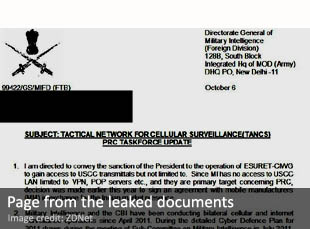
►►Fears of spying hinder US license for China Mobile. China Mobile, the world’s largest mobile provider, applied in October for a license from the Federal Communications Commission to provide service between China and the United States and to build facilities on American soil. But officials from the FBI, the Department of Homeland Security and the Justice Department’s National Security Division are concerned that the move would give the company access to physical infrastructure and Internet traffic that might allow China to spy more easily on the US government and steal intellectual property from American companies. This is according to The Los Angeles Times, which cites “people familiar with the process who declined to be identified because the deliberations are secret”. US officials and lawmakers have expressed similar concerns about a Chinese telecommunications hardware manufacturer Huawei Technologies, which is alleged to have contacts with the Chinese People’s Liberation Army and the Ministry of State Security.







 intelNews.org
Scandinavian phone company helps ex-Soviet republics spy on citizens
May 8, 2012 by intelNews 1 Comment
A highly profitable cellular telecommunications company, which is jointly owned by a Swedish-Finnish public-private consortium, is enabling some of the world’s most authoritarian regimes to spy on their own citizens, according to a new report. TeliaSonera AB, the dominant telephone company and mobile network operator in Sweden and Finland, is currently active in nearly 20 countries around the world. In 2011, it posted a net profit of nearly $3 billion, 25 percent of which came from the company’s operations in countries of the former Soviet Union. They include some of TeliaSonera’s most lucrative franchises, such as Geocell in Georgia, Kcell in Kazakhstan, Ucell in Uzebekistan, Tcell in Tajikistan, and Azercell in Azerbaijan, among others. But a new investigation by Sweden’s public broadcaster, Sveriges Television AB (SVT), accuses TeliaSonera of knowingly giving some of the world’s most oppressive governments the means to spy on their own citizens. The report, which is available online in English, effectively states that TeliaSonera is directly complicit in some of the world’s most severe human rights abuses. The accusation is bound to cause embarrassment among senior officials in the Swedish government, which owns nearly 40 percent of TeliaSonera’s stock. The SVT investigation singles out Uzbekistan, Belarus and Azerbaijan, where TeliaSonera operates monopoly cellular networks on behalf of the state, “in exchange for lucrative contracts”. While running the networks, TeliaSonera allegedly grants local intelligence agencies complete and real-time access to the all telephone calls, pen-register data, and content of text messages exchanged by users. This, says the SVT report, has in turn facilitated several arrests of pro-democracy activists and political dissidents in countries like Belarus and Azerbaijan. Read more of this post
Filed under Expert news and commentary on intelligence, espionage, spies and spying Tagged with Azerbaijan, Azercell, Belarus, cellular telephony, civil liberties, ethics, Finland, Geocell, Georgia, human rights, Kazakhstan, Kcell, Lars Nyberg, News, surveillance, Sweden, Tajikistan, Tcell, telecommunication service providers, TeliaSonera, Ucell, Uzbekistan, wiretapping