Veil of secrecy may soon be lifted on Novichok nerve agent used to attack Skripal
October 24, 2019 5 Comments
 The chemical structure and action mechanism of a top-secret family of nerve agents known as novichoks may soon be available to a wider pool of researchers through its inclusion into the Chemical Weapons Convention (CWC) list of the Organization for the Prohibition of Chemical Weapons (OPCW). The term novichok (meaning ‘newbie’ in Russian) was given by Western scientists to a class of rarely used nerve agents that were developed in the Soviet Union and Russia between 1971 and the early 1990s.
The first public discussion about the existence of these agents took place in the early 1990s, when Vil Mirzayanov, a chemical warfare expert working for the Soviet military, revealed their existence. However, Western intelligence agencies have discouraged public scientific research on these nerve agents, fearing that such activities could reveal their chemical structure and mechanism of action. That could in turn facilitate the proliferation of novichok nerve agents worldwide.
But this attitude shifted drastically after March 2018, when —according to British intelligence— Russian spies used novichok in an attempt to kill Sergei Skripal, a Russian defector to Britain. The British government claims that Russians spies smuggled novichok into Britain by hiding it inside an imitation perfume bottle.
The attempt on Skripal’s life failed, but it prompted the United States, Canada and the Netherlands to propose that two categories of novichoks be chemically identified and added to the CWC list of Schedule 1 chemical weapons. If that were to happen, members of the OPCW —including Russia— would be required to declare and promptly destroy any stockpiles of novichoks in their possession.
Russia’s initial reaction was to oppose the proposal by the United States, Canada and the Netherlands. The Russian OPCW delegation questioned the proposal’s scientific validity and dismissed it as politically motivated. However, according to a report published yesterday in the leading scientific journal Science, Moscow has now agreed with the proposal to list two classes of novichoks in the CWC list, and even proposed adding a third class of the obscure nerve agent to the list. Russia also proposed the inclusion into the CWC list of two families of carbamates —organic compounds with insecticide properties, which the United States is reputed to have included in its chemical weapons arsenal during the Cold War.
According to the Science report, the OPCW Executive Council has already approved Russia’s proposal, which means that the organization is now close to classifying novichoks as Schedule 1 nerve agents. If this happens, academic researchers in the West and elsewhere will be able for the first time to collaborate with defense laboratories in order to research the chemical structure, as well as the mechanism of action, of novichoks. This is likely to produce computer models that will shed unprecedented light on the symptoms of novichoks and the various methods of treating them. But they will also provide information about the chemical structure of the nerve agent, which may eventually lead to proliferation concerns.
► Author: Joseph Fitsanakis | Date: 24 October 2019 | Permalink
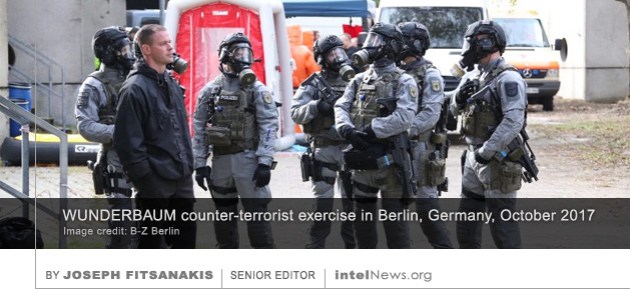 A German newspaper reported last week that at least one European intelligence agency has already warned that the Islamic State is exploring the use of chemicals for attacks in Europe. Such an eventuality would be a radical departure from prior attacks by the Islamic State in the West. In the past, the militant group has shown a strong preference for low-tech means of dispensing violence, such as firearms, vehicles and knives. But it has utilized chemical substances in Iraq and Syria, and its technical experts have amassed significant knowledge about weaponized chemicals.
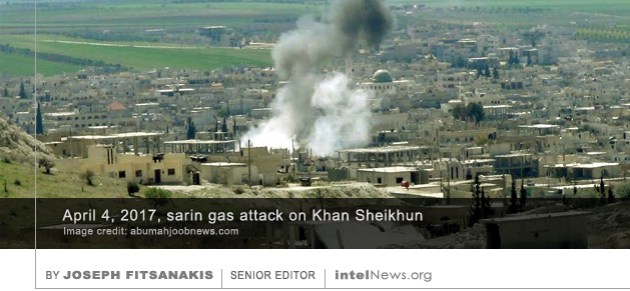 A comprehensive report released yesterday by the French Intelligence Community concludes with certainty that the government of Syrian President Bashar al-Assad was behind the April 4 sarin gas attack in northwestern Syria. The report, a “national evaluation” based on France’s own intelligence sources and scientific analysis of samples collected from the site of the attack, indicates that the poison gas used in the attack came from stockpiles that belong to the Syrian government.
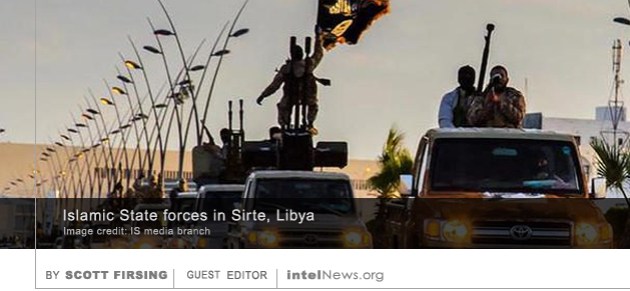 As United States air strikes and special-forces operations
 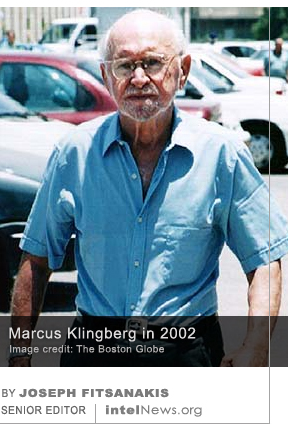 Marcus Klingberg, who is believed to be the highest-ranking Soviet spy ever caught in Israel, and whose arrest in 1983 prompted one of the largest espionage scandals in the Jewish state’s history, has died in Paris. Born Avraham Marek Klingberg in 1918, Klingberg left his native Poland following the joint German-Soviet invasion of 1939. Fearing persecution by the Germans due to his Jewish background, and being a committed communist, he joined the Soviet Red Army and served in the eastern front until 1941, when he was injured. He then received a degree in epidemiology from the Belarusian State University in Minsk, before returning to Poland at the end of World War II, where he met and married Adjia Eisman, a survivor of the Warsaw Ghetto uprising. Together they moved to Sweden, from where they emigrated to Israeli in 1948. It is believed that Klingberg was recruited by the Soviet KGB while in Sweden, and that he moved to Israel after being asked to do so by his Soviet handlers –though he himself always denied it.
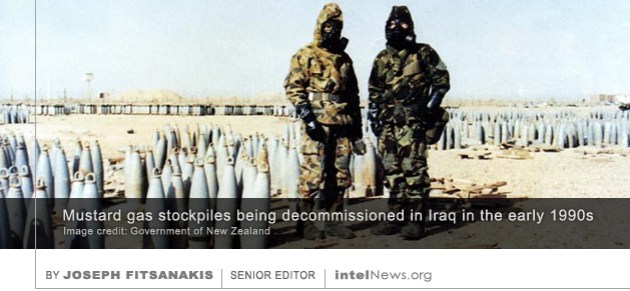 Germany’s foreign intelligence agency says it has evidence that the Islamic State is making use of chemical weapons in northern Iraq, according to media reports. The German Federal Intelligence Service, known as BND, says its operatives in the Middle East were able to collect biological samples from Kurdish fighters engaged in battles against the Islamic State forces. The samples pointed to chemical poisoning that most likely came from sulfur mustards, more commonly known as mustard gas. The chemical, which is banned from use in warfare by the 1993 Chemical Weapons Convention, causes skin irritation that gets progressively worse until sufferers develop debilitating blisters filled with yellow fluid.









 intelNews.org
Concern mounts over Russia’s possible use of chemical weapons in Ukraine
March 11, 2022 by Joseph Fitsanakis Leave a comment
This is not the first time that Moscow has leveled such accusations against the United States and Ukraine. For over a decade, senior officials in the administration of Russian President Vladimir Putin have claimed that the United States and Britain have maintained secret networks of biological weapons laboratories in Eastern Europe. But the Kremlin’s accusations have been getting more frequent and more specific in recent days. On March 7, Igor Kirillov, Chief of the Russian military’s Radiation, Chemical and Biological Defense Forces, alleged that American and Ukrainian soldiers were destroying biological weapons facilities in Western Ukraine. Their goal, Kirillov claimed, was to keep lethal biological agents from falling into the hands of the Russian military.
Two days later, on March 9, Russian Defense Ministry spokesperson Major General Igor Konashenkov stated that Ukrainian forces had secretly transported “80 tons of ammonia” to a location northwest of Kharkiv. The purpose of the operation, Konashenkov said, was to carry out a “provocation using toxic substances”, and then blame Russia of using chemical weapons. During the Syrian Civil War, Moscow leveled similar allegations against Syrian rebels shortly before the government of Syrian President Bashar al-Assad launched chemical attacks against rebel-held areass.
There is also concern among Western analysts that the disconnection of the Chernobyl Nuclear Power Plant’s electrical network from Ukraine’s electrical grid may be “a Russian attempt to trigger nuclear panic over a potential radiological incident” in Ukraine. In light of this incident, some observers are beginning to interpret prior attacks on the Zaporizhia nuclear facility on March 4, and on a research facility containing a nuclear reactor in Kharkiv on March 6, as deliberate acts by Moscow. They say that the Kremlin may actively be seeking to introduce unconventional weapons into the war in Ukraine.
► Author: Joseph Fitsanakis | Date: 11 March 2022 | Permalink
Filed under Expert news and commentary on intelligence, espionage, spies and spying Tagged with 2022 Russian invasion of Ukraine, chemical warfare, chemical weapons, false flag operations, Igor Kirillov, Igor Konashenkov, News, nuclear security, Russia, Ukraine