France approves sweeping spy bill in response to Islamist attacks
May 6, 2015 1 Comment
 By JOSEPH FITSANAKIS | intelNews.org
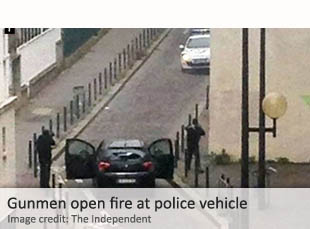
Lawmakers in the French National Assembly have overwhelmingly approved a new bill giving the country’s intelligence services unprecedented domestic spy capabilities. The bill, which is dismissed by critics as France’s version of the United States’ PATRIOT Act, was drafted by the ruling Socialist Party just days after a group of armed Islamists attacked several targets in Paris. The attacks were primarily directed against France’s popular satirical magazine Charlie Hebdo (see photo). A dozen members of the magazine’s staff, including several internationally-known cartoonists, were killed at the magazine’s headquarters in the French capital on January 7 of this year.
The newly approved bill provides blanket-approval for the wholesale interception and storage of communications metadata, which include information about the location and size of Internet-based communications exchanges. They also include information on the identities of those sending or receiving electronic messages. The legislation also includes a provision for the establishment of a new supervisory body called the National Commission for Control of Intelligence Techniques. Its mission will be to supervise the use of surveillance powers by France’s six intelligence agencies, as well as to handle complaints relating to communications interception from members of the public.
As the bill progressed through France’s houses of parliament, the French government and its supporters argued that the country needed national legislation that would take into consideration the rapid technical changes in digital telecommunications. But critics, which included most of France’s Internet service providers, claimed that the new law would give intelligence agencies unreasonably broad surveillance powers and would hamper online commerce. These claims, however, failed to convince lawmakers; the bill was thus approved by 438 votes for to 86 against. Most parliamentarians from France’s three main parties —the Socialist Party, the rightwing Union for a Popular Movement, and the centrist Union of Democrats and Independents— voted in favor of the bill. Observers noted with surprise that most lawmakers from the Radical Party of the Left also voted in favor of the bill. In contrast, the communist-led Left Front, as well as the Greens, voted overwhelmingly against the bill.
 By JOSEPH FITSANAKIS | intelNews.org












 intelNews.org
Ukraine war prompts European Union to overhaul counter-surveillance practices
July 18, 2022 by Ian Allen 1 Comment
According to EUObserver, EU member states have agreed to establish a so-called “CSC-TSCM Expert Group,” which will spearhead the formation of this new unit. In security parlance, TSCM stands for technical security counter-measures, a method of counter-surveillance. In their most basic form, TSCM operations are carried out by teams of technical experts trained in the use of anti-bugging equipment. These are able to detect radio emissions, which are generated by most surveillance devices —commonly referred to as ‘bugs’.
The internal memorandum stipulates that the “CSC-TSCM Expert Group” will be officially set up after July 25. It will consist of experts from several EU states. The resulting unit’s mission will be to “prevent, detect and potentially neutralise eavesdropping of information in any physical or electronic form,” the memorandum states. Counter-measures operations will include regular inspections of “facilities and vehicles and the protection of classified meetings” in buildings that house the EU Council, EU Parliament, and the European Commission.
The forthcoming formation of the “CSC-TSCM Expert Group” appears to be closely linked to news, published earlier this month, relating to the construction of a new facility. The new facility is described in the media as an EU “secure bunker.” According to the EUObserver, the €8 million ($8.07 million) enclosed space will operate as a designated EU sensitive compartmented information facility (SCIF). The term denotes a secure area within a larger building, which is used to discuss sensitive topics and process classified information. Read more of this post
Filed under Expert news and commentary on intelligence, espionage, spies and spying Tagged with Belgium, Brussels, communications surveillance, European Union, News, SCIF, TSCM