Russia announces detention of Norwegian citizen on espionage charges
December 20, 2017 Leave a comment
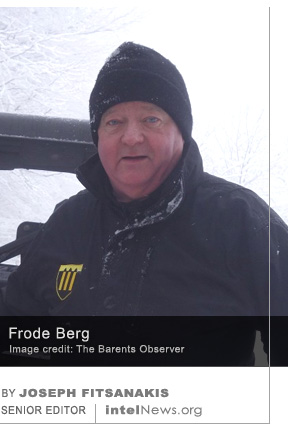 Authorities in Russia have announced the arrest of a Norwegian citizen, whom they accuse of receiving classified information relating to Russia’s Armed Forces. The detainee has been named as Frode Berg, 62, from Kirkenes, a small town in Norway’s far north, located 100 miles from the Russian city of Murmansk. According to articles in the Russian press, Berg is a 24-year veteran of the Office of the Norwegian Border Commissioner, an obscure government agency that operates under Norway’s Ministry of Justice and Public Security. Among other tasks, the Office of the Norwegian Border Commissioner is responsible for enforcing and monitoring bilateral compliance with the Soviet (now Russian)-Norwegian Border Agreement of 1949. Berg, who worked closely with Norway’s National Police Directorate as part of his job, retired from the Office in 2014.
According to reports in the Russian media, Berg was arrested two weeks ago by officers of the Russian Federal Security Service (FSB), the agency responsible for domestic security and counterintelligence. He is now in detention and is accused of receiving classified information relating to the Russian Navy. It is believed that Berg received the classified documents from an unnamed Russian national, who was arrested by the FSB in early December and now faces charges of high treason. No further information has been made public about Berg’s arrest. Relations between Norway and Russia have been tense in recent years, partly due to attempts by the two nations to assert control over undersea territories in the arctic region, which are becoming accessible due to global warming. In 2015, Norway’s state broadcaster accused the FSB of pressuring a Norwegian newspaper, The Barents Observer, to fire one of its journalists who covered fossil fuel exploration in the Arctic Ocean. But the Russian government denied that it has played any role in the journalist’s firing.
Norway’s Ministry of Foreign Affairs said on Tuesday that it had established contact with a Norwegian national who was behind bars in Russia, but did not give the person’s name or further details. Berg’s family in Norway said the last time they had news from him was two weeks ago, when he was holidaying in Moscow. The Russian state prosecutor’s office said that Berg’s lawyers had filed an appeal against his detention, but that the Norwegian would remain in jail until his appeal is heard in court.
► Author: Joseph Fitsanakis | Date: 20 December 2017 | Permalink
 Authorities in Poland have charged three high-level military intelligence officials with acting in the interests of Russia. The three include two former directors of Polish military intelligence and are facing sentences of up to 10 years in prison. The news broke on December 6, when Polish authorities announced the arrest of Piotr Pytel, who was director of Poland’s Military Counterintelligence Service (SKW) from 2014 to 2015. It soon emerged that two more arrests had taken place, that of Pytel’s predecessor, Janusz Nosek, and Krzysztof Dusza, Pytel’s chief of staff during his tenure as SKW director.
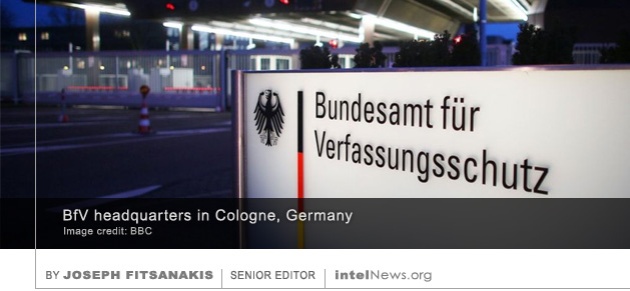 In an unusual step, German intelligence officials have issued a public warning about what they said are thousands of fake LinkedIn profiles created by Chinese spies to gather information about Western targets. On Sunday, Germany’s Federal Office for the Protection of the Constitution (BfV) held a press conference in which it said that it had discovered a wide-ranging effort by spy agencies in China to establish links with Westerners. The agency said that it undertook a 9-month investigation, during which it identified 10,000 German citizens who were contacted by Chinese spy-run fake profiles on LinkedIn. Across Europe, the number of targets could be in the hundreds of thousands,
  Files released on Monday by the British government reveal new evidence about one of the most prolific Soviet spy rings that operated in the West after World War II, which became known as the Portland Spy Ring. Some of the members of the Portland Spy Ring were Soviet operatives who, at the time of their arrest, posed as citizens of third countries. All were non-official-cover intelligence officers, or NOCs, as they are known in Western intelligence parlance. Their Soviet —and nowadays Russian— equivalents are known as illegals. NOCs are high-level principal agents or officers of an intelligence agency, who operate without official connection to the authorities of the country that employs them. During much of the Cold War, NOCs posed as business executives, students, academics, journalists, or non-profit agency workers. Unlike official-cover officers, who are protected by diplomatic immunity, NOCs have no such protection. If arrested by authorities of their host country, they can be tried and convicted for engaging in espionage.
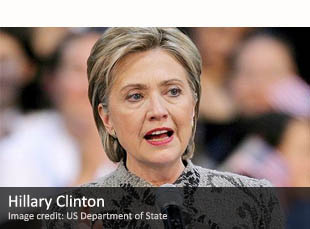 A major reason behind the Federal Bureau of Investigation’s decision to arrest ten Russian spies across the United States in 2010 was their increasing proximity to the then-Secretary of State Hillary Clinton, it has been claimed. The spies had been specifically instructed by their handlers in Moscow to target Clinton, who was seen as the most likely successor to US President Barack Obama, according to recently released FBI files. Ten Russian deep-cover spies, who had no official cover and thus no diplomatic immunity, were
 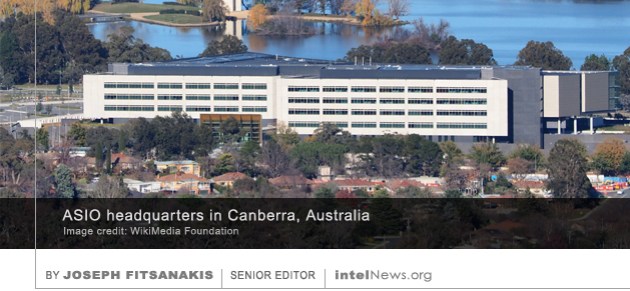 The primary intelligence agency of Australia says its resources are overextended as the country faces “espionage and foreign interference [of an] unprecedented” scale. In its annual report to the Australian houses of parliament, which was produced on Tuesday, the Australian Security Intelligence Organisation (ASIO) says it lacks resources to counter “harmful espionage” and “malicious activity” against the country. The unclassified report is published every year as a summary of a much longer classified report, which is shared with senior government officials and senior civil servants. It is endorsed by ASIO Director Duncan Lewis, who serves as Australia’s Director-General of Security.
 A senior German intelligence official has warned that foreign powers, including Russia, could try to shape the outcome of talks by German parties to form a governing coalition, following last week’s national elections. The elections resulted in a major shakeup of Germany’s political landscape, as Chancellor Angela Merkel’s Christian Democratic Union lost nearly 10 percentage points compared to its 2013 election result. It is now forced to seek the participation of other conservative or centrist political parties in a broad governing alliance. Meanwhile, the far-right Alternative for Germany (AfD) won 12.6 percent, propelling it to third place and giving it 91 seats in the Bundestag. The AfD result marks the first time since 1945 that a German far-right party has managed to secure parliamentary representation.
 Russian espionage in the United States has become increasingly sophisticated and brazen, and American counterintelligence professionals are finding it difficult to contain it “after years’ worth of inattention” according to sources.
 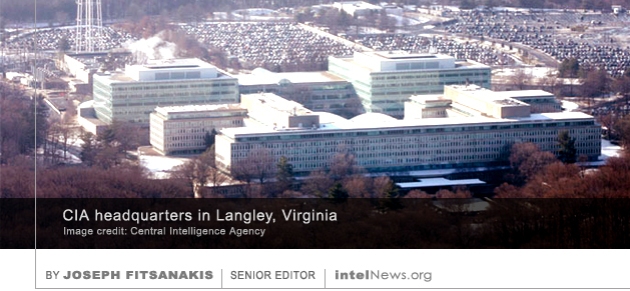 A few years ago, China busted an extensive network of secret operatives run by the United States Central Intelligence Agency. The CIA has yet to recover from the massive blow to its operations, say sources. The CIA has devoted substantial resources to gathering intelligence in China in recent years, and has painstakingly built a network of spies. The latter are Chinese nationals recruited by CIA officers to spy on Beijing on behalf of the United States. But,
 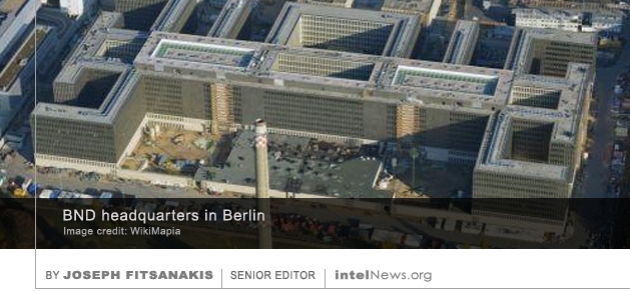 Iranian intelligence operatives are the second most active in Germany after Russian spies, with much of their activity focusing on Israeli targets in the country, according to the German Interior Ministry. The information is contained in a report that was issued in response to a request by a member of Germany’s Bundestag last week. It states that Iranian spies have engaged in nearly two dozen known intelligence operations on German soil since 2007, and have even targeted individuals for assassination.
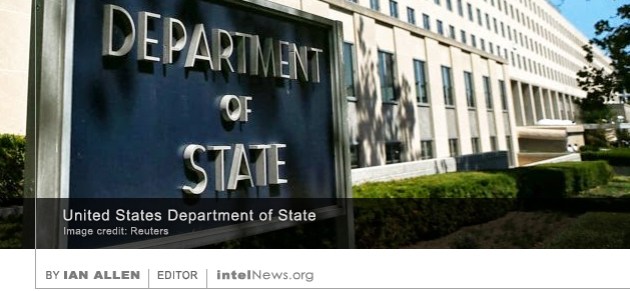 An employee of the United States Department of State has been charged with lying to authorities about her contacts with Chinese intelligence operatives, who gave her money and gifts in return for information. Candace Claiborne, 60, joined the Department of State in 1999 as an office management specialist. She lives in Washington, DC, but has served overseas in American diplomatic facilities in Baghdad, Iraq, Khartoum, Sudan, and China, where she was stationed in Beijing and Shanghai. According to information provided by the Federal Bureau of Investigation, Claiborne had a top security clearance, which required her to report contacts with foreign nationals.
 A Taiwanese government official has alleged that China maintains an army of more than 5,000 spies in Taiwan, many of whom have infiltrated the highest levels of government and industry. The allegation came after two sensational arrests were made in Taiwan last week, of people accused of spying for Beijing. Taiwanese counterintelligence officers reportedly arrested a bodyguard of Annette Lu, Taiwan’s former vice president. The bodyguard, who has been identified in Taiwanese media as Wang Hong-ju, has been charged with receiving payments from his Chinese intelligence handler in return for providing information about Mrs. Lu. This incident followed another arrest, made earlier in the week, this time of a Chinese man who is believed to have initially come to Taiwan as a student. Zhou Hong-xu is
 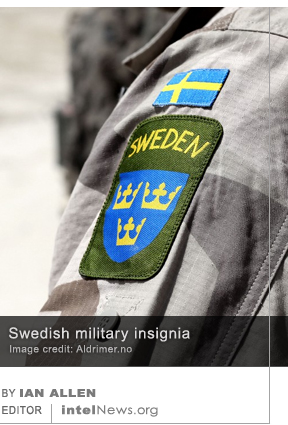 The military intelligence service of Sweden warned last week that there were increasing incidents of espionage perpetrated against Sweden by operatives identified “beyond doubt” as agents of foreign powers. In its
 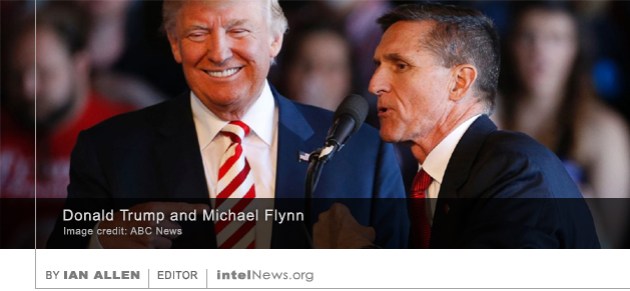 A senior aide to Michael Flynn, National Security Adviser to United States President Donald Trump, will have to step down from his post because his application for a security clearance was rejected, say sources. Flynn had chosen Robin Townley, a former intelligence officer in the US Marine Corps, to serve as Senior Director for Africa on the National Security Council, a forum chaired by the president, which makes key decisions on domestic and foreign issues. Townley, who is described as “one of Flynn’s closest deputies”, held a top-secret security clearance for many years during his government career. But joining the National Security Council requires a so-called “sensitive compartmented information” clearance. This elite-status clearance allows designated individuals to access government programs and operations that are deemed highly sensitive.






 intelNews.org
Ex-CIA case officer arrested in New York for violating Espionage Act
January 17, 2018 by Joseph Fitsanakis 1 Comment
The FBI criminal complaint alleges that Lee kept on his person a number of notebooks that contained classified details of his CIA work. These included the real names of covert CIA personnel and the real names of foreign assets —providers of intelligence information that are recruited by CIA case officers. The notebooks also contained “operational notes from asset meetings” (presumably meetings between Lee and the assets he handled during his CIA career), “operational phone numbers” and even “the addresses of CIA covert facilities” —safe houses where CIA case officers meet their assets in privacy. From the court documents it appears that the FBI has been investigating Lee since at least 2012. In August of that year, the FBI surreptitiously searched Lee’s possessions in a hotel in Hawaii, where he was staying while on holiday with his family. A few days later, FBI officers also searched Lee’s possessions in a hotel in Fairfax, Virginia, and photographed them.
According to The New York Times, Lee’s arrest is connected with reports last May that the Chinese intelligence services had arrested or killed over a dozen CIA assets in China between 2010 and 2012. There is intense speculation that the Chinese acted on information they received from a mole inside a US intelligence agency, possibly the CIA. But the court documents in Lee’s case do not mention any connection to foreign intelligence and do not accuse Lee of sharing classified information with unauthorized users. As of yesterday evening, the CIA was referring all media inquiries to the Department of Justice.
► Author: Joseph Fitsanakis | Date: 17 January 2018 | Research Credit: C.B. | Permalink
Filed under Expert news and commentary on intelligence, espionage, spies and spying Tagged with China, CIA, counterintelligence, FBI, Jerry Chun Shing Lee, News, United States, Zhen Cheng Li