News you may have missed #414

Bookmark and Share

News you may have missed #413

  • Complex politics behind Ugandan spy chief’s removal. The recent sacking of Dr Amos Mukumbi from heading Uganda‘s Internal Security Organisation (ISO) was the handiwork of politics, intrigue and suspicion within the country’s intelligence community and between politicians. It was also related to ongoing turf wars between the ISO and its sister agency, the External Security Organisation.
  • Experts still evaluating WikiLeaks impact. Some analysts believe that the US intelligence establishment will call for an increased clampdown on secrecy in the wake of the WikiLeaks Afghan War Diary files release. But the data dump has also spurred those arguing that the US government needs to reduce the amount of information it classifies as secret, much of which may be unnecessary.
  • Radio program investigates the Mossad. BBC Radio has aired a relatively well-produced primer on Israeli intelligence agency Mossad. The BBC’s Security Correspondent Gordon Corera interviews former Mossad Director Efraim Halevy and former Mossad operative Rafi Eitan, among others.

Bookmark and Share

News you may have missed #409

  • Probe unearths secrets of Bulgaria’s assassination bureau. Previously unknown details on Service 7, Bulgaria’s Cold War-era assassination bureau, have been unearthed by one of Bulgaria’s leading newspapers, following a probe into 5,000 pages of declassified archives from the country’s former communist intelligence service, the First Directorate of the Committee on State Security.
  • US Pentagon bars troops from reading WikiLeaks. Any citizen, any foreign spy, any member of the Taliban, and any terrorist can go to the WikiLeaks web site, and download detailed information. Members of that same military, however, are now banned from looking at those internal military documents, because “doing so would introduce potentially classified information on unclassified networks”.
  • Analysis: Chasing Wikileaks. “[W]hatever the imperfections of WikiLeaks as a startup, its emergence points to a real shortcoming within our intelligence community. Secrets can be kept by deterrence –that is, by hunting down the people who leak them […]. But there are other methods: keep far fewer secrets, manage them better –and, perhaps, along the way, become a bit more like WikiLeaks. An official government Web site that would make the implementation of FOIA quicker and more uniform, comprehensive, and accessible”.

Bookmark and Share

Documents detail history of previously unknown US spy agency

John V. Grombach

J.V. Grombach

By IAN ALLEN | intelNews.org |
A collection of tens of thousands of documents discovered in a barn in a small Virginia town, have brought to light the history and operations of a previously unknown US spy agency that competed for prominence with the CIA during the early stages of the Cold War. The secrecy-obsessed agency was known at various times as the Secret Intelligence Branch, the Special Service Branch, the Special Service Section, or the Coverage and Indoctrination Branch; but insiders referred to it simply as “the Lake” or “the Pond”. It was created in late 1942 by the then newly established US Department of Defense, whose officials did not approve of the civilian character of the Office of Strategic Services (OSS), forerunner of the CIA. In its 13-year existence, the Pond operated on a semi-autonomous base under the Departments of Defense and State, but maintained a poor relationship with the CIA, which it considered too “integrated with British and French Intelligence and infiltrated by Communists and Russians”. This information is contained in the files, which were stored in several safes and filing cabinets by the organization’s secretive leader, US Army Colonel John V. Grombach, who died in 1982. Read more of this post

Israel government extends document secrecy rule to 70 years

Mossad seal

Mossad seal

By JOSEPH FITSANAKIS | intelNews.org |
Researchers, academics and transparency advocates have criticized new Israeli government regulations that extend the classification period of state archives from 50 to 70 years. The measure was approved on July 11 by Prime Minister Benjamin Netanyahu, following strong pressure by the Israeli intelligence community, led by the country’s General Security Service, also known as Shin Bet. Speaking to leading Israeli newspaper Ha’aretz, Israel National Archives Director Yehoshua Freundlich admitted that the move was designed to shield Israel “over [issues relating to its] adherence to international law”. He added that the new legislation was also a response to the rising freedom-of-information movement in Israel, led by such organizations as the Association for Civil Rights in Israel and the Movement for Freedom of Information. Read more of this post

News you may have missed #389

  • Secrecy over attack on Syrian nuclear plant unjustified, says ex-CIA chief. The secrecy surrounding the Israeli attack on the nuclear plant in eastern Syria in September 2007 was justified only for the period immediately after the operation, according to the CIA head at the time, Gen. Michael Hayden. That secrecy had been meant to save Syrian President Bashar al-Assad from embarrassment that could have provoked him to retaliate, argues Hayden in an authorized scholarly journal article.
  • No proof yet of Colombian spying, says Ecuador. Ecuadorean Security Minister Miguel Carvajal said Thursday that allegations that Colombian security agency DAS spied on Ecuadorean President Rafael Correa and other officials is “so far just a newspaper story”. Late last month, the Ecuadorean government threatened to break off diplomatic ties with Colombia over the media revelations.
  • GCHQ releases Stalin-era Soviet intercepts. A series of newly released telegrams and telephone conversations, intercepted by the UK’s General Communications Headquarters, paint a picture of Joseph Stalin’s regime in the immediate aftermath of the Second World War.

Bookmark and Share

News you may have missed #388

  • Political policing rising in US, ACLU report warns. A new report by the American Civil Liberties Union chronicles government spying and what it describes as the detention of groups and individuals “for doing little more than peacefully exercising their First Amendment rights”.
  • Mistrust still marks ISI-CIA ties, say US officials. John Tierney, chairman of the US House Armed Services Committee, told a Pakistani delegation that there is mistrust between the CIA and ISI, according to a report by the Pakistan Senate’s Standing Committee on Defence. Regular intelNews readers should not be surprised.
  • Britain releases secret document at heart of UKUSA agreement. Authorities in the UK have released a six-page document dating from 1946, which describes the “British-US Communication Intelligence Agreement”, known as BRUSA, later UKUSA. The deal has tied the US, UK, Canada, Australia and New Zealand into a worldwide network of electronic listening posts.

Bookmark and Share

News you may have missed #385

  • Indian, Pakistani spy chiefs meet in Islamabad. The meeting between the Director of India’s General Intelligence Bureau, Rajiv Mathur, and his Pakistani counterpart Javed Noor, took place in the aftermath of the arrest of Madhuri Gupta, second secretary at the Indian high commission in Islamabad, Pakistan, who is accused of passing on secrets to Pakistan’s ISI spy agency.
  • CIA releases documents on Korean War. The US Central Intelligence Agency has released a document collection that includes more than 1,300 redacted files consisting of national estimates, intelligence memos, daily updates, and summaries of foreign media concerning developments on the Korean Peninsula from 1947 until 1954.
  • Lebanon to probe top government officials in Israeli spy ring case. The arrest of a senior Lebanese phone firm manager, who is accused of spying for Israel, has prompted prosecutors to ask that several senior government officials be stripped of their immunity so that they can be investigated in relation to a nationwide crackdown on alleged Israeli spy rings in the country.

Bookmark and Share

CIA slowly opens up about botched 1952 mission in China

CIA HQ

CIA HQ

By JOSEPH FITSANAKIS | intelNews.org |
The CIA has produced an hour-long documentary about a failed 1952 covert mission inside China, which resulted in the death of two American pilots and the capture of two CIA paramilitary officers, who spent a total of 40 years in Chinese prisons. The documentary, which premiered last week on a restricted basis at the Agency’s Langley, Virginia, headquarters, is based on internal CIA accounts of the operation, some of which were released in 2006. The premiere was reportedly attended by John Downey and Richard Fecteau, two CIA paramilitary officers on their first mission, who were captured by Chinese People’s Liberation Army (PLA) units inside Chinese territory, after the CIA-operated C-47 Skytrain airplane that was carrying them deep inside Chinese airspace was shot down in a Chinese ambush. Read more of this post

News you may have missed #373 (CIA edition)

Bookmark and Share

Documents reveal Bill Clinton’s secret contact with Iran

Mohammad Khatami

M. Khatami

By IAN ALLEN | intelNews.org |
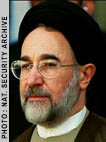
Two newly declassified high-level documents reveal a short-lived overture between Washington and Tehran, initiated in 1999 by the Bill Clinton administration. The US President resorted to the secret communication with Iran in an attempt to preempt several hawkish policy planners in his administration. The latter pressed for strong American military retaliation against Iran, in response to the latter’s alleged involvement in the 1996 Khobar Towers bombing. The bombing, which targeted a US Air Force base in the suburbs of Dhahran, Saudi Arabia, killed 19 and wounded 400 American servicemen and women. By 1999, US intelligence agencies were convinced that the bombing had been financed and orchestrated by members of the Islamic Revolutionary Guards Corps (IRGC), an independent administrative and paramilitary institution tasked with –among other things– exporting the Iranian Revolution abroad. But the Clinton Administration decided to contact the then newly elected reformist Iranian President Mohammad Khatami, and sternly inform him of the evidence against the IRGC. Read more of this post

Documents show Israel offered nukes to apartheid South Africa

Sasha Polakow-Suransky

Polakow-Suransky

By JOSEPH FITSANAKIS | intelNews.org |
Apartheid-era government documents unearthed by an American doctoral researcher reveal that the government of Israel offered to sell nuclear warheads to the racist regime in South Africa, and could possibly provide the first documentary evidence of the existence of Israel’s purported nuclear arsenal. Successive Israeli governments have followed what is often called ‘a policy of ambiguity’, refusing to either confirm or deny the nuclear weapons’ rumored existence. But the documents, which date from 1975, contain detailed minutes of meetings between senior Israeli and South African cabinet officials, including then South African defense minister P.W. Botha and then Israeli defense minister –and Israel’s current President– Shimon Peres. Sasha Polakow-Suransky, the American academic who requested the declassification of the controversial documents, says the Israeli government tried but ultimately failed to prevent the South African government of Jacob Zuma from releasing them. Read more of this post

News you may have missed #358

  • Ex-CIA analyst to lead US declassification center. Sheryl Jasielum Shenberger, who currently serves as a Branch Chief at the CIA Declassification Center, has been named as the first director of the recently established US National Declassification Center. The Center’s aim is to eliminate the backlog of over 400 million pages of classified records by the end of 2013.
  • Hamas expels Egyptian spy from Gaza. A senior Egyptian intelligence officer, who had allegedly “infiltrated the region to collect information on residents and the Hamas government” was arrested and expelled from Gaza on Monday.
  • Israeli nuclear whistleblower back in prison. More than six years after his release from 18 years in solitary confinement, Israeli nuclear whistleblower Mordechai Vanunu has been sentenced to another three months in prison for allegedly “contacting foreign agents”.

Bookmark and Share

News you may have missed #351

Bookmark and Share

News you may have missed #348

  • US knew Guatemalan Army was behind notorious 1982 massacre. Declassified documents released on May 7 show that US officials knew the Guatemalan Army was responsible for the 1982 Dos Erres massacre, one of Guatemala’s most shocking human rights crimes.
  • New presiding judge in US FISA court. Three years after he was first appointed to serve on the US Foreign Intelligence Surveillance Court (FISC), John D. Bates has taken over as the presiding judge. Last week, Judge Martin Feldman was appointed to serve on the secretive court, which reviews (and invariably approves) government applications for counterintelligence surveillance and physical search.
  • UAE security sector benefits from al-Mabhouh assassination. Business for security companies in the United Arab Emirates has been brisk, with some companies reporting a 40% increase in business, as hotels spend millions bolstering their security systems. Some attribute this to last January’s killing in Dubai of Hamas operative Mahmoud al-Mabhouh, by a Mossad hit squad.

Bookmark and Share