News you may have missed #714
April 17, 2012 Leave a comment
 By IAN ALLEN | intelNews.org |
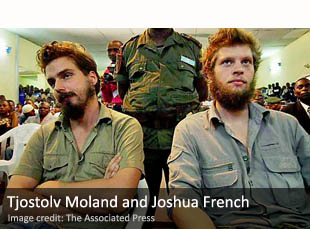
►►British PM urged to intervene in Congo spy case. The mother of Joshua French, who has dual British and Norwegian nationality, and is facing execution in the Democratic Republic of Congo, has urged British Prime Minister David Cameron to ask Congolese authorities to pardon him. French, and his Norwegian friend Tjostolv Moland, were sentenced to death for murder and spying in the vast central African country in 2009. A prison official claimed in August last year that the pair had tried to escape, but their lawyer denies this.
►►Computers of Syrian activists infected with Trojan. Since the beginning of the year, pro-Syrian-government hackers have steadily escalated the frequency and sophistication of their attacks on Syrian opposition activists. Many of these attacks are carried out through Trojans, which covertly install spying software onto infected computers, as well as phishing attacks which steal YouTube and Facebook login credentials. According to the Electronic Frontier Foundation, the latest surveillance malware comes in the form of an extracting file which is made to look like a PDF if users have their file extensions turned off. The PDF purports to be a document concerning the formation of the leadership council of the Syrian revolution and is delivered via Skype message from a known friend.
►►Report claims Australian government spied on anti-coal activists. The leader of the Australian Greens, Bob Brown, says he is outraged at reports that the Australian Security Intelligence Organisation (ASIO) is spying on mining protesters, and says such action is a misuse of the spy agency’s resources. The revelations were reported in Australian newspapers yesterday, and are based on a Freedom of Information request to the Department of Resources, Energy and Tourism that was reportedly rejected because it involved “an intelligence agency document”. The ASIO says it cannot confirm whether it has conducted surveillance of anti-coal protesters, but it says it does not target particular groups or individuals unless there is a security-related reason to do so.









 intelNews.org
Lebanese spy agency used Android app to spy on thousands, say researchers
January 19, 2018 by Joseph Fitsanakis Leave a comment
According to the Lookout/EFF research team, the trojanized phone application was camouflaged as a secure messaging service, resembling popular applications like Signal or WhatsApp. However, once an Android user downloaded it, it gave remote users access to the compromised phone’s cameras and microphone, thus turning it into a bugging device. The virus also stole email and text messages, pins and passwords, lists of contacts, call logs, photographs, as well as video and audio recordings stored on the compromised device. The report states that compromised devices were found in over 20 countries, including Lebanon, France, Canada, the United States and Germany. The majority of those targeted by the virus were civilian and military officials of foreign governments, defense contractors, and employees of manufacturing companies, financial institutions and utility providers.
On Thursday, Reuters contacted Major General Abbas Ibrahim, who serves as director general of GDGS. He insisted that the GDGS is known for collecting intelligence using human sources, not cyber technologies. “General Security does not have these type[s] of capabilities. We wish we had these capabilities”, General Ibrahim told the news agency.
► Author: Joseph Fitsanakis | Date: 19 January 2018 | Permalink
Filed under Expert news and commentary on intelligence, espionage, spies and spying Tagged with cellular telephony, communications interception, Electronic Frontier Foundation, GDGS (Lebanon), Lebanon, Lookout Mobile Security, News