Family of alleged UAE spy who died in Turkish prison call for investigation

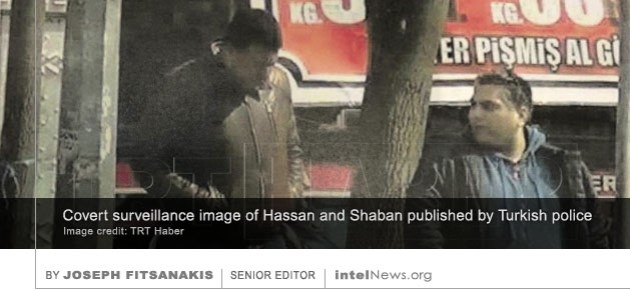
Zaki Mubarak Hassan and Samer ShabanThe family of a man who died in a Turkish prison on Sunday while awaiting trial for allegedly spying for the United Arab Emirates has called for an international investigation into this death. Zaki Mubarak Hassan and Samer Shaban —both Palestinians— were reportedly arrested by Turkish police on April 21 and charged with espionage. Turkish counterintelligence officials suspect that at least one of the suspects may have been involved in a spy operation that relates to the murder of Jamal Khashoggi, a Saudi journalist who was killed last October inside the Saudi Arabian consulate in Istanbul by a 15-member team of Saudi intelligence officers.
Shortly after the two men were arrested, the Reuters news agency cited an anonymous “senior Turkish official” who said that one of two men arrived in Turkey just days after Khashoggi’s murder. He was allegedly monitored by Turkish counterintelligence for a period of six months and his activities led investigators to the second man. The latter is believed to have traveled to Turkey in order “to help his colleague with the workload”, said Reuters. The source added that the two UAE nationals had undergone several hours of interrogation, during which they had confessed that they were employees of the UAE intelligence service. They had also admitted to recruiting local residents as informants. Their activities and targets were consistent with intelligence operations aimed at exiled Arab nationals and students living in Turkey, said the source. The unnamed Turkish official told Reuters that authorities had amassed “extensive evidence” on “covert activities on Turkish soil” by the two men, and described the case against them as “airtight”.

Yesterday, however, the Turkish government announced that one of the men, Zaki Mubarak Hassan, had been found dead in his prison cell in Istanbul. Press reports said that Hassan was found “Sunday morning hanging from a bathroom door” in his cell, and that prosecutors were investigating the formal cause of his death. Late on Monday, his family told the Saudi Arabian Arab News channel that they did not believe Hassan had killed himself. Speaking to Arab News from his home in Bulgaria, Hassan’s brother, Zakeria, said that agents of the Turkish government killed his brother because they realized he was not a spy for the UAE and “they didn’t want to show that they made a mistake”. He added that he had notified the Palestinian ambassador in Ankara of his brother’s arrest, but the ambassador did not seem interested in assisting the family. Meanwhile, the uncle of the second man, Samer Shaban, told another Saudi news channel, Al Arabiya, that his nephew had left the Gaza Strip in 2007 for Egypt. Zaki Mubarak said that Shaban, a Palestinian police officer, was a Fatah supporter and eventually moved from the Hamas-dominated Gaza Strip to the UAE, where he began working as an employee of the Palestinian Authority’s consulate in Dubai. His goal, said Mubarak, was to immigrate with his family to Turkey and from there to Europe.

Author: Joseph Fitsanakis | Date: 30 April 2019 | Permalink

British spy agency calls Trump’s espionage claim ‘utterly ridiculous’

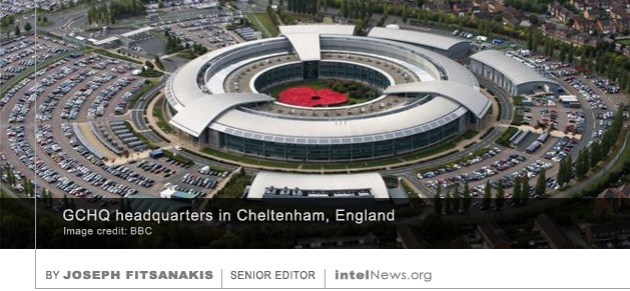
GCHQThe Government Communications Headquarters (GCHQ), Britain’s primary signals-intelligence agency, has called claims by United States President Donald Trump that it spied on his election campaign “utterly ridiculous”. President Trump’s allegations are not new. They apparently rest on claims made in March 2017 by a Fox News commentator, that the GCHQ spied on Trump on orders of then-US President Barack Obama. The claim was repeated on March 17 at the White House by Sean Spicer, Trump’s then-press secretary, who said that Obama had used the GCHQ to spy on Trump so as to evade American privacy laws. At the time, Spicer’s claim prompted an angry response from the British government in London and from the British spy agency itself. In a rare public comment, GCHQ called the allegations “utterly ridiculous”.
This past Wednesday, the US president appeared to repeat his claim that GCHQ had spied on his election campaign, via a post on the popular social networking platform Twitter. Responding to a reiteration of the claim on the conservative cable television channel One America News Network, Trump tweeted “WOW! It is now just a question of time before the truth comes out, and when it does, it will be a beauty!”. The president’s tweet appeared just hours after the British government confirmed that Trump had been invited for a four-day state visit to the United Kingdom in June. The visit is believed to include a meeting with British Prime Minster Theresa May and dinner with Queen Elizabeth II at Buckingham Palace.

Following Trump’s tweet, the US newsmagazine Newsweek contacted GCHQ with a request for a response to the US president’s allegation. A GCHQ spokesperson referred the newsmagazine to the agency’s 2017 statement, and repeated: “The allegations that GCHQ was asked to conduct ‘wire tapping’ against the then president-elect are nonsense. They are utterly ridiculous and should be ignored”. It is extremely rare for GCHQ —one of Britain’s most secretive and publicity-shy agencies— to respond publicly to stories in the media. Late on Wednesday, British Foreign Affairs Secretary Jeremy Hunt said that the invitation to President Trump to visit London would not be rescinded, and insisted that Britain’s “special relationship” with the US remained “intact”.

Author: Joseph Fitsanakis | Date: 25 April 2019 | Permalink

Turkey announces arrests of two alleged UAE intelligence officers in Istanbul

UAE nationals arrested in Turkey on espionage charges

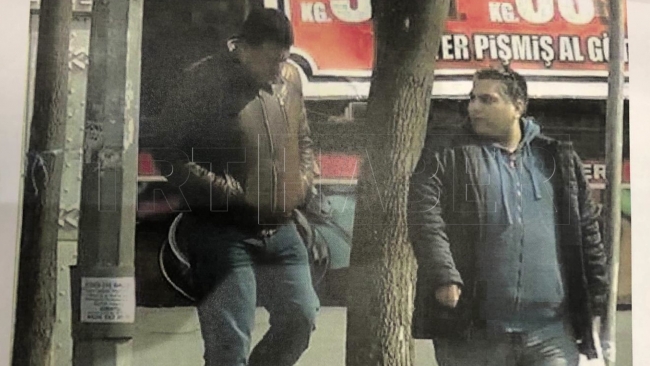
Covert surveillance photograph of two UAE nationals arrested in Turkey on espionage charges (TRT Haber)

Turkish authorities have announced the arrest of two men believed to be intelligence officers for the United Arab Emirates; the two have already confessed to recruiting local informants, according to Reuters. The news agency said Turkish counterintelligence officials suspect that at least one of the suspects may be involved in a spy operation that relates to the murder of Jamal Khashoggi, a Saudi journalist who was killed last October inside the Saudi Arabian consulate in Istanbul by a 15-member team of Saudi intelligence officers.

Last Friday, Reuters cited an anonymous “senior Turkish official” who said that both men are Emirati nationals and that one of them arrived in Turkey just days after Khashoggi’s murder. He was allegedly monitored by Turkish counterintelligence for a period of six months and his activities led investigators to the second man. The latter is believed to have traveled to Turkey in order “to help his colleague with the workload”, said Reuters. Turkey’s state-owned news agency, TRT Haber, published Turkish police photographs of the two men in custody, but did not name them. It also published covert surveillance photographs of the two men, presumably taken by Turkish counterintelligence. A source told Reuters that Turkish counterintelligence officials had entered an Istanbul apartment used by the two men as a safe house, where they found an encrypted computer “in a hidden compartment”. The source added that the two UAE nationals had undergone several hours of interrogation, during which they had confessed that they were employees of the UAE intelligence service. They had also admitted to recruiting local residents as informants. Their activities and targets were consistent with intelligence operations aimed at exiled Arab nationals and students living in Turkey, said the source.

The unnamed Turkish official told Reuters that authorities had amassed “extensive evidence” on “covert activities on Turkish soil” by the two men, and described the case against them as “airtight”. However, when contacted by Reuters, Turkey’s Ministry of Interior declined to comment on the arrests. A spokesman for Istanbul’s Police Department confirmed that a police operation against the two Emirati nationals was ongoing. Turkish media reports on Saturday said that the two men had appeared before a court in Istanbul and that they were being kept in custody on charges of espionage against the Turkish state.

Author: Joseph Fitsanakis | Date: 22 April 2019 | Permalink

Senior Belgian counterintelligence officer arrested on suspicion of spying for Russia

NATO HQ BrusselsA senior counterintelligence official in Belgium’s external intelligence service is under house arrest on suspicion of sharing classified documents with Russian spies, according to a Belgian newspaper. Additionally, the chief of the agency’s counterintelligence directorate has been barred from his office while an internal investigation is underway on allegations that he illegally destroyed government documents. These allegations surfaced last Thursday in a leading article in De Morgen, a Flemish-language daily based in Brussels.
Citing anonymous sources from the General Information and Security Service —Belgium’s military intelligence agency— the paper said that the arrestee has the equivalent rank of major in the General Intelligence and Security Service. Known as GISS, the agency operates as the Belgian equivalent of the United States Central Intelligence Agency or Britain’s Secret Intelligence Service —better known as MI6. GISS officers collect information abroad and are not permitted to operate within Belgium’s borders. The man, a career counterintelligence official, is suspected of having passed secrets to Russia with the help of a woman who claims to be Serbian, but who is in fact believed to be an operative for Russian intelligence. It is not known whether the compromised information included secrets involving the North Atlantic Treaty Organization, of which Belgium is a founding member. In the same article, De Morgen also said that Clement Vandenborre, who serves as chief of GISS’s counterintelligence directorate, has been barred from his office while an investigation is taking place into allegations of mismanagement. He is also accused of having shredded classified government documents without permission. It is not believed that this case is connected with the alleged Russian penetration.

De Morgen quoted a spokesperson for Belgium’s Ministry of Defense, who confirmed that an investigation into alleged foreign espionage targeting a GISS employee was underway, but added that “no comment” would be made on the subject so as “not to hinder” the probe. Ironically, German newspaper Die Welt am Sonntag reported last week that the European Union’s diplomatic agency warned officials in Belgium to watch out for “hundreds of spies” from various foreign countries, including from Russia and China. The warning, issued by the European Union’s diplomatic agency, the European External Action Service (EEAS), said that “approximately 250 Chinese and 200 Russian spies” were operating in Brussels.

Author: Joseph Fitsanakis | Date: 18 February 2019 | Permalink

Hundreds of foreign spies in Brussels, European diplomatic agency warns

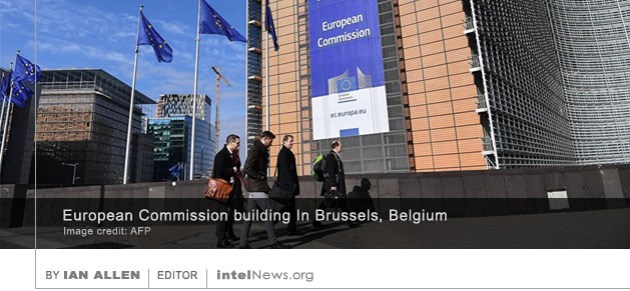
European Commission buildingThe European Union’s diplomatic agency has warned officials who are active in Belgium to watch out for “hundreds of spies” from various foreign countries, according to a German news report. The report appeared last weekend in Germany’s Welt am Sonntag newspaper, which cited a report from the European External Action Service (EEAS). Based in Brussels, the EEAS operates as the European Union’s diplomatic agency and is headed by Federica Mogherini, an Italian former government minister who has been serving as the European Union’s High Representative for Foreign Affairs and Security Policy since 2014.

According to Die Welt, the EEAS estimates that “approximately 250 Chinese and 200 Russian spies” are operating in Brussels. Most of these intelligence officers are allegedly embedded in their countries’ embassies, trade missions, cultural centers and other outreach facilities in the Belgian capital. There are also many intelligence operatives from Western agencies, including those of the United States, as well as from Iran, Turkey and Morocco, among other foreign nations. The report in Die Welt adds that the EEAS advised European Union diplomats to avoid certain establishments in the European Quarter of Brussels, which are believed to be heavily frequented by international spies. Among them are “a popular steakhouse and café” that are “within walking distance of the Berlaymont building” —the headquarters of the European Commission. The same building houses the offices of the EEAS.

Such warnings are not new. In June of last year, Peter Gridling, head of Austria’s main counterintelligence agency, said during a rare public appearance that Vienna —the spy capital of the world— no longer topped the list of preferred destinations for the world’s spies. He said that the Austrian capital had been overtaken by Brussels as the spy capital of Europe and added that, according to his agency’s calculations, there was a greater density of spies in Brussels than in any other European capital. When asked to specify the number of foreign intelligence operatives that are active in Vienna, Gridling said it was “in the neighborhood of hundreds of people, but certainly fewer than 1,000”. In 2012, Alain Winants, former Director of Belgium’s State Security Service (SV/SE), claimed that Brussels was home to more spies than any other city in the world.

Author: Ian Allen | Date: 12 February 2019 | Permalink

Morton Sobell, convicted of conspiracy in the Rosenberg espionage case, dies at 101

Morton SobellMorton Sobell, an American radar engineer who in 1951 was convicted of conspiracy alongside Julius and Ethel Rosenberg in one of the Cold War’s most prominent espionage cases, has died at 101 years old. His death was announced yesterday by his son, Mark, who also said that his father died on December 26 last year at a nursing home, but that the family had not alerted the media.
Sobell was born in New York’s Manhattan Island in 1917 and worked on radar tracking systems for defense contractors. During college, he and several of his friends, including fellow-engineer Julius Rosenberg, joined the United States Communist Party, partly in reaction to the Great Depression. When the Federal Bureau of Investigation began to arrest members of what the United States government claimed was a Soviet atomic spy ring led by Rosenberg, Sobell escaped with his family to Mexico, where he used a fake identity to evade the authorities. But he was dramatically abducted by a paramilitary force and surrendered to the FBI.

He was then tried alongside Rosenberg and his wife Ethel for conspiracy to commit acts of espionage. The Rosenbergs refused to cooperate with the FBI and were sentenced to death. Both were executed in 1953 and remain to this day the only American citizens to have been executed for espionage after the Civil War. Sobel was found guilty of the lesser charge of conspiracy and no evidence was presented in court that connected him to atomic espionage. He was therefore sentenced to 30 years in prison and served 18 of those, following a successful public-relations campaign organized by his wife, Hellen. He was released from prison in 1969 and continued to insist that he had never been a spy and had been wrongly convicted of conspiracy.

But in 2008, at the age of 91, Sobell spoke to The New York Times and publicly admitted for the first time that he had been a spy for the Soviet Union. He said that he had worked systematically to provide Moscow with information on weapons systems and other classified technologies. However, he had “never thought of it” as spying, he said. He also told The Times that he had developed a favorable impression of Soviet communism during the Great Depression, when he and many others saw the Soviet economic system as an antidote to crisis-ridden capitalism. “Now I know it was an illusion”, he told the paper.

Author: Joseph Fitsanakis | Date: 31 January 2019 | Permalink

FBI releases new information on alleged Iranian deep-cover spies

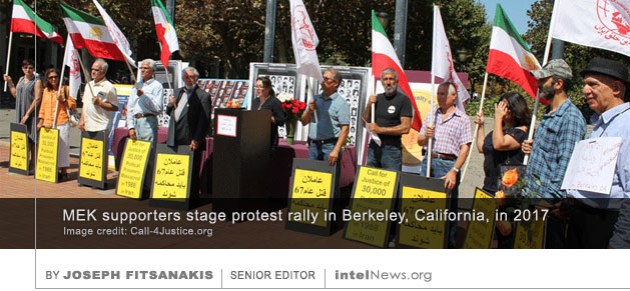
MEK supporters CaliforniaThe United States Federal Bureau of Investigation has charged two men of Iranian descent, who were arrested in California, of operating as deep-cover spies for Iran. Documents filed in a federal court in Washington, DC, name the men as Majid Ghorbani, 59, and Ahmadreza Mohammadi Doostdar, 38. Both have American citizenship and were arrested by the FBI in August, following a year-long counterintelligence investigation. The Los Angeles Times reports that Ghorbani is believed to have immigrated to the US from Iran in 1995. For the past two decades he has worked as a waiter at an upscale Persian restaurant in Santa Ana. Doostdar was born in the southern Californian city of Long Beach, but eventually moved with his family to Canada, and later to Iran, where he grew up. But he kept his US citizenship and made regular trips to America. It is believed that he planned to eventually move with his family to California.

According to the FBI, the two men were tasked by Iranian intelligence with carrying out surveillance on Jewish religious, cultural and political facilities in the US. They were also tasked with conducting surveillance and compiling reports of diplomatic and other facilities connected to the state of Israel. Another part of their mission, said the FBI, was collecting information on the activities and individual members of Mujahideen-e Khalq (MEK), a militant group that has roots in radical Islam and Marxism. The MEK initially supported the Islamic Revolution of 1979, but later withdrew its support, accusing the government of Ayatollah Khomeini of “fascism”. It continued its operations in exile, mainly from Iraq, where its armed members were trained by the Palestine Liberation Organization and other Arab leftist groups. Until 2009, the European Union and the US officially considered the MEK a terrorist organization. But the group’s sworn hatred against the government in Iran brought it close to Washington after the 2003 US invasion of Iraq. By 2006, the US military was openly collaborating with MEK forces in Iraq, and in 2012 the group was dropped from the US Department of State’s list of foreign terrorist organizations. Today the group enjoys open protection from the EU and the US.

Documents filed in court by the FBI state that the two men were secretly recorded during a year-long counterintelligence operation, as they traveled throughout the US to observe MEK rallies and gather intelligence or Israeli diplomatic facilities. Locations visited by the two men allegedly include Chicago, New York and Washington, as well as several cities in the American West Coast. During those visits, they would compile reports that, according to the FBI, were meant to “enable an intelligence or military unit find [and] neutralize a threat”. The men also traveled back to Iran through third countries, bringing back written operational instructions from their Iranian intelligence handlers, according to the FBI documents. IntelNews wrote about the arrest of the two men in August. However, this is the first concrete information released by the FBI about their identities and activities. They are both accused of acting as unregistered agents of a foreign government —a technical term for deep-cover espionage.

Author: Joseph Fitsanakis | Date: 15 January 2019 | Permalink

Huawei fires Chinese employee arrested in Poland for spying

Huawei PolandThe Chinese telecommunications giant Huawei has fired one of its employees who was arrested last week in Poland on charges of spying for China, saying that his actions had “no relation to the company”. The man, identified in media reports as Wang Weijing, was arrested last Tuesday by Polish counterintelligence officers who conducted searches of Huawei’s offices in Warsaw and seized electronic hardware and documents. Wang reportedly learned Polish at the Beijing Foreign Studies University. In 2006, he was posted by the Chinese Ministry of Foreign Affairs at the Chinese consulate in Gdansk, Poland’s largest Baltic Sea port city. In 2011, he left the Foreign Service and joined Huawei, which employed him at its offices in Poland.
Reports from Poland said that Wang was arrested alongside a Polish national, who was identified in media reports only as Piotr D. He is believed to be a mid-level executive of Orange, a French multinational telecommunications carrier who is Huawei’s main domestic partner in Poland. Polish media also reported that, prior to joining Orange, Piotr D. was an upper-level manager in an unnamed Polish intelligence agency. Piotr D.’s house was searched by security officers on Tuesday, along with Wang’s house. The two arrests came six weeks after Meng Wanzhou, Huawei’s chief financial officer, was arrested in Canada. Meng, who is also the daughter of Huawei’s founder, was reportedly detained on December 1 in Vancouver at the request of the United States. Washington says it has evidence that Meng “tried to evade the American embargo against Iran”.

Over the weekend, Poland’s Internal Affairs Minister, Joachim Brudzinski, said that the European Union and the North Atlantic Treaty Organization —of which Poland is a member— should develop a joint position on whether to continue to allow Huawei to operate in Europe. But his call was reportedly met with a lukewarm response from government and private-sector leaders. Meanwhile, China’s Ministry of Foreign Affairs said that it was concerned about Wang’s arrest and urged Warsaw to treat him “with fairness”.

Author: Joseph Fitsanakis | Date: 14 January 2019 | Permalink

American held on espionage charges in Russia has three other citizenships

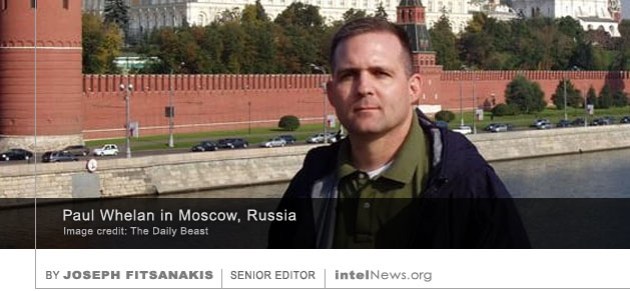
Paul WhelanAn American former Marine, who faces espionage charges in Russia, is a citizen of at least three other countries, namely Canada, Britain and the Republic of Ireland, according to reports. Paul Whelan, 48, was arrested by Russia’s Federal Security Service (FSB) on December 28 at the Metropol, a five-star hotel in downtown Moscow. News of Whelan’s arrest first emerged on January 3 in a report from Rosbalt, a Moscow-based news agency that known to be close to the Russian security services. He was reportedly indicted on Thursday and is now facing between 10 to 20 years in prison for espionage. His trial is not expected to take place until March.

According to Rosbalt, the FSB arrested Whelan in his hotel room while he was meeting with a Russian citizen who allegedly handed him a USB drive containing a list that included “the names of all employees of a [Russian] security agency”. However, Whelan’s family claim that the former Marine arrived in Moscow on December 22 to attend the wedding of an American friend who married a Russian woman. Whelan served two tours in Iraq with the United States Marines and was reportedly discharged for bad conduct. At the time of his arrest last month, he was the director of global security for BorgWarner, a Michigan-based manufacturer of spare parts for cars. He is believed to have visited Russia regularly since 2006, and is thought to have a basic command of the Russian language. He is currently being held in solitary confinement in Moscow’s Lefortovo detention center.

At the time of his arrest, Whelan was identified as an American citizen. On Friday, however, the Associated Press reported that he also has United Kingdom citizenship because he was born to British parents. Additionally, he is now believed to hold Canadian citizenship as well, because he was born in Canada. He then acquired American citizenship after arriving in the US with his parents as a child. It is not known how he acquired Irish citizenship, but the Irish government confirmed it on Friday. Also on Friday, the Washington-based National Public Radio said that embassies of at least four Western countries —the US, Britain, Ireland and Canada— were working to gain consular access to Whelan. On Thursday, the former Marine was visited in prison by Jon Huntsman, America’s ambassador to Russia. Meanwhile, Britain’s Foreign Secretary, Jeremy Hunt, said London was “extremely worried” about Whelan’s fate and warned Moscow “not to try to use [him] as a diplomatic pawn”, possibly by exchanging him with Russians arrested for espionage in the West.

Author: Joseph Fitsanakis | Date: 05 January 2019 | Permalink

China seeks clarification over alleged spy equipment ordered by US embassies

US embassy Berlin GermanyThe Chinese government says it is seeking explanations from Washington after a leaked procurement database showed that American embassies purchased data forensics software and various tactical spy equipment. The purported database was published on December 21 by the international anti-secrecy website WikiLeaks, founded by Julian Assange, who is accused by some in the United States of having violated its espionage laws. WikiLeaks has dubbed the database the “US Embassy Shopping List” and says that it contains over 16,000 procurement requests from officials at American embassies located all over the world.

Most procurement requests included in the WikiLeaks database appear to be for commonplace items or services, such as passenger transportation, heating oil, outdoor freezers, or garage gates maintenance and repair. But there are some requests for so-called “tactical spy equipment”, such as those ordered by the US embassies in Colombia and El Salvador. These appear to be for miniature surveillance cameras hidden into everyday objects, such as buttons, baseball caps, watches and ties. Nearly 100 such items were requested for procurement by the US embassy in San Salvador. Several embassies ordered hardware and software for forensic examination of mobile phones. For example, the US embassy in Yerevan, Armenia, ordered a “Cell Phone Analyzer”, which allows users to access data from cell phones while bypassing security measures such as passwords. Similar devices were ordered by the US embassies in Berlin (pictured), and Kiev, capital of Ukraine, where fears were expressed on Monday about a possible military action by Russian troops during the holidays.

On Monday, China’s Ministry of Foreign Affairs said it was seeking “clarifications” from Washington about the documents made public by WikiLeaks. Speaking to reporters in Beijing, Ministry spokesman Hua Chunying said that the US owed “the rest of the world an explanation […] for what has recently been revealed by WikiLeaks”. Chunying also spoke about prior WikiLeaks revelations, including the so-called “PRISM-gate” in 2013, which revealed extensive intelligence-collection activities by the US on numerous countries, including some if its allies, such as Germany and France. She went on to ask, “why do American embassies buy so much secret surveillance equipment?”. Authorities in Washington had made no comment on the WikiLeaks revelation as of Tuesday morning.

Author: Ian Allen | Date: 25 December 2018 | Permalink

MI6 spy chief outlines ‘fourth generation espionage’ in rare public speech

Alex YoungerThe director of Britain’s Secret Intelligence Service —known as MI6— has outlined the parameters of a new, “fourth generation of espionage”, which he said is needed to combat the “threats of the hybrid age”. Alex Younger, 55, is a career intelligence officer who joined MI6 in 1991, after serving in the British Army. He served as chief of global operations —considered the number two position at MI6— before being appointed director of the spy agency in October 2014. He previously served in the Middle East, Europe, and Afghanistan, where he represented MI6 as its most senior officer in the country following the US-led military invasion of 2001. Until this week, Younger had given a single public address since becoming director of MI6. But on Monday he spoke again, this time at the University of St. Andrews in Scotland, from where he graduated with a degree in economics.

After cautioning his audience that MI6’s methods, operations and people —some of whom “have paid the ultimate price”— must remain secret, Younger said that technological progress has “profoundly changed [MI6’s] operating environment”. Technological change, as well as the degree of interconnectedness, he said, has made the world “dramatically more complicated”. He went on to add that the resulting ambiguity is referred to by MI6 as a constant stream of “hybrid threats”, namely challenges posed by nation-states operating “in the gray spaces of the hybrid era”. They do so in order to probe the West’s “institutions and defenses in ways that fall short of traditional warfare”, said Younger. The British spy chief added that MI6, as “one of the few truly global intelligence agencies” is well positioned to respond to hybrid threats, mostly by augmenting its human intelligence role —using human spies to collect information.

Human intelligence, which is MI6’s core task, “will never change fundamentally”, said Younger, adding that “in fact it will become even more important in a more complex world”. However, it will need to evolve to meet the challenges of the hybrid age. Younger said that MI6 was pioneering a “fourth generation of espionage”, which is the product of the fusion of traditional human skills with “accelerated [technological] innovation”. This new generation of espionage said Younger, relies not on individual work but on operations that are carried out by dynamic teams within and across state agencies. Additionally, the ultimate task of these operations is not simply to know the actions of one’s adversaries, but “to change their behavior”, said the British spy chief. Furthermore, in order to successfully develop fourth generation espionage capabilities, MI6 will have to “ensure that technology is on our side, not that of our opponents”, noted Younger. The spy chief gave an example by referring to the case of the near-fatal poisoning of Sergei Skripal, the Russian former double spy who was allegedly attacked by two Russian military intelligence officers in Salisbury, England, last March. It was “bulk data combined with modern analytics” that exposed the culprits of the operation, he said. But the same methods, which make the modern world more transparent, can posed “a serious challenge if used against us”, warned the MI6 chief.

Author: Joseph Fitsanakis | Date: 04 December 2018 | Permalink

French senior civil servant arrested on suspicion of spying for North Korea

Benoît QuennedeyA senior civil servant in the upper house of the French parliament has been arrested on suspicion of spying for North Korea, according to prosecutors. The news of the suspected spy’s arrest was first reported on Monday by Quotidien, a daily politics and culture show on the Monaco-based television channel TMC. The show cited “a judicial source in Paris” and said that France’s domestic security and counterintelligence agency, the General Directorate for Internal Security (DGSI), was in charge of the espionage case.

The senior administrator has been identified as Benoit Quennedey, a civil servant who liaises between the French Senate and the Department of Architecture and Heritage, which operates under France’s Ministry of Culture. Quennedey was reportedly detained on Sunday morning and his office in the French Senate was raided by DGSI officers on the same day. Quotidien said that he was arrested on suspicion of “collecting and delivering to a foreign power information likely to subvert core national interests”. The report did not provide specific information about the type of information that Quennedey is believed to have passed to North Korea. It did state, however, that a counterintelligence investigation into his activities began in March of this year.

Quennedey is believed to be the president of the Franco-Korean Friendship Association, the French branch of a Spanish-based organization that lobbies in favor of international support for North Korea. Korea Friendship Association branches exist in over 30 countries and are believed to be officially sanctioned by Pyongyang. They operate as something akin to the pre-World War II Comintern (Communist International), a Moscow-sanctioned international pressure group that advocated in favor of Soviet-style communism around the world. French media reported on Monday that Quennedey traveled extensively to the Korean Peninsula in the past decade and has written a French-language book on North Korea. News reports said that the French President Emmanuel Macron had been made aware of Quennedey’s arrest. The senior civil servant faces up to 30 years in prison if found guilty of espionage.

Author: Joseph Fitsanakis | Date: 27 November 2018 | Permalink

Norwegian spy service seeks right to break law during espionage operations

Royal Norwegian Ministry of DefenseNorway’s supreme legislature body is considering a bill that would offer immunity from prosecution to intelligence officers and informants who are authorized by the country’s spy service to conduct espionage. The bill has been proposed on behalf of the Royal Norwegian Ministry of Defense, which supervises the operations of the Norwegian Intelligence Service (NIS), Norway’s primary intelligence agency. The NIS operates primarily abroad and is the only institution of the Norwegian state that can be authorized by the government to break laws in foreign countries. However, supporters of the new bill point out that NIS overseas operations can also break Norwegian law. That is something that the proposed bill addresses, they argue.

The proposed bill offers immunity from prosecution to NIS case officers and their assets —either informants or foreign spies— who may commit offenses under Norwegian law, as part of authorized espionage operations. In its consultation note that accompanies the proposed bill, the Norwegian Ministry of Defense admits that a number of NIS operations “already violate existing Norwegian laws”. That is inevitable, argues the Ministry, because officers and informants who engage in espionage operations will often “act contrary to the stipulations of criminal law […] as part of their assignments”. They may, in other words, “do certain things that would be illegal if they were done not on behalf of the intelligence service”, states the consultation note.

The document does not provide details of the types of offenses that are committed in pursuit of intelligence operations, arguing that “the offenses that the NIS commits, as well as its methods, must remain secret”. It does, however, suggest that intelligence officers may make use of “false or misleading identities, documents and information”. They may also “smuggle large amounts of cash from the country”, which they will use to pay foreign assets. Given that these assets receive Norwegian taxpayers’ funds, and that some of them end up settling in Norway, it is important that their proceeds not be considered taxable income under Norwegian law, according to the Defense Ministry. By reporting their revenue to the Norwegian Tax Administration, these assets would make their NIS connection known, and thus blow their cover, the document states.

The Defense Ministry notes that the new bill “will have little legal significance”, as NIS espionage operations are generally shielded from prosecution under Norway’s existing legal codes. It will, however, formalize the NIS’ legal scope and allow the agency to assure its case officers that they can perform their missions without fearing arrest or prosecution, so long as they act within the parameters of their authorized missions. The spy agency will also be able to recruit more “informants, sources and contractors”, says the document.

Author: Joseph Fitsanakis | Date: 21 November 2018 | Permalink

Austria arrests second spy for Russia in a week: media reports

BVT AustriaAuthorities in Austria have arrested a second alleged spy for Russia in a week, according to media reports. Several Austrian news outlets reported on Monday that police had arrested an Austrian counterintelligence officer on suspicion of passing classified information to Russian intelligence. The news follows reports late last week of the arrest of an unnamed retired colonel in the Austrian Army, who is believed to have spied for Russia since 1988. As intelNews reported on Monday, the unnamed man worked at the Austrian Armed Forces’ headquarters in Salzburg. He is believed to have been in regular contact with his Russian handler, known to him only as “Yuri”, who trained him in the use of “sophisticated equipment” for passing secret information to Moscow. He is thought to have given Russia information on a range of weapons systems used by the Austrian Army and Air Force, as well as the personal details of high-ranking officers in the Austrian Armed Forces.

On Monday, the Vienna-based newspaper Kronen Zeitung, said that a second Austrian man had been arrested on suspicion of carrying out espionage for Moscow. The man was identified in Austrian news reports only as “O.”, due to strict restrictions imposed on media in the country. But the Kronen Zeitung said that the Vienna Public Prosecutor’s Office and the Austrian Ministry of Foreign Affairs had confirmed the reports of the arrest of the second alleged spy. According to the Vienna Public Prosecutor’s Office, the second individual was an employee of the Austrian Office for Protection of the Constitution and Counterterrorism, known as BVT. He had been investigated on suspicion of espionage for more than a year prior to his arrest this week. The man’s arrest took place alongside simultaneous raids at two residential addresses associated with him, according to reports. No further details about this latest case have been made available.

No information is available about the kind of information that the suspect is believed to have shared with Moscow. Furthermore, statements from Austrian officials do not mention any connection between the arrest of “O.” and the arrest of the retired Army colonel that took place last week. The Kronen Zeitung notes that, if found guilty of espionage, “O.” will face a sentence of up to 10 years behind bars. The embassy of Russia in Vienna refused to respond to questions about the arrest of “O.” on Monday night.

Author: Joseph Fitsanakis | Date: 13 November 2018 | Permalink

Austria summons Russian ambassador over arrest of alleged army spy

Sebastian Kurz Mario KunasekThe Austrian Ministry of Foreign Affairs summoned the Russian ambassador to Vienna on Friday, following the arrest of a retired Austrian Army colonel who allegedly spied for Moscow for more than two decades. The news was announced on Friday by Austrian Chancellor Sebastian Kurz at an emergency news conference in Vienna. He did not reveal the alleged spy’s identity, but said that he had been taken into custody as Austrian counterintelligence were investigating the extent of the security breach he caused.

However, according to the Kronen Zeitung, Austria’s highest-circulation newspaper, the suspect is a 70-year-old Army colonel who recently retired after a long military career. He reportedly worked at one of the Austrian Armed Forces’ two headquarters, located in the western city of Salzburg. The unnamed man is believed to have spied for Russia from the early 1990s until his arrest last week. The Kronen Zeitung said that the retired Army colonel was in regular contact with his Russian handler, known to him only as “Yuri”. The Russian handler reportedly trained him in the use of “sophisticated equipment”, which he used to communicate information to Moscow. He is thought to have given Russia information on a range of weapons systems used by the Austrian Army and Air Force, as well as the personal details of high-ranking officers in the Austrian Armed Forces. Austrian media reported that the alleged spy was paid nearly $350,000 for his services to Moscow. According to Austria’s Minister of Defense Mario Kunasek, the arrest came after a tip given to the Austrian government “a few weeks ago” by an unnamed European intelligence agency. He also said that Austrian security services were looking into the possibility that the suspect may have been part of a larger spy ring working for Moscow.

The incident has strained relations between Austria and Russia. In the past decade, Austria —which is not a member of the North Atlantic Treaty Organization— has been seen by observers as a rare ally of Moscow inside the European Union. Unlike the vast majority of European Union countries, Austria chose not to expel Russian diplomats following the poisoning of former Russian double spy Sergei Skripal in March of this year. In August, Russian President Vladimir Putin attended the wedding of his personal friend, Austria’s Foreign Minister Karin Kneissl. But Mrs. Kneissl has now canceled a planned visit to Moscow in December in response to last week’s spy scandal. Speaking in Moscow on Saturday, Russian Foreign Minister Sergei Lavrov dismissed Austria’s accusations as “unfounded” and “unacceptable”.

Author: Joseph Fitsanakis | Date: 12 November 2018 | Permalink