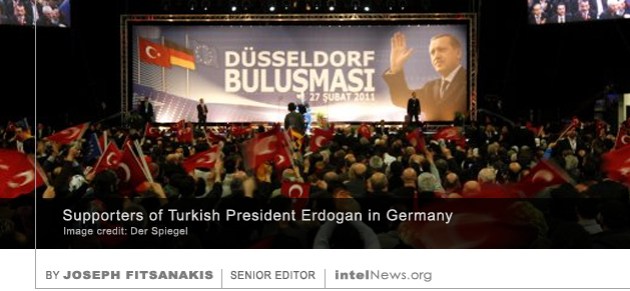
Turkey asks German spies for help in rounding up July coup plotters

Recep Tayyip ErdoğanThe Turkish government has sent an official request to German intelligence for assistance in cracking down on the members of the so-called Gülen movement, which Ankara claims is behind July’s failed coup plot. The movement consists of supporters of Muslim cleric Fethullah Gülen, who runs a global network of schools, charities and businesses from his home in the United States. The government of Turkey has designated Gülen’s group a terrorist organization and claims it has stealthily infiltrated state institutions since the 1980s. The administration of Turkish President Recep Tayyip Erdoğan accuses Gülen’s supporters of orchestrating the July 15 coup that included an armed attack on the country’s parliament and the murder of over 200 people across Turkey.
According to German newsmagazine Der Spiegel, Turkey’s National Intelligence Organization (known by its Turkish initials, MİT) has secretly contacted its German counterpart, the Federal Intelligence Service (BND). The Turks’ request, said Spiegel, involves the provision of assistance to investigate and arrest supporters of the Gülen movement living in Germany, some of whom are German citizens. There are over three million people with Turkish citizenship, or of Turkish descent, currently living in Turkey. Citing “a dossier of classified documents”, Spiegel said that the MİT had asked the BND to investigate a list of 40 individuals for possible links to Gülen, and to extradite to Turkey another three whom Ankara claims have direct ties to the July coup. The documents also allegedly contain a request for MİT officials to pressure German lawmakers to be more critical of Gülen supporters in Germany. Requests for cooperation were also sent by MİT to nearly a dozen state governments in Germany, but all were declined, said Spiegel.

The Turkish government has arrested, fired or demoted tens of thousands of people since July, for alleged links to the Gülen movement. Some European officials, many of them German, have accused President Erdoğan of using the failed coup as an excuse to purge his opponents of all political persuasions in the country. On Sunday, the head of Germany’s Committee on Parliamentary Oversight, Clemens Binninger, said he would launch an investigation into the joint projects between German and Turkish intelligence agencies following the failed July coup. Another member of the Committee, Hans-Christian Ströbele, said he would personally set up a panel to probe any communication between German intelligence agencies and the MİT. By working closely with Turkish intelligence, German spy agencies were risking “becoming complicit in criminal activity”, said Ströbele.

Author: Joseph Fitsanakis | Date: 22 August 2016 | Permalink

German court sentences ex-Yugoslav spies to life for 1983 murder of dissident

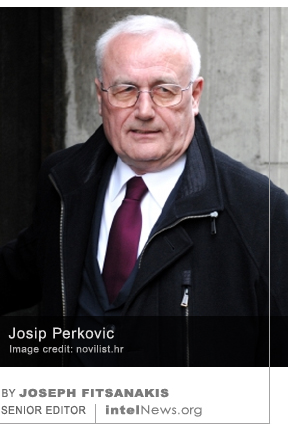
Josip PerkovićA German court has given life sentences to two senior intelligence officers in Cold-War-era Yugoslavia, who masterminded the murder of a Croat dissident in 1983. Josip Perković and Zdravko Mustać, both former senior officials in the Yugoslav State Security Service, known as UDBA, were extradited to Germany from Croatia in 2014. They were tried in a German court in the Bavarian capital Munich for organizing the assassination of Stjepan Đureković on July 28, 1983. Đureković’s killing was carried out by UDBA operatives in Wolfratshausen, Bavaria as part of an UDBA operation codenamed DUNAV. Đureković, who was of Croatian nationality, was director of Yugoslavia’s state-owned INA oil company until 1982, when he suddenly defected to West Germany. Upon his arrival in Germany, he was granted political asylum and began associating with Croatian nationalist émigré groups that were active in the country. It was the reason why he was killed by the government of Yugoslavia.
The court proceedings in Munich included dramatic testimony by another former UDBA operative, Vinko Sindicić, who named both Perković and Mustać as direct accomplices in Đureković’s murder. Sindicić told the court that Perković was acting on orders to kill the German-based dissident, which came directly from the office of UDBA Director Zdravko Mustać. He added that Perković helped organize the logistics of Đureković’s assassination, including the location in Munich where the killing actually took place. Sindicić told the court that a female UDBA operative living in Munich was also involved in organizing the operation, and that the weapons used to kill Đureković had been secretly transported to Germany through Jadroagent, an international shipping and freight company based in Yugoslavia.

On Wednesday, the court found both former UDBA officials guilty of complicity in the assassination of Đureković and convicted them for life. German media reported that the convicted men’s defense team plans to appeal the ruling by advancing the case to Germany’s Federal Court of Justice in Karlsruhe, Baden-Württemberg, which is Germany’s highest ordinary-jurisdiction court. Perković and Mustać declined requests to make comments to the press at the end of the trial. It is believed that at least 22 Croat nationalists were murdered in West Germany by the Yugoslavian intelligence services during the Cold War.

Author: Joseph Fitsanakis | Date: 04 August 2016 | Permalink

German intelligence spied on EU and NATO allies, report finds

Bad Aibling - IAA major parliamentary inquiry into the operations of Germany’s main intelligence agency has concluded that it spied on nearly 3,500 foreign targets in recent years, most of which belonged to allied countries. The inquiry was initiated by the German government in response to a number of recent public controversies involving the Bundesnachrichtendienst, Germany’s Federal Intelligence Service, known as BND.
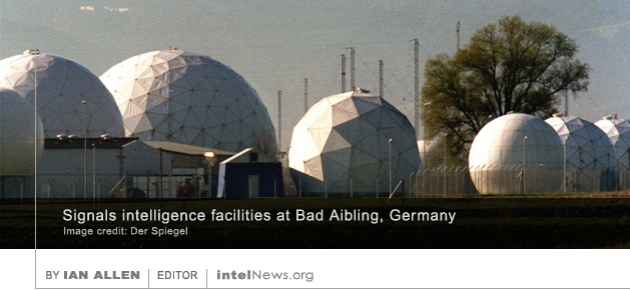
In 2015, the BND was found to have secretly collaborated with the US National Security Agency (NSA) in spying on several European governments and private companies. According to German investigative magazine Der Spiegel, the BND used its facilities at Germany’s Bad Aibling listening station to help the NSA spy on, among other targets, the palace of the French president in Paris, the headquarters of the European Commission in Brussels, and the France-based European conglomerate Airbus. In response to the revelations, Airbus filed a criminal complaint against the German government, while Belgium and Switzerland launched official investigations into the joint BND-NSA activities. The extent of the BND-NSA collaboration prompted widespread public criticism in Germany. In response to the criticism, German Chancellor Angela Merkel promptly fired the director of the BND in April of this year. Additionally, the German chancellor authorized a parliamentary inquiry into the operations of the BND, which was completed last spring.

The resulting 300-page report has not been made public. But summaries leaked to the German media reveal that the BND spied on 3,300 targets until the end of 2013. Nearly 70 percent of these targets belonged to countries that are members of the European Union or the North Atlantic Treaty Organization, and are thus some of Germany’s closest international allies. The targets allegedly included “hundreds of diplomatic missions” in Europe and elsewhere, as well as heads of state, government ministers, aides to foreign cabinet officials, and heads of foreign militaries. The report summary also states that the BND targeted non-governmental organizations and private corporations that are operate in the areas of aviation, weapons design, transportation, advertising and the media.

Last month, the German cabinet approved draft legislation that aims to reform the BND. The legislation explicitly bans the agency from spying on foreign governments or corporations for the benefit of German companies. It also prevents it from spying on targets within the European Union, unless the operation pertains to “information to recognize and confront threats to internal or external security”. The legislation also calls for the establishment of a new independent oversight body consisting of senior judges and representatives of the Office of the Federal Prosecutor, whose job will be to evaluate and approve the BND’s proposed espionage activities against foreign targets.

Author: Ian Allen | Date: 12 July 2016 | Permalink

Ex-Yugoslav spy testifies in German trial about 1983 murder of dissident

Josip Perkovic Zdravko MustacA former officer in the Cold-War-era Yugoslav intelligence service has begun testifying at a trial concerning the 1983 murder in Germany of a Yugoslav dissident by assassins sent by authorities in Belgrade. Stjepan Đureković, who was of Croatian nationality, defected from Yugoslavia to Germany in 1982, while he was director of Yugoslavia’s state-owned INA oil company. Upon his arrival in Germany, he was granted political asylum and began associating with Croatian nationalist émigré groups that were active in the country. He was killed on July 28, 1983, in Wolfratshausen, Bavaria. His killing was part of an operation codenamed DUNAV, which was conducted by the Yugoslav State Security Service, known by its Serbo-Croatian acronym, UDBA.

In 2009, following testimonies by several former UDBA agents, who were arrested in connection with the crime, the Office of the German Federal Prosecutor issued a European Arrest Warrant for Josip Perković, a former senior official in the UDBA. He is accused of having played a central role in organizing Đureković’s assassination. In 2014, Croatia, where Perković has been living since the demise of Yugoslavia, agreed to extradite Perković to Germany. The agreement materialized after heavy pressure was exercised on Croatia by the European Commission, after the country’s admission into the European Union.

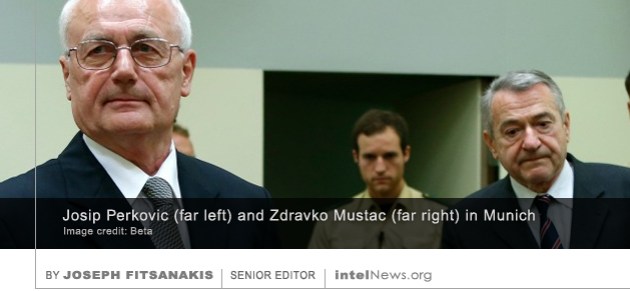
Perković is now co-defendant in the trial taking place in Munich, along with another former UDBA intelligence official, Zdravko Mustać (see photo). Tuesday’s proceedings included testimony by another former UDBA man, Vinko Sindicić, who named both Perković and Mustać as direct accomplices in Đureković’s murder. Sindicić told the court that Perković was acting on orders to kill the German-based dissident, which came directly from the office of UDBA Director Zdravko Mustać. He added that Perković helped organize the logistics of Đureković’s assassination, including the location in Munich where the killing actually took place. Sindicić told the court that a female UDBA operative living in Munich was also involved in organizing the operation, and that the weapons used to kill Đureković had been secretly transported to Germany through Jadroagent, an international shipping and freight company based in Yugoslavia. During his testimony, which lasted for several hours, Sindicić claimed that the two men who carried out Đureković’s murder were UDBA assassins Branko Bijelić and Luka Sekula. The former died in 2004, but the latter still lives in Sweden and has yet to be extradited to Germany in connection with the murder trial.

It is worth noting that Sindicić spent a decade behind bars for his role in a failed attempt to kill another Yugoslav dissident émigré, Nikola Stedul, whom the UDBA tried to kill in the United Kingdom in 1988. Further charges against him were dropped in 2000, in a trial where he stood accused of complicity in the murder of yet another exiled Yugoslav dissident, Bruno Busić, who was killed in Paris in 1978. Both Perković and Mustać deny any involvement in Đureković’s assassination.

Author: Joseph Fitsanakis | Date: 06 July 2016 | Permalink

German cabinet approves spy service reform in wake of NSA controversy

BND - IAThe senior executive body of the German government has approved draft legislation that reforms the country’s intelligence services, following revelations that Germany helped the United States spy on European states. The legislation is seen as a response by the German government to a number of recent public controversies involving the Bundesnachrichtendienst, Germany’s Federal Intelligence Service, known as BND.
In 2015, the BND was found to have secretly collaborated with the US National Security Agency (NSA) in spying on several European governments and private companies. According to German investigative magazine Der Spiegel, the BND used its facilities at Germany’s Bad Aibling listening station to help the NSA spy on, among other targets, the palace of the French president in Paris, the headquarters of the European Commission in Brussels, and the France-based European conglomerate Airbus. In response to the revelations, Airbus filed a criminal complaint against the German government, while Belgium and Switzerland launched official investigations into the joint BND-NSA activities.

The extent of the BND-NSA collaboration prompted widespread public criticism in Germany. In response to the criticism, German Chancellor Angela Merkel promptly fired the director of the BND in April of this year, in a move that surprised many. Gerhard Schindler, who had headed the BND since 2012, was replaced by Bruno Kahl, a senior official in the German Federal Ministry of Finance, who did not come from within the ranks of the BND. Additionally, the German chancellor authorized a parliamentary inquiry into the operations of the BND, which was completed last spring. The resulting 300-page report forms the basis of the draft legislation that was approved on Tuesday by the German cabinet.

The new legislation bans the BND from spying on foreign governments or corporations for the benefit of German companies. It also prevents it from spying on targets within the European Union, unless the operation pertains to “information to recognize and confront threats to internal or external security”. This is taken to mean operations relating to suspected terrorist activity that directly threatens German national security. The legislation also calls for the establishment of a new independent oversight body consisting of senior judges and representatives of the Office of the Federal Prosecutor, whose job will be to evaluate and approve the BND’s proposed espionage activities against foreign targets.

The legislation will need to be finalized through its approval by the German Federal Parliament, known as the Bundestag. The body is expected to approve the legislation before the beginning of its official summer break in mid-July.

Author: Ian Allen | Date: 29 June 2016 | Permalink

German nuclear power plant found to be infected with computer viruses

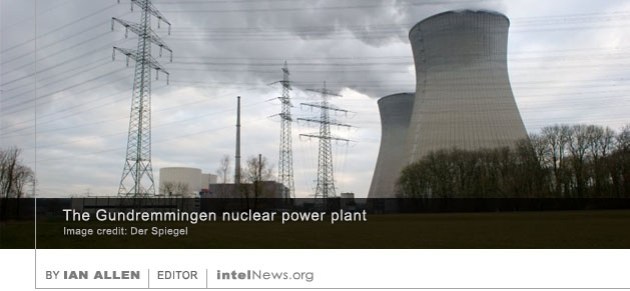
Gundremmingen nuclear power plantThe computers of a nuclear power plant in southern Germany have been found to be infected with computer viruses that are designed to steal files and provide attackers with remote control of the system. The power plant, known as Gundremmingen, is located in Germany’s southern district of Günzburg, about 75 miles northwest of the city of Munich. The facility is owned and operated by RWE AG, Germany’s second-largest electricity producer, which is based in Essen, North Rhine-Westphalia. The company provides energy to over 30 million customers throughout Europe.
On Tuesday, a RWE AG spokesperson said cybersecurity experts had discovered a number of computer viruses in a part of the operating system that determines the position of nuclear rods in the power plant. The software on the system was installed in 2008 and has been designed specifically for this task, said the company. The viruses found on it include two programs known as “Conficker” and “W32.Ramnit”. Both are responsible for infecting millions of computers around the world, which run on the Microsoft Windows operating system. The malware seem to be specifically designed to target Microsoft Windows and tend to infect computer systems through the use of memory sticks. Once they infect a computer, they siphon stored files and give attackers remote access to the system when the latter is connected to the Internet. According to RWE AG, viruses were also found on nearly 20 removable data drives, including memory sticks, which were in use by employees at the power plant. However, these data drives were allegedly not connected to the plant’s main operating system.

RWE AG spokespersons insisted this week that “Conficker”, “W32.Ramnit”, and other such malware, did not pose a threat to the nuclear power plant’s computer systems, because the facility is not connected to the Internet. Consequently, it would be impossible for an attacker associated with the viruses to acquire remote access to Gundremmingen’s computer systems. The company did not clarify whether it believed that the viruses had specifically targeted at the power plant. But they insisted that cyber security measures had been strengthened following the discovery of the malware, and said that they had notified Germany’s Federal Office for Information Security (BSI), which is now looking into the incident.

Author: Ian Allen | Date: 29 April 2016 | Permalink

German intelligence chief fired in surprise move

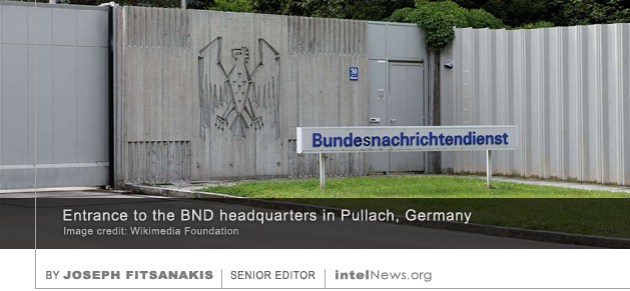
BND GermanyThe head of Germany’s foreign intelligence agency has been removed from his post in a move described by observers as surprising. Gerhard Schindler, 63, had led Germany’s Federal Intelligence Service, known as Bundesnachrichtendienst, or BND, since 2012. Founded 60 years ago with direct input from the United States Central Intelligence Agency, the BND is today responsible for collecting intelligence abroad in the service of German national interests. Headquartered in the southern German city of Pullach, near Munich, the BND is directly subordinate to the office of German Chancellor Angela Merkel.
On Tuesday, the Munich-based Süddeutsche Zeitung newspaper said that Chancellor Merkel had ordered Schindler’s removal from the BND. Several regional television stations followed with similar reports. The Süddeutsche Zeitung cited unnamed government sources as saying that Schindler’s sudden removal from his post was unexpected, as the career intelligence officer was scheduled to retire in two years.

However, intelNews readers will recall that last year Schindler was severely criticized in Germany, after the BND was found to have secretly collaborated with the US National Security Agency in spying on several European governments and private companies. According to German newsmagazine Der Spiegel, the BND used its Bad Aibling listening station to help the NSA spy on, among other targets, the palace of the French president in Paris, the headquarters of the European Commission in Brussels, as well as French-based European conglomerate Airbus. In response to the revelations, Airbus filed a criminal complaint against the German government, while Belgium and Switzerland launched official investigations into the joint BND-NSA activities.

In the months that followed the revelations, Schindler appeared to have convinced the Chancellery that he was not personally responsible for the BND-NSA collaboration, which many political figures in Germany said had subverted Germany’s national interest. In response to criticism, Schindler said that some departments inside the BND had taken on “a life of their own” and promised to reform the agency. On Tuesday, however, his tenure came to an end. It is believed that he will be replaced by Bruno Kahl, a senior civil servant in Germany’s Federal Ministry of Finance, who is a close associate of the country’s Minister of Finance, Wolfgang Schäuble.

Author: Joseph Fitsanakis | Date: 27 April 2016 | Permalink

Revealed: Decorated Nazi commander became Mossad assassin

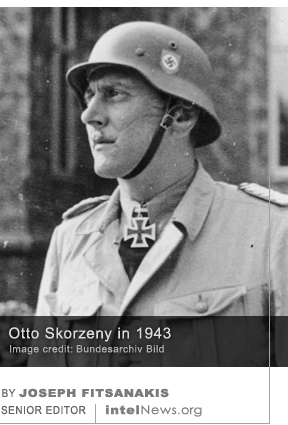
Otto SkorzenyA notorious lieutenant colonel in the Waffen SS, who served in Adolf Hitler’s personal bodyguard unit, worked as a hitman for the Israeli intelligence agency Mossad after World War II, it has been revealed. Austrian-born Otto Skorzeny became known as the most ruthless special-forces commander in the Third Reich. Having joined the Austrian branch of the National Socialist German Workers’ Party at 19, at age 23 Skorzeny began serving in the Waffen SS, Nazi Germany’s conscript army that consisted largely of foreign-born fighters. In 1943, Hitler himself decorated Skorzeny with the Knight’s Cross of the Iron Cross, in recognition of his leadership in Operation EICHE, the rescue by German commandos of Italian fascist dictator Benito Mussolini, who had been imprisoned at a ski resort in the Apennine Mountains following a coup against his government.

Skorzeny survived the war and ended up living in Spain under the protection of the country’s far-right dictator, Francisco Franco. The Mossad, Israel’s covert-action agency, which had made it a priority to arrest or kill senior Nazis who had survived the war, intended to kill Skorzeny. However, two veteran Israeli intelligence observers, Dan Raviv and Yossi Melman, revealed on Sunday that, instead of killing Skorzeny, the Mossad decided to recruit him. Based on “interviews with former Mossad officers and with Israelis who have access to the Mossad’s archived secrets”, Raviv and Melman allege that Isser Harel, who directed the Mossad from 1952 to 1963, decided that the former Waffen SS commander would be a useful asset against other Nazis operating in Europe and the Middle East. Specifically, Harel planned to use Skorzeny as a trap to lure a number of Nazi scientists who were secretly working for Egypt’s missile program.

According to Raviv and Melman, a Mossad team was sent to Spain to meet Skorzeny. After a tense incident that involved Skorzeny pointing a loaded weapon at two Mossad operatives, the former Nazi soldier agreed to cooperate with Israel in return for assurances that his name would be removed from the Mossad’s assassination list. Raviv and Melman claim that one of Skorzeny’s most high-profile operations as an agent of the Mossad culminated in the assassination of Heinz Krug in Munich in 1962. Krug was a German rocket scientist who was working for the Egyptian government under the tutelage of Dr Wolfgang Pilz, another rocketry expert who had put together a top-secret missile program for Cairo. Krug was targeted for assassination by Yitzhak Shamir, Israel’s future prime minister, who was then commander of the Mossad’s clandestine operations service.

Krug, who was worried for his life after receiving threatening messages from individuals he believed were connected with the Mossad, reached out to Skorzeny in hopes that the former Waffen SS commander could give him advice on enhancing his personal security. But Skorzeny, operating on orders of the Mossad, shot dead the German scientist in a remote wooded area outside Munich. A Mossad team then poured acid on Krug’s body before burying it in a grave that had been dug in preparation for his killing. According to Raviv and Melman, Skorzeny also sent German scientists in Egypt a number of mail bombs designed by the Mossad, which killed a number of people. Raviv and Melman also state that they received oral confirmation from Rafi Eitan, a legendary Mossad operations officer, that he “met and ran Skorzeny” on behalf of the Israeli intelligence agency.

Skorzeny died of cancer in Spain in 1975. He was 67. It is believed that the Mossad never tried to kill or kidnap him.

Author: Joseph Fitsanakis | Date: 29 March 2016 | Permalink

German court sentences intelligence officer who spied for CIA

Markus ReichelA court in Germany has sentenced a former officer of the country’s intelligence agency, who spied for the United States and Russia from 2008 to 2014. Regular readers of this website will recall the case of ‘Markus R.’, a clerk at the Bundesnachrichtendienst, or BND, Germany’s external intelligence agency. The 32-year-old was arrested in July 2014 on suspicion of having spied for the United States’ Central Intelligence Agency. Germany’s Office of the Federal Prosecutor said at the time that Markus R. voluntarily made contact with the CIA in 2008 and offered his services to the American spy agency. He began working for the United States as a double agent soon afterwards. Soon after Markus R.’s arrest was made public, the German government ordered the immediate removal from Germany of the CIA chief of station –who was essentially the top American intelligence official in the country. Berlin also instructed its intelligence agencies to limit their cooperation with their American counterparts “to the bare essentials” until further notice.

On Thursday, Markus R., identified in some German media as Markus Reichel, was sentenced for selling over 200 classified German government documents to the CIA between 2008 and 2012, for which he said he received €80,000 ($90,000). During his trial, Reichel also admitted giving German government documents to personnel at the consulate of the Russian Federation in Munich in the summer of 2014. Among the documents that the former BND clerks is said to have given the CIA was a list of thousands of German intelligence operatives —including agents— stationed abroad, which contained their operational cover names and real identities. But Reichel was caught when German counterintelligence officers intercepted correspondence between him and his handlers and then used the information to set up a successful sting operation.

During his trial, Reichel issued a formal apology for engaging in espionage against the German state. He told the court that he had been motivated by boredom and by “lust for adventure”, which he said he did not get working for the BND. He also said he was frustrated by the lack of confidence that his superiors and colleagues had in him. “At the BND, I had the impression that no one trusted me with anything”, said Reichel. “But the CIA was different. You had the opportunity to prove yourself”, he added. Reichel was found guilty of treason against the German state and sentenced to eight years in prison.

Author: Joseph Fitsanakis | Date: 17 March 2016 | Permalink

Germans bill Israeli embassy after Mossad car gets stuck in mud

Mossad sealAuthorities in a northern German town have called on the Israeli embassy in Berlin to pay for the cost of extricating a car belonging to two Israeli spies, which was stuck in a mud pit in a restricted area. According to the Hamburg-based television station NDR, the incident occurred last December in Quarnbek, a coastal town in Germany’s Schleswig-Holstein state with a population of under 2,000. Two men were reportedly spotted late one afternoon driving a Ford Focus near a restricted area that is surrounded by a fence by the banks of the Kiel Canal. The men came across a locked gate to the restricted area, which, according to NDR, is clearly marked with “no trespassing” signs. However, they reportedly picked the lock and drove through the gate into the restricted area. Shortly afterwards, however, the Ford Focus got stuck in a mud pit inside the Kiel Canal restricted area.
As the two men unsuccessfully tried to get their car unstuck, night began to fall. An elderly resident spotted them and asked them if they were government employees. The men responded that they were there to survey the area in preparation for a sailing contest that was to take place in the Kiel Canal in the summer. But the resident became suspicious and called Quarnbek’s Mayor, Klaus Langer. In turn, the mayor called the police, which sent a team of officers to the restricted site. According to NDR, as soon as the two men spotted the police vehicle, they came out of their car and identified themselves as Israeli consular personnel with diplomatic immunity. They presented their credentials and informed the police officers that they were armed; indeed, two handguns were found in the Ford Focus.

German media reports said the police soon confirmed that the two men were officers of the Mossad, Israel’s primary external intelligence agency, and were in the region to accompany the transfer of the ThyssenKrupp submarine to Israeli hands. Known in Israel as the INS Rahav, the submarine was built in the Kiel shipyard on orders of the Israeli government. According to Mayor Langer, a team of local firefighters was dispatched to help extricate the Mossad officers’ car from the mud. Earlier attempts by a local farmer to extricate the car using a forklift had apparently failed. The Ford Focus was eventually extricated and the two Mossad agents were allowed to leave. Shortly afterwards, Mayor Langer, who was elected as a member of the Green Party, sent the Israeli embassy in Berlin a bill for $1392.28 to cover the cost of the extrication. According to recent reports, the Israelis said they intend to pay up.

Author: Joseph Fitsanakis | Date: 09 March 2015 | Permalink

German spy agency tapped Finnish phone lines in early 2000s

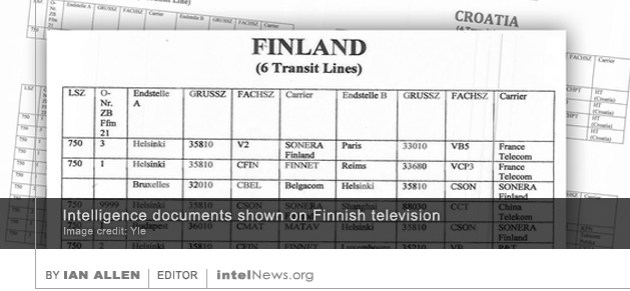
FinlandGerman intelligence, possibly with the collaboration of the United States, monitored communications lines connecting Finland with at least five countries in the early 2000s, according to leaked documents. The documents, aired this week by Yle Uutiset, the main news program of the Finnish Broadcasting Company (Yle), is based on information contained in “leaked German intelligence documents” that were first made public in May 2015. As intelNews reported at the time, the intelligence collection was described as a secret collaboration between Germany’s BND (Bundesnachrichtendienst) and America’s National Security Agency (NSA). According to Austrian politician Peter Pilz, who made the initial allegations, the BND-NSA collaboration was codenamed EIKONAL and was active from 2005 to 2008. Pilz said at the time that many European phone carriers and Internet service providers were targeted by the two agencies. Belgium and Switzerland have already launched investigations into EIKONAL.
Now new information provided by Yle seems to show that the secret BND-NSA collaboration targeted Finnish communications as well, focusing on at least six separate communications transit lines. The lines are believed to carry telephone call and possibly Internet traffic from Finnish capital Helsinki to a number of cities in France, Belgium, Hungary, Luxemburg, and China, said Yle Uutiset. Although the targeted lines are known to carry telephone and Internet traffic, it is unknown at this time whether EIKONAL targeted both kinds. But Yle said the interception lasted for most of the first part of the 2000s and involved large amounts of communications data.

The station contacted Tuomas Portaankorva, Inspector General of SUPO, the Finnish Security Intelligence Service. He told Yle that, speaking broadly, he was not surprised to be told that Finnish telecommunications lines had been monitored by foreign intelligence agencies, Western or otherwise. He went on to caution that, even though Finnish lines had been targeted, it was not possible to conclude that Finland was indeed the target of the surveillance operation. Yle also spoke to Vesa Häkkinen, spokesman for the from Finland’s Ministry of Foreign Affairs, who told the station that SUPO, and not the ministry, was the proper official body to be consulted about EIKONAL. “If there is reason to suspect that these actions were directed at the Finnish state”, said Häkkinen, “we would undertake appropriate action”.

Author: Ian Allen| Date: 20 January 2016 | Permalink | News tip: Matthew Aid

German police caught Anders Breivik with weapons prior to Norway massacre

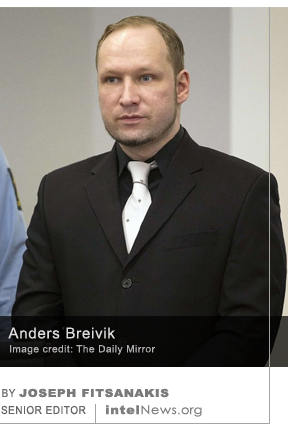
Anders BreivikPolice in Germany caught Anders Breivik with ammunition and weapon parts in 2009, two years before he killed nearly 80 people in Norway, but did not arrest him and failed to notify Norwegian police, according to a new documentary. Breivik is a jailed far-right terrorist, who in 2011 single-handedly perpetrated two terrorist attacks that killed 8 people in Norwegian capital Oslo and another 69 on the island of Utøya. During his trial, he said he killed his victims, most of whom were participants at a Norwegian Labor Party summer camp, in order to protest against “multi-culturalism” and “Islamization” in Norway. The attack, which included the use of a car bomb and semi-automatic weapons, is considered the deadliest terrorist incident in Norway’s history since World War II.
Last week, however, a new documentary aired on Franco-German television station ARTE claimed that German police could have helped stop Breivik’s deadly plans, when it caught the far-right militant with weapons parts and ammunition in 2009. The documentary, entitled Waffen für den Terror (Weapons for Terror) was directed by Daniel Harrich, a German documentary filmmaker who specializes in the international illicit weapons trade. Harrich alleges in his documentary that Breivik was stopped “in early 2009” by German police during a routine check in Wetzlar, a city of 60,000 located just north of Frankfurt.

Citing three unnamed sources, who allegedly verified the claims independently of each other, Harrich said that Breivik was found to be in possession of ammunition and was also carrying some weapons parts. But instead of detaining Breivik, who was carrying a Norwegian passport, and notifying the authorities in Oslo, the German police officers simply confiscated the ammunition and some weapons parts, before allowing him to go. According to Harrich, Breivik was even told he could hold on to a number of parts that German police determined could not be used to build a working weapon. Harrich’s documentary, which is in the German language, can be viewed at ARTE’s website, here.

Author: Joseph Fitsanakis | Date: 15 January 2016 | Permalink | News tip: C.W.

German spy agency says Saudi Arabia is ‘source of regional instability’

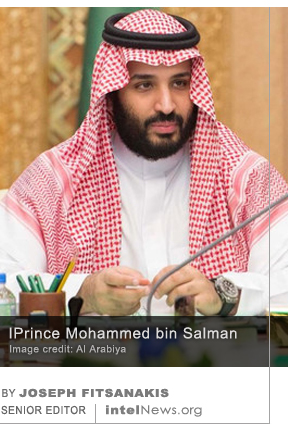
Prince Mohammed bin SalmanA report by Germany’s primary intelligence agency warns that internal power struggles and broader geopolitical changes are turning the Kingdom of Saudi Arabia into a major source of regional instability. The report was produced by the German Federal Intelligence Service, known as BND, and is entitled: “Saudi Arabia: A Sunni Regional Power Torn Between a Paradigm Shift in Foreign Policy and Domestic Power Consolidation”. It explains the energy-rich Kingdom’s new forceful approach to regional problems as an outcome of both domestic and external factors.

On the domestic scene, the BND report connects the changes in Saudi Arabia’s regional stance with an unfolding power-struggle between two factions inside the country’s royal family. On the one side is the ‘traditionalist’ faction led by King Salman, who was enthroned in January of this year following the death of his predecessor, King Abdullah. This faction is being challenged by a group of royal family members led by Deputy Crown Prince Mohammed bin Salman, who currently serves as the country’s minister of defense. According to the BND report, Prince Mohammed, who is second-in-line to the throne, is trying to solidify his position in the royal succession by promoting a more radical and militarized foreign policy. This, says the BND, can be seen in Saudi Arabia’s ongoing military intervention in Yemen, as well as in its highly interventionist policy in support of anti-government rebels in Syria.

The German intelligence report suggests that Prince Mohammed’s policies are also the result of a widespread view among some senior members of the Saudi royal family that the United States is gradually disengaging from the Middle East, and that the country is not any more a strong guarantor of Saudi Arabia’s security. As a result, the Kingdom is “prepared to take unprecedented risks” in the military, diplomatic and financial domains in order to project itself as a strong regional actor and “avoid falling behind in regional affairs” in its struggle for dominance against its neighboring rival, Iran.

But this new policy, says the BND, comes with considerable financial demands, which are challenging the limits of Saudi Arabia’s financial might. This year alone, notes the German report, the Kingdom is expected to announce a budget deficit that will be in the neighborhood of $120 billion. This is angering many senior members of the royal family who are opposed to Prince Mohammed’s aggressive regional stance. These ‘traditionalists’ have repeatedly criticized the prince’s “impulsive policy of intervention”, which they claim is jeopardizing the Kingdom’s relationship with important regional allies, as well as with Washington.

Author: Joseph Fitsanakis | Date: 4 October 2015 | Permalink

Secret program gave CIA ‘unfiltered access’ to German communications

CIAThe United States Central Intelligence Agency had direct and unfiltered access to telecommunications data exchanged between German citizens, according to a new document that has surfaced in the German press. The program, codenamed GLOTAIC, was a collaboration between the CIA and Germany’s Federal Intelligence Service, known as BND. According to German newsmagazine Der Spiegel, which revealed the existence of the program last week, it lasted from 2004 to 2006. During those years, the CIA was given access to telephone and fax data carried by US telecommunications provider MCI Communications, which is owned by Verizon. The US-headquartered company owns a network switching facility in the German city of Hilden, located 10 miles east of Düsseldorf near the country’s border with Holland.

The existence of joint collection programs between the BND and American intelligence agencies has been established in the past, and has prompted the creation of a special investigative committee in the German parliament. The Committee of Inquiry into Intelligence Operations was set up in 2014, after files leaked by American defector Edward Snowden revealed that the US had been spying on the telephone communications of German Chancellor Angela Merkel. But it has also been investigating whether the BND’s collaboration with American intelligence agencies violated the rights of German citizens.

The committee had previously been told that all telecommunications data given to the US by German agencies had previously been vetted by BND officers. But the GLOTAIC documents published by Der Spiegel states that audio recordings of intercepted telephone calls were “directly routed to the US” in the interests of technical efficiency. The parliamentary committee had also been told that the data shared with the CIA concerned non-German citizens using German telecommunications networks. But the documents published last week state that a “technical glitch” in the GLOTAIC system allowed “massive German traffic” to be directly accessed by the CIA without having been first filtered by the BND.

Another document published by Spiegel reveals that the BND warned project CLOTAIC supervisors that the agency faced “serious risks” should the secret operation become public, because it had allegedly violated German federal privacy regulations.

Author: Joseph Fitsanakis | Date: 08 September 2015 | Permalink

German government charges CIA spy with treason

BND GermanyA German intelligence officer, who is accused of spying for the United States Central Intelligence Agency, has been officially charged with treason by authorities in Berlin. The 32-year-old man, identified in court papers only as “Markus R.”, worked as a clerk at the Bundesnachrichtendienst, or BND, Germany’s external intelligence agency. He was arrested in July 2014 on suspicion of having spied for the CIA for approximately two years. German prosecutors say they have evidence that shows Markus R. supplied the American spy agency with around 200 classified German government documents in exchange for around €25,000 —approximately $30,000.

Germany’s Office of the Federal Prosecutor said on Thursday that Markus R. made contact with the CIA in 2008 and offered his services to the American spy agency. He began working for the United States as a double agent soon afterwards. His arrest last year added to the already tense relations between Berlin and Washington. The latter had been damaged a year earlier, when it was revealed that the US National Security Agency, America’s signals intelligence organization, had bugged the personal cell phone of German Chancellor Angela Merkel. The revelation, which was made public by Edward Snowden, an American defector to Russia who had previously worked for the NSA, showed that Chancellor Merkel had been targeted as part of a wider US spy operation against Germany.

The revelations sparked the establishment in Germany of a nine-member parliamentary committee that was tasked with evaluating Snowden’s revelations and proposing Germany’s response. It appears that Markus R. tried to spy on the activities of the committee on behalf of his American handlers. Soon after Markus R.’s arrest was made public, the German government ordered the immediate removal from Germany of the CIA chief of station –who was essentially the top American intelligence official in the country. Berlin also instructed its intelligence agencies to limit their cooperation with their American counterparts “to the bare essentials” until further notice.

It is worth noting that, before his arrest last year, Markus R. is also said to have approached Russian intelligence with an offer to work for them. He is thus believed to have supplied Moscow with classified German government documents as well.

Author: Joseph Fitsanakis | Date: 21 August 2015 | Permalink