German government charges CIA spy with treason
August 21, 2015 1 Comment
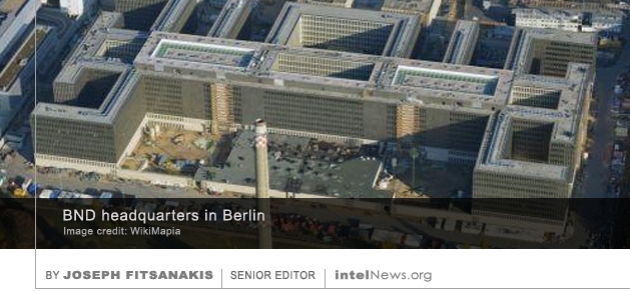 A German intelligence officer, who is accused of spying for the United States Central Intelligence Agency, has been officially charged with treason by authorities in Berlin. The 32-year-old man, identified in court papers only as “Markus R.”, worked as a clerk at the Bundesnachrichtendienst, or BND, Germany’s external intelligence agency. He was arrested in July 2014 on suspicion of having spied for the CIA for approximately two years. German prosecutors say they have evidence that shows Markus R. supplied the American spy agency with around 200 classified German government documents in exchange for around €25,000 —approximately $30,000.
Germany’s Office of the Federal Prosecutor said on Thursday that Markus R. made contact with the CIA in 2008 and offered his services to the American spy agency. He began working for the United States as a double agent soon afterwards. His arrest last year added to the already tense relations between Berlin and Washington. The latter had been damaged a year earlier, when it was revealed that the US National Security Agency, America’s signals intelligence organization, had bugged the personal cell phone of German Chancellor Angela Merkel. The revelation, which was made public by Edward Snowden, an American defector to Russia who had previously worked for the NSA, showed that Chancellor Merkel had been targeted as part of a wider US spy operation against Germany.
The revelations sparked the establishment in Germany of a nine-member parliamentary committee that was tasked with evaluating Snowden’s revelations and proposing Germany’s response. It appears that Markus R. tried to spy on the activities of the committee on behalf of his American handlers. Soon after Markus R.’s arrest was made public, the German government ordered the immediate removal from Germany of the CIA chief of station –who was essentially the top American intelligence official in the country. Berlin also instructed its intelligence agencies to limit their cooperation with their American counterparts “to the bare essentials” until further notice.
It is worth noting that, before his arrest last year, Markus R. is also said to have approached Russian intelligence with an offer to work for them. He is thus believed to have supplied Moscow with classified German government documents as well.
► Author: Joseph Fitsanakis | Date: 21 August 2015 | Permalink
 The German and Dutch governments allegedly joined forces to investigate a Russian supercomputer specialist, who studied in Germany and Holland, suspecting him of passing technical information to Russian intelligence. German weekly newsmagazine Der Spiegel, which published the report in its current issue, identified the physicist only as “Ivan A.” and said that the 28-year-old man was a member of a physics laboratory affiliated with the Max Planck Institute in the western German city of Bonn.
 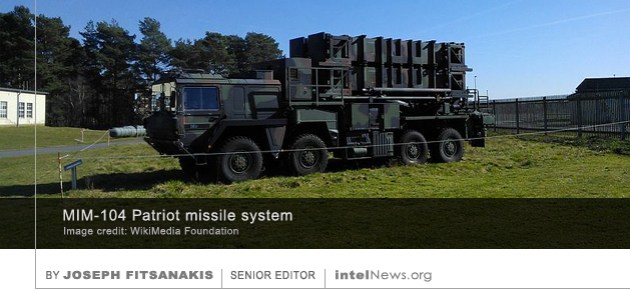 A Patriot missile system stationed in Turkey by the North Atlantic Treaty Organization (NATO) was allegedly hacked by a remote source, according to reports. German magazine Behörden Spiegel
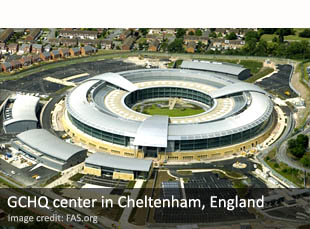
  A German parliamentary committee investigating spying operations may take the German government to court in order to force it to give up secret documents on Berlin’s intelligence cooperation with Britain. The Committee of Inquiry into Intelligence Operations was set up in 2014, after files leaked by American defector Edward Snowden
 The office of the Swiss Federal Prosecutor has launched an investigation into claims that the country’s largest telecommunications provider was spied on by a consortium of German and American intelligence agencies. The spy project was












Secret program gave CIA ‘unfiltered access’ to German communications
September 8, 2015 by Joseph Fitsanakis 1 Comment
The existence of joint collection programs between the BND and American intelligence agencies has been established in the past, and has prompted the creation of a special investigative committee in the German parliament. The Committee of Inquiry into Intelligence Operations was set up in 2014, after files leaked by American defector Edward Snowden revealed that the US had been spying on the telephone communications of German Chancellor Angela Merkel. But it has also been investigating whether the BND’s collaboration with American intelligence agencies violated the rights of German citizens.
The committee had previously been told that all telecommunications data given to the US by German agencies had previously been vetted by BND officers. But the GLOTAIC documents published by Der Spiegel states that audio recordings of intercepted telephone calls were “directly routed to the US” in the interests of technical efficiency. The parliamentary committee had also been told that the data shared with the CIA concerned non-German citizens using German telecommunications networks. But the documents published last week state that a “technical glitch” in the GLOTAIC system allowed “massive German traffic” to be directly accessed by the CIA without having been first filtered by the BND.
Another document published by Spiegel reveals that the BND warned project CLOTAIC supervisors that the agency faced “serious risks” should the secret operation become public, because it had allegedly violated German federal privacy regulations.
► Author: Joseph Fitsanakis | Date: 08 September 2015 | Permalink
Filed under Expert news and commentary on intelligence, espionage, spies and spying Tagged with BND, CIA, communications interception, Germany, Hilden (Germany), intelligence cooperation, MCI Communications, News, Project GLOTAIC, United States, Verizon