More documents emerge on CIA effort to salvage Soviet submarine
April 14, 2014 Leave a comment
 By IAN ALLEN | intelNews.org
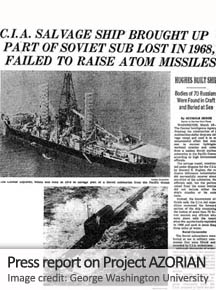
New documents have emerged about a massive effort by the United States Central Intelligence Agency to recover a sunken Soviet nuclear submarine in the 1970s. This blog has written before about Project AZORIAN, a 1974 attempt to recover a Soviet submarine in 5,200 meters of water. The initiative cost the CIA over $800 million, which translates to something like $3 billion in today’s prices. It centered on an effort to salvage K-129, a Soviet Golf II class submarine that had suffered an internal explosion while on a routine patrol mission in the Pacific Ocean, in 1968. The explosion caused the vessel to sink along with the three nuclear ballistic missiles it was carrying and nearly 100 crew members, all of whom died in the incident. The Soviets initiated an immediate frantic effort to recover the vessel but gave up after two months, unable to bring it to the surface. After the Soviets abandoned the site, a number of CIA scientists proposed to undertake an American effort to recover the sunken submarine. This, they suggested, would allow Washington to study the design features of Soviet nuclear warheads, as well as obtain cryptographic hardware that could prove useful in deciphering Soviet naval codes. This prompted the launch of Project AZORIAN, which commenced in 1974, once the Agency secured the necessary funds. As we have indicated before, the recovery team nearly caused a nuclear explosion when the submarine split while being raised, and its body hit the ocean floor. The CIA prepared to enter a new phase of the project in 1975, aimed at launching a second attempt to raise the sunken vessel. But the attempt was cancelled when vague snippets of information about the project were leaked to the press. Nothing more emerged until 2010, when the CIA aired a heavily redacted article about the project, which had originally appeared in the 1980s in Studies in Intelligence, the Agency’s in-house publication. Now, however, intelligence historians are able to rely on 200 pages of mostly fresh information on Project AZORIAN, released under the US Department of State’s Foreign Relations of the United States (FRUS) program. Read more of this post
 By JOSEPH FITSANAKIS | intelNews.org













 intelNews.org
MI5 releases documents on Dutch double spy Mata Hari
April 25, 2014 by Joseph Fitsanakis 1 Comment
The British government has released a set of documents relating to the capture and eventual execution of Mata Hari, modern history’s most legendary female spy. Mata Hari was born Margaretha Geertruida Zelle in northern Holland in 1876. In 1895 she married Rudolf MacLeod, a Dutch Army Captain of Scottish descent serving the Dutch colonial administration of what is now Indonesia. She eventually divorced the alcoholic and abusive MacLeod, who was 20 years her senior, and joined the circus in Paris. Eventually she became wildly popular as an exotic dancer, a position that placed her in close contact with several influential men in France, including the millionaire industrialist Émile Étienne Guimet, who became her longtime lover. Several of her male devotees came from military backgrounds from various European countries. Most historians agree that by 1916 Zelle was working for French intelligence, gathering information from a host of German lovers. However, in February of the following year she was arrested by French counterintelligence officers in Paris and accused of spying on behalf of the German Empire. French prosecutors accused Zelle of having provided Berlin with tactical intelligence that cost the Triple Entente the lives of over 50,000 soldiers. A set of documents released this month by Britain’s Security Service, commonly known as MI5, reveal that allied intelligence operatives trailed the exotic dancer across several European countries before she was apprehended in Paris. They also allege that, while under French custody, the Dutch spy admitted that she had conducted espionage on behalf of the German Secret Service and that her codename was H21. She is also alleged to have admitted that she received payments of approximately 20,000 French francs for her servicse. The papers also suggest that Zelle admitted that several vials of invisible ink fond in her hotel suite had been given to her by her German handlers. However, the MI5 reports claim that the accused spy “never made a full confession” and “never gave away anyone” as her accomplice, leading the British author of the report to conclude that she must have been “working alone”. Read more of this post
Filed under Expert news and commentary on intelligence, espionage, spies and spying Tagged with declassification, history, Mata Hari, MI5, News, World War I