CIA whistleblower complains of seven-year inaction by Agency’s inspector general
July 14, 2017 1 Comment
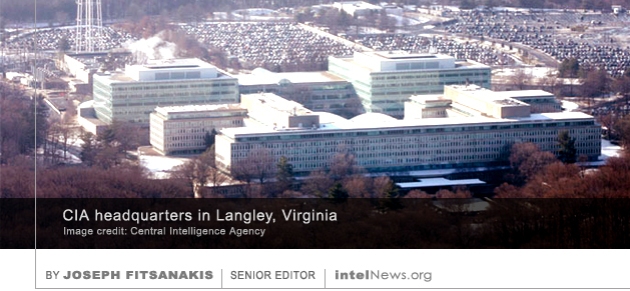 A contractor for the United States Central Intelligence Agency has complained in an interview that no action has been taken in the seven years since he revealed a “billion-dollar fraud” and “catastrophic intelligence failure” within the Agency’s ranks. John Reidy argues that his case illustrates the unreasonable delay that impedes investigations by whistleblowers like him inside the CIA. Individuals like him, he argues, are forced to seek justice through leaks to the media, something which could be avoided if the CIA’s Office of the Inspector General addressed concerns more promptly.
Reidy, 46, from Worcester in the US state of Massachusetts, joined the CIA in 2003, after graduating with a law degree from the University of San Francisco. But he left the agency soon after joining, initially to work for a security contractor before setting up his own company, Form III Defense Solutions. He continued to work with the CIA by subcontracting his services, focusing on Iran. Reidy’s company developed an intelligence study guide for Iran and advised the CIA on the use of human intelligence (known as HUMINT) in the Islamic Republic.
In 2010, Reidy submitted two complaints to the CIA’s Office of the Inspector General, the Agency’s internal watchdog that is tasked with investigating whistleblower allegations. The first issue related to what Reidy describes as large-scale “fraud between elements within the CIA and contractors”. The second issue involved a “massive [and] catastrophic” intelligence failure “due to a bungled foreign operation”. When he filed his concerns with the OIG, Reidy was hoping that attention would be given to his claims right away. However, seven years later, his case is still “gathering dust” at a CIA office, he says. When he realized that no progress had taken place in several years, a frustrated Reidy forwarded his case —which includes copies of 80 emails and nearly 60 other documents— to Senator Chuck Grassley, chairman of the US Senate Committee on the Judiciary. He also reached out to the McClatchy news service with his concerns.
The secrecy rules that apply to those who work for the US Intelligence Community prevent Reidy from disclosing details of the alleged fraud and intelligence failure, or from specifying the country in which these incidents took place —though it seems from his intelligence résumé that they probably involve Iran. But in an interview with McClatchy news service, the intelligence contractor voiced grave concerns about the internal investigation process in the CIA. “I played by the rules [and] they are broken”, he said. “The public has to realize that whistleblowers [like me] can follow all the rules and nothing gets done”, added Reidy. He went on to warn that if the CIA does not improve its internal investigation system, leaks to the media “may grow worse”.
McClatchy contacted the CIA about Reidy’s concerns and was told by a spokesperson, Heather Fritz Horniak, that, “as a general matter, [the CIA does] not comment on ongoing litigation”.
► Author: Joseph Fitsanakis | Date: 14 July 2017 | Permalink
 The security map of the Middle East changed within a few hours on Wednesday, when the Islamic State managed to strike Iran for the first time. Six assailants —five men and a woman— stormed the Islamic Consultative Assembly, which serves as the parliament of Iran, and the mausoleum of the founder of the Islamic Republic, Ayatollah Khomeini. By the time they killed themselves, or were killed by security forces, the six had murdered 12 people and injured over 60. The Islamic State, which carried out the attack, had warned for several months that it would launch a direct assault at the heart of
  the world’s largest Shiite state. It tried to do so before, several times, and failed. But
 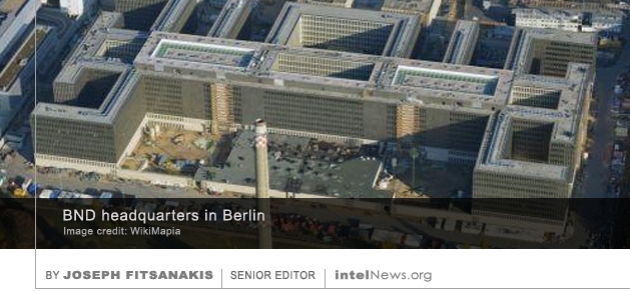 Iranian intelligence operatives are the second most active in Germany after Russian spies, with much of their activity focusing on Israeli targets in the country, according to the German Interior Ministry. The information is contained in a report that was issued in response to a request by a member of Germany’s Bundestag last week. It states that Iranian spies have engaged in nearly two dozen known intelligence operations on German soil since 2007, and have even targeted individuals for assassination.
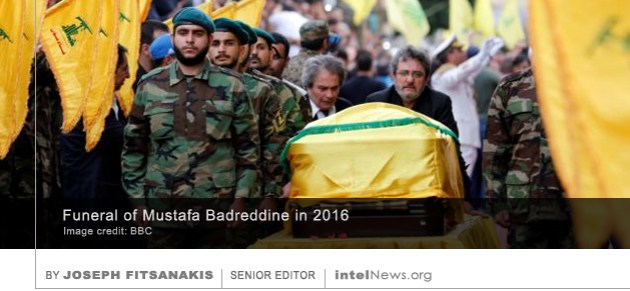 An Israeli military official has repeated claims in the Arab media that the Lebanese Shiite group Hezbollah killed its own military commander in Syria, following a dispute with Iran. Mustafa Amine Badreddine, 55, an expert in explosives and former bomb-maker, was a senior military commander in the military wing of Hezbollah. He rose through the ranks of the organization to become a trusted adviser to Hezbollah’s Secretary General, Hassan Nasrallah. In 2011, the Special Tribunal for Lebanon, set up by the United Nations, charged Badreddine with organizing the assassination of Lebanese Prime Minister Rafik Hariri. Hariri was killed with over 20 other people in a massive bomb blast in Beirut, in February of 2005.
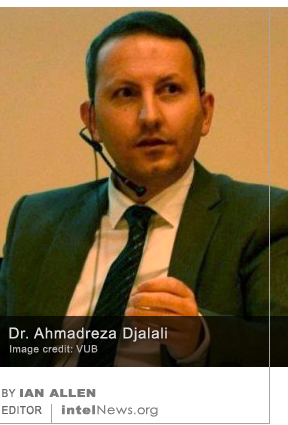 An Iranian scientist who works at a university in Belgium has been sentenced to death in Iran, allegedly for spying. According to his family and his employer in Belgium, Dr. Ahmadreza Djalali is currently in prison in Tehran. Dr. Djalali, 45, is professor of disaster medicine at the Vrije Universiteit Brussel (VUB), a Dutch-speaking university located in the Belgian capital. For the past few years, Dr. Djalali has been based in Italy, where he teaches in the VUB’s European Master’s program in Disaster Medicine. According to an
  Authorities in Germany have pressed espionage charges against a Pakistani man who allegedly spied for Iran and even compiled lists of potential targets for assassination. The man, who has been identified in media reports only as “Syed Mustafa H.”, is a 31-year-old worker at the German Aerospace Center in the northern German city of Bremen. He is also reportedly a graduate of the Materials Science and Production Engineering department of the Universität Bremen. According to court documents, he is believed to have been spying for Iranian intelligence since the summer of 2015. It appears that the Federal Office for the Protection of the Constitution (BfV), Germany’s domestic intelligence agency, had been aware of the man’s espionage activities for at least a year prior to his arrest.
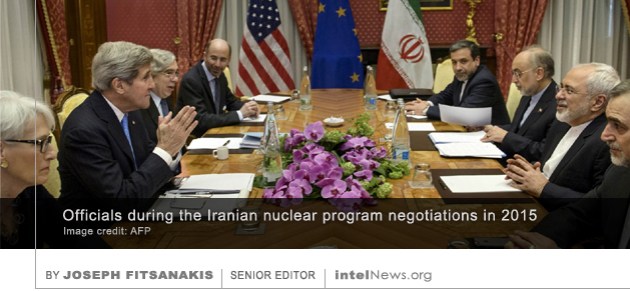 Iranian authorities have reportedly arrested at least 12 members of the country’s team of nuclear negotiators on charges of espionage. The 12 are believed to have represented Iran in international talks about its nuclear program between the Islamic Republic and a group of nations known as P5+1, representing the five permanent members of the United Nations Security Council plus Germany.
 Authorities in Iran have admitted that they executed a former scientist for the country’s nuclear program, who claimed that he was abducted by the United States after disappearing from Iran for a year. Shahram Amiri worked for the Atomic Energy Organization of Iran, the government body that is responsible for operating and regulating the country’s nuclear installations. But in the summer of 2009, while on a religious pilgrimage to the Saudi Arabian city of Mecca, Amiri disappeared. Iranian authorities
  An internet website that offered free URL shortening services appears to have been a front created by British intelligence in order to spread messages and monitor activists involved in protests in Iran and the Arab world. The website was used heavily during the Iranian presidential election protests of 2009, which became known as the Iranian Green Movement. After a brief hiatus, the website was used again in 2011, as the Arab Spring revolts in North Africa and the Middle East were intensifying. The information pointing to the use of the website comes from documents leaked by Edward Snowden, the American former intelligence employee who has been granted political asylum in Russia.
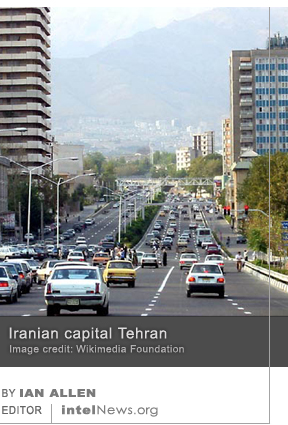 Iranian intelligence officials said on Monday that they foiled “one of the largest terrorist attacks ever planned” against the country, allegedly plotted by Sunni militants aiming to inflict mass casualties during the month of Ramadan. A statement by the Islamic Republic’s Ministry of Intelligence said that the attacks had been planned to take place simultaneously in the capital Tehran and several other Iranian cities. Iranian state-owned news agencies reported that an unspecified number of suspects had been arrested and were under interrogation by the authorities.
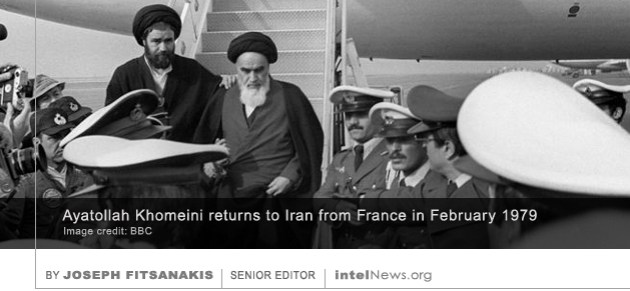 Newly declassified files show that Ayatollah Khomeini, who led Iran after the 1979 Islamic Revolution, had a secret channel of communication with the United States, and even sent a personal letter to US President Jimmy Carter. On January 16, 1979, after nearly a year of street clashes and protests against his leadership, the king of Iran, Mohammad Reza Shah Pahlavi, fled the country for the US. His decision to leave was strongly influenced by his American advisors, who feared that Iran was heading toward a catastrophic civil war. The Shah’s departure did little to calm tensions in the country. Protesters —many of them armed— engaged in daily street battles with members of the police and the military, who remained loyal to Pahlavi. Meanwhile, a national strike had brought the Iranian oil sector to a standstill, thereby threatening to bring about a global energy crisis. Moreover, the country was home to thousands of American military advisors and the Iranian military was almost exclusively funded and supplied by Washington. The Carter administration worried that the weaponry and technical knowledge might fall into the hands of a new, pro-Soviet government in Tehran.
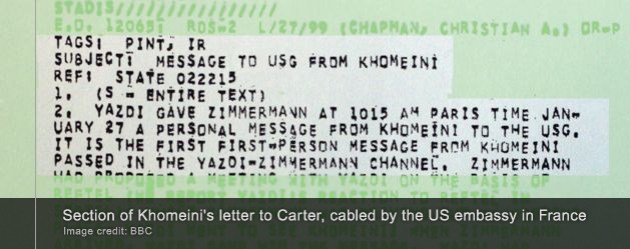 Nine days later, on January 27, Dr. Yazdi gave Zimmerman a letter written by Khomeini and addressed to President Carter. The letter, which addressed Carter in the first person, was cabled to the Department of State from the US embassy in Paris and, according to the BBC, reached the US president. In the letter, Khomeini promises to protect “America’s interests and citizens in Iran” if Washington pressured the Iranian military to stand aside and allow him and his advisers to return to Iran. Khomeini’s fear was that the royalist Iranian military would not allow a new government to take hold in Tehran. But the exiled cleric was aware of America’s influence in Iranian military circles, which at the time were effectively under the command of General Robert Huyser, Deputy Commander of US Forces in Europe, who had been dispatched to Tehran by President Carter. Before answering Khomeini’s letter, the White House sent a draft response to the embassy in Tehran for input and advice. But Khomeini did not wait for Washington’s response. On February 1, he returned to Iran, where he was greeted by millions of people in the streets and welcomed as the next leader of the country. Meanwhile, Washington had already instructed General Huyser to rule out the so-called “option C”, namely a military coup carried out by the Iranian armed forces.
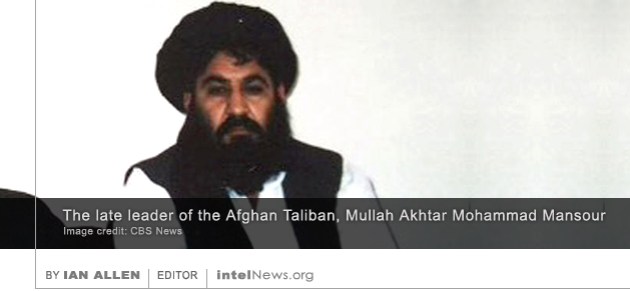 Frequent trips to Iran caused the demise of the late leader of the Afghan Taliban, Mullah Akhtar Mohammad Mansour, who was
 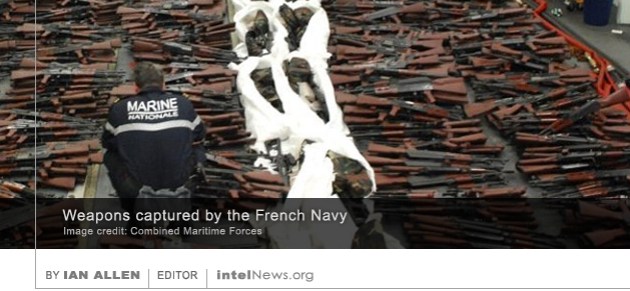 The United States says a ship carrying hundreds of weapons, which was captured by the French Navy in the Indian Ocean, originated from Iran, and that the cargo was destined for Yemeni rebels through Somalia. The ship was seized on March 20 by a French warship patrolling the Indian Ocean as part of the Combined Maritime Forces (CMF). The CMF is a multinational naval fleet that aims to implement United Nations sanctions on Somalia. The sanctions are designed to frustrate the activities of al-Shabaab, an al-Qaeda-linked Somali militant group, and to put an end to maritime piracy in the Horn of Africa.








CopyKittens cyber espionage group linked to Iranian state, says report
July 26, 2017 by Ian Allen Leave a comment
Throughout its existence, CopyKittens has alarmed cyber security researchers by its strategic focus on political targets belonging to governments. The group’s methods of operation do not resemble those of most other hacker groups, which are usually crude by comparison. Now a new report by two leading cyber security groups claims that CopyKittens is linked to the Iranian state. The report was published on Tuesday as a joint effort by Japan’s Trend Micro and Israel’s ClearSky firms. The report analyzes several operations by CopyKittens, some conducted as recently as last April. It concludes that CopyKittens is “an active cyber espionage actor whose primary focus [is] foreign espionage on strategic targets”. Additionally, the report suggests that the group operates using “Iranian government infrastructure”.
According to the Trend Micro/ClearSky report, CopyKittens tends to use relatively simple hacking techniques, such as fake social media profiles, attacks on websites, or emails that contain attachments that are infected with malicious codes. However, its members appear to be “very persistent” and usually achieve their goal “despite lacking technological sophistication”. The security report did not directly address the political ramifications of implicating the Iranian government in the CopyKittens’ hacking operations. The Reuters news agency contacted Iranian officials at the United Nations about the CopyKittens report, but they nobody was available for comment.
► Author: Ian Allen| Date: 26 July 2017 | Permalink
Filed under Expert news and commentary on intelligence, espionage, spies and spying Tagged with ClearSky, CopyKittens, cyberespionage, cybersecurity, Iran, News, Trend Micro