Sweden grants citizenship to man accused by Iran of being a Mossad spy
February 19, 2018 1 Comment
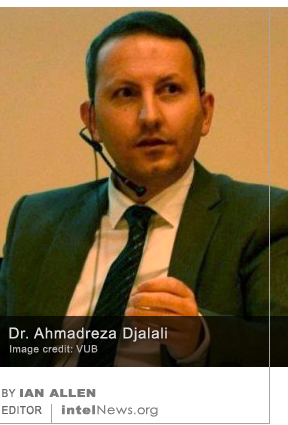 The government of Sweden has granted citizenship to an academic who is on death row in Iran for allegedly helping Israel kill Iranian nuclear scientists. Sweden’s Foreign Affairs Ministry confirmed on Saturday that Ahmadreza Djalali, who lives in Sweden and has lectured at Stockholm’s renowned Karolinska Institute, is now a Swedish citizen. IntelNews has covered extensively the case of Dr. Djalali, 45, a professor of disaster medicine who has also taught at the Vrije Universiteit Brussel (VUB) in the Belgian capital, as well as in the VUB’s European Master’s program in Disaster Medicine in Italy.
It is believed that Djalali was arrested in Iran in 2016, during a visit from Sweden, where he has been living for several years. He was sentenced to death last year for allegedly helping Israel assassinate nuclear scientists and sabotage Tehran’s nuclear program. Four Iranian physicists, who were employed in Iran’s nuclear program, are known to have been assassinated between 2010 and 2012. Most were killed by magnetic bombs that were placed on their vehicles by unknown assailants, who were then able to escape on motorcycles. Tehran believes that the assassinations were carried out by the Mossad, Israel’s external intelligence agency, with the help of agents recruited by the Israelis from within Iran’s nuclear program.
The office of Tehran’s public prosecutor claims that Djalali admitted holding “several meetings with the Mossad”, during which he allegedly “provided [the Mossad] with sensitive information about Iran’s military and nuclear installations”. The Iranians further claim that Djalali gave Israel the names and addresses of at least 30 senior members of the country’s nuclear program. The list included nuclear physicists, engineers, as well as intelligence and military officials with nuclear specializations. In return for supplying inside information, the Israelis allegedly helped Djalali secure permanent residency in Sweden and financed his move there. Iran claims that the information given to the Mossad by Djalali resulted in the assassination of at least one Iranian scientist. But in a letter written from prison in Iran, the jailed academic claims that he was sentenced to death after he refused to carry out espionage operations on behalf of the Iranian state.
A spokeswoman for Sweden’s Ministry of Foreign Affairs said on Saturday that the Swedish government was aware that Djalali had been granted citizenship by the country’s Migration Board. Consequently, the Ministry was in touch with Iranian authorities and had requested access to the jailed scientist, she said. She added that the Swedish government’s demand was that “the death penalty is not carried out” in the case of Djalali.
► Author: Ian Allen | Date: 19 February 2018 | Permalink
 Media reports from Lebanon claim that Israel was behind a
  A temporary ban issued by United States authorities on laptop computers onboard some commercial flights earlier this year came from a tip by Israeli intelligence, according to a new report. The report was published last week in the American magazine Vanity Fair. It
 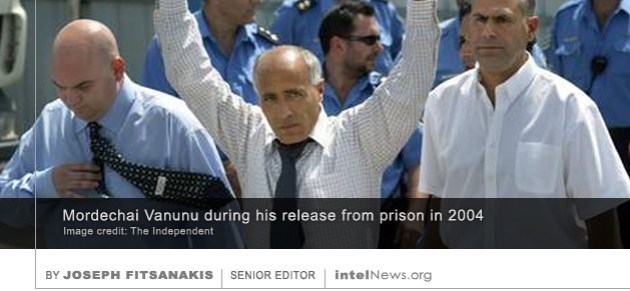 The controversial Israeli nuclear whistleblower Mordechai Vanunu, who was jailed for 18 years for revealing the existence of Israel’s nuclear program, has been invited to go to Norway to be reunited with his new wife. Vanunu was employed at Israel’s top-secret Negev Nuclear Research Center, located in the desert city of Dimona, which was used to develop the country’s nuclear arsenal. But he became a fervent supporter of nuclear disarmament and in 1986 fled to the United Kingdom, where he revealed the existence of the Israeli nuclear weapons program to the London-based newspaper The Times. His action was in direct violation of the non-disclosure agreement he had signed with the government of Israel; moreover, it directly challenged Israel’s official policy of ‘nuclear ambiguity’, which means that the country refuses to confirm or deny that it maintains a nuclear weapons program.
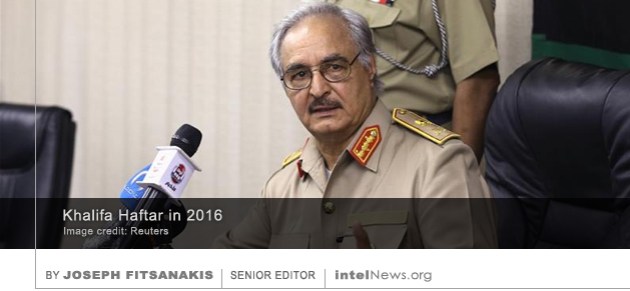 Israel is secretly providing military assistance to Khalifa Haftar, commander of the Libyan National Army, one of the factions in the Libyan Civil War, according to a British-based publication. Libya has remained in a state of war since 2011, when a popular uprising backed by the West and its allies led to the demise of the country’s dictator, Colonel Muammar Gaddafi. Currently the strongest faction in the ongoing Libyan Civil War is the eastern-based Tobruk-led Government, which is affiliated with the Libyan National Army (LNA). The commander of the LNA is Field Marshal Khalifa Haftar, an old adversary of Colonel Gaddafi, who lived in the United States under Washington’s protection for several decades before returning to Libya in 2011 to launch his military campaign.
 The Mossad, Israel’s primary intelligence agency, is preparing to launch a technology investment fund that will support Israeli-based hi-tech startups, with an eye to utilizing cutting-edge technologies in its spy operations. Israeli spy services are known internationally for their advanced use of technology in intelligence collection and special operations. But the planned investment fund is expected to systematize the Mossad’s use of cutting-edge technological solutions to intelligence challenges. It is
 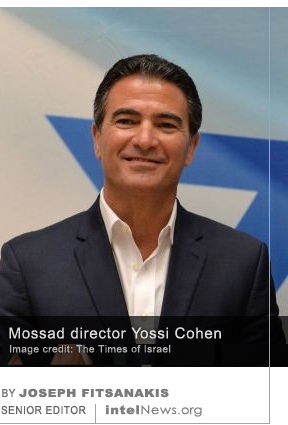 The combined budget of the two primary intelligence agencies of Israel, the Mossad and the Shin Bet, has doubled in the past decade, according to a report issued by the Israeli Ministry of Finance. Shin Bet is Israel’s domestic intelligence service, and is primarily responsible for counterterrorism and counterintelligence. The Mossad is Israel’s primary intelligence service, which means that it collects intelligence from foreign targets. The secretive agency also conducts covert and clandestine operations when authorized to do so by Israel’s government. The two agencies tend to work together with varying degrees of succces, but have distinct budgets.
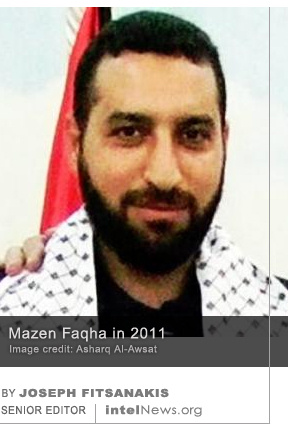 The sophistication behind the killing of a senior Hamas official, who was assassinated in his home in the Gaza Strip on Friday evening, points almost certainly to Israel, according to observers. Mazen Faqha, 38, helped plan several lethal operations by the Palestinian militant group, including a 2002 suicide bombing that killed nine and wounded over 50. Following an extensive manhunt, Israeli authorities arrested Faqha in the West Bank and in 2003 convicted him to nine life sentences. But in 2011, Faqha was among 1,027 Palestinian and Arab-Israeli prisoners that Israel released in exchange for Gilad Shalit, a soldier in the Israel Defense Forces, who was held prisoner by Hamas. Since that time, Faqha had lived in the Gaza Strip, the Hamas-controlled Palestinian enclave that has been under strict Israeli blockade since 2006.
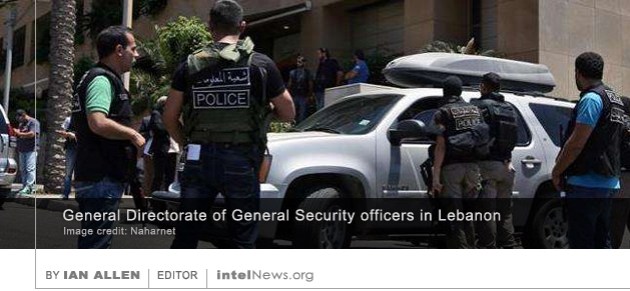 The security services of Lebanon announced on Wednesday that they had arrested five foreign nationals who were allegedly spying of Israel. A brief statement issued by Lebanon’s General Directorate of General Security (GDGS, also known as the General Security Directorate) said the five individuals were members of a “spy ring” set up by the Mossad, Israel’s external intelligence agency. The five —three men and two women— are accused of contacting Israeli embassies in countries in the Middle East, Europe and Asia, with the aim of passing information about domestic Lebanese affairs.
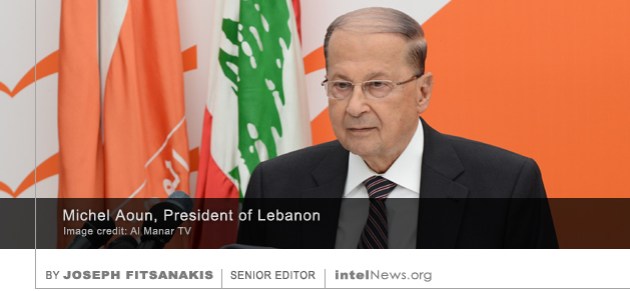 The president of Lebanon said on Wednesday that Israeli intelligence was behind the killing of a Lebanese businessman who was shot dead by a team of assailants last weekend in southwestern Africa. Amine Bakri, 54, who was from southern Lebanon, had lived and worked in Angola since his mid-20s. He was a well-known businessman in the Angola capital Luanda, where he owned a number of factories that make furniture and various medical equipment. On Sunday, Bakri was driving on an unpaved road in the Angolan capital, when his vehicle was ambushed by a group of three armed assailants. According to media reports, one of the men shot the windshield of Bakri’s car and then proceeded to shoot him in the head at close range. The men fled the scene and Bakri was transported to a local hospital, where he soon died from his wounds.
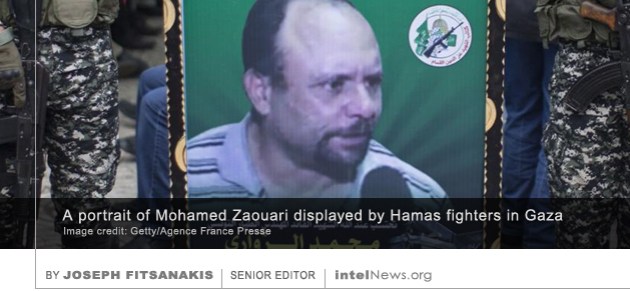 Despite persistent silence from Tel Aviv, commentators there seem increasingly convinced that Israeli spies were behind last week’s killing of an aviation engineer who worked for the Palestinian militant group Hamas. The man, Mohamed Zaouari, 49, was a Tunisian national who had spent over a decade creating an innovative aerial drone program for the Palestinian group that controls the Gaza Strip. He was
  A senior aviation engineer who headed the unmanned aerial vehicle program of the Palestinian militant group Hamas, has been shot dead outside his home in Tunisia by a group of assailants using gun silencers. Mohamed Zaouari, 49, was a Tunisian national who had spent over a decade creating an innovative aerial drone program for Hamas, the Palestinian group that today controls the Gaza Strip. He had lived outside of Tunisia for much of his life, most recently in Syria, where he is believed to have worked as an engineer in a private firm, while also consulting with the Palestinian group. He had returned to Tunisia in 2011, following the upheaval in the country that sparked the so-called Arab Spring.
 Israel’s intelligence services had access to recordings of secret talks between Arab heads of state in 1965, which helped the Jewish state win the Six-Day War, according to the former director of the country’s Military Intelligence Directorate. The brief but important conflict, which is also known as the Third Arab-Israeli War, broke out on June 5, 1967, when the Egyptian, Syrian and Jordanian armies attacked Israel. But within hours the Jewish state had managed to decimate the assailants’ air forces, and went on to deliver fatal blows to its adversaries. By the end of the war, Israel’s territory had increased threefold and Israeli troops were in control of the West Bank, the Gaza Strip and the Sinai Peninsula, among other areas.






 intelNews.org
Hamas accuses Mossad of assassinating Palestinian engineer in Malaysia
April 23, 2018 by Joseph Fitsanakis 1 Comment
Local reports said al-Batsh was gunned down at around 6:00 a.m. on Saturday morning as he was walking from his home to a nearby mosque for early-morning prayers. Footage taken from nearby security cameras shows that al-Batsh was shot by two men riding on a large BMW 1100cc motorcycle, who waited for him to arrive at the scene for at least 20 minutes before opening fire. Malaysian police said the Palestinian man was pronounced dead at the scene, having sustained wounds from 14 bullets in the chest and head. A subsequent report by local police authorities said the incident was being treated as a “targeted killing”, not as a terrorist attack, because the assassins appeared to focus solely on al-Batsh while ignoring several bystanders that were present.
Shortly after al-Batsh’s killing some reports identified him as a relative of Khaled al-Batsh, a senior official in the Palestinian Islamic Jihad. A subsequent statement published by Hamas-affiliated media said al-Batsh was a commander in the Izz ad-Din al-Qassam Brigades, Hamas’ military wing. The militant group described him as a “loyal member” and called him a “shahid” (martyr), who was “assassinated by the hand of treachery”. The Gaza-based group also vowed retaliation against Israel and the Mossad intelligence agency.
Malaysian authorities said on Sunday that they did not rule out anything, including the possibility that al-Batsh may have been killed by militants belonging to the Islamic State. Malaysia’s Deputy Prime Minister, Ahmad Zahid Hamidi, said that the possible involvement of “foreign agents” in al-Batsh’s killing was also being looked at. He added that the two main suspects behind the killing were believed to be “white, European-looking men”. On Monday, Malaysian police released facial composites of the two suspects, based on eyewitness testimonies. An accompanying press release said the two suspects were “around 1.80 meters tall, well built, had fair complexions, and were believed to be of Middle Eastern or Western descent”.
► Author: Joseph Fitsanakis | Date: 23 April 2018 | Permalink | Research credit: R.B. and C.F.
Filed under Expert news and commentary on intelligence, espionage, spies and spying Tagged with assassinations, Fadi al-Batsh, Fadi Albatsh, Fadi M. Albatsh, Gaza Strip, Hamas, Israel, Kuala Lumpur (Malaysia), Mossad, News