News you may have missed #706
April 3, 2012 Leave a comment
 By IAN ALLEN | intelNews.org |
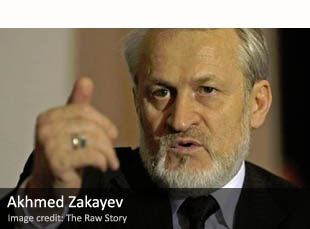
►►UK government accuses Chechen of assassination plot. The British government and intelligence services have accused an alleged henchman of Chechen President Ramzan Kadyrov of seeking to assassinate Akhmed Zakayev, a prominent exiled Chechen politician in London, who was granted asylum there in 2003. According to court documents, British government lawyers asking to deport a 45-year-old, Chechen-born, former elite soldier, referred to only as E1. They told judges that E1 was a threat to national security and had been implicated in a 2009 assassination on behalf of Mr Kadyrov in Vienna. Mr Zakayev, a former actor and self-described separatist leader, said in a recent interview that he believed “there are more Russian spies in Britain today than there were during the Cold War”.
►►Israeli ex-soldiers arrested in Colombia on drugs charges. Eight Israelis have been arrested in Colombia on suspicion of drug trafficking, money laundering and exploitation of minors, the country’s chief prosecutor has told local media outlets. The suspects, who were described in the reports as “former military men”, include former Israeli army Lt. Col. Yair Klein, who was convicted by a Colombian court and sentenced in absentia to nearly 11 years in prison for training drug traffickers’ assassins in the late 1980s. US and British investigations determined two decades ago that Klein was also involved in smuggling 400 Galil assault rifles and 100 Uzi sub-machine guns bought from Israeli into Colombia in 1989 when his plans to create a mercenary-ran training camp on the Caribbean island of Antigua unraveled.
►►Lawyer alleges MI6 agent was killed by ‘secret services’. A coroner has been told that Gareth Williams, an MI6 spy found dead inside a locked duffle bag in his London apartment could have been killed by someone who specialized in “the dark arts of the secret services”. The allegation was made by Anthony O’Toole, who represented the Williams family at an interim hearing ahead of the full inquest into Gareth Williams’ death. O’Toole said that there was “a high probability that there was a third party present in the flat” at the time. He added that “the unknown third party was a member of some agency specializing in the dark arts of the secret services, and perhaps evidence was removed from the scene post mortem by an expert in those dark arts”.








 intelNews.org
Judge orders CIA to release files on drug kingpin Pablo Escobar
August 24, 2012 by intelNews 1 Comment
In the late 1980s, it was nearly impossible to sit through a primetime news bulletin without coming across the name ‘Pablo Escobar’. Born in 1949 in the town of Rionegro, Colombia, Escobar rose to become the leader of the Medellín cartel, history’s most notorious narcotics smuggling ring. By 1986, the Medellín cartel controlled over 80 percent of the global cocaine market, shipping daily around 15 tons of the drug (worth an estimated street value of $500,000) to the United States. In 1989, Forbes magazine included Escobar on his list of the world’s richest persons, with an estimated net worth of $3 billion. By that time, the Medellín cartel had become powerful enough to directly threaten the very institutional integrity of the Colombian state. At the same time, Escobar carefully cultivated his ‘Robin Hood’ image by regularly building hospitals, schools, and churches in some of Colombia’s most impoverished regions. He was thus able to surround himself with a sea of grateful and devoted supporters, who directly depended on his generosity for their livelihood. They also shielded him from the reach of the Colombian and United States government forces, which repeatedly went after him without success. Eventually, the Colombian government, in association with the US Drug Enforcement Administration and the Central Intelligence Agency, managed to stop Escobar by creating a rival organization called Los PEPES —a Spanish-language acronym that stands for ‘People Persecuted by Pablo Escobar’. Los PEPES, which consisted of members of rival drug smuggling cartels, as well as trained mercenaries belonging to Colombian rightwing militias, went after Escobar’s closest associates with indescribable ruthlessness. They hunted down and eventually tortured and killed several of his relatives, advisors and bodyguards. Ultimately, in 1993, they helped the Colombian National Police corner Escobar and shoot him dead at a Medellín barrio. The celebrations in Washington and Bogotá didn’t last long; as soon as Los PEPES disbanded, many of its leading members regrouped to found the United Self-Defense Forces of Colombia (AUC), a rightwing paramilitary group that has since killed thousands of civilians in Colombia’s bitter civil war. The AUC, which funds its operations through kidnappings and drug trafficking, is today a designated terrorist group by most Western governments, including the United States and the European Union. Read more of this post
Filed under Expert news and commentary on intelligence, espionage, spies and spying Tagged with CIA, Colombia, DEA, declassification, FOIA, government secrecy, Institute for Policy Studies, Judge Royce C. Lamberth, lawsuits, Los PEPES, Medellin (Colombia), Medellin cartel, narcotics trade, News, Pablo Escobar, United Self-Defense Forces of Colombia, United States