Korea spy gave North data on 10,000 defectors living in South

North and South KoreaBy JOSEPH FITSANAKIS | intelNews.org |
An employee of the South Korean government has been detained for allegedly providing North Korea with detailed resettlement information on over 10,000 North Korean defectors living in the South. The 33-year-old man, who has been identified simply as “Mr. Yu”, was arrested on January 11 by South Korea’s National Intelligence Service. The NIS, which leads South Korea’s intelligence community, described Yu’s activities as “an unusual breach of the South Korean civil service”. The detainee is accused of providing Pyongyang with a “complete list” of thousands of North Korean defectors living in South Korean capital Seoul. The list is said to include information such as the defectors’ resettlement addresses and employment information among other personal data. Interestingly, the accused spy is himself a North Korean defector, according to South Korean news outlets. A trained surgeon, he is said to have been a member of North Korea’s social elite before defecting to the South on foot via China, in 2004. Seven years later, in 2011, he joined the Seoul city municipal government, where he was tasked with providing assistance and services to the thousands of North Korean defectors living in the South Korean capital and surrounding areas. According to reports, Yu was arrested after the NIS discovered that he made frequent trips to China and came to suspect that he might have crossed into North Korea on several occasions during his trips. South Korean counterintelligence investigators are currently trying to determine whether the accused spy entered South Korea with the intention of conducting espionage on behalf of Pyongyang. Read more of this post

News you may have missed #769 (analysis edition)

John McLaughlinBy IAN ALLEN | intelNews.org |
►►Is S. Korea’s spy agency losing its capabilities? The National Intelligence Service, South Korea’s primary external intelligence agency, is presumed to spend around US $1 billion a year, most of which it uses to spy on its northern neighbor. But when asked about the identity of the young woman who frequently accompanies new North Korean leader Kim Jong Un in his public appearances, the state intelligence agency offers no clear answer. Although it was seven months ago, at the time of Kim Jong-il’s funeral, that the woman was first spotted, the agency still does not know who she is. In the past 20 years, NIS has undergone a process of transformation to rid it of political functions. But the lingering question is: have the changes compromised the overall capabilities of the giant organization?
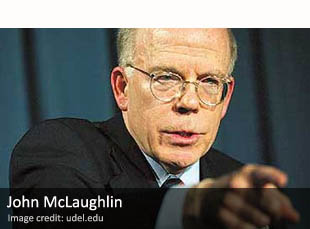
►►How 10 years of war has changed US spies. John McLaughlin, who was a CIA officer for 32 years and served as Deputy Director and Acting Director from 2000-2004, says he is often asked how American intelligence has changed in the 11 years since 9/11. His answer is that the changes are profound and have been transformative. Perhaps the most important thing to realize about American intelligence officers in 2012, he says, is that this is the first generation since Vietnam to have been “socialized” –that is hired, trained, and initiated– in wartime. And to a greater degree than even the Vietnam generation, their experience approximates that of their World War II forbears in the Office of Strategic Services (OSS) –the organization to which most American intelligence officers trace their professional roots.
►►Assessing the Social Media Battlefield in Syria. While the numerous insurgent factions and the Syrian security forces engage each other in combat in towns and cities to secure tangible battlefield gains, the warring parties are also waging a contentious information war in cyberspace, specifically within the virtual arena of online social media. The various strands of the opposition in Syria —political and violent— have taken to social media since the earliest stages of the uprising to advance their agendas. Analogous to their role in facilitating communication and information exchange during the wave of revolts that have been sweeping the Arab world since 2011, new media platforms such as the array of social media websites and related technologies that are available to the public at virtually little or no cost have become crucial to shaping how the crisis in Syria is portrayed and perceived.

News you may have missed #726

Barbara Annette RobbinsBy IAN ALLEN | intelNews.org |
►►Portrait of first female CIA officer to die in line of duty. In 1965, a 21-year-old American woman, Barbara Annette Robbins (photo), was among the victims of a car bombing at the US Embassy in Saigon, South Vietnam. Washington said she was a diplomat. But, at a ceremony last year, the CIA admitted she was an employee of the Agency. This makes her the first woman at the male-dominated CIA killed in the line of duty. She is also the youngest CIA employee ever killed. And she appears to be the first American woman to die in the Vietnam War. The Washington Post has an interesting article about her short life and career.
►►US Jewish leader says release of Israeli spy Pollard ‘inevitable’. The release of Jonathan Pollard, who is serving a life sentence in a US prison for spying on the US for Israel, is “inevitable” and could take place shortly on “technical grounds”, according to Jack Rosen, a prominent Jewish leader and supporter of US President Barack Obama. A New York City real estate executive who hosted Obama at his Upper East Side home for a Democratic Party fundraiser last November, Rosen said that “there are some technical reasons, I’m told, why [Pollard] will be released. I think there’s an inevitability to that happening”.
►►Senior reshuffle at South Korean spy agency. South Korean President Lee Myung-bak reshuffled two top posts at South Korea’s main intelligence agency Monday in a shake-up that also affected five other vice-ministerial posts. Nam Joo-hong, a former well-known security scholar who has so far served as ambassador to Canada, was named the first deputy chief of the National Intelligence Service, while Cha Moon-hee, a veteran intelligence official, was tapped as the agency’s second deputy chief. The spy agency’s first and second deputy chiefs are in charge of its overseas and domestic operations, respectively.

Did Outside Spy Agencies Know About Kim Jong Il’s Death?

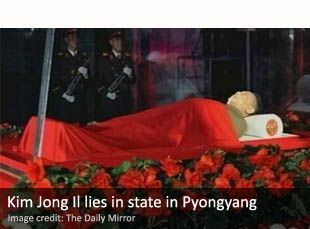
Kim Jong Il lies in state in PyongyangBy JOSEPH FITSANAKIS* | intelNews.org |
According to KCNA, North Korea’s state news agency, Premier Kim Jong Il died at 8:30 am on Saturday, December 17. However, government media did not announce the startling news until early Monday morning, that is, nearly 50 hours after the “Dear Leader’s” sudden passing. Assuming that North Korean reports of the time and location of Kim’s death are truthful, the inevitable question for intelligence observers is: did anyone outside North Korea receive news of Kim Jong Il’s death during the 50 hours that preceded its public announcement? In times like this, most Westerners tend to look at the Central Intelligence Agency, National Security Agency, MI6, DGSE, or any of the other recognizable acronyms that dominate American and European news reports. The reality is, however, that despite their often-mythical status, Western intelligence agencies tend to be limited in their global reach, which is usually heavily concentrated on selected adversaries, like Russia, or China. These agencies therefore tend to rely on their regional allies to get timely and accurate information on smaller nations that are often difficult to penetrate. In the case of North Korea, Western spy agencies depend heavily on actionable intelligence collected by South Korean and Japanese spies. Read more of this post

News you may have missed #616

CSIS seal

CSIS seal

►►S. Koreans say several N. Korean assassination bids stopped. South Korea has arrested several North Korean agents for plotting to assassinate anti-Pyongyang activists, according to Won Sei-Hoon, head of South Korea’s National Intelligence Service, who spoke to the parliament’s intelligence committee. Earlier this month, Seoul prosecutors charged a North Korean agent with trying to murder Park Sang-Hak, an outspoken activist in Seoul, with a poison-tipped weapon.
►►MI5 inspectors’ website shut down after security blunder. A new website for the former High Court judges responsible for oversight of MI5, MI6 and wiretapping has been shut down after it emerged that anyone could edit any page of it. The security blunder forced the Intelligence Services Commissioner, Sir Mark Waller, and the Interception of Communications Commissioner, Sir Paul Kennedy, to pull the plug on their new website.
►►Report urges Canadian spies to share more info with diplomats. Canada’s spy agency needs to share more information with the Department of Foreign Affairs so the department is better prepared for negative reactions to Canadian intelligence work overseas, according to a new report by Canada’s Security Intelligence Review Committee. The Committee, which reports to Parliament on the work of the Canadian Security Intelligence Service, found the organization had “limited exchanges” with Canada’s diplomats on its operations.

South Korea charges North Korean agent caught carrying ‘poison-tipped needle’

Park Sang-hak

Park Sang-hak

By JOSEPH FITSANAKIS | intelNews.org |
The South Korean government has formally pressed charges against a North Korean defector, whom it accuses of trying to kill an outspoken anti-Pyongyang activist living in the South, with the use of a poison-tipped needle. As intelNews reported last month, a man identified only as ‘Ahn’ was arrested at a subway station in southern Seoul, as he tried to assassinate Park Sang-Hak. The alleged target of the assassination is a high-profile North Korean defector known for spearheading an imaginative —and often controversial— propaganda campaign directed against the government of North Korea. In one recent case, Park, along with his wife and children, employed dozens of inflatable helium balloons to smuggle thousands of leaflets, dollar bills, solar-powered radios, and DVDs into North Korea. According to the Korean Central Prosecutor’s Office in Seoul, Park’s activities prompted Pyongyang to employ ‘Ahn’, a North Korean former Special Forces commando, to try to kill the anti-communist propagandist. According to South Korean officials, ‘Ahn’, has operated as a North Korean sleeper agent ever since his relocation to Seoul, in the late 1990s. In the summer of 2011, ‘Ahn’ contacted Park and eventually managed to arrange a meeting with him at a suburban subway station in the South Korean capital for September 3. However, several days prior to the arranged rendezvous, Park received notice from South Korea’s National Intelligence Service (NIS) that ‘Ahn’ was out to either kidnap or kill him. The alleged North Korean agent was arrested at the subway station at the time of his meeting with Park. South Korean government prosecutors claim that NIS agents found a poison-tipped needle in ‘Ahn’s’ possession, which they plan to use as evidence at his upcoming closed-door trial. Read more of this post

News you may have missed #548 (China edition)

NIS HQ

By IAN ALLEN | intelNews.org |
►►China detains Korean spy officers. It emerged last week that Chinese authorities have kept in detention for nearly a year two South Korean NIS intelligence officers, who were caught collecting information about North Korea on Chinese soil. It appears that the Chinese did share the information with the North Koreans, because usually the North Korean news agency would have announced this when the officers were first arrested. Of course, NIS denied the Chinese report. ►►US intelligence on China declassified. George Washington University’s National Security Archive has published a series of declassified US intelligence reports on China, spanning the period from 1955 until 2010. In one report authored in 2005, US intelligence analysts speculate that Beijing might be trying to develop a capability to incapacitate Taiwan through high-power microwave and electromagnetic radiation, so as not to trigger a nuclear retaliation from the US. ►►IMF investigators see China behind computer hacking. Back in June, intelNews reported on a massive and sophisticated cyberattack on the computer systems of the International Monetary Fund, which experts claimed was “linked to a foreign government”. Read more of this post

News you may have missed #478

  • Israel and Chile collaborated to spy on Iran and Venezuela. Documents released by WikiLeaks show Israel and Chile cooperated to spy on Iran as it developed bilateral links with Venezuela. A diplomatic cable from the US embassy in Santiago to the State Department in Washington, dated July 21, 2008, said Chile and Israel both expressed concern about growing ties as well as a potential Iranian presence on the border with Brazil, Argentina and Paraguay.
  • Korean spies broke into Indonesian delegation’s hotel room. Members of South Korea’s NIS spy agency broke into a hotel room of a visiting high-level Indonesian delegation to try to steal sensitive information on a possible arms deal, according to Seoul-based Chosun Ilbo newspaper. The report said the NIS officers left “after being disturbed by a delegate”.
  • High-ranking Libyan pilots defect to Malta. Two air force jets landed in Malta on Monday and their pilots, who said they are “senior colonels” in the Libyan air force, asked for political asylum. The pilots claim to have defected after refusing to follow orders to attack civilians protesting in Benghazi in Libya. Meanwhile, a group of Libyan army officers have issued a statement urging fellow soldiers to “join the people” and help remove Muammar Gaddafi by marching to Tripoli.

South Korean spy reportedly expelled from Libya

Seal of the National Intelligence Service of the Republic of Korea

NIS seal

By IAN ALLEN | intelNews.org |

Libya has expelled a South Korean intelligence officer and has shut down its mission in Seoul, according to South Korean diplomatic sources. The unnamed officer, who was expelled by the Libyans on June 18, is reportedly a member of South Korea’s National Intelligence Service who was stationed in the Libyan capital Tripoli. He was arrested in early June, after having been kept under surveillance for three months by Libyan counterintelligence officers. During that period, he was reportedly photographed in the act of bribing a Libyan intelligence officer. Some reports suggest that the expelled spy attempted to collect intelligence on Libyan leader Muammar al-Gaddafi, his family and senior Libyan government members. Other sources allege that he was gathering information on defense industry contacts between Libya and North Korea. Read more of this post

News you may have missed #0175

  • South Korean spy agency now regards North as ‘international affairs’. The Seoul-based National Intelligence Service (NIS) has relocated its unit that monitors North Korea under a department dealing with international affairs. The change, described as a “paradigm shift” by one South Korean official, apparently reflects President Lee Myung-bak’s view that the North Korean issue should be dealt more “from the international geopolitical perspective”.
  • Robbery of S. African intel agent was planned, say officials. The robbery by five men of a woman said to be an agent of South Africa’s National Intelligence Agency “was conducted as though it was very well planned”, according to police.
  • Interview with ex-West German spy master. Radio France Internationale has aired an interview with Hans-Georg Wieck, chief of the West German Secret Service (BND) between 1985 and 1990. Among other things, Wieck claims that BND had “well-placed” agents in East Germany, as well as in spy services of other communist, including the KGB.

Bookmark and Share

News you may have missed #0163

  • South Korean ex-spy master dies. Lee Hu-rak, who has died at age 85, headed the Korea Central Intelligence Agency, a predecessor of today’s National Intelligence Service, from 1970-1973. He was best known for brokering the signing of a historic 1972 peace document with North Korea, after an unprecedented secret trip to Pyongyang, during which he met North Korean leader Kim Il Sung.
  • Spy like us. How a mild-mannered Baltimore antique dealer became one of the FBI’s best undercover agents.
  • Bulgaria quits plans to disband State National Security Agency. Bulgaria’s government has made clear it does not plan to suspend, but just to “streamline”, the operations of the scandal-prone State National Security Agency DANS.

Bookmark and Share

News you may have missed #0134

  • S. Korean government tries to silence anti-surveillance activist. Park Won-sun, the executive director of the Hope Institute, a civic think tank, says he will continue to criticize the country’s National Intelligence Service (NIS) for spying on civilians, despite charges filed against him by the government.
  • Cleric in CIA kidnap trial seeks millions. Hassan Moustafa Osama Nasr, an Egyptian cleric kidnapped by the CIA from a Milan street in 2003, has asked for €10 million ($15 million) in damages from the American and Italian defendants charged in his abduction.
  • Three US-based Chinese nationals accused of selling arms to China. Chinese nationals Zhen Zhou Wu, Yufeng Wei, Bo Li and Chitron Electronics and Shenzhen Chitron Electronics Co. Ltd., face a 38-count indictment for conspiring to violate the US Arms Export Control Act for allegedly exporting defense weapons and electronics, money laundering and filing false documents with the US Department of Commerce.

Bookmark and Share

News you may have missed #0114

Bookmark and Share

News you may have missed #0059

  • Torture report says UK government ministers shielded MI5, MI6. A new report from Britain’s parliamentary human rights committee accuses senior cabinet ministers of “hiding behind a wall of secrecy” to avoid being held to account over allegations of British intelligence agents’ collusion in torture.
  • US cyber czar resigns. Senior intelligence official Melissa Hathaway, who was US President Barack Obama’s choice to monitor America’s online security, said in an interview that she is leaving “for personal reasons”.
  • South Korean opposition skeptical of request for new intelligence powers. Opposition parties in South Korea are critical of the National Intelligence Service’s (NIS) recent request to gain access to information on financial transactions amounting to 20 million won or more without a warrant.

Bookmark and Share

News you may have missed #0056

  • South Korean spy agency seeks increased access to financial intelligence. The National Intelligence Service is pushing for legal revisions that will allow it to access information on financial transactions of over 20 million won (US$16,000) without a warrant. The agency claims the new powers will help track down “terrorism-related funds”.
  • Nepal to create new spy agency. The Maoist Nepali government is preparing to set up a powerful intelligence body that will be directly accountable to the Prime Minister. IntelNews hears that Indian government advisors are actively involved in setting up the new agency, which will “gather information on foreign intervention in Nepal”.
  • Peru’s Defense minister denies alleged espionage against Chile. Rafael Rey has denied any participation by Peru’s government in the case of Business Track, a company accused of telephonic and electronic interception to Chilean Army officers.

Bookmark and Share