Israeli intelligence using Microsoft servers to store intercepted phone call data

Microsoft ISRAELI INTELLIGENCE IS USING Microsoft’s cloud service to store recordings and metadata from millions of intercepted telephone conversations placed by residents of Gaza and the West Bank, according to a new investigation. The investigation was jointly conducted by British newspaper The Guardian and Israeli weekly magazine Sikha Mekomit (Local Call), which published it last week.

Citing conversation with 11 sources from Microsoft and within Israel, the investigation reveals that Israel Defense Forces (IDF) Unit 8200 is the primary force behind the interception and data storage project. Operating under Aman, Israel’s military intelligence directorate, Unit 8200 is responsible for collecting signals intelligence (SIGINT), cyber warfare, and code decryption, among other tasks.

Israeli security sources cited in the report explain that the commander of Unit 8200, Brigadier General Yossi Sriel, approached Microsoft because the Israeli intelligence unit lacked enough storage space and processing power to store “billions of files”. General Sriel has led a large-budget project that has significantly expanded the scope of information-gathering on Palestinians and has integrated various databases.

In November 2021, an meeting, described in the report as “extraordinary”, took place at Microsoft’s headquarters in Seattle, Washington. On one side were Microsoft Chief Operating Officer, Satya Nadella, and other company executives, while on the other side were General Sriel and other senior officials of Unit 8200. The agenda centered on a plan, promoted by Sriel, to transfer intelligence information held by the Unit to the computing giant’s servers. According to an internal Microsoft document, which was leaked by The Guardian, Sriel requested the transfer to Microsoft’s cloud of 70% of the unit’s data, including “secret and top secret” data.

The meeting allegedly led to the development of one of the world’s most invasive surveillance systems, which has been employed by Israel to monitor Palestinians in Gaza and the West Bank. According to documents cited by The Guardian, as of July this year, 11,500 terabytes of Israeli military data—equivalent to 862 billion documents or 195 million hours of audio—were stored on Microsoft Azure public cloud servers in the Netherlands. A smaller portion of the data was stored in Ireland and Israel. Read more of this post

Russian hacker group using Internet service providers to spy on foreign embassies

Hacking cyber - JFA HACKER GROUP LINKED to Russia’s Federal Security Service (FSB) has compromised Russia’s domestic internet infrastructure and is using it to target foreign diplomats stationed in Russia. According to a report, published last week by Microsoft Threat Intelligence, the hacker group behind this operation is Turla, also known as Snake, Venomous Bear, Group 88, Waterbug, and Secret Blizzard. Analysts have linked the group with “some of the most innovative hacking feats in the history of cyberespionage”.
Turla began its attempt to compromise a host of Russian internet service providers in February, according to Microsoft’s report. The group’s apparent goal has been to gain access to the software that enables Russian security agencies to legally intercept internet traffic, following the issuance of warrants by judges. This software is governed by Russia’s System for Operative Investigative Activities (SORM), which became law in 1995, under the presidency of Boris Yeltsin. All local, state, and federal government agencies in Russia use the SORM system to facilitate court-authorized telecommunications surveillance.

According to Microsoft, targeted Internet users receive an error message prompting them to update their browser’s cryptographic certificate. Consent by the user results in the targeted computer downloading and installing a malware. Termed ApolloShadow by Microsoft, the malware is disguised as a security update from Kaspersky, Russia’s most widely known antivirus software provider. Once installed the malware gives the hackers access to the content of the targeted user’s secure communications.

The Microsoft report states that, although Turla has been involved in prior attacks against diplomatic targets in Russia and abroad, this is the first time that the hacker group has been confirmed to have the capability to attack its targets at the Internet Service Provider (ISP) level. In doing so, Turla has been able to incorporate Russia’s domestic telecommunications infrastructure into its attack tool-kit, the report states. The report does not name the diplomatic facilities or the countries whose diplomats have been targeted by Turla hackers. But it warns that all “diplomatic personnel using local [internet service providers] or telecommunications services in Russia are highly likely targets” of the group.

Author: Joseph Fitsanakis | Date: 02 August 2025 | Permalink

Hackers breach website used by US intelligence community to solicit vendor contracts

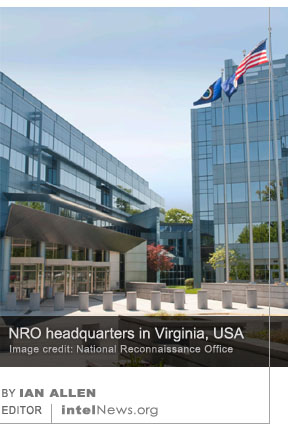
NRO - IAHACKERS HAVE COMPROMISED A website used by the United States Intelligence Community (IC) to solicit sensitive contracts from the private sector, according to a new report. The target of the attack, and the methods used by the hackers, appear to point with a high degree of certainty to a state actor.

The website in question belongs to the Acquisition Research Center (ARC), an initiative of the US government’s Acquisition Center of Excellence. Even though the ARC solicits contracts on behalf of the entire US IC, its public-facing website is maintained by the National Reconnaissance Office (NRO), which last week notified several companies affected by the breach.

The ARC online interface is designed for companies in the private sector who want to register as government vendors in the national security space. Once they register through the ARC system, these companies can pitch a variety of intelligence agencies with a particular technology or idea. Recent projects solicited through the ARC system have involved communications interception systems, artificial intelligence-powered data collection or analysis tools, predictive technologies, signature-reduction systems, or various tools used in physical surveillance.

It is believed that the hackers targeted the unclassified portion of the ARC website, seeking personal information about vendors, as well as proprietary intellectual property. An NRO spokesperson told The Washington Times that the breach was being looked at by federal law enforcement but declined to provide further information about what he described as an “ongoing investigation”.

Author: Ian Allen | Date: 28 July 2025 | Permalink

Senior Mossad veteran discusses recruitment of Iranian assets in rare interview

Mossad - ABTHE MOSSAD, ISRAEL’S PRIMARY foreign-intelligence agency, played a crucial role in Israel’s most recent attack on Iran. It is clear that, without unique intelligence on key Iranian figures and nuclear sites, much of it gathered by the Mossad, the Israeli Air Force could not have been so precise and deadly against Iranian targets.

It is a rare occasion to hear directly from a senior veteran of the Mossad. Oded Eilam (or Ailam), now 71, served in the Mossad for 24 years. In an interview with the German newspaper Bild, Eilam described the strategy that allowed the Israeli intelligence agency to successfully recruit and maintain an “extensive network” of spies inside Iran.

According to Eilam, the key to the Mossad’s success lies in Iran’s complex social structure. “Only 40% of [Iran’s] population of 90 million are Persians,” Eilam said, explaining that the ethnic divide makes it difficult for the Iranian government to control the population. “The [Iranian government’s] surveillance system has huge gaps; you can’t compare it to what the Stasi did in East Germany,” he added.

The former Mossad official explained that various ethnic groups inside Iran, such as Kurds, Turkmen, Baluchis, and Azeris, make up a potential pool for recruiting agents. According to Eilam, the motivation for cooperating with the Mossad is not necessarily support for Israel or financial reward, but often stems from dissatisfaction with the Iranian regime.

“Many people in Iran are unhappy. Large parts of society live in poverty,” explained Eilam. “While Iran has significant gas reserves, instead of investing this money in their country, the clerics have funneled billions into terrorist organizations like Hezbollah,” he added. Another factor that helps Mossad’s activities, according to Eilam, is Iran’s long territorial borders and the difficulty of monitoring them thoroughly. “This makes it possible to smuggle everything into the country,” he noted.

Eilam also emphasized the Mossad’s commitment to safeguarding its assets. “When someone works for us, we take care not only of them but also of their family,” he said, clarifying that the Mossad is dedicated to bringing its spies and their families to safety if needed. Although there are many opportunities to recruit agents in Iran, the Mossad is not in a rush. Eilam highlighted that the organization spends a significant amount of time on the process of selecting and screening candidates. “When we are looking for agents, we don’t just choose someone; we take a lot of time to ensure that the person is suitable.”

“When someone works for us,” the former officer noted, “the importance the Mossad attaches to verifying information. For a target, we do not use information from just one agent, but always multiple sources to be sure that the right person is hit,” said Eilam, also hinting at the extensive vetting processes the organization conducts before operational actions.

Eilam’s interview is a unique source of insight into the espionage operations of the Mossad. It is unclear why it was published—possibly to warn the Iranians to think twice before taking any offensive actions against Israel.

Author: Dr. Avner Barnea* | Date: 22 July 2025 | Permalink

Dr. Avner Barnea is a research fellow at the National Security Studies Center of the University of Haifa in Israel. He served as a senior officer in the Israel Security Agency (ISA). He is the author of We Never Expected That: A Comparative Study of Failures in National and Business Intelligence (Lexington Books, 2021).

Researchers uncover secretive Russian spy unit by studying its commemorative badges

FSB RussiaA GROUP OF RESEARCHERS in Finland have managed to outline the structure and geographic footprint of a highly secretive Russian signals intelligence (SIGINT) unit by studying commemorative badges issued by the Russian government. The research group, known as CheckFirst, specializes in open-source (OSINT) investigative reporting and works to combat online disinformation.

Earlier this month, CheckFirst published its latest report titled “OSINT & Phaleristics: Unveiling FSB’s 16th  Center SIGINT Capabilities”. The 36-page report focuses on the study of Russian government-issued commemorative badges—also known as challenge coins—relating to Center 16 (16-й Центр). Also known as  Military Unit 71330, Center 16 is a secretive SIGINT unit that houses most of the cyber espionage capabilities of Russia’s Federal Security Service (FSB).

Challenge coins are custom-made medallions given by military, intelligence, and government agencies to recognize service, commemorate achievements, or build morale. Originating in the United States military during World War I, and popularized during the Vietnam War, challenge coins are routinely exchanged in ceremonies or offered to personnel as tokens of camaraderie and loyalty within a specific unit or mission.

Often regarded as collectors’ items, challenge coins from various agencies are often resold on websites such as eBay, or displayed online on websites maintained by private collectors. CheckFirst researchers tracked down several versions of Center 16 challenge coins found on a variety of publicly available websites, as well as on the websites of Russian challenge coin manufacturers, such as GosZnak, SpetsZnak, or Breget.

Based on this OSINT methodology, CheckFirst researchers were able to identify 10 distinct directorates within Center 16, which specialize on various aspects of defensive and offensive cyber espionage. Previously only a single Center 16 directorate had been identified in the unclassified domain. Moreover, by examining geographic indicators found on several of challenge coins, such as maps or coordinates, CheckFirst researchers were able to partly map out the geographic structure of Center 16, locating nearly a dozen interception facilities throughout Russia.

Author: Joseph Fitsanakis | Date: 21 July 2025 | Permalink

Austria’s revamped security leadership team tackles challenges

DSN AustriaTHE CONTROVERSIES THAT CONTINUE to be associated with the Austrian intelligence agencies today took place before December 2021, when the current Directorate of State Security and Intelligence (Direktion Staatsschutz und Nachrichtendienst, or DSN) was founded. Despite this, the DSN under the leadership of its director Omar Haijawi-Pirchner is still regarded as stable and predictable.

The DSN’s Western partner agencies were more than happy that the new governing coalition in Vienna was able to prevent the rightwing populist and generally Putin-friendly Freedom Party of Austria (FPÖ) from providing the minister of the interior. The fact that the current Interior Minister Gerhard Karner has been joined by an experienced state secretary is a major plus: Jörg Leichtfried, a Social Democrat born in 1967, has been regarded as a liberal European for many years, including eleven years as a member of the European Parliament. He will be responsible for state security and intelligence agencies.

One of Leichtfried’s stated goals has been particularly well received: he has vowed to improve the country’s national infrastructure and intensify its international cooperation. Various other details, such as the future framework conditions for military intelligence agencies, are also on his list. It is certain that the operational work of the DSN will continue to be led by Haijawi-Pirchner. This is reportedly to be improved, with better monitoring of terrorist threats, made possible by the planned extended access to messenger services.

The Austrian intelligence agencies have always been characterized by the personalities of their individua leaders. It is therefore all the more important who the leadership surrounds itself with—especially as the expectations are high, not least due to the threats from Russia and China. The uncertainty regarding Europe’s partners in the United States also means that the European intelligence agencies are urgently dependent on reliable Austrian partners.

As the political-strategic organization will be the responsibility of Leichtfried, two people who work in his immediate environment, and were previously only known to insiders, have come to the fore: the head of the Cabinet, Christian Strnad, and the head of Strategy and Security Policy, Rastislav Bachora. Both previously worked on the security-policy concept of the Social Democratic Party of Austria (SPÖ), the Social Democratic Strategy for Freedom, Protection and Security. Read more of this post

Leaked counterintelligence document reveals Russian concerns about Chinese spying

FSB RussiaA LEAKED REPORT AUTHORED by Russia’s primary counterintelligence agency reveals deep concern in national security circles about the intensity of Chinese spying against Russian interests, according to The New York Times. The paper said last week that the leaked report, which was produced by Russia’s Federal Security Service (FSB) between 2023 and 2024, offers “the most detailed behind-the-scenes view” of Russia’s counterintelligence concerns about China.

Following the death of Soviet Premier Joseph Stalin, the two communist countries became sworn enemies and nearly went to all-out war against each other. But in recent years Moscow and Beijing put aside their differences, prompted by their mutual desire to challenge the geopolitical supremacy of the United States and bring about a multipolar world. Since 2022, when Moscow resumed its military invasion of Ukraine, Beijing has stood firmly by the Kremlin. China has become the largest importer of Russian energy and has provided the Russian military with much-needed advanced technology. The relationship between the two neighboring nations appears to be deeper than ever before.

But according to a recently leaked report, Russia’s national security establishment is deeply concerned about Chinese efforts to dominate its ally by spying against it. The eight-page report outlines “ENTENTE-4”, a counterintelligence program run by the 7th Service of the FSB’s Department for Counterintelligence Operations. The department is known by its Russian acronym, DKRO. The DKRO’s 7th Service is tasked with counterintelligence planning and operations against Asian countries, with China being its primary target.

According to The Times, the DKRO produced the report sometime between 2023 and 2024. The document appears to have been intended for distribution to the FSB’s field offices across Russia. It was acquired by ARES Leaks, a cyber criminal syndicate, which posted images of the document on the Telegram messenger application. The paper said it shared the leaked document with “six Western intelligence agencies”, all of which assessed it to be genuine. Read more of this post

Russian spies operated in Portugal using forged Brazilian papers, report claims

Porto PortugalTWO RUSSIAN SPIES USED forged documents acquired in Brazil in order to live in Portugal for years and use it as a base from where to conduct espionage, according to an investigation by Portuguese counterintelligence. The spies were husband-and-wife team Vladimir Aleksandrovich Danilov and Yekaterina Leonidovna Danilova, both in their 30s. According to The New York Times, they appeared in Portugal in 2018 using the names Manuel Francisco Steinbruck Pereira and Adriana Carolina Costa Silva Pereira.

Portuguese weekly newspaper Sol said on Saturday that Danilov used a Brazilian passport and supplied authorities with documentation showing his father was a Portuguese national. This allowed Danilov to eventually obtain Portuguese citizenship. Although Danilova did not apply for Portuguese citizenship, she was granted permanent residency by the European Union country. These credentials enabled the spies to move freely in the European Union’s 27 member-states without restriction.

In 2022 the Brazilian Federal Police, with the assistance of United States intelligence agencies, launched a lengthy investigation into the activities of several Russian spies who operated in Brazil in recent years. The spies appear to have used concocted Brazilian identities in order to operate around the world undetected. The investigation eventually incorporated counterintelligence services from as many as eight countries, including Portugal, according to Sol.

So far the Portuguese investigation has revealed that the Danilovs conducted a variety of espionage operations in the coastal city of Porto, which is Portugal’s second-largest urban center following the capital Lisbon. Using Porto as an operational base, the couple traveled extensively around the world using their Brazilian and Portuguese passports. Each time they were able to return to their home in Porto “without encountering any issues”, Sol reports. The two spies have vanished and their current whereabouts are unknown.

Author: Joseph Fitsanakis | Date: 26 May 2025 | Permalink

White House orders spy agencies to prioritize intelligence collection on Greenland

Nuuk GreenlandTHE ADMINISTRATION OF UNITED States President Donald Trump has ordered American intelligence agencies to focus on Greenland, while also mulling a plan to establish a formal association with the island territory. The Wall Street Journal reported last week that the Office of the Director of National Intelligence (ODNI), headed by Tulsi Gabbard, has communicated an official “collection emphasis message” on Greenland to the directors of American intelligence agencies.

Citing “two people familiar with the effort”, the paper said that the classified message was communicated to the leadership of the National Security Agency, the Defense Intelligence Agency and the Central Intelligence Agency, among other members of the intelligence community. The recipients of the order were instructed to prioritize the collection of intelligence about the politics of Greenland and Denmark to which Greenland belongs. They were also instructed to collect information about the island’s economic and social dynamics, including its inhabitants’ views on the United States.

The United States government uses collection emphasis directives as a means of aligning the use of intelligence resources with the White House’s policy priorities. According to The Wall Street Journal, the directive appears to be among the first concrete steps taken by the White House to utilize the government’s national security apparatus in support of President Trump’s often-stated desire to acquire Greenland on behalf of the United States. The island’s 57,000 residents are citizens of Denmark, which is a member of the North Atlantic Treaty Organization and a longtime American military and political ally.

When asked to comment on this report by The Wall Street Journal, DNI Gabbard accused the newspaper of “breaking the law and undermining our nation’s security and democracy [by] leaking classified information”. She added that the newspaper “should be ashamed of aiding deep state actors who seek to undermine the President by politicizing and leaking classified information”.

Meanwhile, the Reuters news agency reported last week that White House officials have begun outlining a plan to pursue a so-called Compact of Free Association (COFA) between the United States and Greenland. The United States maintains COFA agreements with several Pacific Island nations, including Micronesia and Palau. These agreements permit the American military to operate on the soil and maritime jurisdiction of these nations. In return, the United States provides these nations with essential services, as well as security and military protection.

Author: Joseph Fitsanakis | Date: 12 May 2025 | Permalink

Son of senior CIA official dies ‘fighting for Russia’ in Ukraine

CIA Directorate of Digital InnovationA 21-YEAR-OLD American citizen, whose mother is a senior Central Intelligence Agency (CIA) official, died while fighting with the Russian military in Ukraine in 2024, according to a news report. Late last week, the CIA confirmed the accuracy of the story while requesting that the media afford the bereaved family “privacy at this difficult time”.

On April 25, the independent Russian media website Important Stories (known as iStories) claimed that Michael Gloss, 21, the son of CIA Deputy Director for Digital Innovation Gallina Gloss, had “died within the borders of Ukraine” while fighting for the Armed Forces of the Russian Federation. Although his death had occurred in April 2024, the information about his American citizenship and his connection to the CIA had been kept from the media until the iStories report disclosed it to the public.

Later on the same day, a spokesperson for the CIA told NBC News that the spy agency was aware of the incident, which had been treated “as a private family matter for the Gloss family, not a national security issue”. The CIA spokesperson added that Michael Gloss had “struggled with mental health issues” and relayed the Gloss family’s wish for “privacy at this difficult time”.

According to iStories, Michael Gloss voiced strong support for Ukraine early in the Russo-Ukrainian war. He eventually traveled to Europe on his own, joining the Rainbow Family, a modern-day hippie movement with roots in late-1960s counterculture. Gloss eventually traveled across Turkey, where he reportedly began posting increasingly pro-Russian messages and strong criticism of the United States on his social media accounts.

In the summer of 2023, Gloss began posting stories and images from Russia. In one instance, he stated in a social media post that he had decided to “defeat mortality and the military-industrial complex”. Shortly afterwards he enlisted in the Russian army and began posting photos and videos from his military training alongside other international volunteers. He also began participating on Russian social media platforms, such as VKontakte, where he expressed strong support for the Russian war effort and blasted what he referred to as “Western propaganda” about Ukraine and its government.

According to iStories, Michael Gloss “died within the borders of Ukraine”, though it is not known whether he participated in any fighting. An obituary published by his family in the United States makes no mention of his enlistment in the Russian military, stating only that he was “tragically killed in Eastern Europe on April 4, 2024”, while “forging his own hero’s journey”.

Author: Joseph Fitsanakis | Date: 28 April 2025 | Permalink

British civil servants warned of listening devices in pubs near government buildings

Parliament StreetBRITAIN’S SECURITY AGENCIES HAVE reportedly warned civil servants and parliamentarians that public places located near government buildings may be bugged by foreign intelligence agencies. The warning covers the SW1 postcode district of southwest London, which encompasses the City of Westminster and includes the Houses of Parliament, the Office of the Prime Minister at 10 Downing Steet, and Whitehall. The latter is home to several ministries and departments, including the Foreign and Commonwealth Office, the Cabinet office, and the Ministry of Defense.
The historic London borough is littered with historic public houses (commonly referred to as ‘pubs’) and restaurants, where thousands of parliamentarians and civil servants, as well as their aides, gather for lunch or drinks on weekdays. The area is also home to numerous parks, where many government workers eat their lunch during breaks—weather permitting. Among them is St. James’ Park, which is adjacent to Downing Street and within a short walking distance from the Treasury and the Foreign Office.

It is for these reasons, according to Britain’s Daily Mail newspaper, that foreign intelligence agencies consider these gathering hotspots as targets. The paper reports that “Chinese and other spies, including the Russians and Iranians” consider these prime SW1 locations as “the soft underbelly of Whitehall”. Accordingly, government officials holding sensitive positions, as well as junior staff working for them, have been warned to refrain from work-related discussions when frequenting these locations for lunch of drinks after work.

One source reportedly told the paper that St. James’ Park is “full of Chinese agents”, and went on to say: “we have been told the Chinese literally have the park bugged, with devices in the bushes and under park benches”.

Author: Joseph Fitsanakis | Date: 21 April 2025 | Permalink

250 ex-Mossad members sign letter criticizing Netanyahu’s stance on hostages

MossadOVER 250 FORMER MEMBERS of the Mossad, Israel’s external spy agency, have drafted an open letter criticizing the government of Prime Minister Benjamin Netanyahu and warning that they will “not continue to stand by”. The letter campaign is reportedly led by former senior Mossad official Gail Shoresh and renowned hostage negotiator David Meidan. It comes in the heels of similar letters issued last week by Israel Air Force active service personnel and veterans, and by former members of Unit 8200—the cyber and signals intelligence branch of the Israel Defense Forces.

The letter is signed by dozens of former Mossad department heads and deputy department heads, one former deputy director, and three former directors: Tamir Pardo, Efraim Halevy and Danni Yatom. It openly criticizes the administration of Prime Minister Netanyahu for prioritizing the war against Hamas over the lives of 59 Israeli hostages, who are believed to remain captive by the militant Palestinian organization in the Gaza Strip. It also calls on Israeli officials to “make brave decisions and act responsibly for the security of the country and its citizens”.

The letter claims to voice the views of “Mossad and special services veterans, who have dedicated many years to safeguarding the country’s security”. It lambasts the Netanyahu government for refusing to negotiate with Hamas to secure the release of the Israeli hostages, and warns that Mossad and special services veterans “will not continue to stand by” any longer. It also expresses “full support” for an earlier letter written by Israel Air Force pilots, some of whom were subsequently dismissed form the service for criticizing the government.

The letter by the ex-Mossad service members shares the authors’ “deep concern for the future of the country” and calls for Prime Minister Netanyahu “to act immediately to reach an agreement to return all 59 abductees home, without delay, even at the cost of ceasing fighting.” It concludes with a direct message to the embattled Netanyahu: “The sanctity of life, Mr. Prime Minister, takes precedence over ‘God of Revenge’”.

Author: Joseph Fitsanakis | Date: 14 April 2025 | Permalink

Reuters publishes details about alleged Russian airline sabotage plot

DHL AviationTHE REUTERS NEWS AGENCY has disclosed more information about an alleged plot by Russian intelligence to detonate bombs on cargo flights from Europe to North America. Initial details of the plot emerged in October 2024, when it was reported that explosions had occurred earlier that year at shipping warehouses in England and Germany. It later emerged that a similar explosion had occurred at a third shipping warehouse, located in Poland.
It is now understood that the explosions occurred on July 19, 20 and 21, 2024, and that at least two of them took place in facilities belonging to DHL, a German logistics firm headquartered in Bonn. Affected facilities are reportedly located in Leipzig, Warsaw, and Birmingham. All three explosions were caused by rudimentary incendiary devices hidden inside commercial shipments. European officials said at the time that the explosions were part of a broader wider campaign by Russian intelligence to sabotage Western European transportation and shipping networks.

Now the Reuters news agency claims that the explosions were meant to test security systems in preparation for a major sabotage operation. The operation aimed to detonate explosive mechanisms in mid-air on cargo flights from Europe to the United States and Canada. Moreover, a fourth incendiary device, which was found at a Warsaw shipping facility, failed to explode and has been forensically examined by bomb experts, Reuters said. Citing “interviews with more than a dozen European security officials”, including a person familiar with the case in Poland, the news agency said it was able to provide “the most granular account yet of the alleged plot”.

The report claims the incendiary devices were concealed inside pillows, bottles of cosmetics, and sex toys. They were ignited with the use of remote timers taken from cheap Chinese electronic goods. Once detonated, the timers sparked explosions with the help of gelled flammable cocktails that included compounds such as nitromethane—a highly flammable liquid chemical used in industrial applications. All ingredients used in the incendiary devices, including nitromethane, are easily accessible to consumers at a relatively low cost.

According to Reuters, the procedures followed in the DHL attacks fit the profile of similar operations that have been carried out in recent years by the Main Intelligence Directorate of the Russian Forces’ General Staff, known as GRU. Such procedures include hiring disposable agents, most of which are not Russian citizens, for one-off operations. In the case of the DHL attacks, the agents were allegedly hired on the encrypted messaging platform Telegram and paid with the use of cryptocurrencies, or in cash.

Among the alleged suspects in the case is a Ukrainian man identified by Reuters as Vladyslav Dekravets, who was recruited in southern Poland and is now facing extradition to Poland from Bosnia. Another suspect, identified in the Reuters report as Alexander Bezrukavyi, allegedly packaged parcels containing sneaker shoes for shipment to the United States and Canada. The shipments were intended to help the GRU “gather information about parcel-processing methods and timing”. During the operation, the two men came in contact with individuals who appeared to be GRU officers, using the cryptonyms WARRIOR and MARY.

The DHL cases remain at a pre-trial stage in several European countries, Reuters said. They involve the pending extradition of suspects from elsewhere in Europe. The trials are going to feature evidence gathered from criminal investigators and intelligence agencies, according to the report.

Author: Joseph Fitsanakis | Date: 07 April 2025 | Permalink

Taiwan jails soldiers guarding president’s office for spying for China

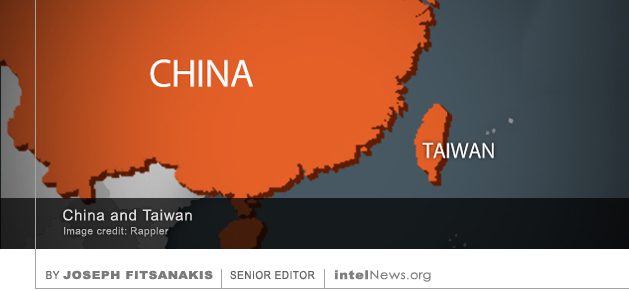
China and TaiwanFOUR TAIWANESE SOLDIERS WITH access to “extremely sensitive” secrets have received jail sentences for spying for Chinese intelligence, as Taiwanese authorities have warned of a sharp rise in Chinese espionage cases. Three of the soldiers had been detailed to the security of the Office of the President, while the fourth soldier was a member of staff at the Taiwanese Ministry of National Defense’s Information and Telecommunications Command.


According to the prosecution, the soldiers made use of their personal mobile phones to photograph “internal military information” they had access to. They then shared the photographs with their Chinese intelligence handlers. In return for their services, their handlers compensated the soldiers by paying them between $7,000 and $20,000 each. The espionage arrangement between the soldiers and their handlers lasted between 2002 to 2024, the court heard.

No information was shared during the open-door portion of the court case about the type of information that the four soldiers were accused of having shared with their Chinese handlers. But the prosecution alleged that the digital photographs given to the Chinese contained information that the four alleged spies had acquired while working in “extremely sensitive and important units” of the Taiwanese military. At the conclusion of the court case, the court sentenced the soldiers to between 70 and 84 months in prison for violating Taiwan’s national security law. In sentencing the accused, the judge said they had engaged in acts that “betrayed the country and endangered national security”.

Meanwhile, the Taiwanese National Security Bureau announced late last week that the number of people who were prosecuted for involvement in Chinese espionage in 2024 broke all recent records for the second year in a row. Specifically, there were 10 prosecutions for Chinese espionage in 2022, 48 in 2023, and 64 in 2024. Many of those caught spying for China were either active or former members of the Taiwanese military. These individuals were deliberately targeted by Chinese intelligence officers because they had knowledge of Taiwanese military secrets, the National Security Bureau said.

Author: Joseph Fitsanakis | Date: 31 March 2025 | Permalink

European Union exploring spy satellites to replace its reliance on US network

European Space AgencyTHE EUROPEAN UNION IS  considering building its own military satellite network in an effort to reduce or eliminate its reliance on American satellite capabilities, according to reports. The London-based Financial Times newspaper said on Saturday that the exploratory project is being led by Andrius Kubilius, a veteran Lithuanian politician who is serving as the European Commissioner for Defense Industry and Space.

Speaking to The Financial Times, Kubilius confirmed that the European Union is considering the construction of a low Earth orbit (LEO) satellite system. Such a system would complement the European Union’s existing Copernicus Earth observation program, which is managed by the European Commission in partnership with the individual European Union member states. The costs and benefits of Copernicus are shared by member states and by several agencies, including the European Space Agency, the European Environment Agency, and the European Maritime Safety Agency.

Unlike Copernicus, a new LEO satellite system would primarily satisfy military priorities and would generate imagery updates every 30 minutes, thus providing near-real-time intelligence on targets. In contrast, Copernicus satellites are able to generate new imagery every 24 hours. Moreover, a new LEO satellite system would integrate into IRIS², an internet network of multi-orbit satellites intended to provide on-demand location-tracking, security surveillance and secure communications links to European Union member states. IRIS² is scheduled to become operational in 2027.

In his comments to The Financial Times, Kubilius acknowledged that the idea for a new European Union LEO satellite system was sparked by “changes in the geopolitical situation” relating to the United States. Subsequently, the European Union is exploring ways to “reduce its reliance on United States military assets”, he said. The commissioner admitted that such a project would be costly—perhaps in excess of $540 billion—as well as time-consuming. But there was much desire to proceed, he said.

In the meantime, the European Union is considering “commercial alternatives” until an independent European Union-run satellite network becomes fully operational, according to the The Financial Times.

Author: Joseph Fitsanakis | Date: 17 March 2025 | Permalink