Magazine publishes CIA-trained burglar’s fascinating story

David WiseBy JOSEPH FITSANAKIS | intelNews.org |
A captivating article about a break-in specialist for the United States Central Intelligence Agency, who turned against the Agency in the 1990s, appears in the October issue of The Smithsonian magazine. Written by David Wise (The Invisible Government, The Spy Who Got Away), the article contains some new information about “The Shop”, a secretive unit under the CIA’s Special Operations Division, which conducts what the agency describes as “surreptitious entries”. Based on “more than 80 interviews with 25 people”, including over a dozen former CIA officers, Wise says the unit features highly specialized teams of lock pickers, safecrackers, photographers, experts in disabling alarm systems, and others. Their mission, he says, is to break into foreign embassies around the world in order to steal classified documents and —most of all— codebooks used by foreign diplomats to communicate securely with their colleagues back home. Unlike most CIA personnel stationed abroad, the Agency’s non-destructive entry specialists do not enjoy the protection of diplomatic cover, says Wise, which means they cannot claim diplomatic immunity if caught red-handed. The author’s main source for the article appears to be Douglas Groat, a former US Special Forces captain, underwater explosives expert and Mandarin-Chinese speaker, who joined the CIA in 1980. Wise claims that Groat, who started working for The Shop in 1982, eventually became the Agency’s “top burglar and premier lock picker”. He designed or participated in approximately 60 different CIA- or National Security Agency-sponsored operations in dozens of countries in the Middle East, Africa, South America and Europe, which earned him several commendations, medals and awards from the NSA and the CIA. The article describes one joint CIA/NSA operation that took place in 1989 at the embassy of the German Democratic Republic in Katmandu, Nepal, which Groat’s team burgled in order to steal a code machine. The operation failed, as did another a few years later in “a Middle Eastern capital”, due to sloppy preparation on behalf of the CIA, says Groat. Read more of this post

News you may have missed #791

Liang GuanglieBy IAN ALLEN | intelNews.org |
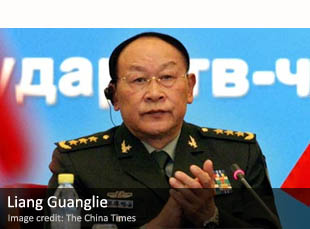
►►India sees espionage behind Chinese cash payments to Indian pilots. According to Indian government sources, Chinese Defense Minister General Liang Guanglie gave two envelopes to the two Indian pilots, both wing commanders, who had flown him in a special Indian Air Force aircraft to New Delhi from Mumbai. After seeing off Liang, the pilots opened the sealed envelopes and found cash gifts inside. They immediately reported this to their superiors, who, in turn, informed the Indian Defense Ministry. India is now planning to lodge a protest with China over the incident.
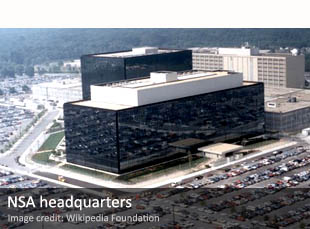
►►NSA says foreign cyberattacks increasingly reckless. Debora Plunkett, of the secretive National Security Agency, whose responsibilities include protecting US government computer networks, has said that other nations are increasingly employing cyberattacks without “any sense of restraint”, citing “reckless” behaviors that neither the United States nor the Soviet Union would have dared at the height of Cold War tensions. She also predicted that Congress would pass long-stalled cybersecurity legislation within the next year. One wonders whether the Stuxnet incident is included in such “reckless” cyberattacks?
►►Taliban ‘using Facebook to lure Australian soldiers’. According to a review of social media by the Australian federal government, Australian soldiers are being warned by their commanders that enemies are creating fake Facebook profiles to spy on them. The report says that Taliban insurgents in Afghanistan are posing as “attractive women” on Facebook to befriend coalition soldiers and gather intelligence about operations. It adds that family and friends of soldiers are inadvertently jeopardizing missions by sharing confidential information online. This is not the first such warning in recent years.


News you may have missed #785 (interview edition)

Stella RimingtonBy IAN ALLEN | intelNews.org |
►►Interview with first-ever NSA Compliance Director. John DeLong, the first-ever compliance director at the US National Security Agency, has given an interview to NextGov. In it, he says that “we’re nothing if we lose the confidence of the American people”. He is referring to frequent allegations, by whistleblowers and others, that the Agency is increasingly spying on Americans’ communications. As Compliance Director, DeLong is responsible for ensuring that the NSA abides by US law, which forbids it from intercepting electronic messages exchanged between US citizens or persons.
►►Ex-MI5 boss offers comment on WikiLeaks. Former MI5 Director-General Dame Stella Rimington has criticized “the indiscriminate pouring out into the public domain of streams of leaked documents by Julian Assange and his WikiLeaks organization”. But she also said that the US government should have taken better steps to prevent WikiLeaks from acquiring the information in the first place. Speaking at an international archiving conference in Brisbane, Australia, Dame Stella said that while the WikiLeaks saga could prompt the US government to come up with better databases, it would more likely encourage it to be even more secretive. This, she added, “must be absolutely the opposite effect of what WikiLeaks was seeking”.
►►Interview with NSA whistleblower. Filmmaker Laura Poitras interviews William Binney, a 32-year veteran of the US National Security Agency, who helped set up STELLAR WIND, the NSA’s top-secret domestic spying program, which was put in place after 9/11. The program was so controversial that it nearly caused top Justice Department officials to resign in protest in 2004. Binney, who resigned over STELLAR WIND in 2001, and began speaking out publicly in the last year, explains how the program he created for foreign intelligence gathering was turned inward on America.

Interview with NSA whistleblower

Comment: There Is No Such Thing as ‘Friendly Espionage’

Benjamin Netanyahu and Barack ObamaBy IAN ALLEN | intelNews.org |
Last month we reported on a story published by The Associated Press, according to which the Near East Division of the United States Central Intelligence Agency views Israel as the most serious threat to its secrets. The report cited interviews with several current and former US intelligence officials, who said the CIA views the Israeli spy community as “a genuine counterintelligence threat” to American interests. But Daniel Pipes, founder of the Middle East Forum and well-known American supporter of Israel, has authored a well-researched response to the Associated Press piece, in which he argues that reciprocal spying has been a decades-old element in Israeli-American relations. He recalls the case of Yosef Amit, a Major in Israel’s Military Intelligence Directorate, who in 1986 was arrested for spying on behalf of the CIA. Amit is believed to have been recruited by US intelligence in Bonn, West Germany; it is said that his handler was Tom Waltz, a Jewish CIA officer from the Agency’s station at the US embassy in Tel Aviv. Amit was convicted in 1987 and stayed in prison until 1993, when he was released after serving two-thirds of his sentence. Pipes also quotes Itamar Rabinovich, Israel’s Ambassador to Washington from 1993 until 1996, who has said that, during his tenure as Israel’s envoy in DC, it was common knowledge among embassy staff that “the Americans were […] tapping our phone lines”, including the embassy’s secure line. Consequently, claims Rabinovich, American intelligence potentially had access to “every juicy telegram” communicated to or from the embassy. Read more of this post

News you may have missed #774 (lawsuit edition)

NSA headquartersBy IAN ALLEN | intelNews.org |
►►NSA whistleblower sues over property seized in leak raid. Diane Roark, a former staffer for the US House of Representatives Permanent Select Committee on Intelligence, has filed a lawsuit to seek return of computers, electronic devices and papers seized from her home in 2007. Roark, who handled the House’s oversight of the National Security Agency from 1997 to 2002, was suspected by the FBI of being a source for The New York Times‘ disclosure of the NSA’s warrantless wiretapping program STELLAR WIND, which she denies.
►►Lawsuit forces US agency to disclose CIA files. The US Veterans Administration has been ordered to disclose documents relating to the CIA’s Cold War-era experimentation on American soldiers. Beginning in the 1950s, the military and CIA utilized former Nazi scientists to test the effects of 400 types of drugs and chemicals, including mescaline, LSD, amphetamines, mustard gas, and nerve agents, on US soldiers, according to a lawsuit brought by the Vietnam Veterans of America and individual soldiers. Under the lawsuit, a judge in California has ruled the VA must hand over documents pertaining to the use of at least 7,800 service personnel as “human guinea pigs” by the US Army and the CIA.
►►Syrian spy tried to infiltrate German intelligence. A suspected Syrian spy who was arrested in Germany earlier this year and has now been charged with espionage, once tried to infiltrate the country’s intelligence services, according to German officials. The man, identified only as Akram O., was employed by Syria’s embassy in Berlin, and tasked with keeping tabs on Syrian opposition activists living in Germany. His application to work for the German federal government was made “at the behest of his intelligence agency handlers”, according to prosecutors. His application was turned down, however. The Syrian national applied for German citizenship in 2009, which was also denied.

News you may have missed #773

Tamir PardoBy IAN ALLEN | intelNews.org |
►►Conflicting reports on CIA-ISI meeting. Lieutenant General Zahir ul-Islam, who heads Pakistan’s premier intelligence agency, the ISI, held talks in Washington with his CIA counterpart General David Petraeus, between August 1 and 3. It was the first time in a year that the chief of the ISI made the trip to the US, signaling a possible thaw in relations. Depending on the source, the meeting was either “substantive, professional and productive”, or “made no big strides on the main issues”.
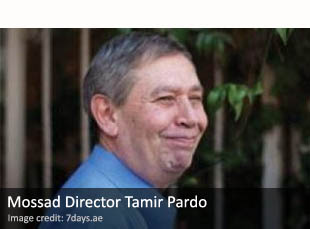
►►Senior Mossad official suspected of financial misconduct. A senior Mossad official is suspected of financial misconduct and has been forced to take a leave of absence until Israeli police complete an investigation into his alleged deeds, Israeli media reported on Sunday. The official, a department head in Israel’s spy organization, has reportedly denied any wrongdoing, but sources said he would likely not be reinstated in light of investigation findings and is effectively being forced to retire. The nature of the official’s alleged misconduct has not been reported, but it is said that the official in question has close ties to Mossad Director Tamir Pardo, who appointed him to his position last year.
►►Ex-NSA official disputes DefCon claims by NSA chief. William Binney, a former technical director at the NSA, has accused NSA director General Keith Alexander of deceiving the public during a speech he gave at the DefCon hacker conference last week. In his speech, Alexander asserted that the NSA does not collect files on Americans. But Binney accused Alexander of playing a “word game” and said the NSA was indeed collecting and indexing e-mails, Twitter writings, Internet searches and other data belonging to Americans. “The reason I left the NSA was because they started spying on everybody in the country. That’s the reason I left”, said Binney, who resigned from the agency in late 2001.

Situation Report: Hacker convention brings out top NSA spy

DefConBy TIMOTHY W. COLEMAN | intelNews.org |
In less than a week, the 20th annual DefCon Hackers convention will take place in Las Vegas, Nevada. The yearly gathering brings out the good, the bad and the script kiddies alike. Computer security practitioners, cyber-criminals, grey and white hat hackers, law enforcement, and members of both the US intelligence community as well as probably foreign government representatives will be on hand to listen to presentations, see novel techniques, and view new innovative methods for cyber intrusion. DefCon has become a Mecca of sorts for those interested in groundbreaking developments and nefarious possibilities within the computer security and cyber realm. As organizers of the event explain in their call for presentations, “DefCon is all about thinking up cool and new ways to approach everything from the most complex modern technology to hacking grandma’s toaster […] what attack exploits, defensive techniques, or unique research [have] you have been working on”. The focus is often two-fold “how to break it”, followed by a segment on “how to fix it”. “Spot the Fed” is an ongoing and widely popular contest at the convention. The task of regular attendees is to properly identify plain-clothed members of law enforcement or the intelligence community. As DefCon explains, “if you see some shady MIB (Men in Black) earphone penny loafer sunglass wearing Clint Eastwood to live and die in LA type lurking about, point him out”.

Read more of this post

News you may have missed #758

Heinz FrommBy IAN ALLEN | intelNews.org |
►►NSA head claims Americans’ emails ‘won’t be read’. The House of Representatives in April approved a bill that would allow the government and companies to share information about hacking. Critics have raised privacy concerns about the sharing of such information, fearing it would allow the National Security Agency, which also protects government computer networks, to collect data on American communications, which is generally prohibited by law. But in a speech at the American Enterprise Institute, NSA Director Keith Alexander said that the new law would not mean that the NSA would read their personal email.
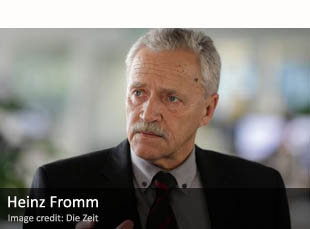
►►German spy chief quits in neo-Nazi files scandal. The head of Germany’s domestic intelligence agency, the Verfassungsschutz, Heinz Fromm, resigned last week, after admitting that his agency had shredded files on a neo-Nazi cell whose killing spree targeting immigrants rocked the country late last year. The “National Socialist Underground” (NSU), which went undetected for more than a decade despite its murder of 10 people, mostly ethnic Turkish immigrants. German media have said an official working in the intelligence agency is suspected of having destroyed files on an operation to recruit far-right informants just one day after the involvement of the NSU in the murders became public. Fromm had led the Verfassungsschutz since 2000.
►►US spy agency accused of illegally collecting data. The US National Reconnaissance Office (NRO) is pressuring its polygraphers to obtain intimate details of the private lives of thousands of job applicants and employees, pushing the ethical and legal boundaries of a program that is designed to catch spies and terrorists, an investigation has found. The NRO appears so intent on extracting confessions of personal or illicit behavior of its employees, that its officials have admonished polygraphers who refused to go after them and rewarded those who did, sometimes with cash bonuses. And in other cases, when it seems the NRO should notify law enforcement agencies of its candidates’ or employees’ past criminal behavior, it has failed to do so.

News you may have missed #751

Leonid ShebarshinBy IAN ALLEN | intelNews.org |
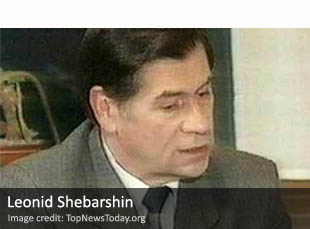
►►Ex-CIA officer remembers his KGB rival. In April, Leonid Shebarshin, a retired General of the KGB, who was often referred to as “the last Soviet spy”, was found dead in his downtown Moscow apartment. Apparently, he had committed suicide. Now Milt Bearden, who was the CIA’s Chief of the Soviet/East European Division during the final years of the USSR, has written a piece in which he remembers Shebarshin. He says that, even though Shebarshin was “the closest thing [he] had to a main adversary” in the USSR, the two became friends in the late 1990s, despite the fact that Shebarshin remained a true believer in the USSR until the very end of his life.
►►NSA won’t reveal how many Americans it spied on. Last month, US Senators Ron Wyden and Mark Udall –both members of the US Senate’s Select Committee on Intelligence– asked the NSA how many persons inside the US it had spied upon since 2008. But Charles McCullough, the Inspector General of the Office of the Director of National Intelligence, has told the two Senators that giving such a figure of how many Americans were spied on was “beyond the capacity” of NSA’s oversight mechanisms, and that –ironically– looking into this matter would violate the privacy of American citizens.
►►Russian scientist who ‘spied for China’ freed. Igor Reshetin, the former director of Russian rocket technology firm TsNIIMASH-Export, who was jailed in 2007 for selling state secrets to China, has been released on parole. Reshetin had been initially sentenced to nearly 12 years, for illegally selling state-controlled technology secrets to a Chinese firm, and with stealing 30 million rubles (US$925,000) through a scheme involving bogus companies. His initial sentence was later reduced on appeal.

US and Israel behind computer virus that hit Iran, say sources

Flame virus code segmentBy JOSEPH FITSANAKIS | intelNews.org |
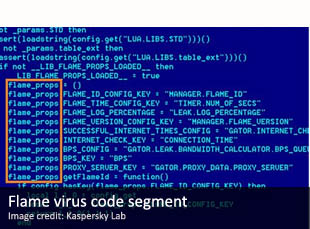
Flame, a sophisticated computer malware that was detected last month in computers belonging to the Iranian National Oil Company and Iran’s Ministry of Petroleum, was created by Israel and the United States, according to a leading American newspaper. Quoting “officials familiar with US cyber-operations”, The Washington Post reported on Wednesday that the malware, which is said to be “massive in size”, is part of a wider covert program codenamed OLYMPIC GAMES. The paper said that the US portion of the program is spearheaded by the National Security Agency, which specializes in cyberespionage, and the CIA’s Information Operations Center. The Post further claims that OLYMPIC GAMES has a three-fold mission: to delay the development of the Iranian nuclear program; to discourage Israeli and American officials from resorting to a conventional military attack on Iran; and to buy time for those officials who favor addressing the Iranian nuclear stalemate with diplomatic pressures coupled with sanctions. According to one “former intelligence official” quoted in The Post, the scale of OLYMPIC GAMES “is proportionate to the problem that’s trying to be resolved”. Russian antivirus company Kaspersky Lab, which first spotted the Flame virus in May, said that it is “one of the most complex threats ever discovered”. It is over 20 megabytes in size, consisting of 650,000 lines of code. In comparison, Stuxnet, a computer super-virus that was detected by experts in 2010, and caused unprecedented waves of panic among Iranian cybersecurity experts, was 500 kilobytes in size. Read more of this post

News you may have missed #748 (US edition)

Michael HaydenBy IAN ALLEN | intelNews.org |
►►US lawmakers probe China companies over spy concerns. In letters sent last week to Chinese communications hardware firms Huawei Technologies and ZTE Corporation, a group of senior members of the US House of Representatives Intelligence Committee have outlined concerns about the companies’ ties with the Chinese government, including the role of a “party committee” at Huawei. The lawmakers have also asked about Huawei’s relationships with five US consulting firms and requested an expansive collection of documents, including the contracts between the firms and Huawei.
►►Lone Senator resists Bush/Obama NSA wiretapping plan. The Obama administration wanted a quick, no-questions-asked-or-answered renewal of broad electronic eavesdropping powers that largely legalized the Bush administration’s illegal warrantless wiretapping program. That’s despite President Barack Obama’s campaign promise to revisit and revise the rules to protect Americans’ rights. Everything seemed to be going to plan after a Senate committee approved the re-authorization in secret last month. But Senator Ron Wyden (D-Oregon) has stepped in to stop the bill because the government refuses to say how often the spy powers are being used.
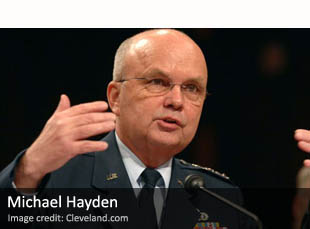
►►What did Hayden tell Obama in January 2009? In December of 2008, a meeting took place between the incoming US Presiden Barack Obama and the departing CIA Director Michael Hayden. Several days later, on January 15, Hayden told journalists that Obama had privately assured him that “no plans to launch a legal inquiry” into the CIA’s use of controversial interrogation methods during the Bush administration. Now, several years later, Salon has published an insider’s account of what was said in that meeting between Obama and Hayden, as well as during the days that followed.

News you may have missed #732 (interview edition)

Thomas DrakeBy IAN ALLEN | intelNews.org |
►►Interview with H. Keith Melton. A well written interview with H. Keith Melton, one of the world’s best-known intelligence historians, who describes himself as “a historical consultant within the US intelligence community”. Melton has been a guest lecturer at the Federal Bureau of Investigation, the National Security Agency and the Joint Military Intelligence College. He also says he is “an ongoing adviser to other US intelligence agencies”.
►►Interview with editor of Eye Spy magazine. An extensive interview with Mark Birdsall, editor of the only independent publication dedicated to espionage and intelligence. He shares the story behind the magazine, his take on the current state of espionage and security, and on global security issues. Among other things, Birdsall says that some claim Eye Spy is “a government organ, [while] others an attempt to glean information that should not be published”. He also states that “it has taken a decade of hard work for the title to get recognition in some intelligence circles”.
►►Interview with NSA whistleblower Thomas Drake. Drake began his NSA career as a contractor in 1991, and formally joined the Agency in 2001, working until 2008 in the Agency’s Signals Intelligence and Engineering directorates. The US government took Drake to court, accusing him of leaking secrets about the NSA to a journalist. But the judge in his case, Richard D. Bennett, refused to sentence him to prison, recognizing that his genuine intention in leaking the secrets was to expose mismanagement at the NSA.

News you may have missed #730

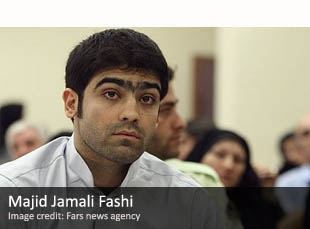
Majid Jamali FashiBy IAN ALLEN | intelNews.org |
►►Iran executes man convicted of killing nuclear physicist. Iran on Tuesday hanged Majid Jamali Fashi, convicted of playing a key role in the 2010 murder of Iranian nuclear scientist Masoud Ali Mohammadi, and of spying for Israel. Mohammadi, a particle physics professor at Tehran University who was killed in a bomb attack outside his home in January 2010.
►►Bahrain sentences man accused of spying for Iran. Bahraini authorities accused the unnamed 47-year-old man of having leaked high-level information on Bahrain’s military, Interior Ministry and US Naval Base. He was allegedly paid more than BD27,000 on behalf of Iran’s Revolutionary Guard by two Iranians who lived in Kuwait. The two Iranians, who worked as diplomats in the Iranian Embassy in Kuwait, were convicted in absentia for selling military, industrial and economic information to Iran between 2002 and last April.
►►NSA declassifies document after publishing it. The National Security Agency last week invoked a rarely-used authority in order to declassify a secret document that was mistakenly posted on the NSA website with all of its classified passages intact. The article (.pdf) is a historical study entitled Maybe You Had to Be There: The SIGINT on Thirteen Soviet Shootdowns of US Reconnaissance Aircraft. It was written by Michael L. Peterson and was originally published in the classified journal Cryptologic Quarterly in 1993.

News you may have missed #712

Abdel Hakim BelhajBy IAN ALLEN | intelNews.org |
►►New US spy satellite could include ‘domestic surveillance. Last week, a new US spy satellite was launched into orbit as part of a secretive military program enabling the surveillance of Earth from space. An official at the Vandenberg base told The Los Angeles Times that the NROL-25 was part of a “national security payload”, which could mean it is to be used for any number of purposes, possibly including domestic surveillance.
►►US steps up intelligence and sabotage missions in Iran. American intelligence agencies are ramping up intelligence and sabotage missions focused on Iran’s nuclear program, according to The Washington Post. Officials from the National Security Agency have increased efforts to intercept email and electronic communications coming from Tehran, according to reports in The Post‘s Sunday edition. The CIA and other agencies have also ramped up sabotage missions in the country, geared toward disrupting Iran’s ongoing nuclear work, the paper reports.
►►MI6 ‘considers paying off’ Libyan official. Britain’s MI6 chiefs allegedly plan to offer more than £1 million ($1.6 million) hush money to a Libyan who claims British spies sent him to be tortured by the Gaddafi regime. The Secret Intelligence Service is scrambling to prevent Abdel Hakim Belhaj releasing details of his case following the revelation that a Labour Party minister sanctioned his extraordinary rendition —contravening UK policy on torture.

News you may have missed #703: US edition

NSA headquartersBy IAN ALLEN | intelNews.org |
►►NSA pressed to reveal details on Google deal. The Electronic Privacy Information Center is locking horns with the National Security Agency over a secret deal the agency cut with Google following an attack on Gmail by Chinese hackers in 2010. The information center has filed a Freedom of Information Act request with the NSA to obtain information about the deal. That request was rejected by a federal court and an appeal process continues.
►►US spy agencies can keep data on Americans longer. Until now, the US National Counterterrorism Center had to immediately destroy information about Americans that was already stored in other government databases when there were no clear ties to terrorism. But it will now be able to store information about Americans with no ties to terrorism for up to five years under new Obama administration guidelines. The new rules replace guidelines issued in 2008 and have privacy advocates concerned about the potential for data-mining information on innocent Americans.
►►Islam convert leads CIA’s Counterterrorism Center. Roger, which is the first name of his cover identity, has been chief of the CIA’s Counterterrorism Center for the past six years. Colleagues describe Roger as a collection of contradictions. A chain-smoker who spends countless hours on a treadmill. Notoriously surly yet able to win over enough support from subordinates and bosses to hold on to his job. He presides over a campaign that has killed thousands of Islamist militants and angered millions of Muslims, but he is himself a convert to Islam. His defenders don’t even try to make him sound likable. Instead, they emphasize his operational talents, encyclopedic understanding of the enemy and tireless work ethic.