Malware targeting ex-Soviet states has Russian hallmarks
August 15, 2014 Leave a comment
 By IAN ALLEN | intelNews.org
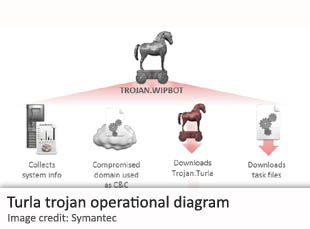
A malicious software that has infiltrated the computer systems of dozens of embassies belonging to former Eastern Bloc nations “has all the hallmarks of a nation-state” cyberespionage operation, according to researchers. Security firm Symantec said last week that the malware appears to be specifically targeting embassies of former communist nations located in China, Jordan, as well as in locations across Western Europe. In a report published on its website, Symantec said “only a nation state” was likely to have the funds and technical resources to create a malware of such complexity. Additionally, the malware seems to be designed “to go after explicit government networks that are not easy to find”, according to Symantec senior security researcher Vikram Thakur. The infiltration appears to occur in two stages. In the first stage, a computer is infected with a reconnaissance program, known as Wipbot. The initial infection usually occurs through a directed phishing attack or via a compromised website. The Wipbot then conducts an initial exploration of the infected system, collecting vital information about its identity, structure and contents. It then proceeds to compromise it only if it matches a specific Internet address that it is looking for. If a match is confirmed, the Wipbot then invites a second program into the compromised system, whose task is to expropriate data and exfiltrate it in batches that are camouflaged as Internet browser requests. Symantec researchers say that the technical similarities between the two programs are sufficient to justify the view that they were designed and developed by programmers working for the same government agency. Thakur said the structure of the malware is particularly creative; it uses Wipbot as an initial reconnaissance tool before delivering the exfiltration program if it judges that the compromised system is of high enough interest. The Symantec report adds that the malware in question is part of a four-year-long series of cyberespionage attacks that have systematically targeted government facilities belonging to former Communist Bloc states. In May of 2012, a similar malware was found to have infiltrated over 60 different computer systems belonging to a former Soviet Republic, including the office of the Prime Minister. A closely linked attack targeted another former communist state’s embassy in Paris, France, as well as its foreign and internal affairs ministries. The Symantec research points out that many of the malicious program’s core components were compiled in the UTC+4 time zone, which includes Russian cities such as Moscow and St. Petersburg.















News you may have missed #883
August 29, 2014 by Ian Allen Leave a comment
►►Indonesia, Australia renew intelligence ties. Australia and Indonesia have signed a pledge not to use intelligence to harm each other, signaling a resumption in cooperation, which had been suspended after last year’s spy scandal. Australian Foreign Minister Julie Bishop and her Indonesian counterpart, Marty Natalegawa, signed the “joint understanding of a code of conduct” in Nusa Dua, Bali, on Thursday.
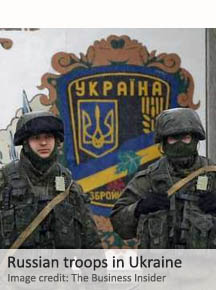
►►Ex-KGB general says Russia has already won in Ukraine. Russia has already won “the real victory” in Ukraine, according to former KGB general Oleg Kalugin, who is now living in the United States. The “southeast of Ukraine, that’s part of the general battle between the Russians and Ukrainians, but it’s not as crucial as the real victory and pride of Russia —the Crimea, I mean”, he said on Thursday. Kalugin reiterated that he does not believe Russian president Vladimir Putin wants annex another region of the country. “It’s not in the interest of Putin”, Kalugin said. “His position as of today is fairly strong in the country, in his own country, so why put it at risk by moving further?”
►►China says Canadian couple were spies disguised as ordinary citizens. Kevin and Julia Garratt have been accused of stealing Chinese military and national defense research secrets. They were detained on August 4, 2014, but not formally arrested, and China has offered little information on what they are accused of doing. The couple ran a coffee shop near the border with North Korea, worked with Christian groups to bring humanitarian aid into North Korea, and worked to train North Korean Christians inside China. Their detention by China’s State Security Bureau has been seen by Canadian authorities as reprisal for the arrest of Su Bin, a Chinese immigrant to Canada suspected of masterminding the electronic theft of US fighter jet secrets.
Filed under Expert news and commentary on intelligence, espionage, spies and spying Tagged with 0 China says Canadian couple were spies disguised as ordinary citizens, 0 Ex-KGB general says Russia has already won in Ukraine, 0 Indonesia and Australia renew intelligence ties, Australia, Canada, China, Crimea, espionage, Indonesia, intelligence cooperation, Julia Garratt, Kevin Garratt, News, news you may have missed, Oleg Kalugin, Russia, Ukraine