Industrial espionage damages a country’s long-term productivity, study finds
August 1, 2017 1 Comment
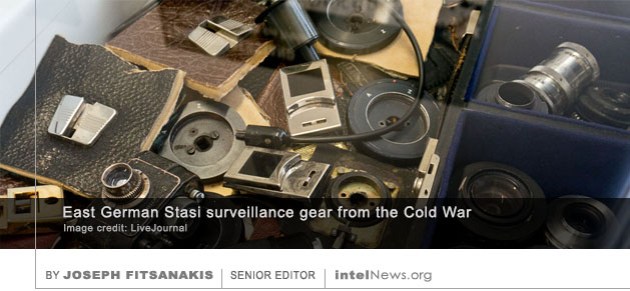 State-sponsored industrial espionage aimed at stealing foreign technical secrets may boost a country’s technological sector in the short run, but ultimately stifles it, according to the first study on the subject. The study is based on over 150,000 declassified documents belonging to the East German Ministry for State Security, known as Stasi. The now-defunct intelligence agency of communist-era East Germany was known for its extensive networks of informants, which focused intensely on acquiring technical secrets from abroad.
The history of industrial and economic espionage by governments is indeed extensive. It includes lucrative efforts by the United States to steal industrial production methods from Europe in the 19th century, and successful attempts by the Soviet Union to steal atomic technology from the American-led Manhattan Project in the 1940s. But there have been no systematic attempts to evaluate the effect of state-sponsored industrial espionage on the entire economy of the sponsoring nation –until now.
This new study –the first of its kind– was carried out by two economists, Erik Meyersson, from the Stockholm School of Economics in Sweden, and the Spain-based Albrecht Glitz of Pompeu Fabra Univeristy in Barcelona. The two researchers describe their preliminary findings in a working paper entitled: “Industrial Espionage and Productivity”, published by the Institute of Labor Economics in Bonn, Germany. Its findings are based on an analysis of nearly 152,000 declassified industrial-espionage-related communiqués sent by Stasi spies to their handlers between 1970 and 1988. The communiqués were examined with reference to their date of authorship and the content-descriptive keywords appended to them by the Stasi.
The report concludes that stealing industrial secrets can boost a nation’s economic activity in the short run. However, in the long run, a nation’s strategic focus on industrial espionage tends to impede homegrown research and development, and ultimately stifles technological productivity on a national scale. This is because “easy access to secrets” from abroad tends to “discourage both state and private investment in research and development”, according to Meyersson and Glitz. That is precisely what happened to East Germany, argues the report. The country’s total factor productivity (TFF –the growth of its output measured in relation to the growth in inputs of labor and capital) rose significantly as a result of its industrial espionage.That was especially noticeable in the digital electronics sector, where the output gap between East and West Germany was narrowed by a fourth. However, that trend was temporary, and East Germany was never able to develop an organic digital-electronics industry. Industrial espionage is like “research and development on cocaine”, professor Meyersson told Science, the magazine of the American Association for the Advancement of Science. “Maybe you can have a little bit of fun with it, but it’s not good for you in the long run”.
► Author: Joseph Fitsanakis | Date: 01 August 2017 | Permalink
 Werner Stiller, also known as Klaus-Peter Fischer, whose spectacular defection to the West in 1979 inflicted one of the Cold War’s most serious blows to the intelligence agency of East Germany, has died in Hungary. Stiller, 69, is believed to have died on December 20 of last year, but his death was not
  A videotaped lecture by Kim Philby, one of the Cold War’s most recognizable espionage figures, has been unearthed in the archives of the Stasi, the Ministry of State Security of the former East Germany. During the one-hour lecture, filmed in 1981, Philby addresses a select audience of Stasi operations officers and offers them advice on espionage, drawn from his own career. While working as a senior member of British intelligence, Harold Adrian Russell Philby, known as ‘Kim’ to his friends, spied on behalf of the Soviet NKVD and KGB from the early 1930s until 1963, when he secretly defected to the USSR from his home in Beirut, Lebanon. Philby’s defection sent ripples of shock across Western intelligence and is often seen as one of the most dramatic moments of the Cold War.















 intelNews.org
East German Stasi spies questioned for evidence on Lockerbie bombing
March 22, 2019 by Joseph Fitsanakis Leave a comment
But Scotland’s independent public prosecution agency, the Crown Office and Procurator Fiscal Service, has always claimed that several other Libyan intelligence operatives helped Megrahi bring down Pan Am flight 103. Last December, the Crown Office said that it was continuing to pursue a criminal inquiry into several individuals —other than Megrahi— who were “involved in the conspiracy” to bomb Pan Am flight 103. As part of the inquiry, Crown Office prosecutors have interviewed potential suspects and witnesses, including Abdullah Senussi, former head of Libyan intelligence.
On Thursday, the German news agency DPA said that five former officers of the East German Stasi —all of them in their 70s and 80s— had been interviewed in connection to the Lockerbie bombing. The news agency said that the interviews had been conducted by German intelligence officers at the request of Crown Office prosecutors in Britain. Later on Thursday, the Berlin office of the German state prosecutor confirmed that the unnamed five individuals had been interviewed “as witnesses, not as suspects” throughout the past nine months. It gave no further information, saying that “it would be inappropriate to comment on a developing criminal investigation”.
All five former Stasi officers are believed to have provided evidence at the trial in the Netherlands that resulted in Megrahi’s conviction. Among other things, they told the court that the Libyans had contracted a Swiss businessman who manufactured the timer that detonated the Lockerbie bomb. Moreover, the 2014 documentary My Brother’s Bomber, directed by the American filmmaker Ken Dornstein, whose brother died in the Lockerbie bombing, claimed that the Stasi had closely monitored the activities of Libyan intelligence in West Germany in the years leading up to the downing of Pan Am flight 103. Some believe that the Stasi had evidence of a conspiracy by several Libyan intelligence officers to carry out the bombing.
► Author: Joseph Fitsanakis | Date: 22 March 2019 | Permalink
Filed under Expert news and commentary on intelligence, espionage, spies and spying Tagged with Abdelbaset Ali Mohmed al-Megrahi, East Germany, Libya, Lockerbie air disaster, News, Stasi (GDR)