European, American, Russian fighters join both sides of Syrian war

Regional map of SyriaBy JOSEPH FITSANAKIS | intelNews.org
Nearly three years into the Syrian Civil War, it is becoming increasingly clear that the opposition forces are far more fragmented than the government side. Many of the rebel factions are now largely concerned with fighting each other for control of territory and other key assets, including oil installations and cross-border trade routes. Amidst the chaos, thousands of foreign fighters are flooding into the country, motivated by ideology or money. It is estimated that between 6,000 and 11,000 foreign fighters have entered Syria since the war, causing United States intelligence officials to speak of “a growing presence of foreigners” in the ranks of armed factions. At least 300 British citizens are estimated to have traveled to Syria with the intent of joining the Civil War, according to The Times of London. Most of them are young Islamist radicals who are intent on helping topple the administration of Syrian President Bashar al-Assad, according to the paper. Another British newspaper, The Daily Telegraph, reported recently that four British citizens —all London residents— died recently in Syria’s largest city, Aleppo, while fighting alongside government troops in support of President Assad. They were fighting against the al-Nusra Front, an opposition group with strong links to al-Qaeda. Meanwhile, The New York Times said on Wednesday that “dozens of Americans” have entered or tried to enter Syria to join various rebel factions in their fight against the government. The paper cited unnamed “American intelligence officials” in alleging that the Americans are a “small subset” of a larger group of “roughly 600” Western-born Islamists who have entered Syria from Western Europe, North America and Australia since 2011. The ongoing conflict has also attracted hundreds of Russian fighters, according to reports. Foreign Policy magazine notes the “rising flow” of radical Islamists from the Russian Federation to Syria in recent months. Read more of this post

British agency spies on foreign diplomats’ hotel reservations

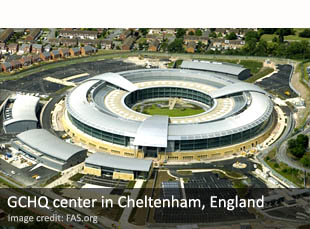
GCHQ center in Cheltenham, EnglandBy JOSEPH FITSANAKIS | intelNews.org
Britain’s signals intelligence agency operates a system that monitors the hotel bookings of international diplomats and foreign government officials around the world, according to information published on Sunday. German newsmagazine Der Spiegel said the revelation came from the personal archive of American intelligence whistleblower Edward Snowden, who has been offered political asylum in Russia. In an article published last weekend, the magazine said the classified program is codenamed ROYAL CONCIERGE, and it is operated by the United Kingdom’s Government Communications Headquarters (GCHQ). The classified documents allegedly show that ROYAL CONCIERGE was launched on an experimental basis in 2010; the program was apparently “so successful” that it was approved for “further development” by GCHQ’s intelligence planners. Since that time, the British signals intelligence agency has been able to compromise the booking systems of at least 350 high-end hotels around the world, which are frequented by international diplomats and foreign government officials. As soon as a room booking is confirmed by an email to an account in a governmental Internet domain, GCHQ receives an alert, allowing it to know the name and arrival details of the guest(s). This information, says Der Spiegel, enables the British “technical operations community” to target the hotel guests according to the intelligence requirements set out by the British government. In some cases, the hotel room’s telephone and fax machine are monitored, while unsuspecting hotel guests have their computers and personal cellphones targeted by GCHQ. Read more of this post
News you may have missed #857 (hacking edition)

Mossad sealBy IAN ALLEN | intelNews.org
►►UK spies hacked Belgian phone company using fake LinkedIn page. British spies hacked into the routers and networks of a Belgian telecommunications company Belgacom by tricking its telecom engineers into clicking on malicious LinkedIn and Slashdot pages, according to documents released by NSA whistleblower Edward Snowden. The primary aim, reports the German newsmagazine Der Spiegel, which obtained the documents, was to compromise the GRX router system that BICS controlled, in order to intercept mobile phone traffic that got transmitted by the router.
►►Indonesian hackers behind attack on Australian spy service website. Indonesian hackers are believed to have brought down the website of the Australian Secret Intelligence Service, Australia’s leading spy agency. The page was not working on Monday afternoon after hackers launched a “denial of service” attack. A “404 not found” message typically appears when a website crashes under a “denial of service” attack. The cyber attack is reportedly a response to revelations that Australia had been spying on its closest neighbor through its Jakarta embassy.
►►Hamas blasts alleged Mossad website. Hamas officials released a warning about a website called Holol (“solutions”), claiming it is a ruse set up by Israel’s Mossad intelligence agency to recruit Gazans as informants. The website’s “Employment” page states, “due to our connections with the Israeli Civil Administration, we can help you bypass the bureaucratic tape and procedural processes which prevent you from leaving Gaza”. The site also offers Israeli medical assistance, “due to connections with the Ministry of Health and the Israeli Civil Administration”. Palestinians interested in contacting the website’s officials are asked to provide their full name, telephone number, email, topic of inquiry, and an explanation of why they are asking for help. Last month, Lebanese group Hezbollah accused the Mossad of being behind a website seeking information on Hezbollah’s intelligence wing.

News you may have missed #854 (SIGINT edition)

NSA/GCHQ listening station in Menwith HillBy IAN ALLEN | intelNews.org
►►British ex-minister accuses GCHQ of ignoring surveillance fears. Nick Brown, a former Labour Party cabinet minister, has warned that GCHQ and Britain’s other intelligence agencies appear to be undertaking mass surveillance without parliament’s consent because the country’s coalition failed to get the communications data bill –-dubbed the “snoopers’ charter” by critics– passed into law after Liberal Democrat opposition. Brown said there was an “uncanny” similarity between the GCHQ surveillance programs exposed by the US whistleblower Edward Snowden and proposals in the first part of the bill.
►►Analysis: The NSA’s new codebreakers. Matthew Aid writes: “There was a time when the codebreakers of the National Security Agency actually took the lead in solving enemy encryption systems. These days, not so much. In today’s NSA, it’s hackers, break-in artists, corporate liaisons, and shadow salesman using front companies who are at the forefront of this effort. Even so-called “hacktivists” play an unwitting role in helping the NSA gain access to computer networks –both hostile and friendly. Just about the only place that’s somewhat immune to the NSA’s new style of codebreaking attacks? North Korea, because it’s so disconnected from the rest of the world’s networks”.
►►UKUSA treaty countries collecting data for NSA. The latest leaks from former US intelligence contractor Edward Snowden reveal a new dimension to the US-led electronic eavesdropping, with address books and ”buddy lists” from Yahoo!, Hotmail, Facebook and Gmail accounts being harvested across the globe. The documents, published by The Washington Post on Tuesday, show the clear involvement of Australia along with the US, Britain, Canada and New Zealand —the so-called “five eyes” intelligence-sharing nations.

British, American citizens among Kenya shopping center attackers

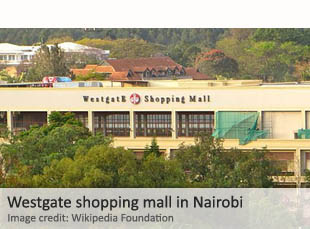
Westgate shpping mallBy JOSEPH FITSANAKIS | intelNews.org
Several Americans and at least one British subject were allegedly involved in planning and carrying out the armed attack on a shopping center in Kenya last week, according to the Kenyan government. The bloody attack was carried out on September 21 at the upscale Westgate shopping mall in Kenyan capital Nairobi. At least 15 attackers stormed the shopping complex and executed several shoppers in cold blood, before proceeding to take several people hostage. Responsibility for the attack has been claimed by Somali Islamist group al-Shabaab. The group has been at war with the Kenyan government since October of 2011, when Kenyan troops invaded Somalian territory. The group said that the attack had been carried out as retribution for Kenya’s invasion of Somalia. Kenyan officials have so far refused to speculate on the precise identity of the perpetrators of the Westgate attack. But on Tuesday, Kenyan President Uhuru Kenyatta said during a televised address to the nation that some of the identities of the armed militants who stormed the complex had been confirmed. He added that the perpetrators included a British woman and “two or three” American citizens. A few hours later, Kenyan Minister of Foreign Affairs, Amina Mohamed, said during a press conference that, according to information currently available, “one Brit[ish subject], a woman”, had been involved in the attack. She added that the female suspect “has done this many times before”, implying that she is a seasoned Islamist militant. Minister Mohamed added that “two or three Americans […], aged about 18 or 19”, were also involved in the attack, adding that they were Arab or Somali in origin and had moved to Africa from “Minnesota and one other place” in the United States. Read more of this post

Spy agencies failed to share intelligence on Omagh bombing: report

Real IRA paradeBy IAN ALLEN | intelNews.org |
A new report on the 1998 bombing of downtown Omagh by an Irish republican splinter group claims that the tragedy could have been avoided had British, Irish and American intelligence agencies shared information with British police. The car bomb attack was carried out on August 15, 1998, by the Real Irish Republican Army (RIRA). The militant organization consisted of former Provisional Irish Republican Army volunteers who rejected the Good Friday Agreement, part of the Northern Ireland peace process. It devastated the small Northern Irish town of Omagh, killing 29 and injuring over 200 people, including six children, several teenagers and a woman who was pregnant with twins. There have been no criminal convictions in connection with the bombing, despite the fact that it was the single worst instance of violence in the so-called Northern Ireland Troubles, which began in the 1960s and ended in 1998, largely because of the Omagh bombing. But now a new report commissioned by the families of the victims of the bombing claims that intelligence services from three countries failed to share information with British police, which could have prevented the disaster in Omagh. The report, authored by a group of retired security experts on behalf of London-based law firm SBP, says the RIRA had been infiltrated by the United States Federal Bureau of Investigation (FBI), Britain’s Security Service (MI5) and the Irish Garda’s Crime and Security Branch. These agencies, claims the report, had at least two informants inside the RIRA: a smalltime Irish criminal named Paddy Dixon, who frequently smuggled stolen cars from Ireland into Britain for use by the RIRA, and David Rupert, an American of Irish descent. Read more of this post

News you may have missed #848

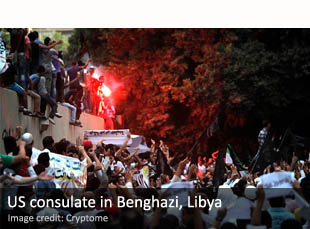
US consulate in Benghazi, LibyaBy IAN ALLEN | intelNews.org |
►►UK officials saw ‘communist spies’ in Japan in 1983. British officials believed in the early 1980s that Japanese institutions had been “slightly” penetrated by communist intelligence services, according to documents declassified last week at the National Archives in London. The documents, from 1983, assert that there were approximately 220 communist intelligence officers working in Japan: 100 for the Soviet Union, 60 for China and 60 for other communist countries.
►►‘Dozens of CIA operatives on the ground’ during Benghazi attack. CNN claims that “dozens of people working for the CIA” were on the ground the night of the attack on the US consulate in Benghazi, Libya, which killed four Americans, including Ambassador Christopher Stevens. The news station adds that, according to one source, the CIA is involved in “an unprecedented attempt to keep [its] Benghazi secrets from ever leaking out”.
►►Australians call for national debate on privatization of intelligence. Dr Troy Whitford, Associate Investigator with the Australian Research Council’s Centre of Excellence in Policing and Security, and lecturer at Charles Sturt University, has called for “a national debate on the extent, cost and consequences of Australia’s security and intelligence outsourcing”. The call was apparently prompted by news that 51% of the intelligence gathering in the US is now carried out by non-government contractors.

Snowden leaks reveal GCHQ’s reliance on NSA money, data

GCHQ center in Cheltenham, EnglandBy JOSEPH FITSANAKIS | intelNews.org |
Information provided by American defector and former intelligence insider Edward Snowden shows that Britain’s signals intelligence agency is very much the junior partner in an uneven relationship with its American counterpart. Snowden, a former computer expert for the Central Intelligence Agency (CIA) and the National Security Agency (NSA), has been given political asylum in Russia. In June, he revealed a number of enormous intelligence-collection programs, including PRISM and TEMPORA. The latter is administered by the General Communications Headquarters (GCHQ), Britain’s signals intelligence organization. The program enables the agency to access communications traffic carried through fiber optic cables worldwide. But GCHQ also receives data from PRISM, a massive electronic surveillance program operated by the NSA, which provides access to millions of email and online chat exchanges facilitated by some of the world’s foremost Internet service providers. Because of these arrangements, GCHQ’s access to electronic data increased by 7,000 percent between 2008 and 2012, according to an internal GCHQ document provided to The Guardian newspaper by Snowden. The agency’s immense access to information has propelled it to a leading role within Britain’s intelligence establishment. It currently receives over half of Britain’s £1.9 billion annual intelligence budget, while its employee size is more than twice that of Britain’s domestic (MI5) and external (MI6) intelligence agencies combined. Its headquarters, the so-called “doughnut building” in Cheltenham, Gloucestershire, was Europe’s largest single construction project when it was being built in the early 2000s.  But the documents provided by Snowden show that, despite its considerable wealth and access to resources, GCHQ’s intelligence planners are deeply concerned about “being left behind by technology” in the fiber optic age. One internal report highlights “the pressure on the agency to deliver” and warns that “the complexity of [GCHQ’s] mission has evolved to the point where existing mission management capability is no longer fit for purpose”. Read more of this post

News you may have missed #847

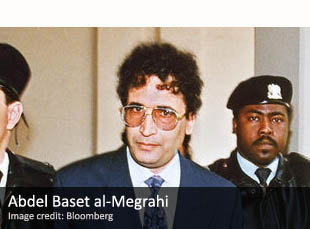
Abdel Baset al-MegrahiBy IAN ALLEN | intelNews.org |
►►Secret letter shows arms deal behind Lockerbie bomber release. An email sent in 2008 by Sir Vincent Fean, the then British ambassador in Tripoli, details how the release by Britain of Lockerbie air disaster bomber Abdelbaset al-Megrahi, was linked to a commercial deal. According to The Daily Telegraph, the email specifies that al-Megrahi would be released once Libya “fulfilled its promise” to buy an £400 million air defense system.
►►Is the US ramping up a secret war in Somalia? The US has expanded its secret war in Somalia, stepping up assistance for federal and regional Somali intelligence agencies that are allied against the country’s Islamist insurgency. It’s a move that’s not only violating the terms of an international arms embargo, according to UN investigators, but it also shows that Washington’s signature victory against al-Qaeda’s most powerful African ally may be in danger of unraveling.
►►Indonesian government ‘angry’ at alleged Western spying. The Indonesian government has reacted strongly to revelations in the Australian media that the country’s President and senior diplomats were spied upon during the 2009 G20 conference in London. The revelations appear to be based on leaks on intelligence-gathering techniques by US whistleblower Edward Snowden.

Scotland sees Nordic spy agencies as post-independence models

United Kingdom and IrelandBy JOSEPH FITSANAKIS | intelNews.org |
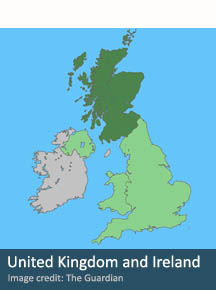
Government administrators in Scotland, which may soon become independent from the United Kingdom, are looking to possibly model their intelligence agencies after those of Scandinavian countries, according to sources. An agreement for an independence referendum, to be held in September 2014, was struck last year between the devolved Scottish Government and the British state. According to the agreement, residents of Scotland, which has been ruled by English-dominated Britain for over 700 years, will be asked whether they agree that the territory should form an independent country. In January of this year, Nicola Sturgeon, Deputy First Minister of Scotland, told the Scottish Parliament’s Committee on Foreign Affairs that an independent Scotland would have to build a domestic intelligence agency to combat security threats such as terrorism, organized crime and cyber attacks. Sturgeon, who is also Deputy Leader of the pro-independence Scottish National Party, opined that, even though a Scottish intelligence agency would serve the interests of the Scottish government and people, it would inevitably maintain “very close intelligence sharing with the rest of the UK”. But Committee members opposed to independence warned Sturgeon that Scottish intelligence agencies would have to prove that they were reliable and safe before they struck intelligence-sharing arrangements with British and American organizations. It appears that, in response to such criticisms, Scottish civil servants have initiated contacts with intelligence experts abroad, in an attempt to replicate the intelligence-agency model of Nordic countries. Read more of this post

Ex-MI6 head ‘might air memoirs’ to set Iraq War record straight

Sir Richard DearloveBy JOSEPH FITSANAKIS | intelNews.org |
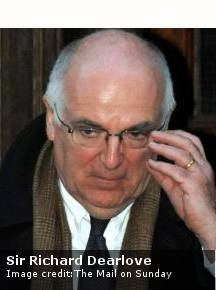
The former director of Britain’s external spy service has hinted he might publish his personal account of the decisions that led to Britain’s entry in the Iraq War, if he is criticized in a public inquiry on the subject. Sir Richard Dearlove led the UK’s Secret Intelligence Service, known as SIS or MI6, from 1999 until his retirement in 2004. He is currently on sabbatical from his post as Master of Cambridge University’s Pembroke College, in order to research and author his autobiography. The memoir is believed to be largely preoccupied with the intelligence that led to the British government’s decision to enter the United States-led 2003 war in Iraq. Sir Richard had previously indicated that he intended to make his memoirs posthumously available as a resource to academic researchers. But in an email to British tabloid The Mail on Sunday, he hinted he would consider publishing his personal account if he finds himself criticized by the Iraq Inquiry. Known in Britain as the Chilcot Inquiry, after its Chairman, Sir John Chilcot, the Iraq Inquiry was commissioned by the British government in 2009 to investigate the executive decisions that led the country to participate in the invasion of Iraq. One of the inquiry’s many goals was to evaluate the intelligence provided by MI6 to the government of Prime Minister Tony Blair. There have been rumors that the inquiry’s declassified findings, which are scheduled for publication soon, are critical of MI6’s performance and place particular blame on Sir Richard’s role in the debacle. Read more of this post

UK to pardon genius wartime cryptanalyst convicted of ‘indecency’

Alan TuringBy IAN ALLEN | intelNews.org |
One of the greatest mathematical minds of modern times, who is widely considered the father of computer science and is credited with helping the Allies win World War II, is to receive a posthumous pardon by the British government, who in 1952 convicted him of homosexuality. Alan Turing, a mathematician and logician, with careers at the universities of Cambridge and Princeton, worked as a cryptanalyst for the British government during World War II. His work for Britain’s Government Code and Cypher School (GC&CS) at Bletchley Park, the British Armed Forces’ wartime joint codebreaking center, was instrumental in helping the British crack German military ciphers. Turing is personally credited with devising a complex method for compromising the Enigma machine, a highly secretive message-encoding device used by the German military and intelligence services. In 1952, while working for the Department of Mathematics at the University of Manchester, Turing was charged with “gross indecency” under Section 11 of the Criminal Law Amendment Act of 1885, which criminalized homosexuality. After pleading guilty to having a sexual relationship with a 19-year-old unemployed man, Turing was convicted and given a choice of imprisonment or undergoing “chemical castration”. The latter was a hormonal treatment based on injections of synthetic estrogen, aimed at reducing a person’s sexual drive. Turing chose the latter option, which rendered him impotent and caused massive chemical imbalance in his brain. Read more of this post

UK to probe Chinese telecoms firm over security concerns

Huawei TechnologiesBy IAN ALLEN | intelNews.org |
The British government has confirmed that it will review the involvement of a Chinese telecommunications hardware manufacturer in a cybersecurity testing center in Oxfordshire, England. The facility, called Cyber Security Evaluations Centre, has been operating since 2010 in the town of Banbury, 64 miles northeast of London. Its establishment was part of a 2005 agreement between firm British Telecom and Chinese telecommunications hardware manufacturer Huawei. According to the stipulations of the agreement, British Telecom would purchase switches and other hardware equipment from the Chinese company, if the latter agreed to set up “the Cell”, as it is known, in Banbury, to test the equipment’s security features. However, last month, a report (.pdf)  by the British Parliament’s Intelligence and Security Committee (ISC) raised strong concerns about Huawei’s involvement at the Centre. The ISC report called the government’s attention to “the risks of Huawei effectively policing themselves” and stressed that Britain’s national security could potentially be compromised by Huawei’s alleged links to the Chinese military. The report based its concerns on the fact that virtually every member of staff at the Banbury testing facility is an employee of Huawei, barring its Director, who is a former deputy director of Britain’s General Communications Headquarters (GCHQ). The parliamentary report urged the government to overcome its “fear of jeopardizing trade links with Beijing” and pressure British Telecom to amend its agreement with Huawei. Instead of Huawei technicians, the ISC report suggested that the Banbury Centre should be staffed exclusively with personnel from GCHQ —Britain’s communications intelligence agency. Late last week, the UK Cabinet Office announced it was in agreement with the principal recommendations of the ISC report and said that a review of the Banbury testing facility will take place. Read more of this post

News you may have missed #846

North and South KoreaBy IAN ALLEN | intelNews.org |
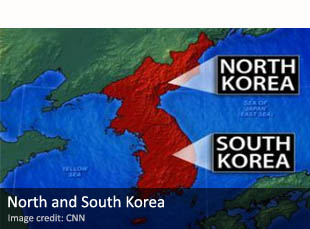
►►Cuba confirms it hid weapons on seized N. Korean ship. Cuba has admitted being behind a stash of weapons found on board a North Korean ship seized in the Panama Canal. The ship was seized by Panama last week after “undeclared military cargo” was found hidden in a shipment of sugar. United Nations sanctions prohibit the supply of arms to North Korea in the continuing dispute over its nuclear program. But the Cuban foreign ministry said the ship was carrying “obsolete arms” from Cuba “for repair” in North Korea.
►►British undercover officers stole identities of dead children. Britain’s Metropolitan Police Service, which is responsible for policing most of the city of London, has admitted that its undercover police officers expropriated the identities of at least 43 dead children. But police officials refused to inform the children’s families at the time, saying the practice was considered “essential to protect covert officers who were working inside dangerous extremist groups”.
►►Snowden has ‘thousands’ of damaging NSA documents. The Guardian’s Glenn Greenwald, who first reported on the disclosures of former CIA employee Edward Snowden, has said that the self-styled whistleblower has “literally thousands of documents” in his possession, which are essentially an “instruction manual for how the NSA is built”. The information could allow someone to evade or mimic NSA surveillance tactics, the journalist said.

Bugging device found in Ecuador’s UK embassy where Assange lives

Ricardo PatinoBy JOSEPH FITSANAKIS | intelNews.org |
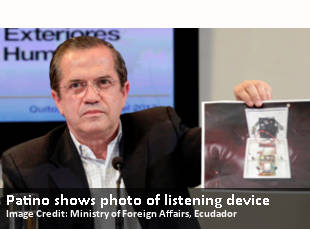
The government of Ecuador has announced the discovery of a “hidden listening device” inside its embassy in London, United Kingdom, where WikiLeaks founder Julian Assange has taken refuge. Ecuador’s Minister of Foreign Affairs, Trade and Integration, Ricardo Patino, said the device was discovered during a security sweep on June 14, in preparation for his official visit there. Speaking during a press conference on Wednesday in Ecuadorean capital Quito, Patino told journalists that the microphone was discovered inside the office of Ambassador Ana Alban, Ecuador’s envoy to the UK. Patino arrived in London two days later and met with Assange, as well as with Britain’s Secretary of State for Foreign Affairs, William Hague, to discuss Assange’s case. The WikiLeaks founder has been hosted inside the Ecuadorean embassy for over a year, resisting extradition to Sweden, where his is facing charges of rape and sexual assault. Assange denies the charges are valid and maintains that the Swedish government is intent on extraditing him to the United States, where he is likely to face more charges over Cablegate. This is the term commonly used to describe the unauthorized release in 2010 by WikiLeaks of thousands of classified cables sent to the US State Department by American diplomatic missions around the world. Patino told journalists on Wednesday that he “regretted to have to inform” them about the discovery, which he characterized as “another instance of declining ethics in the international relations between governments”. Read more of this post