Russian security services honor members of the Cambridge spy ring with plaque

Guy BurgessThe intelligence service of Russia has openly honored two British members of the so-called Cambridge Five spy ring, who caused great controversy during the Cold War by defecting to Moscow. The intelligence services of the Soviet Union recruited five Enlishmen, H.A.R. ‘Kim’ Philby, John Cairncross, Donald Maclean, Anthony Blunt, as well as an unnamed fifth person, to spy for them in the 1930s. All five were recruited while they were promising young students at Britain’s elite Cambridge University, and entered the diplomatic and security services in order to supply Moscow with classified information about Britain and its allies.

In 1951, shortly before they were detained by British authorities on suspicion of espionage, Burgess and Maclean defected to the Soviet Union. They both lived there under new identities and, according to official histories, as staunch supporters of Soviet communism. Some biographers, however, have suggested that the two Englishmen grew disillusioned with communism while living in the Soviet Union, and were never truly trusted by the authorities Moscow. When they died, however, in 1963 (Burgess) and 1983 (Maclean), the Soviet intelligence services celebrated them as heroes.

On Friday, the Soviet state recognized the two defectors in an official ceremony in the Siberian city of Samara, where they lived for a number of years, until the authorities relocated them to Moscow. Kuibyshev, as the city was known during Soviet times, was technically a vast classified facility where much of the research for the country’s space program took place. While in Kuibyshev, Burgess and Maclean stayed at a Soviet intelligence ‘safe house’, where they were debriefed and frequently interrogated, until their handlers were convinced that they were indeed genuine defectors.

At Friday’s ceremony, officials unveiled a memorial plaque at the entrance to the building where Burgess and Maclean lived. According to the Reuters news agency, the plaque reads: “In this building, from 1952-1955, lived Soviet intelligence officers, members of the ‘Cambridge Five’, Guy Francis Burgess and Donald Maclean”. On the same day, a letter written by Sergei Naryshkin, head of Russia’s Foreign Intelligence Service (SVR), one of the institutional descendants of the Soviet-era KGB, appeared online. In the letter, Naryshkin said that Burgess and Maclean had made “a significant contribution to the victory over fascism [during World War II], the protection of [the USSR’s] strategic interests, and ensuring the safety” of the Soviet Union and Russia.

Last year, Russian officials named a busy intersection in Moscow after Harold Adrian Russell Philby. Known as ‘Kim’ to his friends, Philby was a leading member of the Cambridge spies. He followed Burgess and Maclean to the USSR in 1963, where he defected after a long career with the British Secret Intelligence Service (MI6).

Author: Joseph Fitsanakis | Date: 22 December 2019 | Permalink

London accused of hiding report about Russian meddling in Brexit referendum

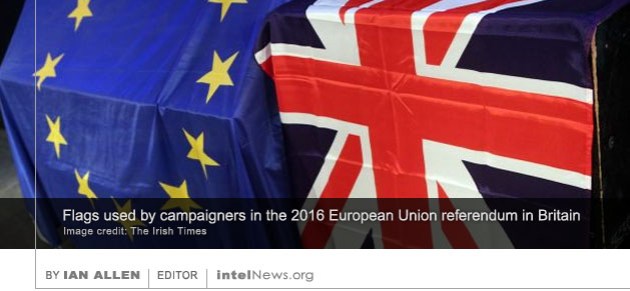
BrexitThe British government has been accused by opposition parties, and by pro-remain conservative figures, of trying to conceal a report documenting Russian meddling in British politics. The report documents the results of an investigation into Russia’s alleged attempts to influence the outcome of the 2017 general election in the United Kingdom, as well as the result of the 2016 European Union referendum, which ended in victory for the pro-Brexit campaign.

The investigation was carried out by the British Parliament’s Intelligence and Security Committee and is largely based on closed-door testimony by senior officials from Britain’s intelligence community. It reportedly contains evidence from Russia experts in agencies such as the Security Service (MI5), the Secret Intelligence Service (MI6) and the Government Communications Headquarters (GCHQ).

According to media reports the probe was completed in March of this year and underwent a redaction process to safeguard intelligence methods and sources. On October 15 it was submitted to Downing Street and on October 17 it reportedly landed on the desk of British Prime Minister Boris Johnson. British opposition politicians allege that even sensitive reports are usually made public no later than 10 days after they are submitted to Downing Street, which means that the document should have been released prior to October 28.

Some fear that, with Parliament about to suspend operations on Tuesday, in anticipation for December’s general election, the report will effectively remain hidden from public view until the spring of 2020. On Friday, Labour Party leader Jeremy Corbyn publicly urged the government to release the report and claimed that the prime minster may have “something to hide”. But cabinet minister Andrea Leadsom argued that it is not unusual for parliamentary committee reports to remain in the government’s hands until they are properly evaluated. “The government has to respond properly, it cannot respond in haste”, said Leadsom.

Author: Ian Allen | Date: 04 November 2019 | Permalink

Veil of secrecy may soon be lifted on Novichok nerve agent used to attack Skripal

Sergei SkripalThe chemical structure and action mechanism of a top-secret family of nerve agents known as novichoks may soon be available to a wider pool of researchers through its inclusion into the Chemical Weapons Convention (CWC) list of the Organization for the Prohibition of Chemical Weapons (OPCW). The term novichok (meaning ‘newbie’ in Russian) was given by Western scientists to a class of rarely used nerve agents that were developed in the Soviet Union and Russia between 1971 and the early 1990s.
The first public discussion about the existence of these agents took place in the early 1990s, when Vil Mirzayanov, a chemical warfare expert working for the Soviet military, revealed their existence. However, Western intelligence agencies have discouraged public scientific research on these nerve agents, fearing that such activities could reveal their chemical structure and mechanism of action. That could in turn facilitate the proliferation of novichok nerve agents worldwide.

But this attitude shifted drastically after March 2018, when —according to British intelligence— Russian spies used novichok in an attempt to kill Sergei Skripal, a Russian defector to Britain. The British government claims that Russians spies smuggled novichok into Britain by hiding it inside an imitation perfume bottle.

The attempt on Skripal’s life failed, but it prompted the United States, Canada and the Netherlands to propose that two categories of novichoks be chemically identified and added to the CWC list of Schedule 1 chemical weapons. If that were to happen, members of the OPCW —including Russia— would be required to declare and promptly destroy any stockpiles of novichoks in their possession.

Russia’s initial reaction was to oppose the proposal by the United States, Canada and the Netherlands. The Russian OPCW delegation questioned the proposal’s scientific validity and dismissed it as politically motivated. However, according to a report published yesterday in the leading scientific journal Science, Moscow has now agreed with the proposal to list two classes of novichoks in the CWC list, and even proposed adding a third class of the obscure nerve agent to the list. Russia also proposed the inclusion into the CWC list of two families of carbamates —organic compounds with insecticide properties, which the United States is reputed to have included in its chemical weapons arsenal during the Cold War.

According to the Science report, the OPCW Executive Council has already approved Russia’s proposal, which means that the organization is now close to classifying novichoks as Schedule 1 nerve agents. If this happens, academic researchers in the West and elsewhere will be able for the first time to collaborate with defense laboratories in order to research the chemical structure, as well as the mechanism of action, of novichoks. This is likely to produce computer models that will shed unprecedented light on the symptoms of novichoks and the various methods of treating them. But they will also provide information about the chemical structure of the nerve agent, which may eventually lead to proliferation concerns.

Author: Joseph Fitsanakis | Date: 24 October 2019 | Permalink

Extracts from Kim Philby’s espionage confession published today for the first time

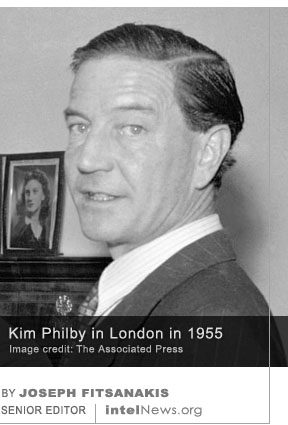
Kim PhilbyExtensive extracts from the confession of Kim Philby, one of the Cold War’s most prolific double spies, are scheduled to be released today for the first time by Britain’s National Archives. While working as a senior member of British intelligence, Harold Adrian Russell Philby, known as ‘Kim’ to his friends, spied on behalf of the Soviet OGPU and NKVD, the intelligence services that later became known as the KGB. His espionage activities lasted from 1933 until 1963, when he secretly defected to the USSR from his home in Beirut, Lebanon. Philby’s defection sent ripples of shock across Western intelligence and is often seen as one of the most dramatic incidents of the Cold War. He was part of a spy ring of upper-class British communists who were known collectively as ‘the Cambridge spies’ because they were recruited by Soviet intelligence during their student days at the University of Cambridge in England.

Britain’s intelligence establishment has never released Philby’s confession, which he made to his friend Nicholas Elliott, an intelligence officer in the Secret Intelligence Service (MI6) in January 1963. The MI6 had sent Elliott to Beirut, where Philby was working as a journalist, to inform him that his espionage role for the Soviets had been established beyond doubt. The MI6 officer had been authorized to offer Philby immunity from prosecution in return for a full confession. Philby accepted the offer and began his confession while in Beirut. But a few days later he vanished and reemerged in Moscow in July of that year. He died there in 1988.

The file that is scheduled to be released today by the National Archives is marked “Secret” and comes from the Security Service (MI5), Britain’s primary counterintelligence agency. It contains details about Philby’s first assignments for Soviet intelligence, which included identifying other communist students at Cambridge who would be susceptible to recruitment. Philby’s list included the names of Donald Maclean and Guy Burgess, who later became members of the Cambridge spy ring. Philby states in his confession that he cautioned his Soviet handlers about recruiting Burgess due to “his unreliability and indiscretion”, but his objections were “overruled”, he says.

When asked by Elliott how he could have sided with Soviet intelligence at a time when the Soviet leader, Joseph Stalin, was slaughtering millions, Philby responds by comparing his service for the KGB to joining the armed forces. Following orders, he says, does not imply that a soldier unquestionably agrees to every action of the government he serves. He goes on to reveal that his Soviet handlers never attempted to win his “total acceptance on the technical level. In short”, Philby continues, “I joined [Soviet intelligence] as one joined the army [… I often] obeyed orders although convinced they were wrongly conceived”.

Author: Joseph Fitsanakis | Date: 24 September 2019 | Permalink

Spy novel written by Kim Philby’s granddaughter to be published this week

Charlotte PhilbyA spy novel written by the granddaughter of Kim Philby, the British senior intelligence officer who secretly spied for the Soviet Union, will be published this week. Charlotte Philby, 36, is the London-based daughter of John Philby, who was one of the five children Kim Philby had with his English wife Aileen Furse. While working as a senior member of British intelligence, Harold Adrian Russell Philby, known as ‘Kim’ to his friends, spied for the Soviet NKVD and KGB. His espionage activities lasted from about 1933 until 1963, when he defected to the USSR from his home in Beirut, Lebanon. Philby’s defection sent ripples of shock across Western intelligence and is often seen as one of the most dramatic incidents of the Cold War. He was part of a larger ring of upper-class British spies, known collectively as ‘the Cambridge spies’ because they were recruited by Soviet intelligence during their student days at the University of Cambridge in England.
Following his sensational defection, Philby lived in the Soviet capital until his death in 1988 at the age of 76. His granddaughter gave an interview to British newspaper The Sunday Telegraph, in which she said that her father, John, “never said anything against Kim” and “enjoyed a very good relationship” with him. The family visited Kim Philby in Moscow every year until his death, when Charlotte was five. She told The Telegraph that she remembers these trips, and staying at Kim Philby’s apartment. She said the family would be met at the airport in Moscow “by men in grey suits” who would usher them into a government car and “whiz [them] to the gated apartment block where Kim lived” in downtown Moscow. During those trips, the family would give the double spy supplies of his favorite English foods and magazines. This may surprise some, given that Philby abandoned his second wife, an American, and his five children from his first wife. She had died six years prior to his defection, so the children, including Charlotte Philby’s father, were raised by relatives and family friends.

Charlotte Philby worked as a journalist for The Independent, a London-based British newspaper that ceased print circulation in 2016, and has since been writing as a freelancer. Her first novel, entitled The Most Difficult Thing, features a female protagonist who has to balance her espionage work with her relationship with those closest to her. The author says that Kim Philby’s ghost “hovers over the pages”. She notes that, if her grandfather had any regrets at the end of his life, “they wouldn’t be to do with betraying his country but with the individuals and the family members that he had to dupe and separate from”.

Author: Joseph Fitsanakis | Date: 15 July 2019 | Permalink

British commander in Iraq contradicts US assessment of increased Iranian threat

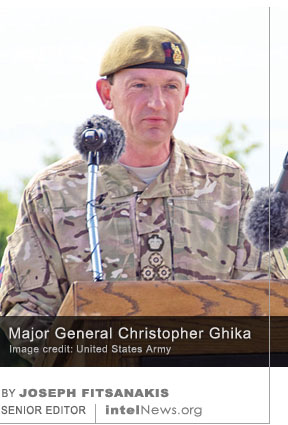
Christopher GhikaThe most senior British military officer in the war against the Islamic State contradicted American assessments of a heightened threat from Iran, prompting an unusually strong rebuke from Washington. Last week, the White House ordered the USS Abraham Lincoln carrier strike group to sail to Middle Eastern waters, following intelligence showing that “Iran or its proxies were planning attacks against US forces in Iraq, Syria and at sea”.
On Tuesday, however, this view appeared to be challenged by Major General Christopher Ghika, Britain’s most senior military official in the Middle East, who is deputy commander of Operation Inherent Resolve (OIR). The OIR umbrella brings together all pro-Western forces that are fighting the Islamic State in Iraq and Syria. General Ghika spoke to American reporters at the US Department of Defense via a live video-link from Baghdad, where he is currently stationed as OIR deputy commander. In responding to questions by reporters about alleged threats to Western forces from Iran or its proxies, General Ghika said that the OIR forces were “aware of that presence [or Iranian-led Shia militia groups in Iraq and Syria], clearly. And we monitor them along with a whole range of others because that’s the environment we are in”. However, added the general, “no, there has been no increased threat from Iranian-backed forces in Iraq and Syria”.

British newspaper The Guardian, which published General Ghika’s comments on Tuesday, noted that his statements appeared to directly contradict Washington’s claims of a heightened Iranian threat in the region. But in a statement released on Tuesday night local time, the US Central Command CENTCOM, whose responsibilities include the Middle East and Central Asia theaters, rejected General Ghika’s comments. “Recent comments from OIR’s Deputy Commander run counter to the identified credible threats available to intelligence from U.S. and allies regarding Iranian backed forces in the region”, said the statement. The Guardian described CENTCOM’s statement as “particularly striking” and “an extraordinary rebuke of an allied senior [military] officer”. The British Ministry of Defense had not responded to CENTCOM’s statement by Wednesday morning.

Author: Joseph Fitsanakis | Date: 15 May 2019 | Permalink

British spy agency calls Trump’s espionage claim ‘utterly ridiculous’

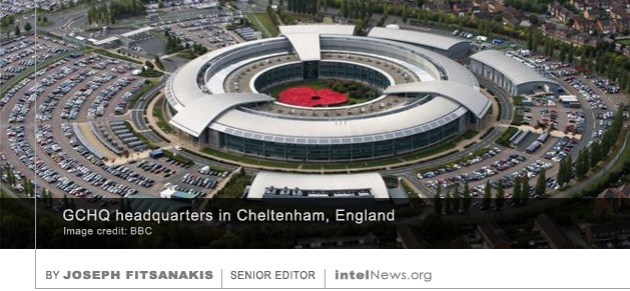
GCHQThe Government Communications Headquarters (GCHQ), Britain’s primary signals-intelligence agency, has called claims by United States President Donald Trump that it spied on his election campaign “utterly ridiculous”. President Trump’s allegations are not new. They apparently rest on claims made in March 2017 by a Fox News commentator, that the GCHQ spied on Trump on orders of then-US President Barack Obama. The claim was repeated on March 17 at the White House by Sean Spicer, Trump’s then-press secretary, who said that Obama had used the GCHQ to spy on Trump so as to evade American privacy laws. At the time, Spicer’s claim prompted an angry response from the British government in London and from the British spy agency itself. In a rare public comment, GCHQ called the allegations “utterly ridiculous”.
This past Wednesday, the US president appeared to repeat his claim that GCHQ had spied on his election campaign, via a post on the popular social networking platform Twitter. Responding to a reiteration of the claim on the conservative cable television channel One America News Network, Trump tweeted “WOW! It is now just a question of time before the truth comes out, and when it does, it will be a beauty!”. The president’s tweet appeared just hours after the British government confirmed that Trump had been invited for a four-day state visit to the United Kingdom in June. The visit is believed to include a meeting with British Prime Minster Theresa May and dinner with Queen Elizabeth II at Buckingham Palace.

Following Trump’s tweet, the US newsmagazine Newsweek contacted GCHQ with a request for a response to the US president’s allegation. A GCHQ spokesperson referred the newsmagazine to the agency’s 2017 statement, and repeated: “The allegations that GCHQ was asked to conduct ‘wire tapping’ against the then president-elect are nonsense. They are utterly ridiculous and should be ignored”. It is extremely rare for GCHQ —one of Britain’s most secretive and publicity-shy agencies— to respond publicly to stories in the media. Late on Wednesday, British Foreign Affairs Secretary Jeremy Hunt said that the invitation to President Trump to visit London would not be rescinded, and insisted that Britain’s “special relationship” with the US remained “intact”.

Author: Joseph Fitsanakis | Date: 25 April 2019 | Permalink

Reports allege third man was involved in poisoning of Sergei Skripal

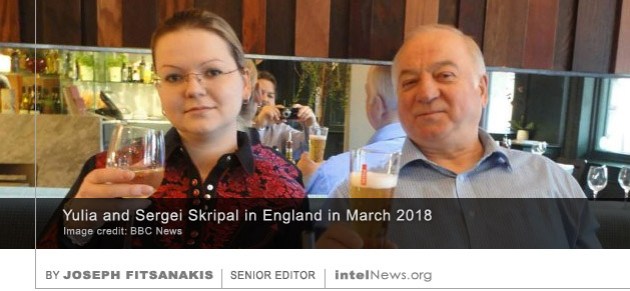
Sergei SkripalNew reports from Russian investigative sites claim that a third man using a fake name was involved in the attempted assassination of former double spy Sergei Skripal in England last year. Skripal, a former military intelligence officer, was resettled in the English town of Salisbury in 2010, after spending several years in a Russian prison for spying on behalf of Britain. But he and his daughter Yulia almost died in March 2018, after they were poisoned with a powerful nerve agent that nearly killed them. The attack has been widely blamed on the Russian government, though the Kremlin denies it had any role in it. Two assailants have so far been identified by British intelligence. They have been named as Dr. Alexander Yevgenyevich Mishkin —cover name ‘Alexander Petrov’— and Colonel Anatoliy Chepiga —cover name ‘Ruslan Boshirov’. Both are said to be employees of the Russian military intelligence agency known as the Main Directorate of the General Staff of the Armed Forces, commonly referred to as the GRU. The two men spoke on Russian television last year, denying any involvement in the attack on the Skripals. Their whereabouts since their television interview remain unknown. Moscow denies that it had any role in the attack.
In October of last year, the Russian investigative news site Fontanka claimed that a third man under the name of Sergey Fedotov, may have been involved in the attack on Skripal. Last Thursday, another Russian investigative news site, Bellingcat, said that the name Sergey Fedotov appears to have been created out of thin air for operational purposes by Russia’s intelligence services. According to Bellingcat, Fedotov appears to have no past prior to 2010, when his identity was invented using the same techniques that the fake identities of ‘Petrov’ and ‘Boshirov’ were concocted by the GRU. Moreover, Fedotov’s records show that he traveled extensively in the Middle East, Asia and Europe between 2010 and 2015. The Russian news site claims that he was in Bulgaria in late April 2015, when Emilian Gebrev, a wealthy local defense industry entrepreneur, fell violently ill. Gebrev was hospitalized for signs of poisoning along with his son and one of his company’s executives for several days, eventually making a full recovery. As the Bulgarian businessman was being taken to hospital, Fedotov skipped his return flight out of Sofia and instead drove to Istanbul, Turkey, where he bought a one-way airline ticket to Moscow, says Bellingcat.

The BBC’s Gordon Corera said he contacted the Russian embassy in London and the Kremlin in Moscow. Both sources strongly refuted the Bellingcat report. A Kremlin spokesman cautioned the BBC to be skeptical about Bellingcat’s report, since “we don’t know what [its] authors based their work on [or] how competent they are”. British Police told Corera that they were “still investigating whether further suspects were involved” in the attack on Skripal and were “not prepared to discuss” details pertaining to “an ongoing investigation”.

Author: Joseph Fitsanakis | Date: 11 February 2019 | Permalink

Hundreds of MI5 officers prepare for Brexit violence in Northern Ireland

New IRAThe British Security Service (MI5) has over 700 officers —more than 20 percent of its entire force— stationed in Northern Ireland, due to fears that the Brexit process might reignite the centuries-long sectarian conflict there. In 1922, nationalist rebels managed to dislodge Ireland from the British Empire. But six counties in Ireland’s north remained under British dominion, and today form the British territory of Northern Ireland. Irish nationalists have for decades engaged in an unsuccessful campaign —at times peaceful and at times violent— to unite these counties with the Republic of Ireland. Following the Good Friday Agreement of 1998, nationalist and British loyalist groups in Northern Ireland terminated their armed operations and entered the political arena, effectively sharing power in the British territory. The integration of Ireland and Britain into the European Union helped in that process by effectively bringing to an end border checks between the two countries. Thus, pro-British loyalists continued to live under British rule, while nationalists have been able to cross from Northern Ireland to the Irish Republic and back without restrictions, as if the two states were effectively unified.
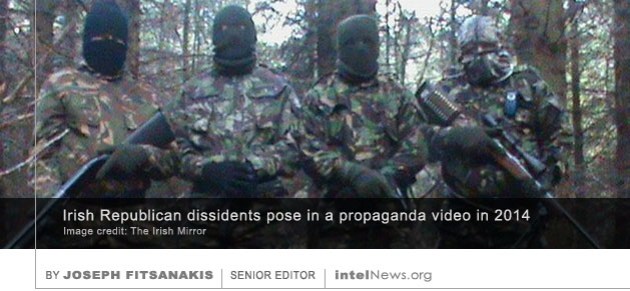
But this open-border regime is about to change once Britain leaves the European Union in March. Many fear that the reinstated border will remind nationalist communities in the North that the island of Ireland remains partitioned and will thus reignite secessionist sentiments. A few days ago, the London-based newspaper The Daily Mail cited an unnamed “counterterrorism source” who said that MI5, Britain’s primary counterterrorism agency, had stationed a fifth of its force in Northern Ireland. The agency is allegedly monitoring a number of dissident republican groups —a term used to describe armed groups of Irish nationalists who continue to reject the nationalist community’s majority view to endorse the Good Friday Agreement back in 1998. One such group —which is commonly seen as the most formidable in existence today— is the self-described New Irish Republican Army. The New IRA was formed in 2012 when dissident republican cells joined another dissident nationalist group, known as the Real IRA. The new formation is particularly strong in Northern Ireland’s extreme northwest, which includes urban centers like Derry. British security officials believe that the New IRA consists of about 40 hardcore members who are committed to an armed campaign against British rule in the North.

Nearly 50 New IRA militants are currently serving sentences in the British and Irish prison systems, while several raids of New IRA members’ residences and other properties have unearthed weaponry —including fully automatic weapons— and explosives. But the group managed to detonate a car bomb in Derry on January 19 of this year. The bomb employed gas canisters and went off nearly 30 minutes after an unidentified man called a charity shop located nearby and issued a bomb warning. Police officers rushed to the scene and were there when the bomb exploded. There were no injuries, according to reports in local media.

Author: Joseph Fitsanakis | Date: 29 January 2019 | Permalink

American held on espionage charges in Russia has three other citizenships

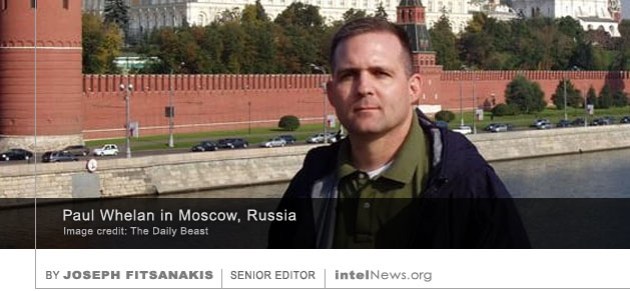
Paul WhelanAn American former Marine, who faces espionage charges in Russia, is a citizen of at least three other countries, namely Canada, Britain and the Republic of Ireland, according to reports. Paul Whelan, 48, was arrested by Russia’s Federal Security Service (FSB) on December 28 at the Metropol, a five-star hotel in downtown Moscow. News of Whelan’s arrest first emerged on January 3 in a report from Rosbalt, a Moscow-based news agency that known to be close to the Russian security services. He was reportedly indicted on Thursday and is now facing between 10 to 20 years in prison for espionage. His trial is not expected to take place until March.
According to Rosbalt, the FSB arrested Whelan in his hotel room while he was meeting with a Russian citizen who allegedly handed him a USB drive containing a list that included “the names of all employees of a [Russian] security agency”. However, Whelan’s family claim that the former Marine arrived in Moscow on December 22 to attend the wedding of an American friend who married a Russian woman. Whelan served two tours in Iraq with the United States Marines and was reportedly discharged for bad conduct. At the time of his arrest last month, he was the director of global security for BorgWarner, a Michigan-based manufacturer of spare parts for cars. He is believed to have visited Russia regularly since 2006, and is thought to have a basic command of the Russian language. He is currently being held in solitary confinement in Moscow’s Lefortovo detention center.

At the time of his arrest, Whelan was identified as an American citizen. On Friday, however, the Associated Press reported that he also has United Kingdom citizenship because he was born to British parents. Additionally, he is now believed to hold Canadian citizenship as well, because he was born in Canada. He then acquired American citizenship after arriving in the US with his parents as a child. It is not known how he acquired Irish citizenship, but the Irish government confirmed it on Friday. Also on Friday, the Washington-based National Public Radio said that embassies of at least four Western countries —the US, Britain, Ireland and Canada— were working to gain consular access to Whelan. On Thursday, the former Marine was visited in prison by Jon Huntsman, America’s ambassador to Russia. Meanwhile, Britain’s Foreign Secretary, Jeremy Hunt, said London was “extremely worried” about Whelan’s fate and warned Moscow “not to try to use [him] as a diplomatic pawn”, possibly by exchanging him with Russians arrested for espionage in the West.

Author: Joseph Fitsanakis | Date: 05 January 2019 | Permalink

Wave of bomb threats prompts hundreds of evacuations in four countries

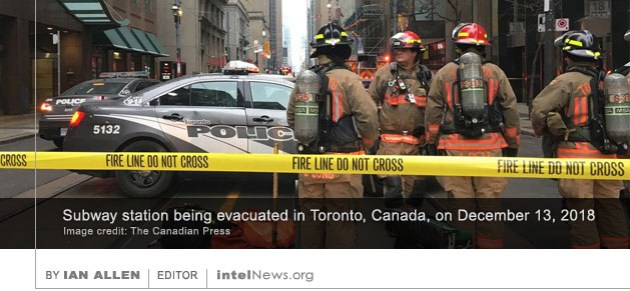
Toronto subway evacuationAn unprecedented “flood of bomb threats” prompted hundreds of evacuations and closures of private buildings, transport hubs and offices in four countries on Thursday, causing confusion and in some cases panic. The threats —which numbered in the hundreds— were issued throughout the day Thursday against businesses, schools, hospitals and media companies in the United States, Canada, New Zealand and the United Kingdom. It is the first time in history that such a large wave of bomb threats was issued against so many targets internationally.
Police agencies in the United States and Canada said that most of the threats were emailed, but some were phoned in by unknown individuals. They warned that devices containing explosive compounds such as tetryl or trinitrotoluene would be detonated unless funds were deposited into an international account using the virtual currency bitcoin. The messages also warned that the alleged devices would be detonated if “any police activity or unusual behavior” were detected. A deadline of one business day was given to deposit the funds. Throughout the day, police agencies across three continents issued notices cautioning people to remain aware of their surroundings and report suspicious messages or behavior. It was eventually determined that virtually all bomb threats were not credible.

However, it was the sheer number and geographical extent of the threats that shocked law enforcement agencies across four countries. In the United States, threats were reported in cities such as Boston, Philadelphia, San Francisco and Oklahoma City, where over dozens of specific addresses were targeted. Nearly 30 schools were placed on lockout in the state of Colorado, while numerous buildings were evacuated in Los Angeles, Chicago, Washington, Cincinnati and Seattle. Smaller cities were also affected, including South Bend, Indiana, Grand Rapids, Iowa, Charlotte, North Carolina, Norfolk, Virginia, and Park City, Utah. In Canada dozens of bomb threats were issued in Montreal, Ottawa, Winnipeg, Calgary, and Toronto, where five of the city’s subway stations were shut down for several hours. Media reports late on Thursday said it was unclear how many —if any— of those targeted paid the bitcoin ransoms demanded by the hoaxers.

Author: Ian Allen | Date: 14 December 2018 | Permalink

MI6 spy chief outlines ‘fourth generation espionage’ in rare public speech

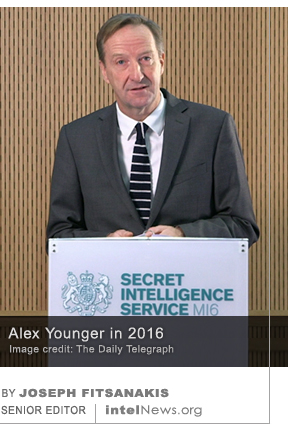
Alex YoungerThe director of Britain’s Secret Intelligence Service —known as MI6— has outlined the parameters of a new, “fourth generation of espionage”, which he said is needed to combat the “threats of the hybrid age”. Alex Younger, 55, is a career intelligence officer who joined MI6 in 1991, after serving in the British Army. He served as chief of global operations —considered the number two position at MI6— before being appointed director of the spy agency in October 2014. He previously served in the Middle East, Europe, and Afghanistan, where he represented MI6 as its most senior officer in the country following the US-led military invasion of 2001. Until this week, Younger had given a single public address since becoming director of MI6. But on Monday he spoke again, this time at the University of St. Andrews in Scotland, from where he graduated with a degree in economics.
After cautioning his audience that MI6’s methods, operations and people —some of whom “have paid the ultimate price”— must remain secret, Younger said that technological progress has “profoundly changed [MI6’s] operating environment”. Technological change, as well as the degree of interconnectedness, he said, has made the world “dramatically more complicated”. He went on to add that the resulting ambiguity is referred to by MI6 as a constant stream of “hybrid threats”, namely challenges posed by nation-states operating “in the gray spaces of the hybrid era”. They do so in order to probe the West’s “institutions and defenses in ways that fall short of traditional warfare”, said Younger. The British spy chief added that MI6, as “one of the few truly global intelligence agencies” is well positioned to respond to hybrid threats, mostly by augmenting its human intelligence role —using human spies to collect information.

Human intelligence, which is MI6’s core task, “will never change fundamentally”, said Younger, adding that “in fact it will become even more important in a more complex world”. However, it will need to evolve to meet the challenges of the hybrid age. Younger said that MI6 was pioneering a “fourth generation of espionage”, which is the product of the fusion of traditional human skills with “accelerated [technological] innovation”. This new generation of espionage said Younger, relies not on individual work but on operations that are carried out by dynamic teams within and across state agencies. Additionally, the ultimate task of these operations is not simply to know the actions of one’s adversaries, but “to change their behavior”, said the British spy chief. Furthermore, in order to successfully develop fourth generation espionage capabilities, MI6 will have to “ensure that technology is on our side, not that of our opponents”, noted Younger. The spy chief gave an example by referring to the case of the near-fatal poisoning of Sergei Skripal, the Russian former double spy who was allegedly attacked by two Russian military intelligence officers in Salisbury, England, last March. It was “bulk data combined with modern analytics” that exposed the culprits of the operation, he said. But the same methods, which make the modern world more transparent, can posed “a serious challenge if used against us”, warned the MI6 chief.

Author: Joseph Fitsanakis | Date: 04 December 2018 | Permalink

Nerve agent used in Skripal attack ‘could have killed thousands’ say experts

GRUThe amount of poison smuggled into Britain for a near-fatal attack on Russian former spy Sergei Skripal was powerful enough to kill “thousands of people”, according those leading the investigation into the incident. Skripal, a former military intelligence officer, was resettled in the English town of Salisbury in 2010, after spending several years in a Russian prison for spying for Britain. But he and his daughter Yulia almost died in March of this year, after being poisoned by a powerful nerve agent that nearly killed them. The attack has been widely blamed on the Russian government, though the Kremlin denies that it had a role in it.

Investigators from Britain and other Western countries have identified the poison used in the attack on the Skripals as novichok. The term (meaning ‘newbie’ in Russian) was given by Western scientists to a series of rarely used nerve agents that were developed the Soviet Union and Russia between 1971 and the early 1990s. It is believed that the poison was smuggled into the United Kingdom hidden inside an imitation perfume bottle, which had been fitted with a custom-made pump used to apply the poison. British authorities have determined that the assailants sprayed the poison on the doorway —including the handle— of the Skripals’ house in Salisbury. They then discarded the perfume bottle, containing the leftover novichok, in a garbage can before leaving the country in a hurry. The bottle was eventually recovered by Salisbury resident Charlie Rowley. His partner, Dawn Sturgess, died of poisoning after she applied some of the contents of the bottle on her wrists. British government scientists have since been examining the contents of the perfume bottle found inside Sturgess’ home.

On Thursday, BBC Television’s Panorama investigative program aired an episode entitled “Salisbury Nerve Agent Attack: The Inside Story”. Among those interviewed was Dean Haydon, a British Deputy Assistant Commissioner who is leading the ongoing investigation into the Salisbury attack. He told Panorama that “a significant amount” of novichok was left behind by the assailants inside the discarded perfume bottle. The amount of poison in the discarded bottle could have been used to kill “thousands”, he said, adding that the way it was applied to the Skripals’ home was “completely reckless”. The BBC program’s producers also spoke to a British government chemical weapons scientist, identified only as “Tim”, who is credited with having identified the substance used on the Skripals. He told the program that less than 100g of novichok was used against the Skripals, leaving the vast majority of the nerve agent inside the bottle. Given that novichok is “one of the deadliest substances known”, which has a “unique ability to poison individuals at very low concentrations”, the scientist said he was shocked by the amount of poison that was smuggled into Britain by the assailants.

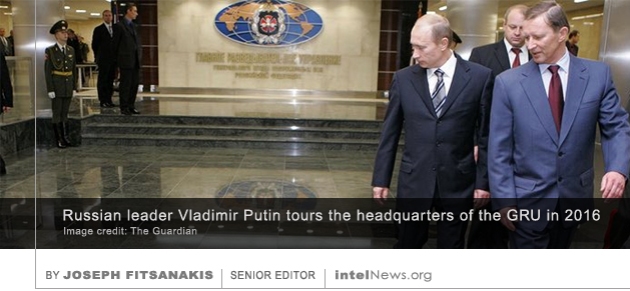
The assailants have been identified by British intelligence as Dr. Alexander Yevgenyevich Mishkin (cover name “Alexander Petrov”) and Colonel Anatoliy Chepiga (cover name “Ruslan Boshirov”). Both men are said to be employees of the Russian military intelligence agency known as the Main Directorate of the General Staff of the Armed Forces, commonly referred to as the GRU. Moscow denies that it had any role in the attack on the Skripals.

Author: Joseph Fitsanakis | Date: 22 November 2018 | Permalink

Moscow names intersection after Kim Philby, British spy for the USSR

Kim PhilbyIn a sign of worsening relations between the United Kingdom and Russia, a busy intersection in Moscow has been named after Kim Philby, the British senior intelligence officer who secretly spied for the Soviet Union. While working as a senior member of British intelligence, Harold Adrian Russell Philby, known as ‘Kim’ to his friends, spied on behalf of the Soviet NKVD and KGB. His espionage activities lasted from about 1933 until 1963, when he secretly defected to the USSR from his home in Beirut, Lebanon. Philby’s defection sent ripples of shock across Western intelligence and is often seen as one of the most dramatic incidents of the Cold War. He was part of a wider ring of upper-class British spies, known collectively as ‘the Cambridge spies’ because they were recruited by Soviet intelligence during their student days at the University of Cambridge in England.
Following his sensational defection, Philby lived in the Soviet capital until his death in 1988 at the age of 76. On Tuesday, a statement published on the website of the Moscow City Council announced that a busy intersection in the city’s southeast would be renamed to ‘Kim Philby Square’ in honor of the British defector. The statement said that the name change had been agreed upon by the city council and decreed by Moscow Mayor Sergei Sbyanin, a close associate of Russian President Vladimir Putin. Interestingly, Philby lived nowhere near the intersection named after him. His apartment —provided to him by the Soviet state in exchange for services rendered during his 30 years of spying— was located in a residential area of central Moscow. However, the intersection in question is situated near the headquarters of the SVR, Russia’s Foreign Intelligence Service, which is the primary successor agency to the Soviet-era KGB. In September of last year, SVR Director Sergei Naryshkin attended an exhibition in Moscow entitled “Kim Philby: His Intelligence Work and Personal Life”, organized by the Russian Historical Society. While there, Naryshkin was told by veterans of the KGB that Philby liked to take long walks through the streets of Moscow and that a street should be named after him in his honor.

French news agency Agence France Presse reported that it contacted the Moscow City Council but a spokeswoman said she was not in a position to comment on the Kim Philby Square renaming. The move comes a few months after a small pedestrian thoroughfare located across from the front entrance of the Russian embassy in Washington DC was symbolically named ‘Boris Nemtsov’, after a Russian opposition leader who was gunned down in downtown Moscow in February of 2015.

Author: Joseph Fitsanakis | Date: 09 November 2018 | Permalink

Britain sees Russian government hackers behind Islamic State cyber group

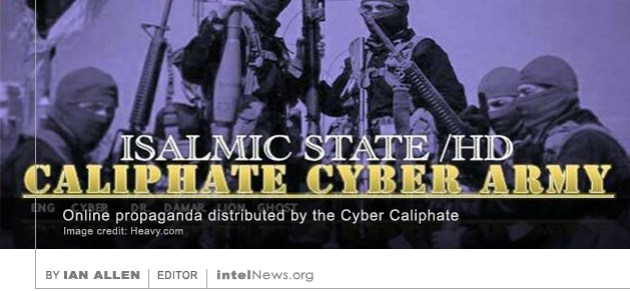
Cyber CaliphateA new report by the British government alleges that the so-called ‘Cyber Caliphate’, the online hacker wing of the Islamic State, is one of several supposedly non-state groups that are in fact operated by the Russian state. The group calling itself Cyber Caliphate first appeared in early 2014, purporting to operate as the online wing of the Islamic State of Iraq and Syria (ISIS), which was later renamed Islamic State. Today the Cyber Caliphate boasts a virtual army of hackers from dozens of countries, who are ostensibly operating as the online arm of the Islamic State. Their known activities include a strong and often concentrated social media presence, as well as computer hacking, primarily in the form of cyber espionage and cyber sabotage.


But an increasing number of reports, primarily by Western government agencies, have claimed in recent years that the Cyber Caliphate is in fact part of a Russian state-sponsored operation, ingeniously conceived to permit Moscow to hack Western targets without retaliation. On Wednesday, a new report by Britain’s National Cyber Security Centre (NCSC) described the Cyber Caliphate and other similar hacker groups as “flags of convenience” for the Kremlin. The report was authored by the NCSC in association with several British and European intelligence agencies. American spy agencies, including the National Security Agency and the Federal Bureau of Investigation, also helped compile the report, according to the NCSC. The report names several hacker groups that have been implicated in high-profile attacks in recent years, including Sofacy, Pawnstorm, Sednit, Cyber Berkut, Voodoo Bear, BlackEnergy Actors, Strontium, Tsar Team, and Sandworm. Each of these, claims the NCSC report, is “an alias of the Main Directorate of the General Staff of Russia’s Armed Forces”, more commonly known as the GRU. The report concludes that Cyber Caliphate is the same hacker group as APT 28, Fancy Bear, and Pawn Storm, three cyber espionage outfits that are believed to be online arms of the GRU.

The NCSC report echoes the conclusion of a German government report that was leaked to the media in June of 2016, which argued that the Cyber Caliphate was a fictitious front group created by Russia. In 2015, a security report by the US State Department concluded that despite the Cyber Caliphate’s proclamations of connections to the Islamic State, there were “no indications —technical or otherwise— that the groups are tied”. In a statement issued alongside the NCSC report on Wednesday, Britain’s Secretary of State for Foreign and Commonwealth Affairs, Jeremy Hunt, described the GRU as Moscow’s “chosen clandestine weapon in pursuing its geopolitical goals”. The Russian government has denied these allegations.

Author: Ian Allen | Date: 05 October 2018 | Permalink