Pakistan denies it plans to release doctor who helped CIA find bin Laden

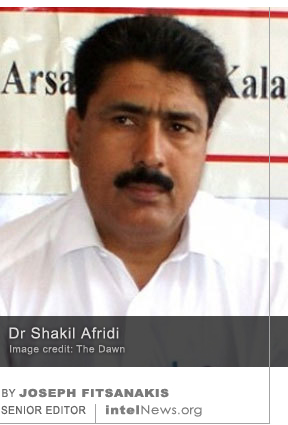
Dr Shakil AfridiAuthorities in Pakistan have dismissed rumors that a medical doctor who helped the United States Central Intelligence Agency find and kill al-Qaeda founder Osama bin Laden in 2011 is to be released from prison. Dr. Shakil Afridi was arrested in 2011, soon after bin Laden was killed in a CIA operation in the Pakistani city of Abbottabad. In the weeks following the CIA raid, it emerged that a team of local doctors and nurses had helped the American spy agency confirm bin Laden’s presence in the compound. The team of nearly 20 healthcare workers participated in a fake vaccination scheme carried out in Abbottabad, whose true purpose was to collect DNA samples from the residents of the compound where the CIA believed bin Laden was hiding.

Pakistani authorities fired 17 healthcare workers who participated in the CIA scheme and arrested its head, Dr. Afridi. Bizarrely, Dr. Afridi was arrested for having alleged links with an Islamist group that operates in the region, known as Lashkar-e-Islam. He then faced charges for alleged medical malpractice, which, according to the prosecution, resulted in the death of one of his patients. He is currently serving a 33-year prison sentence in Pakistan’s northwestern border city of Peshawar. Ever since his arrest, the US has pressured Pakistan to release Dr. Afridi, and Pakistani media often publish sensational reports about alleged covert attempts by the CIA to free the imprisoned medical doctor. Last week, Dr. Afridi was transported by helicopter from Peshawar to a jail near the village of Adiala, located near Pakistan’s border with the Indian region of Kashmir. Dr. Afridi’s move, which took place amid heavy security, sparked rumors in the media that the alleged CIA agent was about to be released and transported to America.

But on Thursday, Muhammad Faisal, a spokesman for Pakistan’s Ministry of Foreign Affairs, dismissed intense media speculation that Dr. Afridi was about to be released. He also denied that Islamabad was attempting to swap Afridi with Pakistani nationals living in the US, including Aafia Siddiqui, who is serving an 86-year prison term in the US for killing an American soldier in Afghanistan. Additionally, Faisal described as “nonsense” media reports of an alleged failed CIA attempt to organize a jailbreak in Peshawar, in order to free Dr. Afridi.

Author: Joseph Fitsanakis | Date: 4 May 2018 | Permalink
Another US diplomat detained in Pakistan over traffic accident that injured two

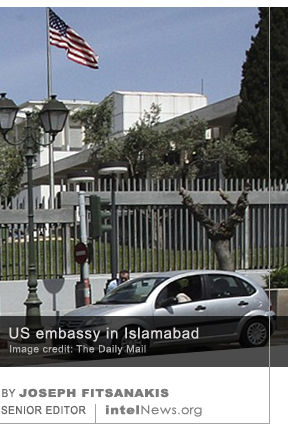
US embassy Islamabad PakistanAnother American diplomat was detained in Pakistan last week, following the second serious traffic accident involving United States diplomatic personnel in Islamabad in less than a month. The incidents are said to be contributing to ongoing diplomatic tensions between the United States and Pakistan. Many in the South Asian country remain angry about a controversial episode in 2011, when a Central Intelligence Agency officer serving at the US consulate in Lahore killed two men by shooting them in the head with a Glock pistol. The CIA officer, Raymond A. Davis, told Pakistani police that the two men had tried to rob him. He was eventually released from detention due to his diplomatic immunity, but only after the personal intervention of the then Secretary of State John Kerry, and after Washington offered monetary compensation to the two dead men’s families.

In the latest incident, Pakistani authorities detained an American diplomat on Sunday, after his Toyota SUV ran over two men riding on a motorcycle in Islamabad. The diplomat, identified in Pakistani media as the US embassy’s Second Secretary Chad Rex Ausburn, was accused by police of having been involved in a hit-and-run incident in the Pakistani capital. According to local reports, Ausburn refused to emerge from his vehicle immediately following the accident, but eventually stepped out and identified himself to police officers. They then took him into custody and impounded his vehicle, which is believed to belong to the US embassy. Ausburn was released once the Pakistani Ministry of Foreign Affairs confirmed his diplomatic status, which grants him immunity from prosecution. The two men injured in the accident are said to be in stable condition at a nearby hospital. Police have reportedly charged the driver of the motorcycle with reckless driving.

However, Pakistani authorities have also charged Taimur Iqbal Pirzada, a security adviser for the US embassy in Islamabad, with seeking to obstruct the police investigation into Sunday’s incident. Pirzada stands accused of trying to stop police officers from detaining Ausburn and impounding his vehicle. He was released on bail on Monday and is currently awaiting trial. US State Department spokesman Nolen Johnson told The New York Times on Monday that the issue involving Ausburn had been “resolved” and that the US government had been “in close contact with Government of Pakistan officials on this matter”. This past April, Pakistani authorities barred another American diplomat from leaving the country, after the car he was driving was involved in an accident in Islamabad, which left a motorcyclist dead. The US embassy’s military attaché, Colonel Joseph E. Hall, remains in Pakistan. Authorities there have demanded that the US Department of State rescinds his diplomatic immunity, so he can face a criminal trial. But the US government has so far refused to grant Islamabad’s request.

Author: Joseph Fitsanakis | Date: 01 May 2018 | Permalink | Research credit: C.F.

Report reveals deeper CIA role in 1963 Vietnam coup and Diem’s assassination

Ngo Dinh DiemA newly declassified report by the Inspector General of the United States Central Intelligence Agency reveals that the South Vietnamese generals who overthrew President Ngo Dinh Diem in 1963 used CIA money “to reward opposition military who joined the coup”. Acknowledging that “the passing of these funds is obviously a very sensitive matter”, the CIA Inspector General’s report contradicts the sworn testimony of Lucien E. Conein, the CIA liaison with the South Vietnamese generals. In 1975, Conein told a United States Senate committee that the agency funds, approximately $70,000 or 3 million piasters, were used for food, medical supplies, and “death benefits” for the families of South Vietnamese soldiers killed in the coup.

The report (.pdf), one of the 19,000 JFK assassination documents released by the US National Archives on Thursday, also contains new details about the South Vietnamese generals’ decision to assassinate Diem that contradict a conclusion of the coup’s history written by the CIA station in Saigon. The majority of the generals, said the CIA at the time, “desired President Diem to have honorable retirement from the political scene in South Vietnam and exile”. According to a newly declassified portion of the 49-page document written by the CIA’s Inspector General, an unidentified field-grade South Vietnamese officer who provided the CIA station with pictures of the bloodied bodies of Diem and his brother and advisor, Ngo Dinh Nhu, said that “most of the generals” favored their immediate execution: “The ultimate decision was to kill them. A Captain Nhung was designated as executioner”.

A redacted version of the Inspector General’s report, dated May 31, 1967, was released by the National Archives in November 2017. In that version of the report, the paragraphs related to the use of CIA funds and the generals’ decision to murder Diem were excised.

* William J. Rust is the author of four books about US relations with Southeast Asia countries during the cold war, including Kennedy in Vietnam. He is currently completing a book about US relations with Indonesia.


Canada evacuates diplomats’ families from Cuba, citing mysterious brain injuries

Embassy of Canada in Havana, CubaThe government of Canada has announced plans to evacuate family members of its diplomats serving in Cuba, because of medical issues caused by an alleged espionage-related technological device. These concerns have persisted among United States and Canadian diplomatic staff since the fall of 2016, when several members of staff at the US embassy in Havana reported suffering from sudden and unexplained loss of hearing. Eventually, their symptoms became so serious that some American diplomats decided “to cancel their tours early and return to the United States”, according to the Associated Press, which published this story in August of 2016.
Since that time, the US Department of State has said that 21 of its diplomatic and support staff have been diagnosed with brain injuries. In response to these concerns, Washington recalled the majority of its diplomats from Havana last September and issued a travel warning advising its citizens to stay away from the island. Now the Canadian embassy has said it will evacuate all family members of its personnel stationed in Havana, according to the BBC. The government of Canada is believed to have made the decision to evacuate its citizens after it confirmed that at least 10 members of diplomatic families living on the island had been found to suffer from “unexplained brain symptoms”, according to Canadian government officials. These include regular spells of dizziness and nausea, as well as difficulty in concentrating on tasks.

Interestingly, Canadian experts have dismissed theories, emanating mostly from the US, that the mysterious brain symptoms come from a mysterious covert weapon that emits sonic waves. But some Canadian experts have said that the symptoms suffered by the diplomats and their families may point to a new illness, whose cause remains unknown. Cuba has dismissed repeated allegations by Washington that it allowed a third party —possibly Russia—to conduct sonic attacks against Western diplomats on the island. Cuban officials have described the allegations as tricks in a game of “political manipulation” that has been concocted by the White House to damage the bilateral relationship between the US and the government of the Caribbean island.

Author: Joseph Fitsanakis | Date: 18 April 2018 | Permalink

Outgoing CIA director acknowledges US killed ‘couple of hundred’ Russians in Syria

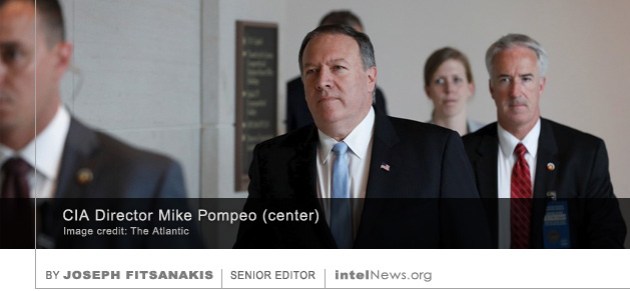
Mike PompeoThe outgoing director of the Central Intelligence Agency, Mike Pompeo, appeared on Thursday to confirm reports from last February that United States troops killed more than 200 Russian soldiers in Syria. According to sources from the US Pentagon, the armed confrontation took place on February 7, when a 500-strong Syrian government force crossed the Euphrates River and entered Kurdish-controlled territory in Syria’s northeastern Deir al-Zour region. US-supported Kurdish forces in the area, which include embedded American troops, responded with artillery fire, while US military aircraft also launched strikes on the Syrian government forces. The latter withdrew across the Euphrates after suffering heavy losses. The US side estimated at the time that over 100 attackers had been left dead, with another 200-300 injured. The toll later rose to several hundred dead.

At a press conference held soon after the armed clash, US Secretary of Defense James Mattis refused to discuss the matter, which he referred to as “perplexing”. Bloomberg said at the time that American officials were “in talks” with Russian counterparts “in search of an explanation for what happened”. On Thursday, however, Pompeo appeared to acknowledge that US troops killed hundreds of Russians in Deir al-Zour. The outgoing CIA director was speaking before a committee of the US Senate, during a hearing pertaining to his nomination to serve as the next US secretary of state. He was making the point that the administration of US President Donald Trump had maintained a hardline policy on Russia. After referring to the recent expulsions of 60 Russian diplomats from the US, Pompeo said: “in Syria, now, a handful of weeks ago the Russians met their match. A couple of hundred Russians were killed”.

Pompeo’s comments were seen by the media as an acknowledgement by a senior US government official of the incident in Deir al-Zour, which has remained shrouded in mystery since it happened. Later in his speech, Pompeo said that the Kremlin had “not yet gotten the full message about US determination to block aggression from Moscow. We need to continue to work at that”, he said.

Author: Joseph Fitsanakis | Date: 13 April 2018 | Permalink

Britain looking to resettle poisoned Russian spy to the United States, says source

Sergei SkripalThe British government may relocate Sergei Skripal, the Russian double spy who appears to have survived an assassination attempt in England, to the United States, in an effort to protect him from further attacks. The BBC reported last week that Skripal, who had been in a critical condition for nearly a month, was “improving rapidly”. Skripal, 66, who spied for Britain in the early 2000s, and has been living in England since 2010, was poisoned with what London claims was a military-grade nerve agent. Nearly every European country, as well as Canada, Australia and the United States, expelled Russian diplomats in response to the attack on the Russian former spy. His daughter, Yulia, who is 33, also came down with nerve-agent poisoning on the same day as her father, but appears to have survived.
The London-based newspaper The Sunday Times said yesterday that British government officials are exploring the possibility of resettling Skripal and his daughter in an allied country. The paper claimed that the countries being considered for possible relocation belong to the so-called “Five Eyes” agreement (also known as UKUSA), a decades-old pact between intelligence agencies from Australia, New Zealand, Britain, Canada and the United States. The Times quoted “an intelligence source” familiar with the negotiations allegedly taking place between the British government and its UKUSA partners. The source reportedly told the paper that the Skripals “will be offered new identities”, but did not elaborate on how they would avoid attention after their images were published by every major media outlet in the world following last month’s incident in England.

The anonymous source told The Times that “the obvious place to resettle [the two Russians] is America because they are less likely to be killed there and it is easier to protect them there under a new identity”. The paper also reported that Britain’s Secret Intelligence Service, also known as MI6, is holding discussions with its American counterpart, the Central Intelligence Agency, about resettling the Skripals on American soil. But an article published on Sunday in another British newspaper, The Daily Telegraph, said that senior government officials in the United States are now worried that Russian defectors and former spies living there may not be safe. The paper quoted an unnamed “senior US administration official” as saying that Washington has “massive concerns” that US-based Russians who have spied for America, or have publicly criticized the Kremlin, could be targeted just like Skripal. The Times said it contacted the British Foreign Office seeking to confirm whether the Skripals would be relocated abroad, but did not get a response.

Author: Joseph Fitsanakis | Date: 9 April 2018 | Permalink

US government publicly admits existence of rogue phone-tapping devices in DC

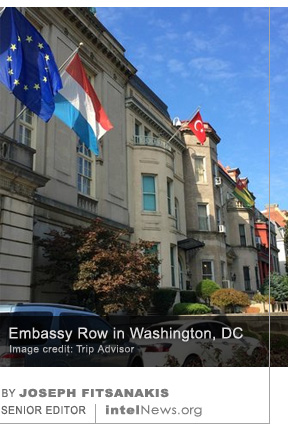
Embassy RowThe United States government has for the first time admitted publicly that it has detected devices known to be used by foreign intelligence services to spy on cellular communications in the nation’s capital. Known commonly as Stingrays, after a leading hardware brand, these devices are primarily used by government agencies, including law enforcement. But they can be purchased by anyone with anywhere from $1,000 to $200,000 to spare. They work by simulating the activity of legitimate cell towers and tricking cell phones into communicating with them. That allows the users of these cellphone-site simulators to monitor the physical whereabouts of targeted cell phones. Some of the more expensive Stingray models can intercept the actual content of telephone conversations and can even plant Trojans on the compromised phones of unsuspecting users.
Many governments have expressed concerns about the use of these devices, which are known to be used by intelligence agencies to monitor cellular communications on foreign soil. Major cities around the world, including Washington, are major targets of cellphone-site simulators, which are frequently located inside foreign embassies. However, the US government has never publicly commented on this issue, despite intense rumors that government agencies headquartered in Washington are major targets of Stingray devices. This changed recently, however, after Senator Ron Wyden (D-OR) wrote a letter to the Department of Homeland Security seeking information about the use of such devices in Washington. Wyden received a written response from Christopher Krebs, who heads the DHS’ National Protection and Programs Directorate. In the letter, dated March 26, Krebs confirmed that the DHS detected a number of active Stingrays in the DC area in 2017, which he referred to as “anomalous activity consistent with Stingrays”. But he added that the DHS lacks both funding and equipment needed to detect the full number of the devices and the full spectrum of Stingrays that are active in the nation’s capital.

The Associated Press, which published Krebs’ letter, said it acquired it from Wyden’s office in the US Senate. The news agency noted that the letter from DHS did not provide the technical specifications of the cellphone-site simulators, and did not enter into speculation about who might be employing them. Additionally the letter did not provide the exact number of Stingrays detected in DC in 2017, nor did it provide the exact locations in DC where Stingray activity was traced. In response to Krebs’ letter, Senator Wyden’s office released a statement blaming the US Federal Communications Commission for having failed to hold the cellular telecommunications industry accountable for the lack of security against Stingrays. “Leaving security to the phone companies has proven to be disastrous”, Senator Wyden’s statement concluded.

Author: Joseph Fitsanakis | Date: 4 April 2018 | Permalink

Surge in Russian spy activity prompts US agencies to bring back retired officers

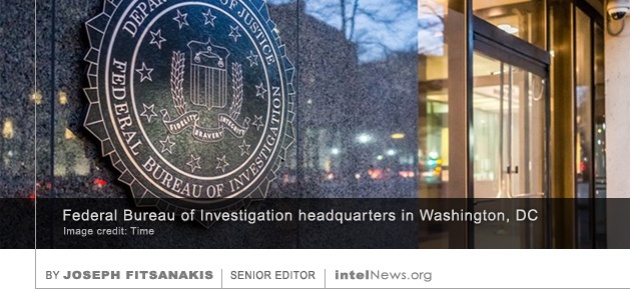
FBIA surge in the activity of Russian intelligence personnel on United States soil has caused American spy agencies to rehire retired Russia specialists, according to Newsweek. Additionally, Russian defectors living in the US are reevaluating their personal safety in light of the poisoning of Russian spy Sergei Skripal in England last month, said Newsweek’s intelligence correspondent Jeff Stein in an article published on Sunday. Writing from Washington, Stein said that US counterintelligence agencies —notably the Federal Bureau of Investigation— are “on edge” over the attack on Skripal, which the British government said was carried out with a military-grade nerve agent on orders of the Kremlin.
Soviet spy agencies have a long history of assassinating defectors, called ‘wet operations’ in Russian spy parlance. But such activities were considerably scaled back after the 1970s. However, many claim that the rise of Vladimir Putin to power brought back these tactics, and that Moscow may now be investing more time and money in ‘wet operations’ training. Stein quoted one anonymous Russian defector living in the US as saying that it would be “easy [for Russian spy services] to find us if they are really determined”. It usually takes an email, text or phone call to friends or relatives back in Russia for Moscow to start tracking the physical whereabouts of defectors. In other cases, family members of defectors may be followed by Russian intelligence personnel while visiting the US to reunite with relatives, said the US-based defector.

The same source told Stein that suspected Russian intelligence personnel had been spotted by US counterintelligence teams surveilling the neighborhoods where Russian defectors reside. To address what they see as an “uptick in Russian activity […] over the past two years”, the FBI and the Central Intelligence Agency “have been bringing people out of retirement” with expertise on Russian intelligence operations, Stein reports. The veteran intelligence correspondent also spoke to retired CIA officers, who did not rule out an attempt by Russian intelligence to carry out a ‘wet operation’ on American soil. Stein contacted the CIA and the FBI, asking them to respond to these concerns. He said the CIA declined to comment, while the FBI did not return his messages.

Author: Joseph Fitsanakis | Date: 01 April 2018 | Permalink

CIA is running informal negotiation channels with North Korea, say sources

Mike PompeoThe Central Intelligence Agency has reportedly established back channels for negotiation between the United States and North Korea, which the Department of State is now using to communicate with Pyongyang. Rex Tillerson, who was summarily fired as US Secretary of State by President Donald Trump last week, was famously in favor of diplomatic negotiations between the US and North Korea. The White House had resisted and even publicly criticized Tillerson’s views. Ironically, Tillerson was fired just as his pro-diplomacy views on North Korea are being adopted by the White House.
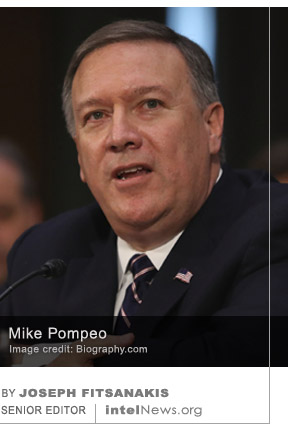
It is now the task of the new US Secretary of State, Mike Pompeo to help facilitate President’ Trump’s desire to meet with North Korean Supreme Leader Kim Jong-un. On Sunday, US television network CBS reported that Pompeo had already established an informal negotiation channel with Pyongyang during his prior post as director of the Central Intelligence Agency. According to CBS, the CIA used the back channel to communicate directly with the North Korean regime, bypassing the Department of State, which is the traditional instrument of US foreign policy. The network quoted “two current and one former” US officials, which it did not name.

Now that Pompeo has been placed in charge of the Department of State, said CBS, he has already tapped into the CIA’s direct line of communication with Pyongyang, and has begun utilizing it as Secretary of State. The CIA remains in charge of the channel, according to the television network. Meanwhile, German news media said on Sunday that North Korea’s missiles could now reach Germany and other areas of Western Europe. The reports quoted Dr. Ole Diehl, deputy director of the BND, Germany’s foreign-intelligence agency, who allegedly made the statement at a closed-door meeting of the Bundestag, Germany’s parliament.

Author: Joseph Fitsanakis | Date: 19 March 2018 | Permalink

Philippines summons US ambassador to protest negative intelligence report

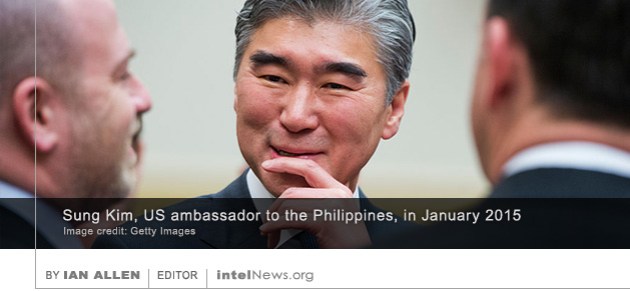
Sung KimThe United States ambassador to the Philippines has been summoned by Manila in response to the publication of an American intelligence report that described President Rodrigo Duterte as a threat to democracy. The report, published on February 13, represents a joint assessment of worldwide challenges to the interests of the United States. It is compiled annually by all 16 member agencies that make up the US Intelligence Community. This year’s report focused on the administration of President Duterte, who has led a self-styled “war on drugs, corruption and crime” in the Philippines since he assumed office in June 2016.
By the government’s own account, Duterte’s war has left more than 4,000 people dead in the past 18 months. But some human rights groups estimate the number of deaths at 11,000 or even higher. The US intelligence report notes that Duterte declared martial law in the Philippines’ southern region of Mindanao, which is expected to remain in place for most of 2018. It expresses concerns about rumors that the government may continue to impose martial law indefinitely and that it may extend it nationwide. It also expresses concern about Duterte’s prior statements that he intends to turn his government into a “revolutionary regime”.

At a press conference in Manila, President Duterte’s spokesman Harry Roque said that the US ambassador to the Philippines capital, Sung Kim, met with Salvador Medialdea on Tuesday. Medialdea is the president’s executive secretary, who is the highest-ranking official in Duterte’s office. According to Roque, Medialdea told the US ambassador that the Philippine embassy in Washington was prepared to “give US intelligence accurate information about the reality” of the political situation in the Philippines. He also informed Ambassador Kim that the Philippines president had respect for the rule of law. A statement issued by the US embassy in Manila said that Ambassador Kim informed Medialdea about “the nature of the […] report, which is based on widely available information”.

The meeting ended with the two officials reaffirming “the strength of the broad and deep bilateral relationship” between Washington and Manila. They also said that the US would continue to cooperate with the Philippines on political, economic and security issues. However, tensions between the two countries have been high all week. On Thursday, President Duterte accused the Central Intelligence Agency of funding Rappler.com, a very popular news and information website based in the Philippines and Indonesia, which he said was engaged in a systematic effort to undermine his administration.

Author: Ian Allen | Date: 27 February 2018 | Permalink

US intelligence assessment describes Philippines leader as threat to democracy

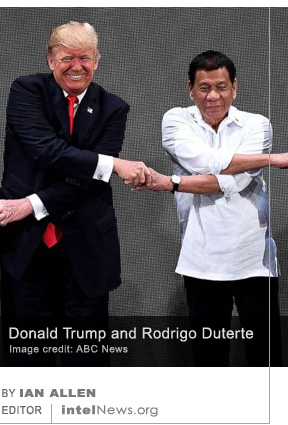
Trump and DuterteA wide-ranging assessment by the United States Intelligence Community views the President of the Philippines, Rodrigo Duterte, as a major threat to democracy and human rights in Southeast Asia. The report, published on February 13, represents a joint assessment of worldwide challenges to the interests of the United States. It is compiled annually by all 16 member agencies that make up the US Intelligence Community. This year’s report warns that democratic governance and human rights would continue to be “fragile” in 2018, because of the autocratic governing style of several national administrations. Many Southeast Asian governments were also corrupt and displayed nepotistic tendencies, says the report. It singles out the government of Myanmar, which has been widely criticized for its inhuman treatment of the country’s Muslim Rohingya minority. It also mentions the autocratic government of Thailand, which recently changed the country’s constitution, giving increased legislative powers to the country’s armed forces.
But much of the criticism in the report focuses on the administration of President Duterte, who has led a self-styled “war on drugs, corruption and crime” in the Philippines since he assumed office in June 2016. His critics in the Philippines and abroad have voiced strong objections to his aggressive tactics, which, by the government’s own account, have left more than 4,000 people dead in the past 18 months. Some human rights groups estimate the number of deaths at 11,000 or even higher. The US intelligence report notes that Duterte declared martial law in the Philippines’ southern region of Mindanao, which is expected to remain in place for most of 2018. It expresses concerns about rumors that the government may continue to impose martial law indefinitely and that it may extend it nationwide. It also expresses concern about Duterte’s prior statements that he intends to turn his government into a “revolutionary regime”.

On Tuesday, opposition lawmakers in the Philippines expressed concern about the US intelligence report and advised the Duterte administration to take its contents into consideration. But government representatives in Manila dismissed the US assessment as “myopic” and “speculative at best”. They insisted that the Philippines president “adheres to the rule of law” and would “remain loyal to the constitution” of the country. In November of last year, US President Donald Trump met Duterte during the Asia-Pacific Economic Cooperation summit in Danang, Vietnam. Earlier in the year, the two men spoke on the phone. During that conversation, the American leader reportedly praised his Philippine counterpart for doing an “unbelievable job” in combating the drug trade in his country. Duterte is expected to visit the White House later this year.

Author: Ian Allen | Date: 22 February 2018 | Permalink

Conflicting reports of Russian fighters killed by US forces in Syria

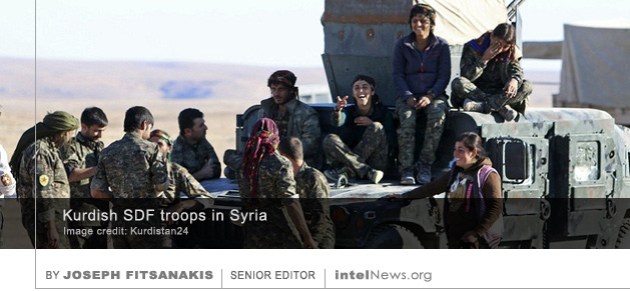
Kurdish SDF There are conflicting reports of Russian and Ukrainian fighters having been killed by American forces in northeastern Syria, with some sources claiming that up to 200 Russians and Ukrainians, most of them private contractors working for the Syrian government, were left dead in clashes last week. If such reports are accurate, they could point to the most lethal American-Russian confrontation since the end of World War II.

According to the United States Department of Defense, the armed confrontation took place on February 7. On that day, a 500-strong Syrian government force crossed the Euphrates River and entered Kurdish-controlled territory in northeastern Syria. A Pentagon spokesman, Colonel Thomas F. Veale, told reporters last week that the pro-government forces crossed the Euphrates near the town of Khursham, in Syria’s Deir al-Zour region. The town is firmly held by the Syrian Democratic Forces (SDF), a Kurdish armed faction that is supported by the US. Veale said that the Syrian government forces advanced in a “battalion-sized formation supported by artillery, tanks, multiple-launch rocket systems and mortars”. The SDF force in the area, which includes embedded American troops, responded with artillery fire, while US military aircraft also launched strikes on the government forces. The latter withdrew across the Euphrates after suffering heavy losses. The US side estimates that over 100 attackers were left dead, with another 200-300 injured. There were allegedly no SDF fatalities during the clash.

On February 8, CBS News cited an unnamed US Pentagon official, who claimed that Russians were among the dead in Deir al-Zour. The BBC said that “at least two Russians” were killed in the attack, while The New York Times raised the toll to “perhaps dozens”. But US news network Bloomberg claimed that over 200 Russians and pro-Russian Ukrainian mercenaries were among the dead. Citing anonymously “three Russians [and] one US official […] familiar with the matter”, the network said that most of the fatalities were Russian and Ukrainian private contractors who were fighting in Syria in support of the government of President Bashar al-Assad. These reports mark the first known instance of Russian citizens killed by American forces in Syria. If the Bloomberg account is accurate, the Deir al-Zour clash could be the most extensive armed confrontation between Americans and Russians since the end of World War II.

Bloomberg said that it spoke by phone to one Russian military contractor who said that “dozens of his wounded men” were still receiving treatment at military hospitals in Russia. On February 8, the Syrian government accused Washington of carrying out a “brutal massacre” in Deir al-Zour, but said nothing about foreign fighters. A statement by the Russian Ministry of Defense said that 25 Syrian troops were hurt in the attack, but denied that Russian soldiers had participated in the February 7 clashes. Speaking on behalf of the Kremlin, Russian government spokesman Dmitry Peskov said that Moscow only tracked casualty data about its official military forces stationed in Syria. He added that no Russian forces were stationed in Deir al-Zour. At a press conference last week, US Secretary of Defense James Mattis refused to discuss the matter, which he referred to as “perplexing”. Bloomberg said that American officials were “in talks” with Russian counterparts “in search of an explanation for what happened”.

Author: Joseph Fitsanakis | Date: 14 February 2018 | Research credit: N.L. | Permalink

US immigration and customs agency seeks to join Intelligence Community

Immigration and Customs Enforcement ICEThe United States Immigration and Customs Enforcement (ICE) is reportedly seeking to join the Intelligence Community, which includes the Central Intelligence Agency, the Defense Intelligence Agency, and other intelligence-focused arms of the federal government. Currently, ICE is a federal law enforcement that operates under the umbrella of the Department of Homeland Security. It consists of two components: Homeland Security Investigations, which probes cross-border criminal activity, including drugs and weapons trafficking, money laundering and cybercrime; and Enforcement and Removal Operations, whose mission is to find and capture undocumented aliens.
But some senior ICE officials have been exploring the possibility of joining the US Intelligence Community. According to The Daily Beast, which reported the alleged plans, the officials believe that by joining the Intelligence Community, ICE will become privy to intelligence that will assist in its mission. They also claim that membership in the Intelligence Community would afford ICE “greater prestige, credibility and authority” within the federal government. The Daily Beast reports that ICE’s effort to join the Intelligence Community began during the administration of US President Barack Obama. However, it has picked up steam following the election of President Donald Trump. Some believe that President Trump would be willing to sign an executive order that would incorporate ICE in the Intelligence Community.

Some civil liberties watchdogs, however, are weary of such plans. They claim that ICE is a domestic law enforcement agency and should not have access to practices and techniques used by spy agencies like the CIA or the National Security Agency. The latter frequently break the laws of foreign countries in pursuit of their mission, which is to steal foreign intelligence. These agencies are characterized by a different culture, say critics, which is not respectful of legal constraints. But supporters of ICE’s proposed inclusion into the Intelligence Community argue that there are several law enforcement agencies that are already members of the Intelligence Community. Notably, the Federal Bureau of Investigation and the Drug Enforcement Administration —both law enforcement agencies— belong to the Intelligence Community.

The Daily Beast said it contacted ICE but a spokesperson refused to comment on the story. The Department of Homeland Security did not return emails and phone calls about the proposal to include ICE in the Intelligence Community.

Author: Joseph Fitsanakis | Date: 08 February 2018 | Permalink

Ex-spy chief claims Palestinian officials worked with CIA to wiretap opponents

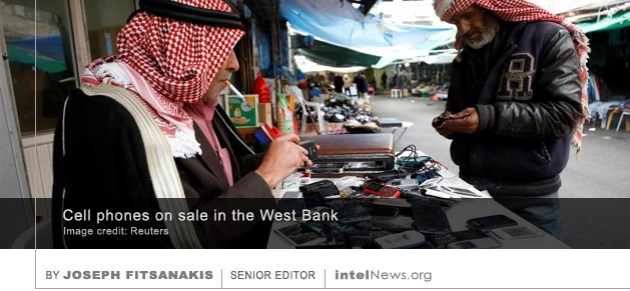
Telephones PalestineThe former head of the Palestinian Authority’s spy agency claims that the Palestinian government in the West Bank worked with the United States Central Intelligence Agency to wiretap thousands without court authorization. Tawfiq Tirawi, who headed the Palestinian General Intelligence from its founding in 1994 to 2008, has filed an official complaint against the Palestinian Authority and is calling for a criminal investigation into the alleged wiretaps. The complaint has also been signed by Jawad Obeidat, who is the president of the West Bank’s Bar Association. It is based on a leaked 37-page document that surfaced last month on the social networking application WhatsApp. The document was leaked by an anonymous individual who claims to have worked for a surveillance unit in the Palestinian Preventive Security Service, the Palestinian Authority’s domestic security service.


The leaked document appears to show that the Palestinian Preventive Security Service reached out to the CIA in 2013 asking for assistance with installing a communications surveillance system in the West Bank. The CIA agreed to provide the system in exchange for access to the intercepted data. The two agencies installed the interception system in the summer of 2014 and initiated what appears to have been a large-scale operation that included thousands of telephone subscribers. Initial targets of the operation included members of Hamas —the Palestinian group that controls the Gaza Strip— as well as members of the Iran-supported Islamic Jihad Movement in Palestine. But, according to the Associated Press, over time the targets of the program expanded to include “thousands of Palestinians, from senior figures in militant groups to judges, lawyers, civic leaders and political allies of Abbas”. The list of targets included Tirawi and Obeidat, who filed the official complaint on Tuesday.

The anonymous leaker of the document said he decided to quit his job and reveal the information about the intercepts after US President Donald Trump shifted Washington’s policy on Israel’s capital, by officially recognizing Jerusalem as the capital of the Jewish state. Earlier in February, the Palestinian Authority dismissed the leaked document as “nonsense” and said it was part of a large conspiracy that sought to harm Palestinian interests. The CIA refused to comment on the allegations.

Author: Joseph Fitsanakis | Date: 07 February 2018 | Permalink

Dutch spies identified Russian hackers who meddled in 2016 US election

Cozy BearDutch spies identified a notorious Russian hacker group that compromised computer servers belonging to the Democratic Party of the United States and notified American authorities of the attack, according to reports. In 2016, US intelligence agencies determined that a Russian hacker group known as Cozy Bear, or APT29, led a concerted effort to interfere in the US presidential election. The effort, which according to US intelligence agencies was sponsored by the Russian government, involved cyber-attacks against computer systems in the White House and the Department of State, among other targets. It also involved the theft of thousands of emails from computer servers belonging to the Democratic National Committee, which is the governing body of the Democratic Party. The stolen emails were eventually leaked to WikiLeaks, DCLeaks, and other online outlets. Prior descriptions of the Russian hacking in the media have hinted that US intelligence agencies were notified of the Russian cyber-attacks by foreign spy agencies. But there was no mention of where the initial clues came from.

Last Thursday, the Dutch current affairs program Nieuwsuur, which airs daily on Holland’s NPO 2 television, said that the initial tipoff originated from the AIVD, Holland’s General Intelligence and Security Service. On the same day, the Dutch newspaper De Volkskrant published a detailed account of what it described as AIVD’s successful penetration of Cozy Bear. According to these reports, AIVD was able to penetrate Cozy Bear in mid-2014, before the hacker group intensified its campaign against political targets in the US. Citing “six American and Dutch sources who are familiar with the material, but wish to remain anonymous”, De Volkskrant said that the AIVD was able to detect the physical base of the Cozy Bear hackers. The latter appeared to be working out of an academic facility that was adjacent to Moscow’s Red Square. The AIVD team was then able to remotely take control of security camera networks located around the facility. Eventually, the Dutch team hacked into another security camera network located inside the buildings in which the hackers worked. They soon began to collect pictures and footage of Cozy Bear members, which they then compared with photos of “known Russian spies”, according to De Volkskrant.

The paper said that the AIVD team continued to monitor Cozy Bear’s activities until at least 2017, while sharing intelligence with the Central Intelligence Agency and the National Security Agency in the US. The intelligence was allegedly instrumental in alerting US spy agencies about Russian government-sponsored efforts to meddle in the 2016 presidential election. Several newspapers, including The Washington Post in the US and The Independent in Britain, contacted the AIVD and the MIVD —Holland’s military intelligence agency— over the weekend. But the two agencies said they would not comment on reports concerning Cozy Bear.

Author: Joseph Fitsanakis | Date: 29 January 2018 | Research credit: E.J. & E.K. | Permalink