Vietnam arrests deputy security minister in unprecedented anti-corruption campaign
August 10, 2018 Leave a comment
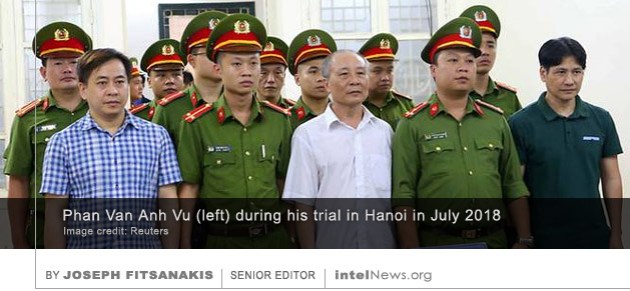 In a move that has stunned Vietnamese society, authorities in Hanoi have arrested one of the country’s most powerful security officials, allegedly for helping a business tycoon and former intelligence agent escape abroad. The move, which observes described as “unprecedented” in modern Vietnamese history, signals a widening of the anti-corruption campaign that started in 2016 and is now affecting Vietnam’s powerful intelligence agencies. Vietnam boasts one of Asia’s fastest-growing economies, but its economic performance is severely hampered by corruption, which is endemic in the communist country of 93 million. In its most recent Corruption Perceptions Index, Transparency International ranked Vietnam 107th out of the world’s 180 countries, behind nations like Colombia, Albania and Zambia. Two years ago, the Vietnamese government launched an anti-corruption campaign, which has so far resulted in a wave of arrests and demotions of senior officials in the country’s lucrative energy and banking sectors. The moves have stunned the Vietnamese public, which is not used to witnessing public discussions of corruption, let alone the open punishment of state officials.
Until this week, one major area of government appeared to have been spared from the anti-corruption probe: the feared security and intelligence community. This largely means the Ministry of Public Security (MPS), which is the most powerful civilian agency in the country and has traditionally been off-limits during previous transitional periods in Vietnam’s turbulent history. The MPS is in charge of the country’s extensive police force, its civilian intelligence wing, and its nascent cyber security units. The size of its employee base is classified, though it is believed to be vast.
But now the traditional shielding of the MPS from the unprecedented changes taking place in the Vietnamese government appears to have ended. On Wednesday, authorities announced the arrest of Bui Van Thanh, MPS’ deputy minister and the country’s second most powerful intelligence official. A press statement issued by the government said that Thanh had committed “serious violations in his work”. Consequently, he had been dismissed and his military rank would be lowered from lieutenant general to colonel. Government officials said Thanh came under suspicion for facilitating the escape of Phan Van Anh Vu, a government employee who became a property tycoon after amassing a large personal fortune while working as an MPS agent. Vu was wanted by Hanoi for allegedly selling state secrets in exchange for money, but managed to leave the country. In January, however, he was arrested in Singapore and extradited to Vietnam. He reportedly told authorities that a fake passport in his possession had been given to him by Thanh. He also said that Thanh helped him buy state property by giving him inside information affecting the sale prices. In July, Vu was jailed or nine years for espionage and corruption, following a closed-door trial. The precise charges against him remain unclear.
Earlier this week, the Vietnamese government announced that a “major restructuring” would be taking place in the MPS, with the aim of reducing its size and maximizing its efficiency. Government media reported that “hundreds of departments” would be merged and the overall structure of the organization would be heavily scrutinized. Many observers believe that more arrests and demotions will follow in connection with this announcement. Some critics have argued, however, that political infighting is fueling the anti-corruption probe and that it is a concealed attempt to neutralize intra-party opponents of the current administration in Hanoi.
► Author: Joseph Fitsanakis | Date: 10 August 2018 | Permalink
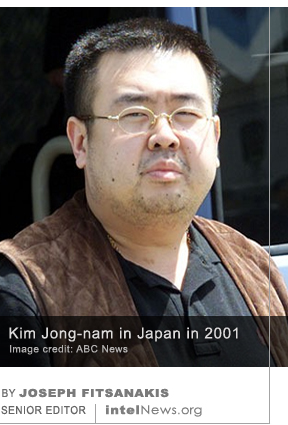 Two women have been arrested in the past 48 hours in connection with the assassination of Kim Jong-nam, half-brother of North Korea’s supreme leader, who died in Malaysia on Monday. Kim, the grandson of North Korea’s founder Kim Il-Sung, died after two women approached him at the Kuala Lumpur International Airport and splashed his face with liquid poison. Some reports suggest that he was injected with a poisoned needle.

 By IAN ALLEN | intelNews.org |










 intelNews.org
Malaysia releases second female assassin of Kim Jong-un’s half-brother from prison
May 3, 2019 by Joseph Fitsanakis Leave a comment
Both women told Malaysian police that they worked as escorts and that they were under the impression that they had been hired by a Japanese YouTube show to carry out a televised prank on an unsuspecting traveler. They claimed that they did not realize that the men who had hired them several months prior to the assassination operation were agents of the North Korean government —which international authorities blamed for Kim’s murder. In March of this year, Malaysian authorities announced that all charges against the Indonesian woman, Siti, had been dropped, and that she would be released from detention. No reasoning behind the decision was provided to the media. On Thursday, it was revealed that Huong would be freed, after she agreed to plead guilty to a much lesser charge of “causing bodily injury”, as requested by government prosecutors.
What is behind the decision of the Malaysian court? British newspaper The Guardian said last month that the government of Indonesia engaged in intense “behind-the-scenes diplomacy” in order to have its citizen released. These efforts “significantly influenced how events […] unfolded in the courtroom”, said the paper. Additionally, the Malaysian government had been uncomfortable with the international attention of this incident from the very beginning, and had expressed the desire “to be done with the trial because it was diplomatically inconvenient”, according to The Guardian. The paper added that, as the international status of Kim Jong-un rose unexpectedly through his meetings with United States President Donald Trump, Malaysia sought to be “part of this conversation”. Kuala Lumpur thus decided that “the recovery of [its] relationship with Pyongyang [was] more important than justice for the assassination of Kim Jong-nam”, former South Korean intelligence officer Dr. Nam Sung-wook told The Guardian.
► Author: Joseph Fitsanakis | Date: 03 May 2019 | Permalink
Filed under Expert news and commentary on intelligence, espionage, spies and spying Tagged with assassinations, Doan Thi Huong, Indonesia, Kim Jong-nam, Malaysia, News, North Korea, Siti Aisyah, Vietnam