KGB officer who handled Aussie double spy is now Putin crony
November 10, 2014 Leave a comment
 By JOSEPH FITSANAKIS | intelNews.org
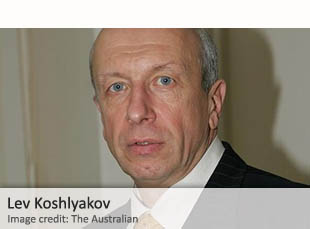
A KGB intelligence officer, who handled an Australian double spy during the closing stages of the Cold War, now holds several prestigious corporate posts in Moscow and is believed to be close to Russian President Vladimir Putin. Lev Koshlyakov, 69, is director of corporate communications for two Russian airline companies, including the state carrier, Aeroflot, and a member of the prestigious Moscow-based Council for Foreign and Defense Policy. But from 1977 until 1984, Koshlyakov served as the press and information officer for the Russian embassy in Australian capital Canberra. Intelligence sources, however, told The Weekend Australian last week that Koshlyakov’s diplomatic status was in fact a cover for his real job, which was station chief for the Soviet KGB. During his stint in Canberra, Koshlyakov is believed to have handled an especially damaging mole inside the Australian Security Intelligence Organisation (ASIO), who was allegedly recruited by his predecessor, KGB station chief Geronty Lazovik. Canberra was alerted to the existence of the mole in 1992, when the United States Central Intelligence Agency (CIA), along with Britain’s’ Secret Intelligence Service (MI6), briefed Australian officials on information acquired from Russian defectors. Soon afterwards, a government-commissioned report produced by Australian former diplomat Michael Cook described Koshlyakov as “one of the most dangerous KGB officers ever posted” to Australia. Eventually, Koshlyakov was assigned to a desk job by the KGB, after his cover was blown in Norway, where he was also serving as KGB chief of station. The Norwegians expelled Koshlyakov in 1991 after accusing him of espionage activities that were incompatible with his official diplomatic status. Since his retirement, however, Koshlyakov has done well for himself, having been appointed to senior corporate positions —some say with the personal backing of Russia’s President Vladimir Putin. As for the ASIO mole he allegedly handled in the 1980s, The Australian reports that he was forced to retire in 1992, after he was identified by the CIA and MI6. There was insufficient evidence to try him, however, so he “lived out his retirement in Australia” looking nervously over his shoulder, says the paper.










 intelNews.org
Putin says US and Ukrainian intelligence ‘lured’ Russian mercenaries into Belarus
August 28, 2020 by Joseph Fitsanakis 1 Comment
The Investigative Committee, Belarus’ primary investigating authority, determined that the 33 had entered the country as part of a 200-strong group of Russians working for Wagner, in order to destabilize the country in the run-up to the presidential election. The election resulted in the return to office of Belarus’ authoritarian leader, Alexander Lukashenko, for a record sixth term. According to Belarussian state television, the 33 Russians were found in possession of Sudanese currency and a Sudanese smartphone card. Sudan is believed to be one of Wagner Group’s most active areas of operation, and in the past the company has used Belarus as a transit center from which it coordinates its operations in the African continent.
On Thursday, however, Russian President Vladimir Putin claimed that the 33 Russians were arrested as part of a joint American-Ukrainian intelligence operation, which lured the Wagner employees into Belarus. Speaking to state-owned Rossiya 24 television, Putin said the alleged operation was “carried out jointly by Ukrainian and American special services. The Russians, he said, had been hired “for absolutely legal work in Latin America and the Middle East” by an employer who “dragged them into Belarus”. The men were then “presented as a ‘strike force’ to destabilize [Belarus] during the presidential campaign”, said the Russian strongman.
Putin’s statement follows reports earlier this month in the Russian media, which claim that the 33 Russians were given forged passports as part of the alleged joint American-Ukrainian operation, in order to enable them to leave Russia undetected. However, neither the Russian media nor the Russian leader have provided evidence for these claims. Meanwhile Belarus expelled 32 of the 33 Russians a few days following their arrest. One remains in prison in the Belarussian capital Minsk.
► Author: Joseph Fitsanakis | Date: 28 August 2020 | Permalink
Filed under Expert news and commentary on intelligence, espionage, spies and spying Tagged with Belarus, interviews, News, PMC Wagner, Russia, Vladimir Putin