German spy services face criticism for failing to anticipate swift Taliban victory
August 20, 2021 2 Comments

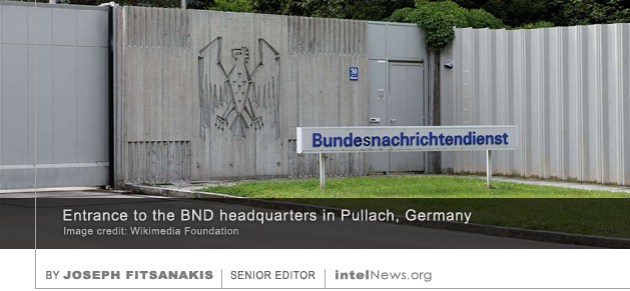
THE PRINCIPAL EXTERNAL INTELLIGENCE service of Germany, known as the Federal Intelligence Service, or BND, is facing growing criticism for allegedly failing to anticipate the swift ascendance of the Taliban in Afghanistan. Critics from every political faction have described the situation in Afghanistan as an “impending disaster” for German interests, and have questioned the BND’s effectiveness and competence.
In a statement to the Bundestag this past June, Germany’s Minister of Foreign Affairs, Heiko Maas, insisted that it was “inconceivable” that the Taliban “would, within just a few weeks, be able to seize power” in Afghanistan. In subsequent weeks, other leader members of Chancellor Angela Merkel’s cabinet echoed Maas’s statement. It now appears that, as German diplomats and intelligence officers were forced to leave hastily the Central Asian country, they left behind numerous “people employed in Germany’s interests”, analysis to the German national broadcaster, Deutsche Welle (DW).
In his according of the BND’s performance in the Afghan situation, DW journalist Marcel Fürstenau quotes former BND intelligence officer Gerhard Conrad, who claims that the spy agency lacked sources on the ground. Others, including University of London researcher Jan Koehler, tell Fürstenau that the German intelligence services failed to grasp the broader dynamics of Afghan society, which are permeated by “a lack of trust among the Afghan security forces in their own government”, and led them to surrender to the Taliban en masse.
The possibility of an official parliamentary investigation into the performance of the BND is now a strong prospect in the coming weeks, says Fürstenau. He adds that that several senior members of Chancellor Merkel’s government would have to testify behind closed doors during a probe. The soon-to-retire ‘iron lady’ of German politics may even have to testify after she leaves office, he concludes.
► Author: Joseph Fitsanakis | Date: 20 August 2021 | Permalink


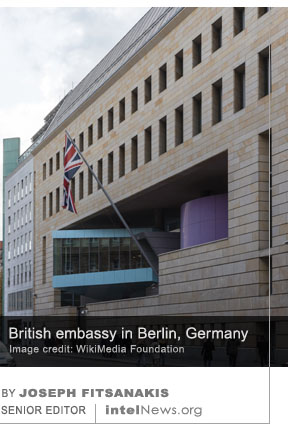 An employee of the British embassy in Berlin, who was arrested last week on suspicion of spying for Russia, drew the attention of the authorities after he stopped using his bank account, according to reports. The man, who was
 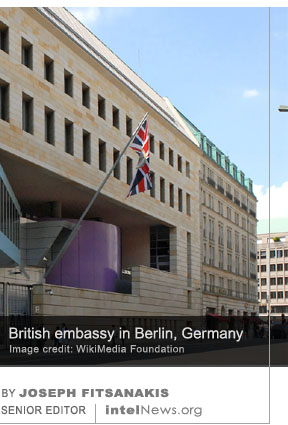 An employee of the British embassy in Berlin has been arrested by German authorities, who charged him with spying for the intelligence services of the Russian Federation, according to reports. The German newsmagazine Focus
 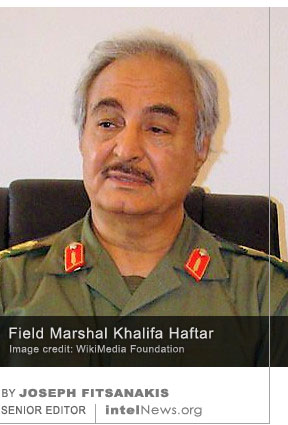 A new documentary aired on Tuesday by the BBC offers new evidence of extensive involvement in Libya by the Wagner Group, a secretive security firm believed to operate on behalf of Russian military intelligence. After first appearing in Ukraine in 2014, the company has been seen to operate around the world as a private paramilitary entity. Its mission is allegedly to afford the Kremlin “plausible deniability” capabilities for operations in the Middle East, Africa and Eastern Europe. As intelNews has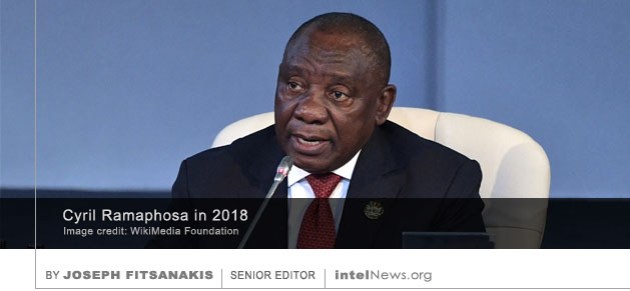

 POLAND’S COUNTERINTELLIGENCE SERVICES HAVE arrested for the second time a former executive of the Chinese telecommunications manufacturer Huawei Technologies, who is accused of spying for Beijing. As intelNews has previously









 intelNews.org
UK names Russian intelligence operatives who allegedly poisoned Alexei Navalny
August 23, 2021 Leave a comment
THE BRITISH GOVERNMENT HAS announced sanctions against seven Russian intelligence operatives who, according to London, participated in the poisoning of the Russian blogger and political activist Alexei Navalny. Navalny, 45, remains in prison after being arrested last year by Russian authorities, who accused him of violating his parole. His arrest occurred as soon as he arrived in Russia from Germany. He had gone there to receive emergency treatment after he was allegedly poisoned during a domestic Russian flight that originated from Siberia.
While in Germany, Navalny was in a comatose condition for over three weeks, and then spent a further 32 days recovering in hospital. Medical examiners concluded that he was most likely poisoned with a military-grade nerve agent. Many Western biomedical experts believe that Navalny, a vocal critic of Russian President Vladimir Putin, was poisoned with a so-called Novichok substance —a technical term that describes a category of nerve agents developed by the Soviet Union during the Cold War. Novichok agents are typically designed to asphyxiate their host by paralyzing the muscles they come in contact with.
On Friday —the day that marked the first anniversary of Navalny’s alleged poisoning— the British Foreign and Commonwealth Office announced that it would impose sanctions against seven Russian citizens. They were named as: Ivan Osipov, Alexei Sedov, Vladimir Panyaev, Kirill Vasilyev, Vladimir Bogdanov, Alexey Alexandrov and Stanislav Makshakov. All are believed to be employees of the Russian Federal Security Service (FSB), which operates as the country’s primary counterterrorism and counterintelligence agency.
British authorities released a statement to explain their decision to impose the sanctions against the seven Russians. The statement notes that the seven alleged FSB officers were identified using “phone and travel records”. These suggest that they were “involved in the use of a chemical weapon in the attempted assassination of Russian opposition leader Alexey Navalny during his August 2020 visit to Siberia”, the statement said. In an accompanying statement, Britain’s Foreign Secretary, Dominic Raab, urged Moscow “to declare its full stock of Novichok nerve agents”. The Russian government has dismissed all allegations that it tried to kill Navalny.
► Author: Joseph Fitsanakis | Date: 23 August 2021 | Permalink
Filed under Expert news and commentary on intelligence, espionage, spies and spying Tagged with Alexei Navalny, Alexei Sedov, Alexey Alexandrov, FSB, Ivan Osipov, Kirill Vasilyev, poisoning, Russia, Stanislav Makshakov, UK, Vladimir Bogdanov, Vladimir Panyaev