Freed Russian scientist convicted for spying maintains innocence
November 27, 2012 3 Comments
 By JOSEPH FITSANAKIS | intelNews.org |
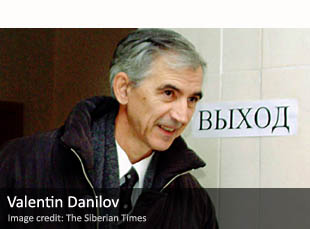
A Russian scientist who was pardoned last week, after spending nearly a decade behind bars for allegedly spying for China, has dismissed the charges against him as “pure fantasy”. Physicist Valentin Danilov was arrested by the FSB, the Russian Federal Security Service, in February of 2001 and charged with conducting espionage in the service of the Chinese space program. At the time of his arrest, Danilov headed the Thermo-Physics Center at Russia’s Krasnoyarsk State Technical University (KSTU), located in Siberia’s third largest city. For several years leading up to his arrest, he conducted research on the impact of solar activity on the condition and performance of space satellites. During his lengthy trial, Danilov admitted selling to the Chinese information on satellite technology belonging to the Russian government. But his defense team argued that the information in question had already been declassified and available in public sources since the early 1990s. Eventually, in November of 2004, a Russian Federal court found Danilov guilty of treason and sentenced him to 14 years in prison. He was supposed to be released in 2017. Earlier this month, however, a court in Krasnoyarsk found that, since Danilov had served most of his prison sentence in good behavior, and since his health was weak, he would be released early. In his first public interview since his release, Danilov, 66, has said he intends to take his case against the Russian government to the European Court of Human Rights. Speaking to reporters as soon as he emerged from prison, the Russian scientist said: “I would truly appreciate it if someone finally told me what state secret I sold”. He went on to comment directly on Russian President Vladimir Putin: “Everybody would be the same as him in his place, because it is the court that makes the czar”, he said, employing a traditional Russian proverb. Read more of this post







 intelNews.org
Belgian intelligence employees ‘outed themselves’ on LinkedIn
November 28, 2012 by Joseph Fitsanakis 6 Comments
Several alleged employees of Belgian security and intelligence agencies have revealed their identities on social networking sites, it has been reported. Belgian newspaper De Standaard, which made the revelation in a leading article on Tuesday, said that many LinkedIn and Facebook users appear to list their employer as Belgium’s State Security Agency (Sûreté de l’État or SE/SV) or the Coordinating Body for Threat Analysis (OCAM/OCAD). The SE is Belgium’s foremost civilian intelligence agency, operating under the country’s Ministry of Justice. OCAM is one of Belgium’s several anti-terrorist intelligence collection and analysis agencies, which operates under the joint supervision of the Justice and Interior Ministries. De Standaard contacted the two agencies, which refused to comment on whether the social networking profiles are authentic. But the paper spoke with an unnamed Belgian senior intelligence official, who said that this was potentially a very serious issue for Belgian national security. “Russian and Chinese intelligence services employ thousands of people”, said the official, “and have the resources and time to manually search for such profiles and then exploit the information they provide. Our people could, by their very presence on such sites, become the target of hostilities”. De Standaard also spoke to Belgian Senator Dirk Claes, who is a member of the country’s Parliamentary Committee on Intelligence. He told the paper that his colleagues in the Committee would be up in arms if the profiles turned out to be authentic. “These individuals have security clearances and are obligated to stay in the background, as much as possible. I will be raising this issue in the [Intelligence] Committee”, Claes told De Standaard. Read more of this post
Filed under Expert news and commentary on intelligence, espionage, spies and spying Tagged with Belgium, Dirk Claes, Facebook, LinkedIn, News, OCAM (Belgium), social networking, SV/SE (Belgium)