Analysis: Potential espionage aspects of attack on US Capitol must be considered

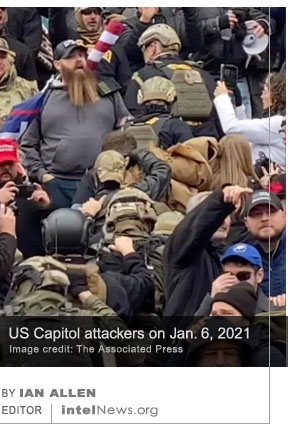
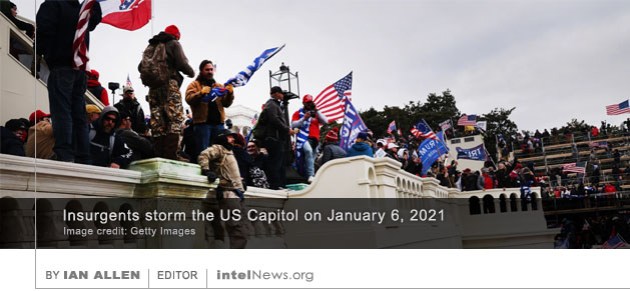
US CapitolTHE INSURGENTS WHO STORMED the United States Capitol Building Complex on January 6 may have unwittingly provided cover for teams of foreign spies, who could have stolen or compromised sensitive electronic equipment. This largely neglected security-related aspect of the attack is discussed in an insightful article by David Gewitz, a ZDNet and CNET columnist who writes about cybersecurity affairs.

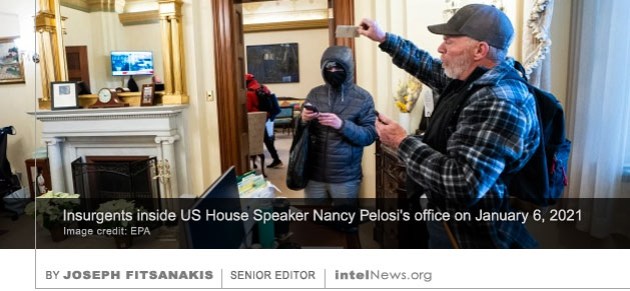
Hundreds of unauthorized people entered the US Capitol last Wednesday. Many of them entered the offices of several members of Congress, some of whom are members of Congressional committees on intelligence, armed services, defense, and other sensitive matters. According to Gewitz, “there is absolutely no knowing what actions were taken against digital gear inside the building” by the intruders. Most of them were clearly members of disorganized mobs, who appeared to have no concrete plan of action once inside the Capitol. However, points Gewitz, it would have been easy for foreign actors to blend in with the crowd of wild-eyed rioters and surreptitiously entered the Capitol in order to steal or compromise sensitive electronic equipment.

In addition to stealing electronic equipment, foreign spies could have stolen sensitive documents, access codes and passcodes, says Gewitz. He adds that more sophisticated efforts could have included loading malware onto Capitol computer systems, or plugging surreptitious USB drives into the internal ports of tower PCs —a process that takes less than two minutes for someone who is equipped with an pocket-size electric screwdriver. Foreign actors could also have left dozens of “generic USB drives in various drawers and on various desks” around the Capitol, hoping that members of Congress or their aides will make use of them in the coming days or weeks. For all we know, says Gewitz, the place could now be riddled with USB chargers with built-in wireless key-loggers, devices that look like power strips but actually hide wireless network hacking tools, fake smoke detectors, electric outlets or switches that contain bugs, and many other surreptitious spying devices.

What should Capitol security personnel do to prevent the potential espionage fallout from the January 6 attack? Gewitz argues that, given the extremely sensitive nature of the information that is stored in the Capitol’s digital systems, federal cybersecurity personnel should “assume that ALL the digital devices at the Capitol have been compromised”, he writes. They will therefore need to resort to “a scorched Earth remediation effort”, meaning that they will have to “completely scrub” those systems, and even lock the USB drive slots of every PC in the building complex. This damage will take months, even years, to clean up, he concludes.

Author: Joseph Fitsanakis | Date: 12 January 2021 | Permalink

FBI, NYPD forewarned Capitol Police of serious violence by Trump supporters

US CapitolTHE FEDERAL BUREAU OF Investigation and the New York Police Department gave Capitol Police officials specific warnings that supporters of United States President Donald Trump were determined to engage in serious violence on January 6, according to federal officials. The FBI even made contact with known far-right radicals across the United States in early January, and warned them not to travel to Washington for the pro-Trump rally that resulted in the bloody attack on the US Capitol, according to NBC News.
Citing “senior law enforcement officials”, including “a senior FBI official”, NBC reported on Sunday that the FBI had “credible and actionable information” about specific far-right radicals who intended to join the protest on January 6. This information was allegedly communicated to Capitol Police officials, according to the report. The senior FBI official, who is not named in report, told NBC that the Bureau made contact with those radicals and warned them not to travel to Washington for the protest. Citing “multiple law enforcement officials”, the news network also said that the Capitol Police was given extensive intelligence by NYPD about planned acts of violence on January 6. The intelligence was “specific”, “detailing the threats and extremist rhetoric on social media”, according to the news network.

Despite these warnings, however, Capitol Police reportedly turned down an offer of assistance by the US National Guard three days before the fateful siege of the Capitol Building Complex by thousands of pro-Trump insurgents, many of whom were armed. According to the Associated Press, despite the advanced and detailed warnings given to it, “the Capitol Police planned only for a free speech demonstration”.

Meanwhile, the experts warning of a significant risk of widespread violence on January 20, when President-Elect Joe Biden is scheduled to be sworn into office, are growing in number. On Sunday, Cindy Otis, a former Central Intelligence Agency analyst and vice-president of the Alethea Group, which tracks online threats, warned that “we are in a tinderbox situation right now”. She pointed to numerous threats made online, which claim that last Wednesday’s attack on the Capitol was “just a taste of things to come”. There are reports that far-right insurgents are preparing for a violent showdown in DC, aimed at preventing Biden from entering the White House on January 20. Other reports suggest that groups of insurgents seek to organize synchronous potentially violent rallies in every state of the union that day.

Author: Joseph Fitsanakis | Date: 11 January 2021 | Permalink

Analysis: US Capitol attack marks the beginning of a prolonged period of insurrection

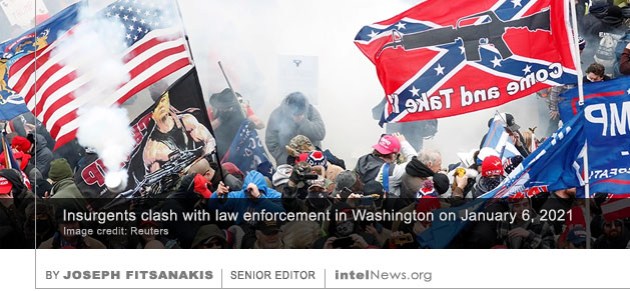
Rightwing militancy 2021IF WEDNESDAY’S ATTACK ON the United States Capitol Complex was part of a coup d’état, then the American political system should be considered safe for the time being. The mob that ransacked the Capitol was disordered, leaderless, and appeared to have no coordination, or even direction. However, the broader militant movement that it represents is evolving very rapidly. If left unchecked, it will be able to turn its weaknesses into strengths and spell major trouble ahead for the already stormy waters of American politics. The nation’s law enforcement and security agencies must therefore prepare for a period of widespread insurrection, some of which will be armed and lethal in nature. Insurrectionist acts are likely to occur across the nation, and may last for months, if not longer.
WHO CARRIED OUT THE ATTACK?

Wednesday’s attack was carried out by what can be described as the militant wing of the American nationalist-populist movement. This wing is not strictly representative of the US president’s broader political base. Its members see themselves as vanguard soldiers who are prepared to take extreme action to avert President Trump’s imminent departure from the White House. Such militant attitudes are not typical among Trump voters. Yet this vanguard is revered by Trump’s political base, a sizeable portion of which appears to be in support of Wednesday’s attack on the US Capitol. Indeed, early polling by YouGov suggests that over 40 percent of Republican voters strongly or somewhat support the attack on the US Capitol.Q Quote 1

Many members of this frontline force belong to organized militant cells, like the Oath Keepers, the Three Percenters, and —more recently— the Proud Boys. But these groups provide limited operational direction to their members, and were certainly not commanding Wednesday’s events. In fact, an audiovisual analysis of the attack shows that most of the assailants operated in makeshift groups and many didn’t even know each other’s names. There were no leaders directing the attacks on Wednesday. It is indeed likely that the militant figureheads of the movement were as surprised by the turn of events as the hapless members of the US Capitol Police.

HOW WAS THE ATTACK PREPARED?

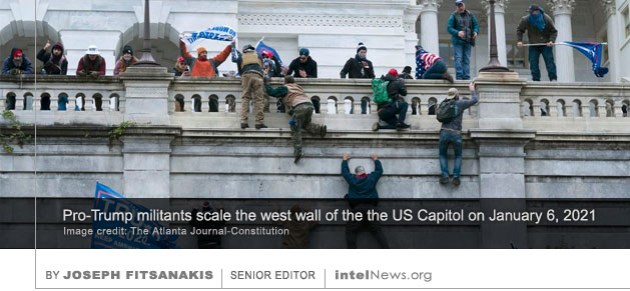
Many of the assailants were armed with tactical equipment, as well as with clubs, shields, chemical irritants, knives and other weapons. It also appears that at least one group of insurgents arrived at the Capitol with ropes, which they subsequently used to scale its walls. This points to earlier planning and coordination, which likely involved at least some reconnaissance. Read more of this post

Isaac Shoshan, Israeli undercover operative and case officer, dead at 96

MossadIsaac Shoshan, an Israeli undercover operative, who was involved in some of Israel’s most daring and controversial intelligence operations for over 40 years, has died. In 1990, Shoshan co-authored the book Men of Secrets, Men of Mystery with another Israeli former intelligence officer, Rafi Sutton. In 2019, his career was featured in the book Spies of No Country: Secret Lives at the Birth of Israel, written by the Israeli-Canadian journalist Matti Friedman.

In 1942, Shoshan, a Syrian Jew, traveled for the first time from his native Aleppo to Palestine, which was then under a British mandate. The 18-year-old was soon recruited by the Palmach, the intelligence wing of the Haganah, an armed underground Zionist organization. He carried out undercover work under the Palmach’s so-called ‘Arab Section’, or ‘Arab Platoon’, which consisted of Zionist paramilitaries and intelligence collectors who had grown up speaking Arabic.

After undergoing Islamic religious and cultural training, Shoshan participated in a Palmach operation to kill Sheikh Nimr al-Khatib, in early 1948. Al-Khatib was a Palestinian warlord that the Haganah feared would lead an Arab insurrection against Israel after the impending British withdrawal from Palestine. Although the assassination operation failed, al-Khatib was seriously injured and effectively incapacitated for the rest of his life.

Shoshan was then tasked with carrying out operations in several Arab countries, posing as an Arab. His base was Beirut, where he operated a taxi and worked at a kiosk as a cover. His activities included an elaborate assassination operation against Lebanon’s Prime Minister, Riad al-Suhl, which was aborted at the last minute by the Israeli leadership.

In the mid-1950s, Israeli intelligence disbanded its Arab units, following several failed operations, such as the so-called ‘Lavon affair’, which led to the arrests and executions of some of its undercover operatives. At that time, Shoshan was recalled to Israel, where he began to work as a case officer, with occasional undercover trips abroad, during which he posed as an Arab. He retired in 1982, but continued to carry out contracting work for the Mossad and other Israeli intelligence agencies until the late 1980s.

Author: Joseph Fitsanakis | Date: 05 January 2021 | Permalink

Afghans expel 10 Chinese spies who allegedly made contact with pro-Taliban group

The Afghan government reportedly expelled from the country 10 Chinese intelligence officers on Saturday, after they were found to have contacts with pro-Taliban groups. Meanwhile the White House was recently briefed about claims that Beijing offered Afghan militants bounties for killing American soldiers.
Several Indian news agencies reported last month that Afghanistan’s National Directorate of Security (NDS) arrested 10 Chinese nationals in Kabul on December 10, on suspicion of espionage. The 10 Chinese included at least one woman, and were believed to work for the Ministry of State Security (MSS), China’s primary intelligence agency.

According to reports in the Indian press, the Chinese nationals had used Kabul as a base to buld a fictitious chapter of the East Turkestan Islamic Movement (ETIM). Based in China’s heavily Muslim Xinjiang Province, ETIM is a sepratist armed group, which seeks to create an Islamic breakaway state for ethnic Uighurs. The purpose of the ruse was reportedly to entrap ETIM supporters and members who were operating in Afghanistan.

It is also alleged that at least two of the Chinese spies had contacts with the Haqqani network, a militant group that has pledged allegiance to the leadership of the Taliban, but maintains an independent command structure. Indian news networks named the two Chinese alleged spies with Haqqani Network contacts as Li Yangyang and Sha Hung. Interestingly, the arrests of the 10 Chinese nationals took place shortly before United States President Donald Trump was reportedly briefed about contacts between the MSS and pro-Taliban groups in Afghanistan. According to Axios, US intelligence agencies told the president that Chinese spies had offered Afghan militants bounty in exchange for killing American troops.

Citing “diplomats and security officials in Kabul” who are “familiar with the matter”, The Hindustan Times reported on Monday that the ten Chinese nationals had been released after 23 days in detention. They boarded a chartered airplane heading for China on Saturday, said the paper. None were formally charged. Their release was reportedly ordered by Afghan President Ashraf Ghani, following direct negotiations with Beijing.

Author: Joseph Fitsanakis | Date: 05 January 2021 | Permalink

Iran state media claims Britain and Germany helped US kill Soleimani

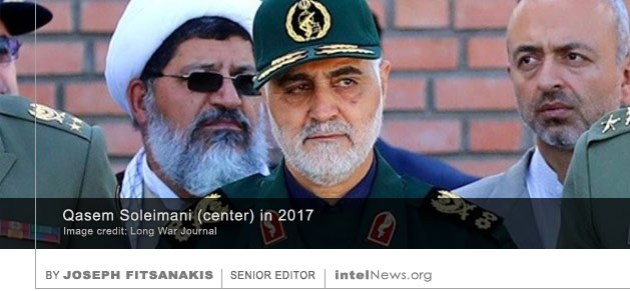
Qasem SoleimaniIRANIAN STATE MEDIA CLAIMED last week that several countries, including Britain and Germany, helped the United States assassinate its top paramilitary commander, Qassem Soleimani (pictured). The reports emerged on the one-year anniversary of the assassination of Soleimani, who led Iran’s Islamic Revolutionary Guard Corps (IRGC). He was killed by a drone strike on January 3, 2020, in Baghdad, Iraq. The same missile strike also killed Abu Mahdi al-Muhandis, who commanded the Popular Mobilisation Committee, an umbrella organization composed of about 40 pro-Iranian militias in Iraq.
Last week, Iran’s state-owned DEFA Press news agency reported that Tehran’s own investigation into the assassination operation showed that Washington was assisted by several countries, and even by some private security firms. According to the report, the Iranian government’s prosecutor, Ali Alqasimehr, stated that G4S, a security services contractor based in Britain, had “played a role” in Soleimani and al-Muhandis’ killing. He added that the US forces also made use of facilities at the Ramstein Air Base, located in southwestern Germany, to carry out the attack.

In addition to Britain and Germany, Iranian officials said that the governments of Qatar, Kuwait, Lebanon, Syria and Iraq assisted in the operation by providing logistical support and intelligence. According to DEFA Press, more countries are likely to be added to the Iranian government’s list of culprits, once Tehran concludes its investigation into the killing. Iranian officials have provided no evidence for such claims. It is also unclear whether Iran is considering launching revenge attacks against countries that allegedly assisted the US in its effort to kill the two paramilitary commanders.

Speaking during a commemoration event on Friday, Soleimani’s successor at the helm of the IRGC, Esmail Ghaani, said that Iran was “ready to avenge” Soleimani’s death. During the event, which was held at the University of Tehran, Ghaani warned that “someone who will retaliate for your crime […] may emerge from inside your own house”. He did not elaborate. Large commemorative gatherings to mark the one-year anniversary of the assassinations took place throughout Iran and Iraq, where Iran-backed paramilitary groups hold significant power.

Last January Iran issued a warning against Greece, saying that it would retaliate if the US used its military bases on Greek soil to attack the Islamic Republic. It was the first time that Iran had threatened to launch attacks against a member of the European Union in connection with the ongoing rise in tensions between Tehran and Washington.

Author: Joseph Fitsanakis | Date: 04 January 2021 | Permalink

Year in review: The biggest spy-related stories of 2020, part III

End of Year ReviewSince 2008, when intelNews was launched, it has been our end-of-year tradition to take a look back and highlight what we believe were the most important intelligence-related stories of the past 12 months. In anticipation of what 2021 may bring in this highly volatile field, we present you with our selection of the top spy stories of 2020. They are listed below in reverse order of significance, starting from 10 and leading up to 1. This is part three in a three-part series. Part one is available here and part two is here.

01. COVID-19 prompts spy agencies’ mission shift that is ‘reminiscent of the space race’. The worldwide competition to invent a vaccine that can curtail the spread of COVID-19, and to secure sufficient quantities of the vaccine, has prompted a mission shift in major intelligence agencies around the world. This mission shift is taking place with such speed that it is “reminiscent of the space race”, according to The New York Times. In an article published in September, the paper cited “interviews with current and former intelligence officials and others tracking the espionage efforts”, who suggest that the mission shift observed in spy agencies worldwide has been among the fastest in history.

02. Swiss neutrality ‘shattered’ as leading cryptologic firm revealed to be CIA front. Switzerland continues to reel from the shock caused by revelations in February that Crypto AG, the world’s leading manufacturer or cryptologic equipment during the Cold War, whose clients included over 120 governments around the world, was a front company owned by the United States Central Intelligence Agency. The revelation, published by The Washington Post and the German public broadcaster ZDF, confirmed rumors that had been circulating since the early 1980s, that Crypto AG had made a secret deal with the US government. According to this year’s revelations, the CIA and West Germany’s Federal Intelligence Service (BND) secretly purchased the Swiss company and paid off most of its senior executives in order to buy their silence. The secret deal allegedly allowed the US and West Germany to spy on the classified government communications of several of their adversaries —and even allies, including Italy, Spain and Greece, as well as Austria, Jordan, Saudi Arabia and the United Arab Emirates.

03. Danish spy service helped US collect intelligence on NATO allies. There was surprise among intelligence observers in August, when Lars Findsen, director of the Danish Defense Intelligence Service (FE, or DDIS in English) was “relieved of duty for the time being”. The Danish Ministry of Defense said the decision was taken following “a series of whistleblower revelations”. We now know the reason: apparently a secret arrangement between Danish and American intelligence agencies enabled Washington to collect intelligence on Danish citizens, as well as spy on some of its closest European allies, including Germany, France, Sweden, Norway, and Holland. The revelation prompted a heated political discussion in Denmark, while Norwegian, Swedish and Dutch authorities launched investigations into the alleged spying. Some in Denmark called for the Minister of Defense, Trine Bramsen, to release to the public a four-volume report government produced about the alleged Danish-US spy collaboration. This has not yet happened.

04. US forces are secretly helping the Taliban fight the Islamic State in Afghanistan. The original reason the United States sent troops to Afghanistan was to fight al-Qaeda and its local allies, the Taliban. Now, however, it appears US forces are helping the Taliban defeat the Islamic State in northeastern Afghanistan. The American military’s newfound role in Afghanistan reportedly reflects the view of the White House that the Taliban have no aspirations outside of Afghanistan, while the Islamic State seeks to challenge America’s interests worldwide. According to The Washington Post‘s military affairs reporter Wesley Morgan, US Joint Special Operations Command (JSOC) forces in Afghanistan have been instructed to provide air cover to Taliban forces as they fight the Islamic State. The resources used in that capacity consist of weaponry that was initially deployed against the Taliban, but is now being secretly repurposed to assist the Taliban in their fight against the Islamic State. According to Morgan, the JSOC team in Kunar, which provides air cover to the Taliban, jokingly refers to itself as the “Taliban air force”. It is unclear whether al-Qaeda, which is a close ally of the Taliban, is benefiting from that assistance.

This is part three in a three-part series. Part one is available here and part two is here.

Author: J. Fitsanakis and I. Allen | Date: 31 December 2020 | Permalink

Year in review: The biggest spy-related stories of 2020, part II

Year in ReviewSince 2008, when intelNews was launched, it has been our end-of-year tradition to take a look back and highlight what we believe were the most important intelligence-related stories of the past 12 months. In anticipation of what 2021 may bring in this highly volatile field, we present you with our selection of the top spy stories of 2020. They are listed below in reverse order of significance, starting from 10 and leading up to 1. This is part two in a three-part series. Part one is available here. Part three will be published on Thursday.

05. A group of foreign mercenaries, including Americans, organized a failed coup in Venezuela. In early May, Venezuelan authorities stopped Operation GEDEÓN, an attempt by around 60 armed mercenaries and local dissidents to forcibly remove President Nicolás Maduro from office. The plan centered on infiltrating Venezuela by sea and capturing the Simón Bolívar International Airport, in an attempt to arrest and expel Maduro and other senior cabinet members. It appears, however, that the operation had been infiltrated by Venezuelan government spies and informants. At least two Americans participated in the failed operation, which was allegedly masterminded by Major General Clíver Alcalá Cordones a Colombia-based retired military officer who has since entered US custody on drug-trafficking charges. It has also been alleged that the coup was launched from Colombia with the support of Silvercorp USA, a private security group led by Jordan Goudreau, a Canadian-born former sergeant in the US Green Berets. Allegations by the Venezuelan government that the coup was also supported by the Central Intelligence Agency have not been corroborated with evidence.

06. Argentine ex-president and spy agency leaders indicted in wiretapping probe. In Argentina, a widening investigation into a domestic spying program was broadened to include Mauricio Macri, the country’s former president, and the spy chief that served under him. The alleged espionage took place between 2015 and 2019, when Macri served as the first democratically-elected non-Peronist president of Argentina. But the country’s current president Alberto Fernández, has pledged to reform the security agency, which is known as the Federal Intelligence Agency (AFI, formerly SIDE). In June, the government gave a federal court in Buenos Aires a deposition containing list of over 80 names of Argentine citizens who were allegedly spied on by the AFI without a warrant during Macri’s administration. Since that time, the court has been investigating, aside from Macri, Gustavo Arribas, who served as AFI director under Macri, as well as his deputy director in the spy agency, Silvia Majdalani, and her brother-in-law, Darío Biorci. The names of other alleged culprits remain secret, reportedly because they are still serving as undercover agents in the AFI.

07. One of the world’s most wanted men may have worked for several spy agencies. Austrian financier Jan Marsalek, dubbed by some as “the world’s most wanted man”, is connected with the sudden collapse of Wirecard AG in Germany. Wirecard (est. 1999) was a German provider of financial services, such as electronic payment transaction systems. It declared insolvency in June, after an audit revealed that nearly €2 billion ($2.3 billion) were missing from its accounts. Marsalek, who had worked as Wirecard’s chief operating officer since 2010, was last seen heading to Manila, Philippines, before vanishing into thin air. An investigative report by The Financial Times revealed that his entrance record into the Philippines had been forged, probably by an intelligence agency. Some claim that Marsalek is now under Russian protection. Other reports suggest that he may have worked “for several intelligence agencies at the same time” prior to his disappearance, including as an informant for the Austrian Office for the Protection of the Constitution and Counterterrorism (BVT). Meanwhile, Marsalek’s whereabouts remain unknown.

This is part two in a three-part series. Part one is available here. Part three will be published on Thursday.

Author: J. Fitsanakis and I. Allen | Date: 30 December 2020 | Permalink

Year in review: The biggest spy-related stories of 2020, part I

End of Year ReviewSince 2008, when intelNews was launched, it has been our end-of-year tradition to take a look back and highlight what we believe were the most important intelligence-related stories of the past 12 months. In anticipation of what 2021 may bring in this highly volatile field, we present you with our selection of the top spy stories of 2020. They are listed below in reverse order of significance, starting from 10 and leading up to 1. This is part one in a three-part series. Part two will be available on Wednesday and part three on Thursday.

08. Spanish high court broadens illegal wiretap probe to include senior politicians. In September, Spain’s highest criminal court broadened the scope of the Gürtel case, which refers to one of the most extensive corruption scandals in Spanish political history. It centers on an extensive network of tax evasion, bribery and money laundering, which brought together leading business executives, criminal kingpins, and senior politicians from Spain’s conservative Partido Popular (PP). In 2018, the scandal effectively brought an end to the government of conservative Prime Minister Mariano Rajoy, and has virtually annihilated the PP’s once robust electoral popularity. But this corruption investigation is now resulting in several related probes, among which is Operation KITCHEN, an espionage effort connected to the Gürtel case, which targeted Luis Bárcenas, a PP senator and treasurer. It turns out that, once senior government executives realized Bárcenas was about to turn government witness, they set up an espionage operation aimed at preventing him from doing so. Now a new series of prosecutions is taking place in connection to Operation KITCHEN, involving leading PP figures.

09. Massive hacker attack triggers emergency US National Security Council meeting. The computer systems of the United States government are targeted by hackers every minute of every day. These attacks do not usually prompt emergency meetings of the National Security Council —the country’s most senior decision-making body, which is chaired by no other than the president. But the massive data breach that was uncovered earlier this month did just that, with some experts describing it as potentially being among “the most impactful espionage campaigns on record”. Although only discovered two weeks ago, the cyberespionage campaign is believed to date to last spring, possibly as early as March. Sources called it a highly sophisticated operation that originated from a “top-tier” adversary —a term that refers to a handful of state actors that have access to the most elite cyber operatives and advanced technologies in existence. It will take weeks to uncover the extent of the damage caused by this breach, and many months —possibly even longer— to recover from it. Security expert Bruce Schneier said that, in order to fend off against “persistent access, the only way to ensure that your network isn’t compromised is to burn it to the ground and rebuild it, similar to reinstalling your computer’s operating system to recover from a bad hack”.

10. In extremely rare move, Russia’s spy agency disclosed identities of undercover officers. The Russian Foreign Intelligence Service (SVR), which inherited the external intelligence functions of the Soviet-era KGB, does not usually disclose the identities of its undercover operatives. But in January of this year, in an extremely rare move, its director, Sergei Naryshkin, did just that during a commemoration event marking the centenary of the KGB and the SVR. The identities of seven non-official-cover officers, referred to in Russian as ‘pазведчики-нелегалы’, or ‘illegals’ —most of whom are now retired or dead— were disclosed along with brief biographical notes. The term illegals refers to undercover intelligence officers who are secretly posted abroad without diplomatic cover. Accordingly, they have no official connection to a Russian diplomatic facility, while some even pose as citizens of third countries. The accompanying biographies released by the SVR disclose no specifics about the countries in which these illegals operated, the type of work they carried out, and the specific dates in which they were active. Most of them operated between the late 1960s and the early 1990s.

This is part one in a three-part series; Part two will be available on December 30 and part three on December 31.

Author: J. Fitsanakis and I. Allen | Date: 29 December 2020 | Permalink

George Blake, arguably the most prolific Soviet spy of the Cold War, dies at 98

George BlakeGEORGE BLAKE, A DUTCH-born British intelligence officer, whose espionage for the Soviet Union gained him notoriety in the West and hero status in Moscow, has died aged 98. His death was announced on Saturday by the state-owned Russian news agency RIA Novosti. It was later corroborated by a spokesman for the Russian Foreign Intelligence Service (SVR), who said Blake “had a genuine love for our country”.

Blake was nearly 18 when German troops entered his native Holland, prompting him to join the local anti-Nazi resistance forces. A British subject thanks to his Egyptian Jewish father, who had acquired British citizenship by fighting in British uniform during World War I, Blake eventually made his way to London via neutral Spain and Gibraltar. Within two years, he had been recruited by the Secret Intelligence Service, or MI6, and by war’s end he was working in its Dutch Section.

Named after King George by his fiercely pro-British and royalist father, Blake drew no suspicion by his MI6 colleagues. He was hard-working and came across as a strict Calvinist, with strong religious leanings. But his view of the Soviet Union began to change at Cambridge University, where he had been sent by MI6 to learn Russian language and history. In 1950, while he was serving under official cover at the British embassy in Seoul, Korea, he was captured and detained for three years by North Korean forces. His ideological defection to communism appears to have taken place during his capture, during which he was given access to English-language Marxist literature and had long discussions with Soviet political instructors.

By 1953, when he was released by his captors and returned to a hero’s welcome in London, Blake was a committed communist. Less than a month following his release, he made contact with Nikolai Rodin (codename SERGEI) who was the KGB’s station chief in London. He began to spy for the Soviet Union, and did so for eight years, including during his stint as an MI6 case officer in Berlin. During that time, he is believed to have betrayed information that led to the detection of over 500 Western intelligence officers and assets operating behind the Iron Curtain, with as many as 44 of those losing their lives as a result. His career as a double spy ended in 1960, when he was betrayed by Polish defector Michael Goleniewski. Goleniewski’s debriefing by the United States Central Intelligence Agency helped Britain identify two Soviet moles inside its intelligence establishment, one of whom was Blake.

In 1960, after pleading guilty to espionage, Blake began serving a 42-year prison sentence in Britain’s Wormwood Scrubs maximum security prison complex. But in 1966 he was able to escape with the help of a group of Irish republican prisoners, and made contact with Soviet intelligence. He was eventually smuggled into East Germany and from there to Russia. Once there, he joined the KGB and served as a consultant and instructor until his retirement in the early 1990s. He learned to speak Russian fluently, married a Russian wife (his British wife having divorced him once he was convicted of espionage) and had a son.

Russian President Vladimir Putin issued a statement on Sunday, praising Blake’s espionage “in the cause of peace”, while the SVR described him as a model intelligence officer. A report published by RIA Novosti on Sunday said that the Moscow city council was considering a proposal to rename a street in the Russian capital after Blake.

Author: Joseph Fitsanakis | Date: 28 December 2020 | Permalink

Colombia and Russia expel diplomats over espionage allegations

SVR hqCOLOMBIA EXPELLED TWO RUSSIAN diplomats earlier this month, without publicly explaining why, according to news reports. Several Colombian news outlets reported on Tuesday that the two Russians were expelled after they were found engaging in espionage. Also on Tuesday, Colombian officials confirmed earlier reports that Moscow had expelled two Colombian diplomats in a tit-for-tat response.

At a press conference held in Bogota on Tuesday December 22, officials from Colombia’s Ministry of Foreign Affairs revealed that two Russian diplomats had been expelled from the Colombian capital on December 8. However, they refused to provide the reasons for the expulsions, other than to claim that the two Russians had “engaged in violations” of the Vienna Convention on Diplomatic Relations. In a separate interview, Colombian President Ivan Duque said that “to reveal more information at this moment would not correspond with the principal of continuing bilateral relations” between Colombia and Russia.

However, several leading Colombian newspapers, including El Tiempo and Semana claimed that the two Russians had engaged in espionage that targeted Colombia’s energy and minerals industry in the city of Cali. An urban center of 2.2 million inhabitants, Cali is known as southern Colombia’s leading economic hub, and is among Latin America’s fastest-growing local economies.

El Tiempo named the two Russians as Alexander Paristov and Alexander Belousov. Also on Tuesday, Colombia’s W Radio alleged that Paristov is an officer in the Russian Foreign Intelligence Service, which is the Russian equivallent of the United States’ Central Intelligence Agency. It added that Belousov is an officer in the Main Directorate of the Russian Armed Forces’ General Staff, which is known as GRU.

The Russian Ministry of Foreign Affairs and the Russian embassy in Bogota did not respond to questions by Colombian media about the diplomats’ expulsions.

Author: Joseph Fitsanakis | Date: 24 December 2020 | Permalink

Mutual distrust of China heightens US-Indian intelligence cooperation to historic levels

India External Affairs MinistryINTELLIGENCE COOPERATION BETWEEN THE United States and India has reached historic levels in the closing months of 2020, and is driven by the two countries’ mutual distrust of China. This development is particularly noteworthy for India, which has traditionally maintained a non-aligned stance in military and intelligence matters for much of its existence. New Delhi’s increasingly close relationship with Washington is described by some experts as “a revolution in the way that India views the world and aligns with partners in Asia”.

The deepening intelligence cooperation between India has its roots in 2002, when the military forces of the two nations formalized intelligence-sharing systems on matters of regional security. In 2016, a new bilateral logistics agreement enabled them to share each other’s facilities in order to repair or resupply vehicles, vessels and aircraft. Two years later, the US gave India access to secure communications equipment that is also used by the US Navy and Air Force.

These military- and intelligence-sharing agreements were reinforced in recent months, after India and China were involved in a bloody border dispute in the Himalayan region. The heated dispute lasted for over a month, resulting in the death of nearly 30 Indian and Chinese military officers. The incidents alarmed observers, as they marked the first violent clashes between Indian and Chinese troops in several decades. Since that time, India has deliberately deepened its intelligence-sharing relationship with the US, led by its growing rift with China.

The most recent demonstration of the deepening relationship between India and the US is the Basic Exchange and Cooperation Agreement (BECA), which was signed by Washington and New Delhi in October of this year. It allows US intelligence agencies, such as the Defense Intelligence Agency and the National Geospatial-Intelligence Agency, to provide India with archival and real-time geospatial data. The latter includes aeronautical, nautical and topographical intelligence, much of which concerns China or the activities of Chinese vessels and aircraft in Southeast Asia and the Pacific. BECA is said to be instrumental in allowing India to advance its understanding of Chinese military targets, as well as detect the pattern of Chinese military activity in the wider region. However, the agreement has raised concerns among officials in India’s regional foe, Pakistan, as well as in Russia, which has historically been one of India’s closest regional allies.

Author: Ian Allen | Date: 23 December 2020 | Permalink

British Channel Islands being used as ‘offshore global spy center’ study finds

Cell Phone - IATHE CHANNEL ISLANDS, AN archipelago consisting of dependencies of the British Crown located off the northern coast of France, are being used as an offshore global spy center due to their unregulated telecommunications industry, according to a new study. The archipelago is made up of Jersey and Guernsey, groups of islands that are not technically part of Britain, but are instead considered offshore British territories. They are regularly new study as offshore tax havens.

But now a referred to by Britain’s Guardian newspaper and the Bureau of Investigative Journalism, claims that lax regulation of the Channel Islands’ telecommunications systems is allowing foreign spy agencies and contractors to use them as a base to carry out worldwide surveillance operations. Many of these operations rely on SS7, a decades-old feature of the global cellular telecommunications system, which allows cellular providers to provide service to mobile phone users as they travel internationally.

The SS7 system allows a mobile phone registered in a specific country to be used in a different country, and its user to be billed for the service. But to do so with accuracy, the SS7 system enables the service provider to track the owner of the device being charged for the phone call. This is done through what is known in cellular telecommunications parlance as a Provide Subscriber Location, or PSL, request.

Citing “leaked data, documents and interviews with industry insiders”, the study claims that intelligence agencies exploit the Channel Islands’ lax telecommunications regulation, which allows them to file PSL requests, not for billing purposes, but to detect the physical whereabouts of targets around the world. They do so by renting access from mobile phone operators based in the Channel Islands.

These PSL requests originate from Britain’s +44 country code, which is generally trusted in the global telecommunications industry, and are thus facilitated without raising suspicions. Notably, many of these PSL queries do not seek to acquire bulk data on users, but rather target specific individuals around the world. Additionally, if handled in certain ways, PSL queries can provide spies with access to the content of targeted communications, and thus information relating to unsuspecting users’ personal data, including text messages, bank accounts and passwords.

The study suggests that the British government is aware of this misuse of the system, but is finding it difficult to stop it because it has no direct legal jurisdiction over the Channel Islands.

Author: Ian Allen | Date: 22 December 2020 | Permalink

White House seeks to split Pentagon cybersecurity functions from signals intelligence

NSATHE WHITE HOUSE IS reportedly trying to implement what could be one of the most important changes in the United States Department of Defense in recent years, by separating the cybersecurity functions from its signals intelligence functions. Until 2009, the US National Security Agency (NSA) was in charge of protecting America’s cyber networks and combating online threats. But in 2009 the administration of US President Barack Obama determined that the online environment represented a new theater of war and established a brand new Cyber Command (CYBERCOM).

Since that time, these two agencies, NSA and CYBERCOM, have been operated in parallel and have been led by the same director, who is always a four-star military officer. Moreover, CYBERCOM has historically relied on NSA’s impressive technical infrastructure and cyber arsenal. But there are some in government, especially those who support a more offensive US cyber posture, who have championed the view that CYBERCOM should be removed from the NSA’s command structure, and should operate as a completely separate agency. The administration of US President Donald Trump pushed this idea in 2017, but strong resistance from the NSA prevented it from materializing.

Now, however, the Trump administration appears determined to implement this proposed split, despite strong resistance from NSA’s leadership. Citing anonymous US officials, Defense One reported last week that the White House had sent Chairman of the Joint Chiefs of Staff General Mark Milley and Acting Secretary of Defense Christopher Miller documents detailing the proposed split. The two men are required to consent to the proposal before its implementation is officially authorized.

Acting Secretary Miller is believed to be in support of the move, according to several sources. However, General Milley has previously voiced support for the logic behind the existing close operational relationship between NSA and CYBERCOM. Therefore, some believe he may decide to stall on the proposal, thus waiting for the Trump administration to transition out of power. On Sunday a spokesman for Milley said that the General had “not reviewed, nor endorsed, any proposal to split CYBERCOM and NSA”.

According to reports, there are some at the Pentagon who feel strongly that the decision to split CYBERCOM from NSA should be left to the incoming administration. Nevertheless, the Trump administration seems determined to demonstrate that it can enact sweeping changes in the Department of Defense, as demonstrated by its recent decision to scale down significantly America’s military footprint in Afghanistan, Iraq and Somalia.

Author: Joseph Fitsanakis | Date: 21 December 2020 | Permalink

Activist portrayed in movie Hotel Rwanda sues airline for alleged abduction

Paul KagameAn anti-genocide activist, whose story was made famous in the 2004 Hollywood film Hotel Rwanda, has sued an airline company for complicity in his alleged abduction from Dubai and eventual imprisonment in Rwanda. During the Rwandan genocide of 1994, Paul Rusesabagina was the manager of the Hôtel des Mille Collines in the Rwandan capital Kigali. The hotel catered largely to Westerners, and its grounds were seen as off-limits by the brutal armed gangs that perpetrated the genocide. Therefore, Rusesabagina used his position to shelter over 1200 displaced civilians from the warring militias.

After the end of the genocide, Rusesabagina, a Hutu, became a vocal critic of Rwanda’s Tutsi president, Paul Kagame (pictured). In 1996, Rusesabagina survived an assassination attempt, after which he went into self-exile in Belgium, of which he is a citizen. Eventually he obtained permanent residency to the United States and relocated to San Antonio, Texas. He continued to voice strong criticisms of President Kagame from exile, whom he accuses of dictatorial tendencies, corruption and mismanagement.

In August 2020, Rusesabagina boarded a chartered airplane in Dubai, United Arab Emirates, which he was told would transport him to Burundi. While there, he had agreed to do a lecture tour, hosted by a Christian group. However, according to Rusesabagina, the invitation was a trap designed to lure him to Rwanda. He was allegedly bound and gagged shortly after the plane took off from Dubai. He was then transported to Kigali, where he was arrested on August 31 on an international warrant issued by the Rwandan government.

Rusesabagina has remained in prison since his arrest, charged with terrorism, murder, kidnap, arson, and forming, as well as funding, terrorist organizations. He rejects these charges and claims he was abducted and subjected to extraordinary rendition for supporting groups that oppose President Kagame’s rule. He is awaiting trial, which is scheduled to take place on January 26, 2021.

On Thursday, Rusesabagina’s lawyers filed a lawsuit in the US state of Texas, claiming that GainJet, the charter airline company whose plane was allegedly used to transport him from Dubai to Kigali, was complicit in his abduction. According to the BBC, the airline, which is registered in Greece, agreed to participate in his abduction because of its close relationship with senior Rwandan government officials. Rusesabagina’s lawyers are expected to file a similar lawsuit against GainJet in Belgium.

Author: Joseph Fitsanakis | Date: 17 December 2020 | Permalink