‘Unusual’ high-level meeting held at CIA headquarters to discuss Iran, say sources

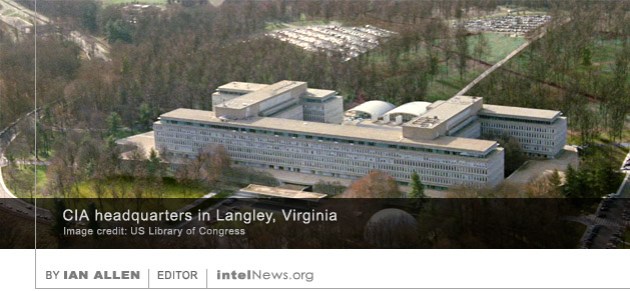
CIA headquartersAn untypical high-level meeting was convened at the headquarters of the United States Central Intelligence Agency last week to discuss Iran, according to NBC News. The meeting, which NBC described as “highly unusual” was convened by President Donald Trump’s National Security Adviser John Bolton. Participants allegedly included Secretary of State Mike Pompeo, Acting Secretary of Defense Patrick Shanahan, Director of National Intelligence Dan Coats, CIA Director Gina Haspel, and Chairman of the Joint Chiefs of Staff General Joe Dunford. Citing “six current US officials”, NBC said the meeting was held at 7 a.m. on Monday, April 29, in Langley, Virginia.

The list of participants refers to a high-level national security meeting. These are almost always held at the White House —typically in the Situation Room— says NBC. In general, it is extremely rare for senior White House officials, like Bolton, or members of the Cabinet, like Pompeo, to participate in meetings at CIA headquarters. It is also worth noting that, according to NBC’s sources, the meeting was not related to Washington’s recent decision send the USS Abraham Lincoln carrier strike group to the Middle East. This leaves two options, according to the NBC report: first, that the meeting concerned a “highly sensitive covert action” involving Iran or an Iranian proxy, such as the Lebanese Hezbollah. It could have been an update on an existing CIA operation, or a description of options for an impending operation. Alternatively the meeting could have been called due to a disagreement between the CIA and the White House about the results of an intelligence assessment or estimate about Iran.

NBC said it contacted the National Security Council to inquire about the April 29 meeting, but a spokesperson refused to comment. Meanwhile, Pompeo abruptly canceled the final leg of a four-nation tour of Europe on Thursday and returned to Washington, reportedly in light of heightening tensions between Washington and Tehran. Also on Thursday, the Iranian government described the Trump administration’s decision to deploy the USS Abraham Lincoln carrier strike group to the Middle East as “an action of psychological warfare” against the Iranian people. Late on Thursday, President Trump urged Iran to reach out to him: “What I would like to see with Iran, I’d like to see them call me”, said the US leader during a press conference at the White House. Iranian officials did not immediately respond to his comments.

Author: Ian Allen | Date: 10 May 2019 | Permalink

Intel that prompted US to deploy aircraft carrier to Middle East ‘came from Israel’

USS Abraham LincolnThe sudden decision by the United States to deploy significant firepower to the Middle East was partly in response to intelligence that was given to Washington by Israeli officials, according to a report. On Wednesday, the US announced that the USS Abraham Lincoln carrier strike group had received instructions to sail to the Middle East. The aircraft carrier is reportedly sailing alongside a cruiser and four destroyers, while an unspecified number of B-52 heavy long-range bombers have been ordered to fly to a US military base in Qatar.

Commenting on this last-minute development, US National Security Adviser John Bolton warned Iran that it would face “unrelenting force” if it threatened American interests in the Middle East and beyond. The Chairman of the Joint Chiefs of Staff, General Joseph Dunford, said that the move aimed to “deter Iran […] so that there would be no ambiguity about our preparedness to respond to any threat against our people or partners in the region”. Speaking in Congress, the US Acting Secretary of Defense Patrick Shanahan said that the decision to move a significant amount of firepower to the Middle East came in response to intelligence showing that Iran had “made plans to target US forces in Iraq and elsewhere in the Middle East”. According to ABC News, the intelligence suggested that “Iran or its proxies were planning attacks against US forces in Iraq, Syria and at sea”. But there was no further information reported about the precise nature of the alleged warnings.

Meanwhile, the American news and information website Axios said on Monday that the intelligence that caused Washington’s response was given to the US by Israeli officials. Citing “senior Israeli officials”, the website said that the intelligence given to the US had been gathered “primarily by the Mossad”, Israel’s main external intelligence agency. It added that the information about possible Iranian attacks against the US or its allies in the Middle East was “raised two weeks ago” during closed-door talks at the White House between a US team led by Bolton and an Israeli delegation headed by his Israeli counterpart, Meir Ben Shabbat. The intelligence, said Axios, showed that the US or its allies, including the United Arab Emirates or Saudi Arabia, would be targeted by Iran. The information is “understood to be part of the reason for Bolton’s announcement” this week, said Axios.

Author: Joseph Fitsanakis | Date: 09 May 2019 | Permalink

US lifts sanctions on Venezuelan ex-spy chief, calls on others to defect

SEBIN VenezuelaIn an effort to persuade senior members of the Venezuelan government to defect, the United States has lifted punitive financial sanctions on the country’s intelligence director, who left his post on April 30. General Christopher Figuera became director of the Bolivarian National Intelligence Service (SEBIN) in October 2018. SEBIN is Venezuela’s primary intelligence agency and has a dual domestic and international role. Much of its domestic mission is to protect and defend the Bolivarian Revolution, which forms the ideological framework of the government headed by President Nicolás Maduro. It follows that SEBIN’s employees are all trusted supporters of Venezuela’s embattled President.

On February 15 of this year, the United States government included General Figuera on a financial sanctions list of Venezuelan government officials who held senior posts in the Maduro government. But on April 30, General Figuera appeared to be one of relatively few senior Venezuelan officials to respond favorably to an open call by Juan Guaidó, the United States-supported President of the Venezuelan National Assembly, to remove Maduro from power. Figuera was reportedly denounced by Venezuelan government officials and summarily replaced by Gustavo Gonzalez Lopez, who was director of SEBIN until he was replaced by Figuera in 2018.

On Tuesday, the United States government said that it had removed General Figuera from its financial sanctions list. Speaking before reporters in Washington, US Vice President Mike Pence said that Figuera was “an example to follow” for other senior Venezuelan government officials and urged more of them to follow Figuera’s example. Pence added that the US government wanted to reward Figuera for abandoning his post and denouncing Maduro. In a subsequent statement given to the media, the US Department of the Treasury said that removal of sanctions “may be available” for all senior Venezuelan officials “who take concrete and meaningful actions to restore democratic order” in the Latin American country. The statement did not elaborate on the meaning of taking “concrete and meaningful actions”.

In a potentially related development, the Venezuelan government said on Tuesday that it had taken control of three private airfields in the vicinity of the capital city of Caracas, in order “to prevent illicit acts which would compromise the safety of civil aviation”. It is believed that General Figuera left the country with his family using a private airfield, and that the Maduro government is trying to stop others from following his example.

Author: Joseph Fitsanakis | Date: 08 May 2019 | Permalink

Deposed president’s brother and two former spy chiefs arrested in Algeria

Mohamed MedièneThe younger brother of Algeria’s deposed president Abdelaziz Bouteflika has been arrested along with two former directors of the country’s spy services. All three men are known as some of the North African country’s most powerful figures. Saïd Bouteflika, 61, served as senior advisor to his brother for over a decade. In 2013, when President Bouteflika suffered a debilitating stroke, Saïd became what many see as Algeria’s de facto leader and its primary decision-maker. He had not been seen in public since February 22, when mass demonstrations broke out across the country just hours after President Bouteflika, 82, announced that he would run for the highest office in the land for a record fifth time. The massive protests forced Bouteflika, who had held the presidency for two decades, to resign on April 2.

But the demonstrators have continued to protest weekly. They demand that Bouteflika’s inner circle be removed from power. Saïd, who was widely believed to be his brother’s most likely successor to the presidency, topped the protesters’ list. He was reportedly arrested on Saturday afternoon by officers of the Intelligence and Security Department, known as DRS. Another group of DRS officers reportedly arrested General Mohamed “Toufik” Mediène (pictured above, in brown suit), who served as director of the DRS form 1990 until his firing in 2015. His successor, DRS Director General Athmane Tartag, was also arrested by a third team of DRS officers on Saturday, according to reports from Algiers. All three men were delivered to the armed forces and have remained in custody since.

Saturday’s arrests were significant, given the influence of these once all-powerful men. At the moment of his arrest, General Tartag was the head of the country’s feared spy agency, while General Mediène was once known as the world’s longest-serving intelligence director. All three are accused of conspiracy against the popular movement that prompted the end of the Bouteflika regime last month. Their accusers are the leaders of the country’s military, and are led by Lieutenant General Ahmed Gaed Salah, the Army’s chief of staff. General Salah has vowed to launch an anti-graft campaign and rid the country of corruption before surrendering power back to civilian rule. A nationwide election has been scheduled for July 4 of this year.

Author: Joseph Fitsanakis | Date: 06 May 2019 | Permalink

Malaysia releases second female assassin of Kim Jong-un’s half-brother from prison

Siti AisyahThe second of two female assassins who killed the half-brother of North Korean leader Kim Jong-un in 2017 in Kuala Lumpur has been released from prison by the Malaysian state, after a mostly secret trial. The two women, Doan Thi Huong of Vietnam and Siti Aisyah of Indonesia (pictured), approached Kim Jong-nam as he was waiting to board a plane at the Kuala Lumpur International Airport on February 13. The estranged half-brother of the North Korean leader was about to travel to Macau, where he had been living in self-exile since 2007. Soon after his encounter with the two women, Kim collapsed and eventually died from symptoms associated with VX nerve agent inhalation. Huong was arrested on February 15, when she returned to the same airport to catch an outbound flight to Vietnam. Siti’s arrest was announced a day later.
Both women told Malaysian police that they worked as escorts and that they were under the impression that they had been hired by a Japanese YouTube show to carry out a televised prank on an unsuspecting traveler. They claimed that they did not realize that the men who had hired them several months prior to the assassination operation were agents of the North Korean government —which international authorities blamed for Kim’s murder. In March of this year, Malaysian authorities announced that all charges against the Indonesian woman, Siti, had been dropped, and that she would be released from detention. No reasoning behind the decision was provided to the media. On Thursday, it was revealed that Huong would be freed, after she agreed to plead guilty to a much lesser charge of “causing bodily injury”, as requested by government prosecutors.

What is behind the decision of the Malaysian court? British newspaper The Guardian said last month that the government of Indonesia engaged in intense “behind-the-scenes diplomacy” in order to have its citizen released. These efforts “significantly influenced how events […] unfolded in the courtroom”, said the paper. Additionally, the Malaysian government had been uncomfortable with the international attention of this incident from the very beginning, and had expressed the desire “to be done with the trial because it was diplomatically inconvenient”, according to The Guardian. The paper added that, as the international status of Kim Jong-un rose unexpectedly through his meetings with United States President Donald Trump, Malaysia sought to be “part of this conversation”. Kuala Lumpur thus decided that “the recovery of [its] relationship with Pyongyang [was] more important than justice for the assassination of Kim Jong-nam”, former South Korean intelligence officer Dr. Nam Sung-wook told The Guardian.

Author: Joseph Fitsanakis | Date: 03 May 2019 | Permalink

Maduro fires intelligence chief amidst reports of inner circle defections

Venezuela crisisThe embattled President of Venezuela, Nicolás Maduro, has reportedly fired his intelligence director, as news emerged early on Thursday that members of his inner circle were considering removing him from power. These reports circulated shortly after Juan Guaidó, President of the Venezuelan National Assembly, openly called on the country’s Armed Forces to remove Maduro from power. Guaidó has been recognized by over 50 countries —including the United States and much of the European Union— as the legitimate president of Venezuela. But Maduro continues to be supported by a number of powerful allies, including China and Russia, which sent troops there last month.
On Wednesday, Maduro dismissed General Christopher Figuera from the post of director of the Bolivarian National Intelligence Service (SEBIN). SEBIN is Venezuela’s primary intelligence agency and has a dual domestic and international role. Much of its domestic mission is to protect and defend the Bolivarian Revolution, which forms the ideological framework of the country’s socialist government. Critics accuse SEBIN of operating as the Venezuelan government’s political police, and of committing scores of human rights abuses against supporters of the opposition. But it appears that Figuera responded favorably to Guaidó’s call on April 30 for an uprising against Maduro. Speaking at a rally on Tuesday, Guaidó said that the Venezuelan military “no longer back […] Maduro […]. They are backing the constitution and are for a change of government”, he said. He went on describe the movement against Maduro as “a usurpation”.

On Thursday, The Wall Street Journal claimed that Venezuelan opposition forces had been holding “secret talks” with members of Maduro’s inner circle, aimed at removing Maduro from power. Among those who held secret talks with opposition negotiators, said the paper, were Minister of Defense General Vladimir Padrino, and General Iván Rafael Hernández, head of Venezuela’s military spy agency, the Directorate General of Military Counterintelligence (DGCIM). Meanwhile, the American-based geopolitical intelligence firm Stratfor said on Wednesday that the uprising led by Guaidó appeared to be “more extensive than initial reports indicated”. According to Stratfor, members of the military and security forces “seized multiple garrisons across the country” and created “substantial cracks” in the security services and the military. Other sources, however, including Britain’s Daily Telegraph, claimed that Guaidó’s efforts were “weak” and “folded” quite quickly. By Tuesday night, said The Telegraph, several members of Guaidó’s reform movement had sought asylum in foreign embassies in Caracas, and Guaidó’s whereabouts remained unknown. Observers noted, however, that the likelihood of further violence increased as the uprising continued to unfold, and that another “major event” could take place at any moment.

Author: Joseph Fitsanakis | Date: 02 May 2019 | Permalink


Family of alleged UAE spy who died in Turkish prison call for investigation

Zaki Mubarak Hassan and Samer ShabanThe family of a man who died in a Turkish prison on Sunday while awaiting trial for allegedly spying for the United Arab Emirates has called for an international investigation into this death. Zaki Mubarak Hassan and Samer Shaban —both Palestinians— were reportedly arrested by Turkish police on April 21 and charged with espionage. Turkish counterintelligence officials suspect that at least one of the suspects may have been involved in a spy operation that relates to the murder of Jamal Khashoggi, a Saudi journalist who was killed last October inside the Saudi Arabian consulate in Istanbul by a 15-member team of Saudi intelligence officers.
Shortly after the two men were arrested, the Reuters news agency cited an anonymous “senior Turkish official” who said that one of two men arrived in Turkey just days after Khashoggi’s murder. He was allegedly monitored by Turkish counterintelligence for a period of six months and his activities led investigators to the second man. The latter is believed to have traveled to Turkey in order “to help his colleague with the workload”, said Reuters. The source added that the two UAE nationals had undergone several hours of interrogation, during which they had confessed that they were employees of the UAE intelligence service. They had also admitted to recruiting local residents as informants. Their activities and targets were consistent with intelligence operations aimed at exiled Arab nationals and students living in Turkey, said the source. The unnamed Turkish official told Reuters that authorities had amassed “extensive evidence” on “covert activities on Turkish soil” by the two men, and described the case against them as “airtight”.

Yesterday, however, the Turkish government announced that one of the men, Zaki Mubarak Hassan, had been found dead in his prison cell in Istanbul. Press reports said that Hassan was found “Sunday morning hanging from a bathroom door” in his cell, and that prosecutors were investigating the formal cause of his death. Late on Monday, his family told the Saudi Arabian Arab News channel that they did not believe Hassan had killed himself. Speaking to Arab News from his home in Bulgaria, Hassan’s brother, Zakeria, said that agents of the Turkish government killed his brother because they realized he was not a spy for the UAE and “they didn’t want to show that they made a mistake”. He added that he had notified the Palestinian ambassador in Ankara of his brother’s arrest, but the ambassador did not seem interested in assisting the family. Meanwhile, the uncle of the second man, Samer Shaban, told another Saudi news channel, Al Arabiya, that his nephew had left the Gaza Strip in 2007 for Egypt. Zaki Mubarak said that Shaban, a Palestinian police officer, was a Fatah supporter and eventually moved from the Hamas-dominated Gaza Strip to the UAE, where he began working as an employee of the Palestinian Authority’s consulate in Dubai. His goal, said Mubarak, was to immigrate with his family to Turkey and from there to Europe.

Author: Joseph Fitsanakis | Date: 30 April 2019 | Permalink

Analysis: Sri Lanka attacks may indicate ISIS is moving east, say experts

Sri Lanka ISISThe April 21 suicide attacks in Sri Lanka, which were claimed by the Islamic State, may indicate that the militant group is moving east in search of fertile recruiting ground, according to some observers. In the words of The New York Times’ Rukmini Callimachi and Eric Schmitt, the attacks “reminded the world in dramatic fashion that [the Islamic State] does not need to control territory to be a major threat”. In fact, as the loss of its Middle Eastern territory has forced the Islamic State to decentralize, the group has begun to turn to its peripheral affiliates further afield. These “will become more dangerous” as the core of the Islamic State weakens, according to Callimachi and Schmitt.
But the Sri Lanka attacks may also demonstrate that the Islamic State is moving further east in search of either territory to conquer or new groups of committed fighters to incorporate into its ranks. It follows that Sri Lanka is one of several East Asian countries that face major threats by the group, as the latter tries “to ignite creating fear in societies already battling so much division”, says Ash Gallagher, an American war correspondent based in East Asia. Writing for the British newspaper The Independent, Gallagher notes that not only is the Islamic State already established in Afghanistan (where it has “swallowed whole units of Taliban fighters”, according to The Times), but it is becoming increasingly powerful in the Philippines. Experts have been warning for a while that the number of foreign Islamic State fighters entering the Philippines has been growing, and the momentum they generate among local Islamist groups may prompt them to declare a new caliphate in the near future. In fact, a caliphate was declared there in May 2017 by local Islamist leaders who had previously declared their allegiance to the Islamic State. By October, government forces had defeated the so-called “East Asia Wilayah”, a self-declared overseas province of the Islamic State, by retaking Marawi, the capital city of Mindanao’s Lanao del Sur province, from Islamic State rebels. The military operation became known as “the battle of Marawi” and is thought to have been the longest urban battle in the postwar history of the Philippines. More than 1,200 people died in the five-month battle, most of them civilians. Hundreds of thousands remain displaced to this day as a result of the fighting. Read more of this post

Malaysia is helping Iran evade US economic sanctions, intelligence sources claim

Petronas MalaysiaCiting “Western intelligence officials”, Israeli newspaper Haaretz said on Thursday that a deepening alliance between Malaysia and Iran is expected to enable Tehran evade some of the economic sanctions imposed on it by the United States. In the past, every time Washington has imposed economic sanctions on Iran, it has issued renewable waivers for a number of countries whose economies have historically depended on substantial Iranian energy imports. This is done in order to prevent these economies from entering a recession due to lack of access to sufficient energy supplies. This week, however, US President Donald Trump said that Washington would not renew waivers for these countries, which include Italy, India, Turkey, South Korea and China. These waivers are now expected to run out on May 2, 2019, after which date the US has threatened to impose economic sanction on all countries that have substantial financial dealings with Tehran.

Many observers believe that these new sanctions will have a deep and immediate impact on the Iranian economy. But, according to Haaretz, the American sanctions are bringing Iran closer to Malaysia. Throughout the past month, says the Israeli newspaper, “atypical numbers” of oil tankers have been sailing between the two countries —a sign of trying to move as much oil as possible out of Iran before the US sanctions hit. Citing “Western intelligence officials”, Haaretz claims that Iran plans to continue to funnel funds from oil and natural gas sales through Malaysian banks. Much of that assistance, which sources claim will grow in the next month, is facilitated through Petronas, Malaysia’s state-owned oil company. As one of the world’s largest companies and the most powerful corporate entity in Malaysia, Petronas has immense political power. Much of the country’s political elite connected with Petronas —including the country’s current Prime Minister, Mahathir Mohamad, who was a senior advisor to the company in the early 2000s. In 2017, Petronas signed a cooperation agreement with an Iranian refinery facility and announced its intention to develop an emerging oilfield in the Middle Eastern country. Then in late 2018, Petronas officials traveled to Iran to sign a memorandum of understanding on mutual cooperation between the Malaysian company and Iran’s state-owned energy producer and distributor, the National Iranian Oil Company.

Haaretz notes that cultural and political ties between Malaysia and Iran run deep. The Southeast Asian country is one of a handful of nations that allow Iranians to visit without first having to obtain a visa. If fails to note, however, that in recent times there have been tensions between the two countries, due to concerns in Kuala Lumpur that Iran is trying to spread a militant version of Shia Islam in Malaysia.

Author: Joseph Fitsanakis | Date: 26 April 2019 | Permalink

British spy agency calls Trump’s espionage claim ‘utterly ridiculous’

GCHQThe Government Communications Headquarters (GCHQ), Britain’s primary signals-intelligence agency, has called claims by United States President Donald Trump that it spied on his election campaign “utterly ridiculous”. President Trump’s allegations are not new. They apparently rest on claims made in March 2017 by a Fox News commentator, that the GCHQ spied on Trump on orders of then-US President Barack Obama. The claim was repeated on March 17 at the White House by Sean Spicer, Trump’s then-press secretary, who said that Obama had used the GCHQ to spy on Trump so as to evade American privacy laws. At the time, Spicer’s claim prompted an angry response from the British government in London and from the British spy agency itself. In a rare public comment, GCHQ called the allegations “utterly ridiculous”.

This past Wednesday, the US president appeared to repeat his claim that GCHQ had spied on his election campaign, via a post on the popular social networking platform Twitter. Responding to a reiteration of the claim on the conservative cable television channel One America News Network, Trump tweeted “WOW! It is now just a question of time before the truth comes out, and when it does, it will be a beauty!”. The president’s tweet appeared just hours after the British government confirmed that Trump had been invited for a four-day state visit to the United Kingdom in June. The visit is believed to include a meeting with British Prime Minster Theresa May and dinner with Queen Elizabeth II at Buckingham Palace.

Following Trump’s tweet, the US newsmagazine Newsweek contacted GCHQ with a request for a response to the US president’s allegation. A GCHQ spokesperson referred the newsmagazine to the agency’s 2017 statement, and repeated: “The allegations that GCHQ was asked to conduct ‘wire tapping’ against the then president-elect are nonsense. They are utterly ridiculous and should be ignored”. It is extremely rare for GCHQ —one of Britain’s most secretive and publicity-shy agencies— to respond publicly to stories in the media. Late on Wednesday, British Foreign Affairs Secretary Jeremy Hunt said that the invitation to President Trump to visit London would not be rescinded, and insisted that Britain’s “special relationship” with the US remained “intact”.

Author: Joseph Fitsanakis | Date: 25 April 2019 | Permalink

Iran abruptly replaces head of Revolutionary Guard Corps —no reason given

Hossein SalamiAuthorities in Tehran revealed on Sunday the sudden replacement of the head of the Islamic Revolutionary Guard Corps. The unexpected move was announced by pro-government media, but no explanation was given. Since 2007, the IRGC has been led by Major General Mohammad Ali Jafari, 61, a conservative military commander who is widely believed to have consolidated the IRGC’s role within Iran’s power structure. Under his leadership, the IRGC has come to be seen as the staunchest defender of the principles of the 1979 Iranian Revolution. Many Western observers describe the IRGC as a ‘praetorian guard’ whose members possess immense power and often wealth. Today the IRGC is a military force with a command structure that is distinct from that of Iran’s regular Armed Forces. It maintains its own army, navy and air force, has its own paramilitary and political protection units, and is in charge of Iran’s nuclear program.

But in a brief report aired on Sunday, Iranian state media announced that Jafari had stepped down from the leadership of the IRGC after 11 years at the helm. The report said that Jafari had been replaced by the IRGC’s deputy commander, Major General, Hossein Salami. Like Jafari, Salami, 59, is believed to be close to the Iranian regime’s hardliners; he is thus critical of the reformers who support President Hassan Rouhani —seen by most as the architect of the Iranian nuclear deal. Moreover, like Jafari, Salami is known for his asymmetrical warfare thinking, which the Iranians employed with considerable success in Iraq following the military invasion of the country by the United States in 2003. The same tactics were utilized by the IRGC in Lebanon during the 2006 conflict between Israel and Iranian ally Hezbollah.

Jafari’s surprise replacement came two weeks after Washington announced that it would designate the IRGC as a foreign terrorist organization —a move that most observers saw as a clear move by the White House to undermine the Iranian government. Explaining the decision, US President Donald Trump said in a statement that the IRGC was the primary vehicle through which the government in Tehran “directed and implemented […] terrorism as a tool of statecraft”. Among other things, the new designation means that the US government is now able to bring criminal charges against any individual or organization that is found to have political or financial dealings with the IRGC.

Author: Joseph Fitsanakis | Date: 24 April 2019 | Permalink

Video shows alleged Sri Lanka suicide bombers posing with ISIS flags

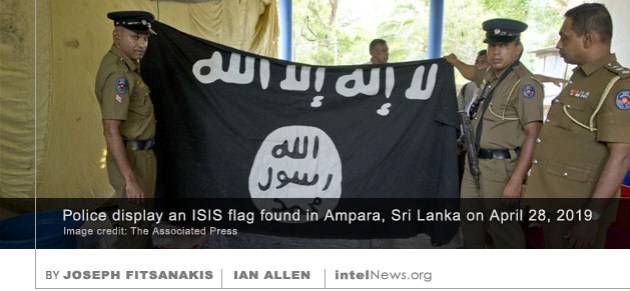
National Thowheeth Jama'ath NTJA video posted online by supporters of the Sunni militant group Islamic State appears to show the suicide bombers who carried out Sunday’s bloody attacks in Sri Lanka posing alongside Islamic State flags. Three Catholic churches and three five-star hotels were targeted on Easter Sunday by a total of nine separate blasts, which killed nearly 260 people and injured over 500. The near-simultaneous attacks struck locations in Sri Lanka’s western and eastern coasts and are believed to constitute the bloodiest terrorist attack in the country’s history.

All seven suicide bombers who carried out Sunday’s attacks have been identified as Sri Lankan nationals and members of the Sunni jihadist group National Thowheeth Jama’ath (NTJ). The Sri Lankan group has claimed responsibility for no more than a handful of mostly sabotage-themed operations in its three-year history. It is believed to have been established by hardline Islamists in 2016. It made its first public appearance in 2018, in response to a series of anti-Muslim pogroms that were led by Sinhalese Buddhists in the island country. There are reports suggesting that Sunday’s blasts were part of a much wider operation aimed at destabilizing Sri Lanka. Police said they found nearly 100 bomb detonators at the Central Colombo bus station on Monday, while an unexploded bomb was found inside a parked vehicle at another church in the Sri Lankan capital. An unexploded pipe bomb was also discovered in the vicinity of the Bandaranaike International Airport in Colombo on Sunday night.

Indian intelligence officials were the first to openly draw a connection between Sunday’s attacks and the Islamic State, the Sunni militant group that is also known as the Islamic State of Iraq and Syria (ISIS). One Indian official told the Hong Kong-based Asia Times newspaper that “the NTJ were only foot soldiers and the controllers were someone else”. On Monday, a video appeared on an online channel associated with supporters of ISIS, which contains a montage of the aftermath of Sunday’s attacks, interspersed with still images of masked men brandishing rifles in front of ISIS flags. The video names the men and implies they carried out the suicide blasts. The video claims to come from ISIS and issues threats against “Crusaders” —an anti-Western term often used by Sunni jihadists. The video also warns that the Islamic State’s “armies remain everywhere and [continue to] blast the fortresses of the infidels”.

Meanwhile, the Sri Lankan government declared a state of emergency on Monday night, which is expected to last several weeks. The announcement of the state of emergency was made by the country’s President, Maithripala Sirisena, following a meeting of the National Security Council, which he chaired.

Author: Joseph Fitsanakis | Date: 23 April 2019 | Permalink

Turkey announces arrests of two alleged UAE intelligence officers in Istanbul

UAE nationals arrested in Turkey on espionage charges

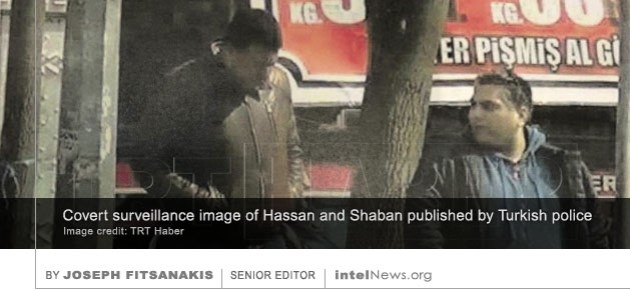
Covert surveillance photograph of two UAE nationals arrested in Turkey on espionage charges (TRT Haber)

Turkish authorities have announced the arrest of two men believed to be intelligence officers for the United Arab Emirates; the two have already confessed to recruiting local informants, according to Reuters. The news agency said Turkish counterintelligence officials suspect that at least one of the suspects may be involved in a spy operation that relates to the murder of Jamal Khashoggi, a Saudi journalist who was killed last October inside the Saudi Arabian consulate in Istanbul by a 15-member team of Saudi intelligence officers.

Last Friday, Reuters cited an anonymous “senior Turkish official” who said that both men are Emirati nationals and that one of them arrived in Turkey just days after Khashoggi’s murder. He was allegedly monitored by Turkish counterintelligence for a period of six months and his activities led investigators to the second man. The latter is believed to have traveled to Turkey in order “to help his colleague with the workload”, said Reuters. Turkey’s state-owned news agency, TRT Haber, published Turkish police photographs of the two men in custody, but did not name them. It also published covert surveillance photographs of the two men, presumably taken by Turkish counterintelligence. A source told Reuters that Turkish counterintelligence officials had entered an Istanbul apartment used by the two men as a safe house, where they found an encrypted computer “in a hidden compartment”. The source added that the two UAE nationals had undergone several hours of interrogation, during which they had confessed that they were employees of the UAE intelligence service. They had also admitted to recruiting local residents as informants. Their activities and targets were consistent with intelligence operations aimed at exiled Arab nationals and students living in Turkey, said the source.

The unnamed Turkish official told Reuters that authorities had amassed “extensive evidence” on “covert activities on Turkish soil” by the two men, and described the case against them as “airtight”. However, when contacted by Reuters, Turkey’s Ministry of Interior declined to comment on the arrests. A spokesman for Istanbul’s Police Department confirmed that a police operation against the two Emirati nationals was ongoing. Turkish media reports on Saturday said that the two men had appeared before a court in Istanbul and that they were being kept in custody on charges of espionage against the Turkish state.

Author: Joseph Fitsanakis | Date: 22 April 2019 | Permalink

German spies dismiss US warnings about Huawei threat to 5G network

Huawei 2German intelligence officials appear to be dismissing Washington’s warning that it will limit security cooperation with Berlin if China’s Huawei Telecommunications is allowed to build Germany’s 5G network. The company, Huawei Technologies, is a private Chinese venture and one of the world’s leading telecommunications hardware manufacturers. In recent years, however, it has come under scrutiny by some Western intelligence agencies, who view it as being too close to the Communist Party of China. More recently, Washington has intensified an international campaign to limit Huawei’s ability to build the infrastructure for 5G, the world’s next-generation wireless network. Along with Britain, Australia and Canada, the US is concerned that the Chinese telecommunications giant may facilitate global wiretapping on behalf of Beijing’s spy agencies.

In the past several months the United States has repeatedly warned Germany that intelligence sharing between the two countries will be threatened if the Chinese telecommunications giant is awarded a 5G contract by the German government. In March, Washington informed German officials that intelligence cooperation between the two allies would be severely impacted if Chinese telecommunications manufacturers were given the green light to build Germany’s 5G infrastructure. The warning was allegedly included in a letter to Peter Altmaier, Germany’s Minister of Economic Affairs and Energy, written by Ambassador Richard Grenell, America’s top diplomat in Germany. The letter urged the German government to consider rival bids by companies belonging to American allies, such as the Swedish telecommunications equipment manufacturer Ericsson, Finland’s Nokia Corporation, or the South Korean Samsung Corporation.

But a report by Bloomberg on Wednesday said that German authorities were not convinced by Grenell’s argument. Citing “four people with knowledge on the matter”, the news agency said that Germany’s intelligence community see Washington’s warnings as “political grandstanding”. The US and Germany “need each other’s resources to tackle global conflicts” and “rely on each other too much to risk jeopardizing crucial data sharing”, said the report. The anonymous officials told Bloomberg that Germany does benefit from America’s “vast array” of intelligence. However, German spy agencies also provide their American counterparts with crucial intelligence from several regions of the world, they said. The US Department of State did not comment on the Bloomberg report. The Chinese government has repeatedly dismissed allegations that Huawei poses an espionage threat to Western nations.

Author: Ian Allen | Date: 18 April 2019 | Permalink

Spain returns stolen material to North Korean embassy in Madrid, say sources

North Korea SpainAuthorities in Spain have returned material that was stolen from the embassy of North Korea in Madrid by a group of raiders in February, according to a source that spoke to the Reuters news agency. The unprecedented attack took place in the afternoon of February 22 in a quiet neighborhood of northern Madrid, where the North Korean embassy is located. Ten assailants, all Asian-looking men, entered the three-story building from the main gate, brandishing guns, which were later found to be fake. They tied up and gagged the embassy’s staff and some visitors to the embassy. After several hours spent inside the buildings, the assailants abandoned the building in two embassy vehicles that were later found abandoned.

A few weeks following the raid, a North Korean dissident group calling itself Cheollima Civil Defense —also known as Free Joseon— claimed responsibility for the attack. Cheollima Civil Defense is North Korea’s first known active resistance group. Its members call for the overthrow of the Kim dynasty. Subsequent reports said that some of those who took part in the embassy raided fled to the United States and approached the Federal Bureau of Investigation (FBI) with an offer to hand over computer hardware and telephones captured in the attack. On Tuesday, the Reuters news agency reported that the FBI “returned the material [to Spanish authorities] two weeks ago”, and that Spanish police handed it over to the North Koreans. Citing “a Spanish judicial source”, Reuters said that American authorities returned the material directly to the Spanish court that is investigating the raid.

According to the news agency, Spanish authorities returned the material to the North Korean embassy without reviewing its contents, thus complying with the norms of diplomatic protocol. Data and items belonging to foreign embassies are usually off-limits to the authorities of host nations. The report did not clarify whether the FBI returned all the material that was stolen by the raiders in February, nor did it state whether the FBI reviewed its contents prior to handing it over to the Spanish court.

Author: Joseph Fitsanakis | Date: 17 April 2019 | Permalink