New book by ex-Mossad officer examines Israel’s intelligence doctrine
June 23, 2015 1 Comment
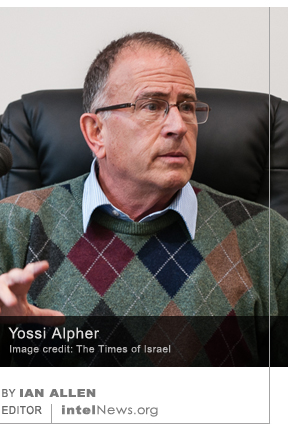 Yossi Alpher, a former Israeli intelligence officer, who was directly involved in numerous top-secret operations during his spy career, has published a new book that analyzes the overarching strategy behind Israel’s spy operations. Alpher served in Israeli Military Intelligence before joining the Mossad, where he served until 1980. Upon retiring from the Mossad, he joined Tel Aviv University’s Jaffee Center for Strategic Studies, which he eventually directed. Throughout his career in intelligence, Alpher worked or liaised with every Israeli spy agency, including the Shin Bet –the country’s internal security service.
In Periphery: Israel’s Search for Middle East Allies, published this week by Rowman & Littlefield, Alpher examines Israel’s so-called ‘periphery doctrine’. This strategy was devised by Israel’s founder and first Prime Minister, David Ben-Gurion, and formed the basic operational doctrine of the Mossad since the organization’s inception, in 1949. The strategy was based on forging deep operational ties between Israeli and non-Arab intelligence services in the Middle East and Africa, and then presenting these alliances as assets to the United States, so as to win Washington’s support. In pursuit of the periphery doctrine, Israel focused on strengthening ties with religious or ethnic minorities in the Middle East, including the Kurds in Iraq and Syria, and signed intelligence cooperation agreements with countries such as Iran, Turkey, Ethiopia, Kenya and Uganda.
According to Alpher, the most ambitious part of the periphery doctrine was the secret intelligence pact signed between Israel, Turkey and Iran. Known as C’lil in Israel, and as Trident in the United States, the agreement was struck in Ankara in 1958. Almost immediately after signing the treaty, senior Israeli officials contacted Washington and presented the secret pact between three American allies as a barrier against Soviet influence in the Middle East. Alpher says the Americans’ response was so enthusiastic, that the Central Intelligence Agency even agreed to fund the construction of a two-story building in a remote region of Israel, which served as C’lil/Trident’s headquarters. The building still exists today, says Alpher.
In another aspect of the periphery doctrine, the Mossad trained the bodyguards of senior Moroccan government officials and funded the science and technology division of the Moroccan intelligence services, almost in its entirety. In the book, Alpher reveals that Yitzhak Rabin visited Morocco incognito when he was prime minister, wearing a blond wig, in order to avoid being noticed by the press, diplomats or foreign spies. Alpher also discusses in unprecedented detail Operation ROTEV, a secret program implemented by the Mossad in the 1960s to arm the Yemeni royalists involved in the North Yemen Civil War. He told Israeli newspaper Yedioth Ahronoth that he was personally tasked with inspecting Israeli weapons and ammunition destined for the Yemeni royalists, in order to ensure that they could not be traced back to Israel.
A number of Israeli authors, notably Shimon Shamir, professor emeritus of Middle East history at Tel Aviv University, have authored highly critical appraisals of the Mossad’s periphery doctrine, arguing that it prevented Israel from seeking peace with its Arab neighbors. Additionally, the periphery strategy prompted the Mossad to collaborate with several governments that Yedioth Ahronoth calls “dark regimes and terrible dictatorships, by actively supporting them and sometimes tipping the scales in their favor”. Alpher recognizes the ethical problems of the periphery doctrine; however, he remains supportive. The periphery doctrine allowed Israel to survive by giving it funds to develop weapons programs, which in turn allowed it to win two wars against Arab armies, he says.
► Author: Ian Allen | Date: 23 June 2015 | Permalink: https://intelnews.org/2015/06/23/01-1720/
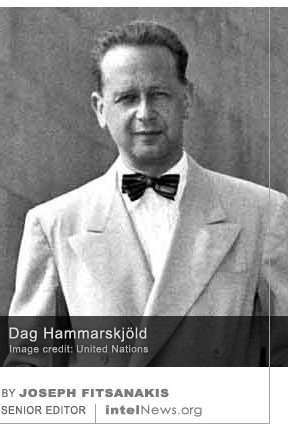 A panel of experts commissioned by the United Nations is about to unveil fresh evidence on the mysterious death in 1961 of UN secretary general Dag Hammarskjöld, who some claim was murdered for supporting African decolonization. The evidence could spark a new official probe into the incident, which has been called “one of the enduring mysteries of the 20th century”.
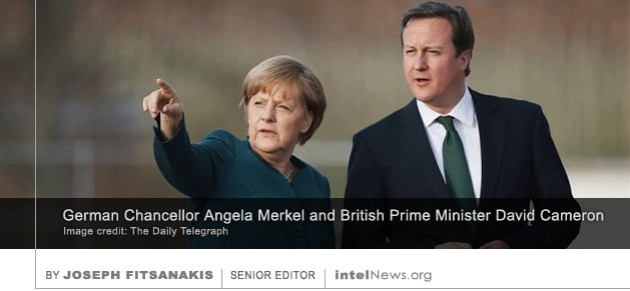 A German parliamentary committee investigating spying operations may take the German government to court in order to force it to give up secret documents on Berlin’s intelligence cooperation with Britain. The Committee of Inquiry into Intelligence Operations was set up in 2014, after files leaked by American defector Edward Snowden
 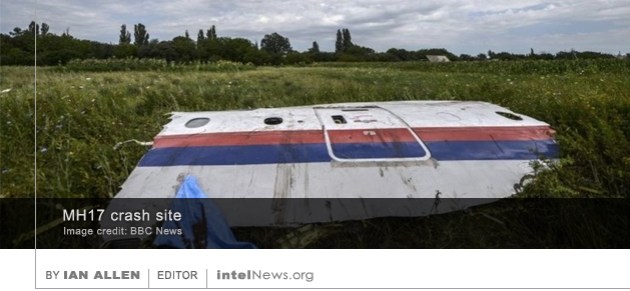 A German investigator, who is probing the downing of a civilian airliner over Ukraine nearly a year ago, says that an informant has claimed a multimillion reward for information pointing to those responsible for the attack. The investigator, Josef Resch, of Lübeck, Germany, says that a binding non-disclosure agreement does not allow him to reveal his client, who offered the $47 million reward. But he told German business magazine Capital that he is hopeful his client will soon reveal the details, since “people who pay that kind of money in exchange for information do not keep it for themselves”. However, he also hinted that his client may be an intelligence agency, who may decide to “deal with the matter without fanfare”.
 Australian law enforcement and intelligence agencies routinely use paid informants in Indonesia and Pakistan as part of a decade-old covert war against human traffickers in the Indian Ocean. This information has been revealed by The Australian newspaper in response to
 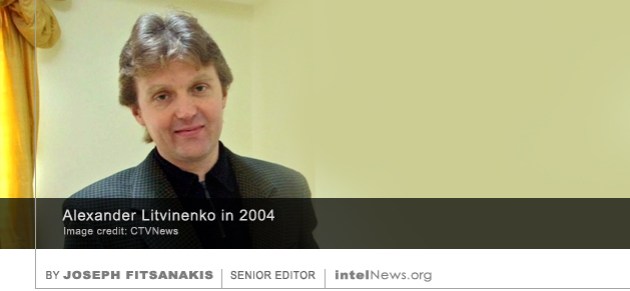 A Russian former intelligence officer, who is accused by the British government of having killed a former KGB spy in London, has agreed to testify at a public inquiry to be held in the British capital next month. British government prosecutors believe Russian businessman Dmitri Kovtun, who worked for the KGB during the Cold War, poisoned his former colleague in the KGB, Alexander Litvinenko, in 2006. Litvinenko was an officer in the Soviet KGB and one of its successor organizations, the FSB, until 2000, when he defected with his family to the United Kingdom. He soon became known as a vocal critic of the administration of Russian President Vladimir Putin. In 2006, Litvinenko came down with radioactive poisoning soon after meeting Kovtun and another former KGB officer, Andrey Lugovoy, at a London restaurant. He was dead less than two weeks later.
 American Congressional lawmakers have voted to cut funding for the Central Intelligence Agency’s secret operations in Syria, in a surprise move that indicates growing concern on Capitol Hill with Washington’s strategy on the Syrian Civil War. The CIA’s involvement in the Syrian Civil War began in 2012, when US President Barack Obama
 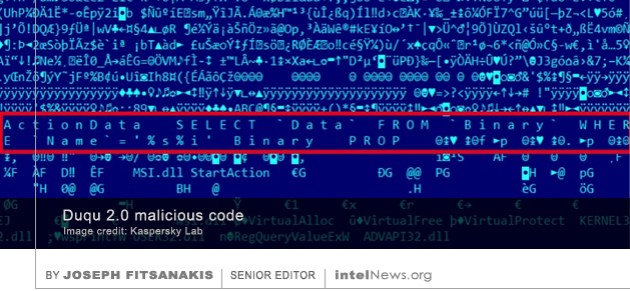 The Israeli government rejected reports yesterday that its spy agencies were behind a virus found on the computers of three European hotels, which hosted American and other diplomats during secret negotiations on Iran’s nuclear program. Cybersecurity firm Kaspersky Lab said on Wednesday that it first discovered the malware, which it dubbed “Duqu 2.0”, in its own systems. The Moscow-based firm said the sophisticated and highly aggressive virus had been designed to spy on its internal research-related processes. Once they detected the malicious software in their own systems, Kaspersky technicians set out to map Duqu’s other targets. They
 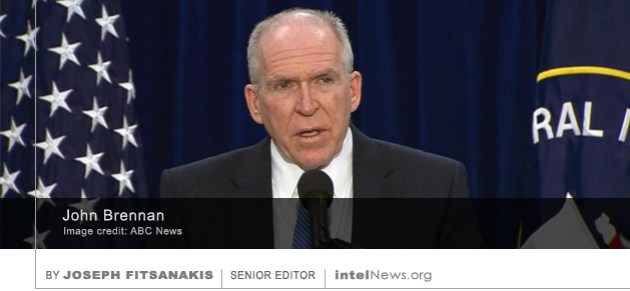 The director of the United States Central Intelligence Agency visited Israel in secret last week to discuss the Jewish state’s refusal to endorse an emerging deal with Iran over its nuclear program. Citing “two senior Israeli officials”, the Tel Aviv-based Israeli newspaper Haaretz said on Tuesday that CIA Director John Brennan arrived in Israel last Thursday. Although he was officially hosted by Tamir Pardo, director of Israeli intelligence agency Mossad, Brennan used the opportunity to hold secret meetings with several senior Israeli officials, said Haaretz. Among them were Prime Minister Benjamin Netanyahu, National Security Adviser Yossi Cohen, as well as Major General Hartzl Halevi, who heads Israel’s Military Intelligence Directorate.
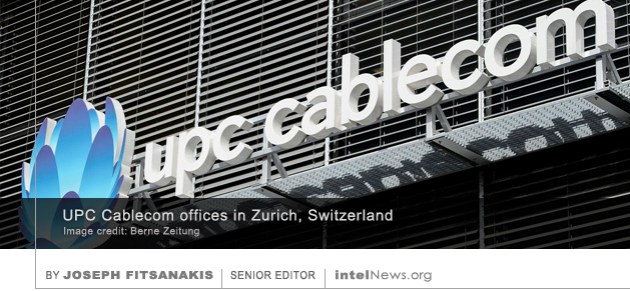 The Swiss federal government has rejected a multi-million dollar contract bid by one of the world’s largest broadband Internet service providers, saying it is foreign-owned and could serve as “a gateway for foreign spies”. The company, UPC Cablecom, is headquartered in Zurich, is subject to Swiss law, and is currently the largest broadband cable operator in Switzerland. However, in 2005 it became a subsidiary of the UPC Broadband division of Liberty Global Europe, an international telecommunications and television company based in London, England. It is therefore technically considered a foreign company according to Swiss law. In 2013, UPC Cablecom submitted a bid for a competitive contract to provide broadband Internet services to Swiss government agencies. But in January 2014, the company was informed by Swiss officials that such a contract could not be awarded to a foreign-owned telecommunications service provider such as UPC Cablecom.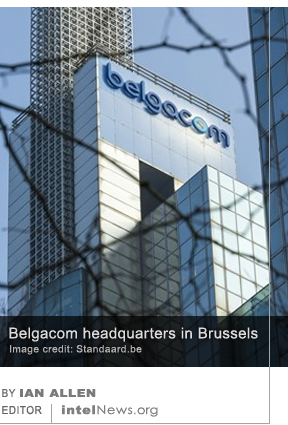
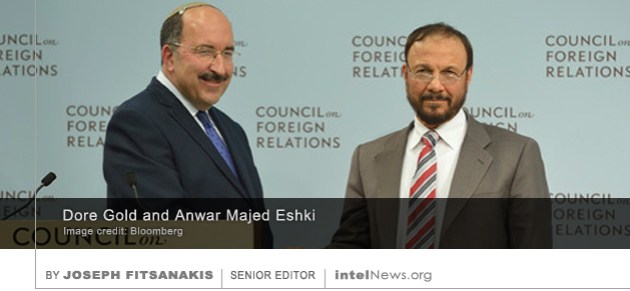 Representatives from Israel and Saudi Arabia have publicly admitted for the first time that they met secretly to discuss their common foe Iran, even though Saudi Arabia does not officially acknowledge Israel’s existence. The admission was made at a symposium held on Thursday at the Council on Foreign Relations, a foreign-policy think tank based in Washington, DC.
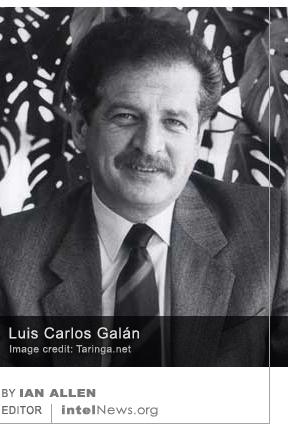 The former director of Colombia’s intelligence service returned to court this week to face charges of complicity in the assassination of a leading presidential hopeful, who was gunned down in 1989 by a powerful drug cartel. Luis Carlos Galán, a senator and former minister, was tipped to win the 1990 presidential election in which he stood on the Liberal Party ticket. His popularity with the electorate is largely attributed to his uncompromising stance against Colombia’s powerful drug cartels. He had vowed to arrest leading drug lords and send them to the United States to face criminal charges. He would do so, he said, after signing a mutual extradition treaty with Washington. However, Galán was assassinated on August 18, 1989, during a campaign rally in Soacha, a working-class suburb of Colombia’s capital, Bogotá. The assassination took place before thousands of spectators who were present at the rally, and is considered one of the highest-profile political killings in the history of Colombia.
 A team of officers from Israel’s Mossad intelligence agency were heading to Cyprus late yesterday to be briefed on the arrest of a dual Lebanese-Canadian citizen, who was found to be in possession of 67 thousand packages of ammonium nitrate. It is not yet clear whether the passports held by the 26-year-old man are genuine. Cypriot police said he used his Canadian passport to enter the Mediterranean island about a week ago. But he was






 intelNews.org
French president calls crisis meeting to discuss US spy revelations
June 24, 2015 by Joseph Fitsanakis Leave a comment
The files were published on Tuesday by the international whistleblower website WikiLeaks. They consist of what WikiLeaks described as “top secret intelligence reports and technical documents”, which detail NSA spying operations against the French presidency, as well as espionage directed at several French government ministers and at France’s ambassador to the US. WikiLeaks would not indicate whether it acquired the documents from American defector Edward Snowden, who is currently living in Russia. But it said that “French readers can expect more timely and important revelations in the near future”.
The material –termed “Espionnage Élysée” by WikiLeaks– features a list of “selectors”, which includes French government telephone numbers targeted for interception. One of the numbers is identified as belonging to the president of France. The document collection also includes a handful of intelligence briefs, which are presumably based on intercepted communications from the telephone lines listed among the “selectors”. They detail the thoughts and diplomatic maneuvers by French presidents and other senior officials on subjects such as the Greek economic crisis, the Israeli-Palestinian dispute, and the United Nations.
French newspaper Liberation, which partnered with WikiLeaks to release the NSA material, said on Tuesday that the revelation should not surprise anyone in the post-Snowden era, but that it was still likely to cause a significant rift in French-American relations. In 2014, Germany expelled the station chief of the Central Intelligence Agency in Berlin –essentially the highest-ranking American intelligence officer in the country– over revelations that the US spied on the personal communications of Chancellor Angela Merkel.
Liberation contacted the NSA but was told by its spokesman, Ned Price, that the Agency was “not going to comment on specific intelligence allegations”. A spokesman from the Élysée Palace told the paper that an official statement would be issued following the Conseil de la Défense meeting on Wednesday.
► Author: Joseph Fitsanakis | Date: 24 June 2015 | Permalink: https://intelnews.org/2015/06/24/01-1721/
Filed under Expert news and commentary on intelligence, espionage, spies and spying Tagged with communications interception, Conseil de la Défense (France), François Hollande, France, Jacques Chirac, News, Nicolas Sarkozy, NSA, United States, Wikileaks