UK spies intercepted emails from top European, American media

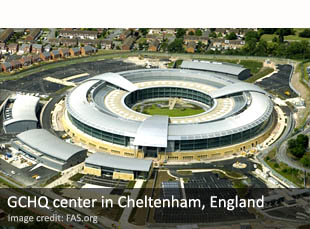
GCHQ center in Cheltenham, EnglandBy JOSEPH FITSANAKIS | intelNews.org
Britain’s communications-interception agency captured private emails from journalists and editors in some of the world’s top media, including The New York Times, the BBC, The Washington Post, and NBC. British broadsheet The Guardian said on Monday that the interception occurred in 2008 by experts in the General Communications Headquarters (GCHQ), which spies on international communications on behalf of the British government. The London-based newspaper said the emails were among 70,000 that were captured during a 10-minute interception drill that took place in 2008. The exercise involved the installation of a number of taps on fiber-optic cables, which function as superhighways of digital signals exchanged between users around the world. The messages captured included emails sent by journalists and editors working for some of the world’s most recognizable media in Britain, France and the United States. Following the exercise, the content of the intercepted messages was posted on GCHQ’s internal servers, where any one of its employees with access to the organization’s intranet could read them. The Guardian said it based its revelation on internal GCHQ files disclosed by Edward Snowden, a former contractor for GCHQ’s American counterpart, the National Security Agency, who defected to Russia in 2013. The purpose of the British spy agency’s exercise is not known, nor is there any information in the leaked documents to show whether journalists and their editors were deliberately targeted by GCHQ. However, the paper said that another document leaked by Snowden contains an “information security assessment”, in which GCHQ targeting officers listed “investigative journalists” in a detailed hierarchical list of security threats, which included computer hackers and terrorists. The document cautions that “journalists and reporters […] specializing in defence-related exposés […] represent a potential threat to security”. The Guardian contacted GCHQ but was told by a spokesman that the organization has a “longstanding policy that we do not comment on intelligence matters”. The spokesman added, however, that the agency’s interception activities are subject to “rigorous oversight, including from the secretary of state”.

Sri Lanka expels Indian spy official for meddling in elections

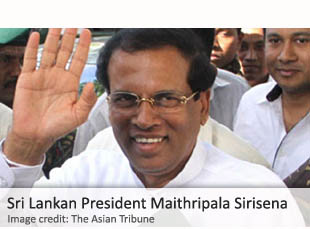
Maithripala SirisenaBy IAN ALLEN | intelNews.org
The government of Sri Lanka has expelled a senior Indian intelligence official, accusing him of meddling in national elections that took place earlier this month. Sri Lanka’s President, Mahinda Rajapaksa, stepped down on January 9 after losing a nationwide electoral contest to his former cabinet aide and main contender for the post, Maithripala Sirisena. Sirisena led a coalition of opposition parties and figures, including several of Rajapaksa’s government ministers, who defected to the opposition en masse in the months leading to the election. Rajapaksa’s defeat surprised observers, who believed he would easily win a successive third term in office. Since 2005, when he was first elected president, Rajapaksa led an all-out military campaign against the Liberation Tigers of Tamil Eelam (LTTE, also known as Tamil Tigers), after dismissing a prior truce deal between the government and the separatist group as “treasonous”. Under his leadership, the Sri Lankan military drove the Tigers out of Sri Lanka’s entire Eastern Province, reducing the extent of the group’s territorial control by 95%. However, relations with India, a traditional Sri Lankan ally, deteriorated drastically under Rajapaksa’s leadership. New Delhi became concerned that Colombo was making too many openings toward India’s geopolitical rival China. Late last year the Indian government protested after Sri Lanka permitted Chinese submarines to dock there without first informing its northern neighbor. On December 28, Sri Lankan media alleged that the senior representative of India’s Research and Analysis Wing in Colombo had been expelled from the country due to his behind-the-scenes support of the opposition’s electoral campaign. According to Sri Lankan sources, it was the Indian intelligence official who convinced Sirisena to resign from President Rajapaksa’s cabinet and run against him. The Indian intelligence operative then hosted secret meetings between Sirisena and other opposition figures, during which a united political front against Rajapaksa was formed. The allegations were also reported by the Reuters news agency on January 18, in an article that cited “political and intelligence sources” in Sri Lanka and India. New Delhi denied the allegations, saying that the intelligence official had been replaced because his overseas tour had expired, not because he had been expelled by authorities in Colombo. Meanwhile, the newly installed President Sirisena said he intends visit New Delhi on his first foreign trip in February, adding that India will form his government’s “first, main concern” on matters of foreign policy.

Canadian arbitrator sides with agency that fired spy-in-training

CSIS headquarters in OttawaBy IAN ALLEN | intelNews.org
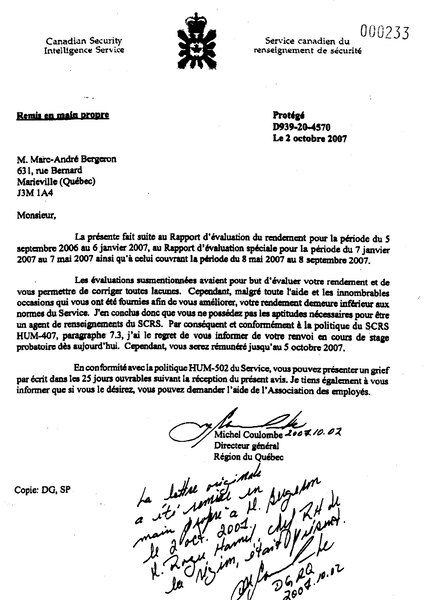
An arbitration court in Canada has reversed an earlier court decision by upholding a dismissal of a spy-in-training by the country’s primary national intelligence service. Marc-André Bergeron used the operational alias Marc-André Bertrand while working for the Canadian Security Intelligence Service. According to the secretive agency’s recruitment system, all new employees are considered trainees and remain on probation for five years, at which point they can be fired with relative ease. Bergeron, who worked for the CSIS in Quebec, was dismissed in October of 2007, just three months before his probation period was scheduled to expire. The Service said his dismissal was due to operational incompetence on his part. But the former spy filed a wrongful dismissal claim against CSIS, arguing he was fired due to a severe personality conflict with his superior, whom he described as manipulative and petty. As intelNews reported in 2011, Bergeron won his case by representing himself and successfully arguing that CSIS had failed to give him an opportunity to “explain himself”, something that he blamed on the “lack of transparency” that plagued the organization. The dispute between the sides continued, however, and earlier this month the Public Service Labour Relations Board backed CSIS’s decision to fire the spy trainee. Prior to announcing its decision, the Board heard that Michel Coulombe, who became CSIS’ director in 2013, had personally signed Bergeron’s dismissal letter in 2007. At the time, Coulombe served as CSIS’ head for the province of Quebec, where Bergeron was employed. According to the Quebec-based Journal de Montreal, which accessed a copy of the letter, it states that Bergeron lacked the “skills and abilities needed to be an intelligence officer at the CSIS”. The Service also claimed that Bergeron had demonstrated inability to differentiate fact from fiction, was an analyst of poor quality, and had filed incomplete investigation reports during his probationary period. Neither CSIS nor Bergeron made comments following the announcement of the Board’s decision.

German who spied for CIA stole list of 3,500 German spies’ names

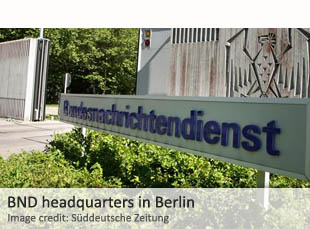
BND headquarters in BerlinBy JOSEPH FITSANAKIS | intelNews.org
A German intelligence officer, who was arrested last summer for spying for the United States, may have given his American handlers information on the real identities, as well as operational aliases, of nearly 3,500 German intelligence operatives. In July, Germany expelled the Central Intelligence Agency station chief in Berlin, following the arrest of Marcus R., a 31-year-old, low-level clerk at the Bundesnachrichtendienst, or BND, Germany’s external intelligence agency. He was believed at the time to have spied for the CIA for approximately two years, and to have supplied the American spy agency with around 200 classified German government documents in exchange for around €25,000 —approximately $30,000. It is thought that Markus R. contacted the CIA by sending an email over an encrypted connection to the American embassy in Berlin. From then on, his communication with his American handlers appears to have taken place mostly via the Internet. Sources suggest that he conferred with them via a secure link that was included in a specially-designed weather application that he had been instructed install on his computer. Now German authorities, who have been investigating the 31-year-old double spy’s computers ever since his arrest, say they found in one of them a stolen digital document containing a list of the real and cover identities of thousands of BND employees stationed abroad. According to German publications Bild and Spiegel, which reported the alleged discovery, the employees whose names are contained in the document are members of the BND’s Foreign Relations department, also known as Foreign Theater Operations department. The department is tasked with stationing intelligence operatives abroad in German embassies and consulates, as well as with embedding them with German military missions in places such as Sudan, Lebanon, Afghanistan and Mali. German investigators say they are not yet certain whether Markus R. passed the names of the BND operatives on to his CIA handlers.

News you may have missed #887 (Anglosphere edition)

Ian FletcherBy IAN ALLEN | intelNews.org
►►Canadian military deploys spies during Arctic exercise. The Canadian military has been routinely deploying a counter-intelligence team to guard against possible spying, terrorism and sabotage during its annual Arctic exercise, according to internal documents. In the view of intelligence experts, the move is unusual because Operation NANOOK is conducted on Canadian soil in remote locations of the Far North.
►►Sudden resignation of NZ spy chief raises questions. Opposition parties in New Zealand have raised questions over the sudden resignation of Government Communications Security Bureau (GCSB), Ian Fletcher, who is stepping down after three years in the role. Chris Finlayson, the minister responsible for the spy agency, said Fletcher was making the move for family reasons. Fletcher will finish in the role on 27 February and an acting director will be appointed from that date.
►►British government argues for more powers for spy agencies. Britain’s spying agencies need more powers to read the contents of communications in the wake of the Paris terror attacks, British Prime Minister David Cameron has said. Speaking in Nottingham, he said the intelligence agencies need more access to both communications data –records of phone calls and online exchanges between individuals– and the contents of communications. This is compatible with a “modern, liberal democracy”, he said.

Western intelligence points to new Syrian nuclear plant: report

Al-Qusayr, SyriaBy JOSEPH FITSANAKIS | intelNews.org
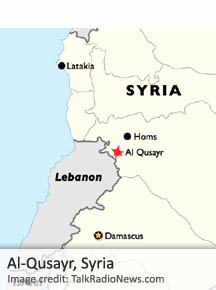
Western intelligence indicates that the government of Syria is in the process of constructing a new secret nuclear plant aimed at producing nuclear weapons. In the early hours of September 7, 2007, an air attack believed to have been carried out by Israel destroyed a mysterious facility deep in the Syro-Arabian Desert. The site, named al-Kibar, located 20 miles from Deir el-Zor in eastern Syria, is widely thought to have been a nuclear reactor under construction by Damascus. The Syrian government has never commented or protested about the incident. But in late 2008, the Israeli government told the International Atomic Energy Agency (IAEA) that Syria was once again “actively involved in plutonium production” and that Damascus had renewed its nuclear collaboration with North Korea, which was actively supplying Syria “with nuclear materials and research”. Now a report in leading German newsmagazine Der Spiegel claims that the government of Syrian President Bashar al-Assad had transported 8,000 fuel rods that had been destined for al-Kibar to a new location in the southwest of the country. The report, published on Saturday, cited information from “Western intelligence sources”, which it did not identify. The newsmagazine said it had seen intelligence reports containing satellite photographs and transcriptions of intercepted radio traffic, which left little doubt that the Syrian government was in the process of constructing a new nuclear reactor. The German-language publication said the plant is being constructed deep underground in a remote mountainous region near the small town of Al-Qusayr, located less than two miles from the northern Lebanese border. According to the report, construction on the al-Qusayr plant, which the Syrians appear to have codenamed “Zamzam”, began in 2009 under the watchful eye of Lebanese paramilitary group Hezbollah, which currently guards the plant with “elite units”. The site appears ideal, said Der Spiegel, as it is adjacent to significant supplies of water, and is connected to the energy grid through special access nodes. The newsmagazine said radio traffic intercepts include conversations between senior Syrian military officials and Ibrahim Othman, head of the Syrian Atomic Energy Commission. The discussions seem to indicate that the construction project is being assisted by members of the Islamic Revolutionary Guard Corps. The article points out that Western monitors are certain the technical aspects of the project are being led by North Korean experts, and that some of them are currently in Damascus. According to the IAEA, the Syrian government is in possession of approximately 50 tons of natural uranium, which, if enriched, could provide material for up to three nuclear bombs.

Opinion: Paris attackers bring Mideast urban warfare to Europe

Attack on Charlie HebdoBy JOSEPH FITSANAKIS* | intelNews.org
Until Wednesday morning, the last time the offices of Charlie Hebdo, France’s best known satirical weekly, were attacked was on November 2, 2011. On that day, unknown assailants had thrown Molotov cocktails into the premises, setting them on fire. Since that attack, France has seen its share of Islamist-inspired terrorist incidents. In March of 2012, French citizen Mohammed Merah shot dead three French soldiers before attacking a Jewish school in Toulouse, where he killed three students and a teacher. Last May, authorities in Marseille arrested another Frenchman, Mehdi Nemmouche, for opening fire at a Jewish museum in Belgian capital Brussels earlier that month, killing a French national and two Israeli citizens. And the French public has been shocked in recent months by a number of seemingly random attacks on pedestrians by vehicles driven by Muslim Frenchmen, who appear to be politically motivated.

The common thread running through these incidents is that they were all haphazardly planned and executed by ‘lone-wolf’ attackers, who were markedly limited in both resources and skill. But the men implicated in Wednesday’s attack on Charlie Hebdo, which left 12 people dead, were different. The two brothers, Cherif and Said Kouachi, who are said to be the main perpetrators of the assault, are believed to have “returned to France from Syria in the last year”, according to MSNBC. Undoubtedly, the two siblings saw action in the Syrian armed conflict, which is primarily fought in urban settings, and were systematically trained in urban warfare by men with considerable experience in it.

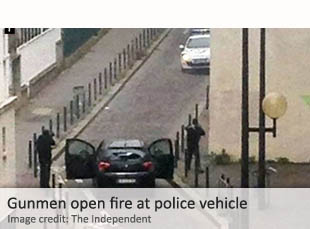
This explains their proficient delivery on Wednesday, as shown in the footage of the bloody attack, which has emerged since. The assailants arrived at their target carrying Kalashnikov rifles and magazines, neither of which can be easily acquired in France. Once inside the building, they remained there for a good 12 minutes, carefully executing their victims, some of whom they methodically sought out by name. They exited just as they entered, calm and collected. Even when they encountered a police vehicle, they stopped, aimed and shot at its passengers with considerable discipline, firing single or —in a handful of cases— double shots, instead of opting for bursts of rapid fire, which is the hallmark of inexperienced users of automatic rifles in moments of panic. After executing the police officers, they calmly walked back into their getaway vehicle and slowly drove away. It has been reported that at no point did they break the speed limit during their escape. Read more of this post

North Korean hackers operating secretly in China, says defector

Shenyang railway stationBy JOSEPH FITSANAKIS | intelNews.org
An underground network of North Korean hackers are conducting complex cyberattacks against worldwide targets from Chinese cities without the knowledge of Beijing, according to a former professor who trained them. Kim Heung-Kwang was a professor of computer science in North Korean capital Pyongyang, until his defection in 2004. He told CNN on Tuesday that part of his job was training members of North Korea’s elite cyberintelligence corps, whose task was to compromise computer systems around the world. Kim alleged that some of the hackers joined a specialized outfit called Bureau 121. It was established in complete secrecy in 1995 and ten years later it began sending its operatives abroad, especially in northern China. According to Kim, Bureau 121 set up a complex network of hackers in the Chinese city of Shenyang, in northern China’s Liaoning Province. Shenyang is the largest Chinese city near North Korea, and Bureau 121 operatives were allegedly able to effortlessly blend in the sizeable Korean community there. The former professor told CNN that the hackers “entered China separately” over time, “in smaller groups […], under different titles” such as officer workers, trade company officials, or even diplomatic personnel. They operated like typical spies, working regular jobs by day and “acting on orders from Pyongyang” by night, said Kim. They gradually set up an underground “North Korean hacker hub”, operating secretly in Shenyang for several years, relocating from place to place in order to shield their activities from computer security experts. Kim told CNN that Shenyang’s bustling, money-driven life and its good Internet facilities made it easy for Bureau 121 members to work secretly on several projects that required sophisticated telecommunications infrastructure. North Korea lacks China’s telecommunications network capabilities, said Kim, which is why Pyongyang decided in the early days of the Internet to transport its hackers to Shenyang. He added that Bureau 121 has rolled back considerably its overseas operations in recent years, due to the advancement of high-speed telecommunications networks in North Korea; but some North Korean hackers are still active in northern China, he said.

Hezbollah official admits group ‘battling espionage’ in its ranks

Naim QassemBy JOSEPH FITSANAKIS | intelNews.org
Public comments by a senior Hezbollah official appear to confirm earlier reports that the man who directed the personal security detail of the Lebanese group’s leader was a spy for Israel. Several Lebanese news outlets reported in December that Mohammed Shawraba, a 42-year-old Hezbollah official from southern Lebanon, had been arrested by Hezbollah’s counter-intelligence force and was undergoing trial for having leaked sensitive information to Israel for several years. Sources said that Shawraba used to oversee the security detail of Hassan Nasrallah, Hezbollah’s secretary-general. He was subsequently promoted to director of Hezbollah’s Unit for Foreign Operations, also known as Unit 910, which conducts intelligence operations on Israeli targets abroad. One Lebanese source described the Shawraba case as “one of the most significant security breaches” in the history of Hezbollah. Ever since the first public allegations emerged, the militant Shiite group has remained silent. On Saturday, however, Naim Qassem, Hezbollah’s Deputy Secretary General, admitted that the group was “battling espionage within its ranks” and that its counter-spies had been able to uncover “a number of significant infiltrations”. Qassem’s comments, made during an interview on Al-Nour, a Beirut-based radio station affiliated with Hezbollah, have been taken by observers as an indirect admission that the rumors about Shawraba are accurate. Qassem told the radio station that Hezbollah was a party that aimed for virtue and pureness, but that it was made up of human beings who are inevitably fallible. But he refused to be more specific about the cases of espionage, saying only that Hezbollah was Lebanon’s strongest and most resilient political organization and would easily overcome any harm caused by double agents within its ranks. A spokesman for the militant group, who was asked on Sunday whether Qassem’s comments were a reference to Shawraba, refused to comment on the case.

Iran says it foiled Mossad assassination of nuclear scientist

Yaqoub BaqeriBy IAN ALLEN | intelNews.org
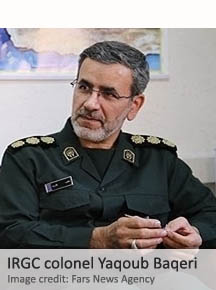
A senior Iranian military official has claimed that Tehran foiled an attempt by Israeli spies to assassinate a scientist working for Iran’s nuclear program. In a report filed on Saturday, Iran’s semi-official Fars News Agency quoted Colonel Yaqoub Baqeri saying that the Islamic Revolutionary Guards Corps (IRGC) had managed to prevent Israel from killing the scientist “during the last two years”. Baqeri is deputy chief liaison officer in the air force division of the IRGC, a branch of Iran’s armed forces dedicated to protecting and furthering the goals of the 1979 Islamic Revolution. Baqueri told Fars, which is known to have strong links with the IRGC, that Israel’s covert-action agency, the Mossad, had been “trying hard to assassinate an Iranian nuclear scientist”, but that the well-timed involvement of the IRGC had “thwarted the terrorist operation”. At least five Iranian nuclear scientists have been targeted by unknown assailants since 2007, when Ardeshire Hassanpour, who worked at Iran’s Isfahan nuclear facility, was found dead in his Tehran apartment, allegedly having suffocated in his sleep from fumes from a faulty gas pipe. Another Iranian nuclear scientist, Shahram Amiri, disappeared in 2009, while Masoud Ali Mohammadi, described by the Iranian government as a “dedicated revolutionary professor”, was killed in 2010 by a remotely controlled explosive device that had been planted at the entrance of his residence. Later that year, two near-simultaneous bomb attacks killed Majid Shahriari and injured Fereydoon Abbasi Davan, nuclear researchers and professors at the Shahid Beheshti University. The two were attacked in separate incidents by motorcyclists who targeted them during the morning rush hour in Tehran as they were driving to work. The assailants attached small bombs to the car surfaces of their targets and detonated them from a relatively safe distance before speeding away through heavy traffic. The Fars News Agency report also claimed that Iran’s intelligence agencies had uncovered secret training bases run by the Mossad and located “within the territories of one of Iran’s western neighbors”, in which teams of assassins were allegedly being “trained and assisted” by the Israelis. In 2012, Israel’s two leading intelligence correspondents, Dan Raviv and Yossi Melman, claimed in their book Spies Against Armageddon: Inside Israel’s Secret Wars, that the “decapitation program” against the Iranian nuclear effort was led by Israel with the expressed but passive endorsement of the United States.

Revealed: Letters between Margaret Thatcher and KGB defector

Oleg GordievskyBy IAN ALLEN | intelNews.org
Files released this week have revealed part of the personal correspondence between the late British Prime Minister Margaret Thatcher and one of the Cold War’s most important Soviet spy defectors. Oleg Gordievsky entered the Soviet KGB in 1963. He soon joined the organization’s Second Directorate, which was responsible for coordinating the activities of Soviet ‘illegals’, that is, intelligence officers operating abroad without official diplomatic cover. Gordievsky’s faith in the Soviet system was irreparably damaged in 1968, when Warsaw Pact troops invaded Czechoslovakia. In 1974, while stationed in Danish capital Copenhagen, he made contact with British intelligence and began his career as a double agent for the United Kingdom. In 1985, shortly before he was to assume the post of KGB station chief at the Soviet embassy in London, he was summoned back to Moscow by an increasingly suspicious KGB. He was aggressively interrogated but managed to make contact with British intelligence and was eventually smuggled out of Russia via Finland, riding in the trunk of a British diplomatic vehicle. His defection was announced a few days later by British Prime Minister Margaret Thatcher, who had personally approved his exfiltration from the USSR. Files released this week by the British National Archives show that the British Prime Minister took a personal interest in Gordievsky’s wellbeing following his exfiltration, and even corresponded with him after the Soviet defector personally wrote to her to ask for her intervention to help him reunite with his wife Leila and two daughters, who remained in the Soviet Union. In his letter, written in 1985, Gordievsky told Thatcher that his life had “no meaning” unless he was able to be with his family. On September 7, 1985, the British Prime Minister responded with a letter to the Soviet defector, urging him not to give up. “Please do not say that life has no meaning”, she wrote. “There is always hope. And we shall do all to help you through these difficult days”. She added that the two should meet once the “immediate situation” of the worldwide media attention caused by his exfiltration subsided. Thatcher went on to publicly urge for Moscow to allow Gordievsky’s family to reunite with the Soviet defector, “on humanitarian grounds”. But it was in 1991, after the collapse of communism in the USSR, when Gordievsky’s family was finally able to join him in the UK.

Year in Review: The 10 Biggest Spy-Related Stories of 2014, part II

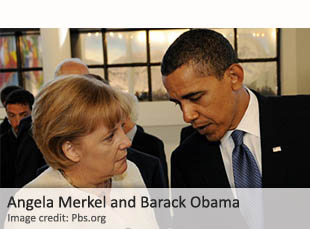
Angela Merkel and Barack ObamaBy J. FITSANAKIS and I. ALLEN | intelNews.org
Since 2008, when we launched this website, we have monitored daily developments in the highly secretive world of intelligence and espionage, striving to provide an expert viewpoint removed from sensationalism and conspiratorial undertones. As 2014 is about to conclude, we take a look back at what we think are the ten most important intelligence-related developments of the past 12 months. Those of you who are regular readers of this blog will surely agree that we witnessed our fair share of significant intelligence-related stories this year. Some of them made mainstream headlines, while others failed inexplicably to attract the attention of the news media. In anticipation of what 2015 may bring, we present you with our selection of stories below, which are listed in reverse order of importance. This is part two in the series. Part one is here.

5. China stops using US-made communications hardware, fearing espionage. Authorities in China removed for the first time this year Apple products from a government procurement list, because of fears that they are susceptible to electronic espionage by the United States. The products that have been removed from the list include the iPad and iPad Mini, as well as MacBook Air and MacBook Pro products –though interestingly the inventory of removed items does not include Apple smartphone products. There are unconfirmed reports that Russia is about to act likewise, as some Russian lawmakers in the State Duma want deputies with access to classified government information to be banned from using iPhones and iPads, among other Apple products. Do they know something we don’t?

4. Western spy agencies secretly collaborating with Assad regime. Back in 2013, the United States and other NATO allies were preparing to go to war with Syria, in order to help topple the government of President Bashar al-Assad. But the rise of the Islamic State of Iraq and al-Sham, also known as ISIS, has prompted a remarkable U-turn in Western policy on Syria. Last January, the BBC confirmed that secret meetings were being held between Western intelligence officials and senior members of the Syrian government, aimed at “combating radical Islamist groups” in Syria. There are even compelling rumors that American spy agencies are sharing intelligence, and even weapons, with Lebanese militant group Hezbollah, which is now seen by Washington as a force that can help neutralize ISIS. What a difference a year can make!

3. US, Cuba, exchange alleged spies as part of rapprochement. Public spy-swaps between adversary governments are extremely rare occurrences. What makes the recent exchange of spies and alleged spies between Washington and Havana even more remarkable is that it appears to be part of a wider warm-up in relations between the two neighboring nations, which have remained virtually frozen since 1960, when the Eisenhower administration broke off all official diplomatic contacts with the Caribbean island. Still, there is one aspect of this very public exchange that remains a mystery: Washington is refusing to provide information about Rolando Sarraff Trujillo, a Cuban intelligence officer who spied for the United States until his arrest by the Cubans in 1995. He was part of the exchange and is now believed to be on American soil.

2. NSA spy leaks continue to cause diplomatic headaches for Washington. The NSA has seen itself feature in news headlines more times than ever before this year. For an Agency that relies on secrecy and a low public profile, this is clearly a regrettable state of affairs. We now know about the existence of the NSA’s Office of Tailored Access Operations, described as “something like a squad of plumbers that can be called in when normal access to a target is blocked”. And we know that the NSA targets allies of the US with the same intensity that it targets its traditional adversaries. This, along with leaks about an alleged CIA operation against Germany, caused Berlin to break all intelligence collaboration with Washington and even expel the CIA station chief in the German capital. Turkey came close to doing the same, according to some sources.

1. Western spy agencies refocus on Russia. It is too early to proclaim a Cold War 2.0, but there is no question that Western intelligence agencies have actively began to refocus on Russia more intensely than at any time since the collapse of communism in 1991. This is especially noticeable in the United Kingdom, where military intelligence agencies are reportedly scrambling to rehire retired Russian-language analysts, due to the crisis in Crimea. Meanwhile, this past November Britain’s civilian spy agencies launched a new drive to recruit Russian-language speakers. According to some, the Cold War never ended. IntelNews regulars will recall that, in March of 2013, Oleg Gordievsky, the Soviet KGB’s former station chief in London, who defected to the UK in the 1980s, alleged in an interview that Russia operates as many spies in Britain today as it did during the Cold War.

[Second of two parts. Part one is here]
Year in Review: The 10 Biggest Spy-Related Stories of 2014, part I

Happy New YearBy J. FITSANAKIS and I. ALLEN | intelNews.org
Since 2008, when we launched this website, we have monitored daily developments in the highly secretive world of intelligence and espionage, striving to provide an expert viewpoint removed from sensationalism and conspiratorial undertones. As 2014 is about to conclude, we take a look back at what we think are the ten most important intelligence-related developments of the past 12 months. Those of you who are regular readers of this blog will surely agree that we witnessed our fair share of significant intelligence-related stories this year. Some of them made mainstream headlines, while others failed inexplicably to attract the attention of the news media. In anticipation of what 2015 may bring, we present you with our selection of stories below, which are listed in reverse order of importance. The stories are presented in two parts; part two will be published tomorrow. This is part one in the series. Part two is here.

10. South Korean ex-spy chief jailed for bribery and political interference. Much of the world’s media has focused on the seemingly endless stream of lunatic antics by the corrupt government of North Korea. But corruption is also prevalent south of the 38th parallel. The year 2014 saw the disgraceful imprisonment of Won Sei-hoon, who headed South Korea’s National Intelligence Service (NIS) from 2008 to 2013. Last September, a court in Seoul heard that Won ordered a group of NIS officers to “flood the Internet” with messages accusing South Korean liberal election candidates of being “North Korean sympathizers”. Prosecutors alleged that Won initiated the Internet-based psychological operation because he was convinced that “leftist adherents of North Korea” were on their way to “regaining power” in the South. A few months earlier, Won had been sentenced to prison for accepting bribes in return for helping a private company acquire government contracts.

9. Australia spied on US law firm representing Indonesia in trade talks. Spying for direct commercial gain is viewed as a taboo by Western intelligence agencies, who claim to focus their efforts solely on matters directly relating to national security. But according to documents leaked in February, the Australian Signals Directorate (ASD) targeted Mayer Brown, one of the world’s largest law firms, because it represented the commercial interests of the Indonesian state in commercial negotiations with Canberra. To make things worse, the documents also show that that the Australian agency offered to share the intelligence collected from the operation with its American counterpart, the National Security Agency (NSA). After Indonesia withdrew its ambassador from Australia, the two countries signed a joint agreement aimed at curbing their intelligence activities against each other.

8. Hezbollah leader’s senior bodyguard was a Mossad agent. It turns out that the man who directed the personal security detail of the secretary-general of Lebanese militant group Hezbollah was an agent of Israeli intelligence. According to multiple sources in Lebanon and Israel, Mohammed Shawraba, 42, who was arrested earlier this year by Hezbollah’s counter-intelligence force, and is now undergoing trial, was able to penetrate the highest levels of the Shiite militant group and leaked sensitive information to Israel for several years prior to his capture. In 2008, Shawraba was promoted to director of the group’s Unit for Foreign Operations, also known as Unit 910, which collects information on Israeli activities abroad.

7. Public fight breaks out between Congress and the CIA. The intensity of the media’s focus on the recently published summary of the Congressional report on CIA interrogation practices is understandable. Having said that, we have known about the CIA’s use of waterboarding for years, and the CIA’s use of ‘enhanced interrogation’ goes back to the 1960s, so nobody can claim to have been shocked. What is perhaps more revelatory is the incredibly public spat between the Agency and the Senate Select Committee on Intelligence. The CIA’s own inspector general found that Agency officers spied on Congressional staff investigating the CIA’s use of torture in interrogations. CIA Director John Brennan apologized for the incident, but many are wondering how this will affect intelligence oversight in years to come.

6. Turkey in turmoil as dozens arrested for spying on PM, spy chief. Turkey’s political system appeared to be sinking deeper into crisis this year, as over 100 police officers, some of them senior, were arrested for illegally wiretapping the telephones of high-level government figures, including the Prime Minster and the intelligence chief. They included two former heads of Istanbul police’s counterterrorism unit. Another 13 were later indicted for systematic “political and military spying” against senior government figures. However, critics of Prime Minister Recep Tayyip Erdoğan’s government noted that one of the police officers arrested is the former deputy chief of the Istanbul police department’s financial crimes unit, which earlier this year led an investigation into alleged corrupt practices by senior members of the Erdoğan cabinet.

[First of two parts. Part two is here]

Shiite rebels abduct, then release, Yemen’s intelligence chief

YemenBy IAN ALLEN | intelNews.org
Shiite rebels, who are in control of most of Yemeni capital Sana’a, released the country’s intelligence chief a few hours after abducting him from his home, according to local sources. The chief, Major General Yehia al-Marani, directs Yemen’s Political Security Organization (PSO), and is regularly referred to as the second most powerful security official in the country, after the director of the country’s National Security Bureau. The Associated Press reported early on Thursday that about 20 armed militia members appeared outside al-Marani’s home in Sana’a at daybreak and demanded that the general come with them. The PSO chief ordered his bodyguards to lay down their weapons and then went away escorted by the rebels. Al-Marani’s kidnappers were almost certainly Houthi militiamen, who are members of a Shiite militant group known as Ansarullah. The Houthis, who come from western Yemen, have been engaged in a secessionist armed struggle since 2004 against the Sunni-dominated Yemeni government. Last September, they took advantage of the power-vacuum created by the collapse of the regime of longtime dictator Ali Abdullah Saleh and stormed the Yemeni capital, easily taking control of it within a few days. Their official reason for the takeover was their expressed desire to force President Abed Rabbo Mansour Hadi, who succeeded Saleh, to dissolve Yemen’s Sunni-led government, which the Houthis said was closely connected with al-Qaeda in the Arabian Peninsula (AQAP). After a period of prolonged negotiations with the rebels, President Hadi dissolved the government and replaced it with a more inclusive group of non-partisan technocrats. But the rebels refused to disband and disarm, and have since intensified their armed campaign, taking over a number of Yemeni cities and several major roads across the country. The Houthi leadership claims that they need to remain armed in order to fight militant Sunni groups operating in the country, and to battle corruption. Al-Marani was released by the rebels late on Thursday, with no explanation given as to his earlier abduction. It is believed that, before his appointment as head of PSO, the General served for 15 years as the Organization’s regional director in Sa’dah province, a Shiite stronghold where the Houthi insurgency has its roots. Some speculate that the rebels intended to settle old scores with al-Marani. Yemen government officials have refused to confirm or deny the reports of the Generals’ abduction and release.

Mystery surrounds CIA spy ‘of Cuban origin’ released last week

Rolando Sarraff TrujilloBy JOSEPH FITSANAKIS | intelNews.org
Almost nothing is known about a Cuban intelligence officer who spied for the United States and is now believed to be on American soil following his release from a Cuban prison last week. His release was part of a wider exchange between Washington and Havana of persons held in each other’s prisons on espionage charges. It included the release of Alan Gross, a contractor for the US Agency for International Development, who was imprisoned in the Caribbean island in 2009 on charges of political subversion. The deal also involved the release of the remaining three members of the so-called “Cuban Five”, a ring of Cuban intelligence officers operating on American soil, who were convicted in 1998 of spying on anti-Castro exile groups on behalf of Havana. But the ample media coverage has shied away from another prisoner who was exchanged as part of the deal, a spy for the Central Intelligence Agency who was described by US President Barack Obama as one of the most important intelligence assets that America has ever had in Cuba. The initial piece of information came from Cuban President Raul Castro himself, who on December 17 announced that an American spy “of Cuban origin” was to be released. Castro did not identify the spy. But later on that same day, Newsweek’s Jeff Stein said his name was “Rolando ‘Roly’ Sarraff Trujillo”, a former cryptographer in the Cuban Ministry of Interior’s Directorate of Intelligence. Trujillo was allegedly recruited by the CIA in the 1980s and spied for Washington until 1995, when he was arrested by Cuban counterintelligence, charged with espionage and sentenced to 25 years in prison. One source told Stein that the damage that Trujillo had caused Havana was so great that “the only thing that saved him from execution was the fact that both his parents were retired senior intelligence officers”. In a report published last Thursday, The Washington Post’s Adam Goldman said Trujillo’s release had been “a major priority for the [US] Intelligence Community” and would have been part of any spy swap with the Cuban government. Both Stein and Goldman claim that Trujillo was instrumental in the capture by the FBI of the Cuban Five, as well as in the 2009 arrest of State Department analysts Walter and Gwendolyn Myers, who spied on America for Cuba for 30 years. He is also said to have had a role in the capture of Ana Belen Montes, the top Cuba analyst in the Defense Intelligence Agency, who was convicted in 2002 of spying for Cuba. All this is speculative, however, as no official confirmation has been issued on Trujillo from either Washington or Havana. One former senior CIA official told The Post that the Agency had another spy in Cuba, alongside Trujillo, codenamed TOUCHDOWN. But, unlike Trujillo, he managed to defect to the US in the late 1980s, before getting captured by the Cubans.