Proposed Afghan spy chief divides Western, Afghan officials

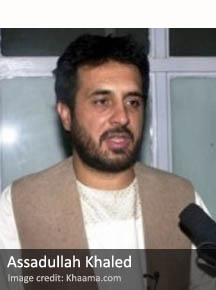
Assadullah KhaledBy JOSEPH FITSANAKIS | intelNews.org |
Last month we reported Afghan President Hamid Karzai’s plan to appoint one of his most trusted advisors, Assadullah Khaled, to lead the country’s intelligence agency. There appears to be a slight problem with this proposal: Khaled is known as a fierce character in Afghan politics, who has been accused by Western diplomats of corruption, extreme brutality and narcotics trafficking. During the past few years, Khaled, currently Afghanistan’s Minister for Border and Tribal Affairs, has reportedly become “almost a surrogate family member” of the Karzai family, and is viewed “as a son” by the Afghan President. He also has a close relationship with officials in the United States Central Intelligence Agency, who seem to appreciate Khaled’s hardline stance against Pakistan. Moreover, Khaled is an ethnic Pashtun, that is, he belongs to the largest Afghan ethnicity, whose members occupy central Afghanistan. However, he has strong connections with leading figures in the former Northern Alliance, whose support is crucial for the survival of the Karzai regime. Some Western officials, therefore, see him as a potential unifying figure in the country. But in a confidential cable sent to the US Department of State by the American Embassy in Kabul in 2009, and leaked by WikiLeaks, Khaled was described by one senior American diplomat as “exceptionally corrupt and incompetent”. Later that same year, a high-level Canadian diplomat publicly accused Khaled of participating in international narcotics trafficking and systematically employing torture against his political enemies in Kandahar. The diplomat, who served in Afghanistan after the 2001 US-led invasion, was referring to Khaled’s tenure as Governor of Kandahar Province, where he personally run what Kandaharis described as “the torture prison”. Colvin is apparently not alone voicing such concerns. Read more of this post

MI6 chief paid ‘extremely rare’ secret visit to Israel: newspaper

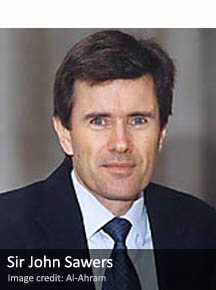
Sir John SawersBy JOSEPH FITSANAKIS | intelNews.org |
The Director of Britain’s Secret Intelligence Service, widely known as MI6, visited Israel in secret in late August in an effort to convince the Israelis not to launch military strikes on Iran, according to a British newspaper. In an article published on Tuesday, The Daily Mail said Sir John Sawers, who leads Britain’s foremost external spy agency, held private meetings with leading Israeli officials, among them Prime Minister Benjamin Netanyahu and Defense Minister Ehud Barak. His message, according to the paper, was that London wanted more time so that the economic and diplomatic sanctions imposed on Iran by the international community to bear fruit. Sanctions are considered by some in the West a viable alternative to calls by Israeli officials for direct military attacks on Iran, aimed at stopping the country’s nuclear program. If confirmed, Sir John’s visit to Israel would represent a near-unprecedented move; this is because, unlike his counterpart at the United States Central Intelligence Agency, the Director of MI6, known informally as ‘C’, does not routinely travel to foreign countries as a diplomatic messenger of the British government. Many, therefore, will see Sawers’ alleged trip to Israel as yet another sign that the Jewish state is beginning to lean heavily in favor of attacking Iran using overt military means. In a possibly related development, Israel’s Minister for Intelligence and Atomic Energy said on Wednesday that he supported international sanctions on Iran. Read more of this post

News you may have missed #791

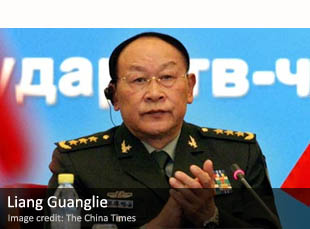
Liang GuanglieBy IAN ALLEN | intelNews.org |
►►India sees espionage behind Chinese cash payments to Indian pilots. According to Indian government sources, Chinese Defense Minister General Liang Guanglie gave two envelopes to the two Indian pilots, both wing commanders, who had flown him in a special Indian Air Force aircraft to New Delhi from Mumbai. After seeing off Liang, the pilots opened the sealed envelopes and found cash gifts inside. They immediately reported this to their superiors, who, in turn, informed the Indian Defense Ministry. India is now planning to lodge a protest with China over the incident.
►►NSA says foreign cyberattacks increasingly reckless. Debora Plunkett, of the secretive National Security Agency, whose responsibilities include protecting US government computer networks, has said that other nations are increasingly employing cyberattacks without “any sense of restraint”, citing “reckless” behaviors that neither the United States nor the Soviet Union would have dared at the height of Cold War tensions. She also predicted that Congress would pass long-stalled cybersecurity legislation within the next year. One wonders whether the Stuxnet incident is included in such “reckless” cyberattacks?
►►Taliban ‘using Facebook to lure Australian soldiers’. According to a review of social media by the Australian federal government, Australian soldiers are being warned by their commanders that enemies are creating fake Facebook profiles to spy on them. The report says that Taliban insurgents in Afghanistan are posing as “attractive women” on Facebook to befriend coalition soldiers and gather intelligence about operations. It adds that family and friends of soldiers are inadvertently jeopardizing missions by sharing confidential information online. This is not the first such warning in recent years.

Why did Canada suddenly suspend all diplomatic ties with Iran?

John BairdBy JOSEPH FITSANAKIS | intelNews.org |
On Friday September 7, 2012, John Baird, Canada’s Minister of Foreign Affairs, announced that Canada was suspending all diplomatic relations with Iran and was expelling Iranian diplomats from the country, effective immediately. Additionally, said Baird, Ottawa would officially list Iran as a state sponsor of terrorism under the Canadian Justice for Victims of Terrorism Act. By the time Baird made his announcement, all Canadian diplomats serving in Iran were on their way home. Iranian diplomats in Canada were given five days to leave the country. Relations between the two countries have been rocky since at least 2003, when Canadian photographer Zahra Kazemi was killed under detention in Tehran, and Iran has not had a full ambassador in Canada for nearly five years. Still, the news surprised even former government insiders in Canada. Ray Boisvert, until recently Assistant Director of the Canadian Security Intelligence Service, described Ottawa’s move as “unprecedented”. What was it that caused the final rupture in Canadian-Iranian relations? Why expel the Iranian diplomats now? Leading Middle Eastern experts in Canada cannot seem put their finger on a specific reason. Iran observer James Devine, of Canada’s Mount Allison University, told CBS that Ottawa’s move was “not tied to a specific event”. The Canadian former Ambassador to Tehran, John Mundy, said he believed the break in relations was not tied to a direct threat against Canadian interests. But CBS said many Iranian-Canadians believe the drastic move by the Canadian government should be seen as “an immediate sign” of a looming military attack on Iran by Western powers or Israel. In a recent article on the subject, Canadian political analyst Brian Stewart argued that Ottawa’s “overnight liquidation” of its diplomatic relations with Tehran must be rooted in “new intelligence” showing that Iran “absolutely poses a security threat in Canada”.   Read more of this post

Prominent Syrian defector thanks “French intelligence” for help

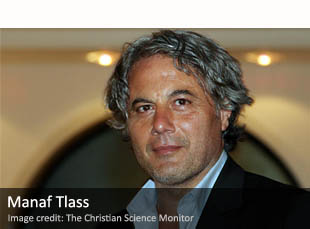
Manaf TlassBy JOSEPH FITSANAKIS | intelNews.org |

A senior Syrian military commander, whose public defection to the rebel side last summer made news headlines around the world, has thanked the French intelligence services for helping him defect.  Brigadier General Manaf Tlass, a member of the Central Committee of the Baath Party and commander of the 10th Brigade of Syria’s elite Republican Guard, secretly left the country in early July. On July 6, he resurfaced in Paris and said he had defected to the rebel-led Free Syrian Army (FSA). His defection was hailed by both the FSA and Western powers as “an enormous blow” to the regime of Syrian President Bashar al-Assad. His central position in Syria’s governing apparatus aside, Tlass was a major symbolic figurehead for the regime. His father, Mustafa Tlass, was Syria’s Minister of Defense for over three decades during the reign of Hafez al-Assad, the current President’s father. Consequently, the Tlass family has long been fully integrated in the Syrian political and military elite that has run the country for nearly half a century.  Although there were reports that the extended Tlass family was considered too close to the rebels by the Assad regime, Tlass’ defection in July came as a shock to most Syrians. The General reportedly disappeared from his post sometime in early July, shortly after sending his wife and son to Beirut, Lebanon. Rumor has it that he secretly traveled to Turkey and from there to Paris, France, either directly or after joining his family in Lebanon. The details of his defection, however, remain obscure. Speaking on Monday to French television channel BFM, Tlass, who is now based in Paris, said he was helped in “getting out of Syria” by what he called “the French services” —presumably the French intelligence services. When the French journalist asked him to clarify how exactly he was able to leave Syria, Tlass responded that he would rather not be drawn into a discussion on the details of his escape, because it could place his contacts inside Syria in danger. Instead, the prominent Syrian defector said he was grateful to the “French services for helping me get out of Syria, and I thank them for that”. Read more of this post

News you may have missed #790

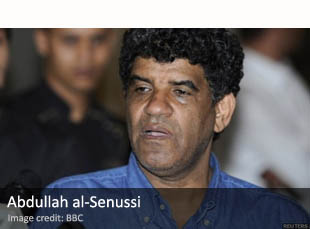
Abdullah al-SenussiBy IAN ALLEN | intelNews.org |
►►New report reopens CIA torture allegations. A report from Human Rights Watch, which was released last week, said that Libyan fighters opposed to Muammar Gaddafi’s regime were subjected to harsh interrogation techniques while in US custody overseas, during the administration of George W. Bush. The accusations, if substantiated, would suggest wider use of waterboarding than US officials have previously acknowledged. The report, which is based on documents and interviews in Libya after the fall of Gaddafi, includes a detailed description of what appears to be a previously unknown instance of waterboarding by the CIA in Afghanistan nine years ago.
►►Analysis: What does Gaddafi’s ex-spy chief know about Lockerbie? Abdullah al-Senussi became a hate-figure in his home country as head of an intelligence machinery responsible for the mistreatment of thousands of opponents of the regime of Muammar Gaddafi, his brother-in-law. He is nicknamed the “butcher” and known as Gaddafi’s “black box” because of the secrets he supposedly holds. The new Libyan regime had been negotiating for months with Mauritania where al-Senussi had fled following the fall of the Gaddafi regime last September. But now that al-Senussi has been flown back to Libya by private jet, he may at last be able to face questions by British police about Lockerbie.
►►Chinese hardware manufacturer denies spying allegations. The Chinese hardware-manufacturing firm Huawei has released a 24-page report, written by John Suffolk, a former British government chief information officer who has now turned Huawei’s global security officer, which states that protecting the network security of its worldwide customers is one of company’s “fundamental interests”. The report follows allegations in the United States, Australia, India, and elsewhere, that the company maintains close operational ties to China’s intelligence establishment.

CIA declassifies internal review on Iraq ‘intelligence failure’

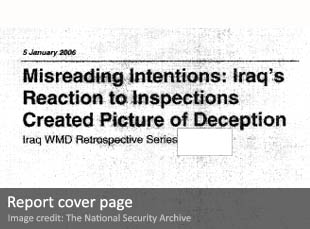
Report cover pageBy JOSEPH FITSANAKIS | intelNews.org |
An internal report on the alleged failure of the Central Intelligence Agency to accurately read the intentions of the Iraqi regime in the run-up to the 2003 invasion by the United States, has been declassified. The report, entitled Misreading Intentions: Iraq’s Reaction to Inspections Created Picture of Deception, was authored in 2006, classified ‘secret’. It was prepared by the CIA’s Directorate of Intelligence (DI), the part of the Agency that is responsible for collating and assessing gathered intelligence in order to assist the decisions of US policy-makers on key foreign issues. The report describes what it sees as the DI’s intelligence failure to assess the true state of Iraq’s purported weapons of mass destruction program in the run-up to the US invasion. It says that invalid predispositions and “analytic liabilities” among CIA analysts prevented the Agency from seeing the issue of weapons of mass destruction from the viewpoint of the Iraqi government. Although heavily redacted, the report seems to state that CIA analysts spent little time examining the view, held by many at the time, that the Iraqi regime had in fact terminated its WMD program by 1995. Furthermore, Agency analysts failed to realize in time that, although it had terminated its WMD program, the Iraqi regime maintained a deliberate policy of ambivalence about the purported existence of the program, in order to save face, deter potential adversaries and appear more dangerous than it actually was. Such a policy of deception was well within the character of the Iraqi regime and should have been detected by American intelligence experts, says the report. Read more of this post

Israeli PM had ‘sharp exchange’ with US Ambassador over Iran

Benjamin Netanyahu and Barack ObamaBy JOSEPH FITSANAKIS | intelNews.org |

A United States Congressman, who chairs the US House of Representatives Intelligence Committee, says he witnessed a “sharp exchange” between the Israeli Prime Minister and the American Ambassador to Israel, over the Iranian nuclear program.  Earlier this week we reported that Representative Mike Rogers (R-MI), who visited Israel in an official capacity last week, said that he did not believe Israel would attack Iran before the US Presidential elections in November. But in a radio interview with the Detroit-based WJR station on Thursday, Rogers said he thought Israeli leaders were “at wits’ end” over what he described as indecisiveness by the Barack Obama administration in responding to the Iranian nuclear program. The Republican politician said that the meeting he attended at the Israeli Prime Minister’s office was supposed to be a “discussion on intelligence and technical issues”. But it quickly “spun out of control”, he said, when the Israeli leader allegedly criticized the US Ambassador to the country, Dan Shapiro, over the US government’s perceived unwillingness to go beyond imposing diplomatic sanctions on Iran. Rogers described the situation as “a very tense […], very sharp exchange” between the two men, which revealed “elevated concerns on behalf of the Israelis” about the unfolding Iranian nuclear stalemate. Responding to a question from the interviewer, Rogers added that he did not think he had ever witnessed “such a high-level confrontation” between a representative of the American government and a foreign official. Read more of this post

News you may have missed #789

Mikhail FradkovBy IAN ALLEN | intelNews.org |
►►Putin adds spy chief to energy commission. Russian President Vladimir Putin has reinforced a presidential commission seen as Kremlin’s vehicle for vying for control over the country’s crucial oil and gas sector, by adding the country’s top police officer and senior spy to its ranks. They are Interior Minister Vladimir Kolokoltsev and Mikhail Fradkov, director of the Foreign Intelligence Service, formerly a department of the KGB. The commission is driven by Igor Sechin, a former KGB officer and close ally of President Putin.
►►US spy sat agency plans major expansion. The National Reconnaissance Office (NRO), America’s secretive spy satellite agency, operates a vast constellation of spy satellites in orbit. But these surveillance spacecraft have traditionally only been able to gaze down on a few small areas of the planet at a time, like flashlights probing the dark. And this, only with careful advance planning by human operators on the ground. Now the NRO wants to expand the current flashlight-like satellite deployment to a horizon-spanning, overhead spotlight that can illuminate vast swaths of the planet all at once. The agency also wants new spacecraft that can crunch the resulting data using sophisticated computer algorithms, freeing the satellites somewhat from their current reliance on human analysts.
►►GCHQ warns of ‘unprecedented’ cyberattack threat. The British government’s electronic eavesdropping and security agency, GCHQ, has warned the chief executives of Britain’s biggest companies about an allegedly “unprecedented threat” from cyber-attacks. “GCHQ now sees real and credible threats to cybersecurity of an unprecedented scale, diversity, and complexity”, said Ian Lobban, the agency’s director. The magnitude and tempo of the attacks pose a real threat to Britain’s economic security’, Lobban adds, but notes that about 80% of known attacks would be defeated by embedding basic information security practices.

Ex-CIA Director cautions Israel against attacking Iran

Michael HaydenBy JOSEPH FITSANAKIS | intelNews.org |
The former Director of the United States Central Intelligence Agency has warned that an Israeli attack on Iran would likely backlash and might actually push Tehran to build nuclear weapons earlier than currently projected. General Michael Hayden, the only person to lead both the CIA and the US National Security Agency, told Israeli newspaper Ha’aretz on Monday that Iran is not yet close to building a nuclear weapon and that Israel should carefully consider how to respond to its neighbor’s alleged nuclear weapons ambitions. During his CIA tenure, General Hayden supervised the 2007 US National Intelligence Estimate, produced cooperatively by all 16 agencies of the US intelligence community, which concluded that Iran had halted its nuclear weapons activities. In his interview on Monday, Hayden said that, in his view, the conclusion of the 2007 NIE “still holds”, as Tehran has not yet made the decision to weaponize its missile and fissile material. Hayden, who was recently appointed as national security adviser to Republican Presidential hopeful Mitt Romney, said that, by rushing to attack Iran now, Israeli military leaders would “actually push [Tehran] to do that which [an attack] is supposed to prevent: getting nuclear weapons”. The retired General added that any military attack on Iran would “pose a difficult challenge” in terms of its strategic outcome, since “there is no absolute certainty that all targets are known” inside Iran. Furthermore, he said, even if Israel decided to attack Iran militarily, it would have to go beyond mere air raids, and would soon discover that its resources were limited. Read more of this post

CIA Director reportedly in Turkey for secret talks

David PetraeusBy JOSEPH FITSANAKIS | intelNews.org |

Turkish and American authorities have refused comment on persistent reports that the Director of the Central Intelligence Agency is currently on a secret visit to Turkey. News of the alleged trip was first reported on Monday by Turkish tabloid daily Akşam. The newspaper said David Petraeus, who heads the United States’ foremost civilian intelligence agency, had arrived earlier that day in Istanbul’s Atatürk International Airport, on his private plane. According to the article, the CIA chief decided to embark on the unannounced trip in order to discuss “counterterrorism and the situation in Syria” with senior Turkish officials. Several hours later, French news agency Agence France Presse reported that, according to “a US official”, the CIA Director was indeed in Turkey, holding secret “meetings on regional issues”. However, the unnamed US source would not provide specific information about Petreaeus’ meeting arrangements while in Turkey, nor would (s)he divulge the names of the Turkish officials that were scheduled to meet with him. Another Turkish daily, Hürriyet, said the CIA Director would probably meet with his Turkish counterpart, MİT chief Hakan Fidan, as well as with Turkey’s Prime Minister Recep Tayyip Erdoğan . But repeated efforts by the paper to confirm this were rebuffed by representatives of the US embassy in Ankara, as well as Turkish officials. Read more of this post

Mossad allegedly behind assassination of Egyptian militant in Sinai

Sinai PeninsulaBy JOSEPH FITSANAKIS | intelNews.org |

Israeli intelligence operatives were allegedly behind the assassination late last month of an Egyptian militant who died when his motorcycle suddenly exploded in Egypt’s Sinai Peninsula. Citing unnamed Egyptian security sources, the Palestinian Ma’an News Agency said the target of the assassination was Ibrahim Ouda Bereikat, a member of the militant group Jamaat Ansar Bait Al-Maqdis fi Sinaa. The group had claimed responsibility for a series of cross-border attacks in August of 2011, which killed eight Israeli citizens. Five Egyptian police officers and ten militants were also reportedly killed in the attacks, which sparked a diplomatic episode between Cairo and Tel Aviv. The Ma’an report cited Egyptian sources who said that the Israeli raid was the first known incursion into Sinai ever since Israel and Egypt signed the 1979 Camp David Accords. The news agency said that Bereikat’s assassination was carried out by a team of four officers from the Mossad, Israel’s primary covert-action agency. The four allegedly bribed several Bedouin tribesmen who live in southern Sinai, and had them lead them to Bereikat’s whereabouts, approximately 10 miles (15 kilometers) into Egyptian territory. The report claims that the eight-member team —four Mossad operatives and four Bedouins— first tried to kill Bereikat on August 22, but failed because, ironically, their target had been picked up for questioning by Egyptian security forces. The Mossad officers thus returned late on Saturday, August 25, and planted explosives on Bereikat’s motorcycle. Read more of this post

News you may have missed #788

U-2 surveillance aircraftBy IAN ALLEN | intelNews.org |
►►US spy planes violated Israeli airspace in 1950s. American U-2 espionage planes repeatedly entered Israeli airspace in the 1950s for a series of secret spy missions, according to new information to be published by the Israel Air Force magazine next week, bringing to an end a decades-long mystery. At the time, Israel’s defense establishment was baffled by the entrance of high-flying crafts. For years, officials in IAF command disagreed on the identity of the mystery crafts, with some claiming that they were British Vickers-Valiants, and others saying they were American Vought F-8 Crusader planes, that had been stationed on a US aircraft carrier. According to documents to be published next week, it was the USSR that aided Israeli officials to expose the identity of the mystery planes, after a US U-2 espionage plane was shot down over Soviet soil.
►►US guard pleads guilty to espionage. A civilian guard at a new US consulate in China pleaded guilty on Thursday to attempting to sell Chinese security officials photographs and access to the compound so they could plant listening devices. According to a court proffer, Bryan Underwood had lost a significant amount of money in the stock market and hoped to make between $3 million and $5 million by supplying classified photos and information to China’s Ministry of State Security. Underwood, 32, appeared in federal court in Washington and pleaded guilty to one count of attempting to communicate national defense information to a foreign government.
►►CIA torture probe ends without any charges. The US Department of Justice has ended its investigation into the CIA’s interrogation program for terror detainees, without bringing charges. Attorney General Eric Holder said there was not enough evidence to “sustain a conviction beyond a reasonable doubt”. Jameel Jaffer, deputy legal director of the American Civil Liberties Union, said the investigation’s conclusions were a “nothing short of a scandal”. But CIA officials welcomed the decision. CIA Director David Petraeus thanked his staff for co-operating with the investigation. “As intelligence officers, our inclination is to look ahead to the challenges of the future rather than backwards at those of the past”, he said. No surprises here, surely.

Afghan President replaces spy chief with controversial figure

Assadullah KhaledBy JOSEPH FITSANAKIS | intelNews.org |

The office of the Afghan President announced yesterday the dismissal of the country’s intelligence chief and his replacement with a controversial official accused by Canadian and British sources of using torture to implement his policies. Speaking to reporters in Kabul, Afghan President Hamid Karzai thanked Rahmatullah Nabil, the outgoing Director of the National Directorate for Security (NDS), for his service, and said he would soon be appointed ambassador to a foreign country. According to Karzai’s representatives, the dismissal falls under the President’s decision that “no intelligence Director could serve longer than two years”. But observers point out that Nabil’s dismissal is part of a broader bureaucratic turf-war between the Office of the President and the Afghan Parliament, over the control of Afghan intelligence and military agencies. Earlier this month, the Parliament managed to oust two senior government officials, Minister of the Interior Besmillah Mohammadi and Minister of Defense Abdul Rahim Wardak. Both men are considered to be among President Karzai’s closest political allies. Nabil’s dismissal is therefore seen by many as an act of retribution by the President against defiant Afghan parliamentarians. What is arguably more interesting, however, is Karzai’s choice of the person to replace the fired Nabil, who is no other than Assadullah Khaled, currently Afghanistan’s Minister for Border and Tribal Affairs. According to sources in Kabul, Khaled’s appointment to lead the NDS is a matter of days, and that is appointment can already be considered as having been “confirmed”. This is despite the fact that Khaled is known for resorting to brutal torture and outright intimidation to get his way, especially during his time as Governor of the province of Kandahar. While there, he built a notorious reputation for abducting, torturing, and often killing, his personal and political opponents. Read more of this post

News you may have missed #787

Alexander Makowski By IAN ALLEN | intelNews.org |
►►An interview with a senior Yemeni spy. Here’s something you don’t read every day: an interview with Ahmed Bin Mo’aili, 66 (pictured here), who worked as a spy for Yemen’s Political Security Organization (PSO) for more than 30 years. He says that, due to his “different duties in different countries”, which required him to travel in several Arab countries, he acquired “tens of wives” over the years. He is now upset with the PSO because the Organization has “separted him from his 31 children who live all around the Arab countries he has worked in and who are awaiting his return”.
►►Cyprus wants answers from UK over Syria spy claims. Dr. Erato Kozakou-Marcoullis, the Minister of Foreign Affairs of the Republic of Cyprus, has asked British authorities for “a full explanation” into media reports that UK military installations in Cyprus are providing intelligence to Syrian rebels. Earlier this month, The London Times claimed that two British military bases on Cyprus, located in Dhekelia and Akrotiri, were being used to collect signals intelligence on Syria. The data collected at the listening posts, operated by the General Communications Headquarters, Britain’s foremost signals intelligence agency, was passed on to the Free Syrian Army through Turkish intelligence operatives, said The Times. But the Cypriot Foreign Minister said that it was crucial that the bases were not being used for purposes not enshrined in the island’s Treaty of Establishment, which mandates the British Bases to be used for defensive purposes only.
►►CIA ‘turned down offer’ to kill bin Laden in 1999. In late 1999, two years before the 9/11 terrorist attacks, which killed nearly 3,000 people, a group of Afghan agents loyal to an anti-Taliban guerrilla leader proposed assassinating Osama bin Laden. In returne, they asked for the $5 million reward the Bill Clinton administration had offered for bin Laden’s capture. But the CIA rejected the plan, saying: “we do not have a license to kill”. This is according to the book Ferreting Out Bin Laden (not yet available in English), by Polish former spy Alexander Makowski (pictured), who claims he was the Afghans’ go-between on the plot. Makowski’s credentials are many: the son of a spy, he attended primary school in Great Britain, high school in the United States, and received a postgraduate law degree from Harvard. He graduated from the Polish military intelligence academy at Stare Kiejkuty before spending 20 years in Polish intelligence.